
Hire by Technology
SERVICES


APIs aren't a feature of a modern fintech product anymore. Instead, we have watched them turn into the foundations of a variety of different products.
They usually end up being the things that determine how fast you can add a payment method, onboard a partner, or launch in a new market without a rebuild. This means you want to think through your API development very carefully to ensure that you set yourself up for success.
Let’s look at everything you need to know about API development for fintech apps. If you need skilled developers with production experience in financial technology, we can help.
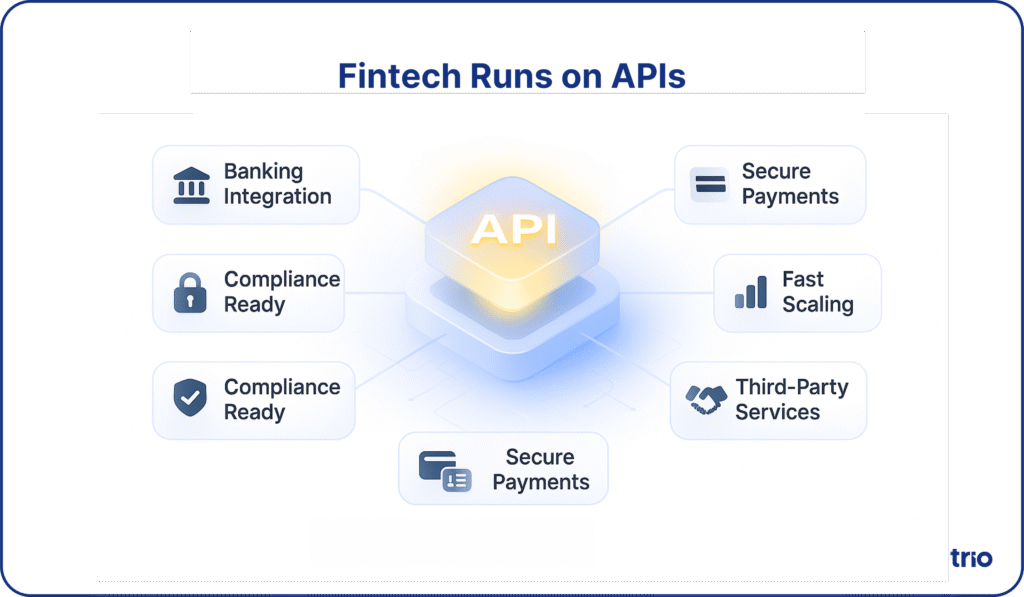
API development in fintech is where technology, system architecture, and product strategy actually converge.
Whether you're building a new platform or evolving an existing one, your APIs determine how flexible the product is, how fast you can ship new capabilities, and how easily you can adapt when a regulation or a partner requirement changes underneath you, which tends to happen often in the global fintech environment.
Due to this, API-first design has become the default starting point for fintech products.
This essentially means designing a capability's API before its interface, so that every function exists as a well-defined API first. The web or mobile experience then sits on top of it, built as one consumer of that API rather than the other way around.
As we already mentioned, taking this approach allows your platform to scale individual services independently, so you just need to make minor configuration changes instead of reworking your code when adding a new partner.
A specific pattern worth knowing here is Backend-for-Frontend (BFF).
This is where a dedicated backend layer is built for one specific client, web, mobile, or partner, rather than one generic API trying to serve all of them equally well.
We have seen genuine adoption in banking specifically. Westpac's Node.js BFF, for example, powers its React dashboards.
The value is straightforward, since a mobile client and a web client genuinely need different data shapes and different payload sizes, and a single generic API trying to satisfy both tends to either over-fetch for one or under-fetch for the other.
In a fintech context, every request that flows through your API gateway, including authentication decisions, policy checks, and even error conditions, is potential audit evidence.
A central gateway handling authentication, rate limiting, and routing isn't optional infrastructure here. Auditors will eventually ask questions about it directly.
Financial-grade API security patterns have emerged specifically to answer those questions.
FAPI 2.0, the security profile from the OpenID Foundation, is becoming the reference standard. It requires:
A gateway that only validates standard bearer tokens leaves a real compliance gap here.
PCI DSS also adds urgency, since version 4.0.1's requirements became mandatory in March 2025, and API security controls specifically face stricter scrutiny under it.
Architecturally, this also shapes how much isolation your API layer needs.
Running dedicated, single-tenant infrastructure for anything touching cardholder data or account access reduces the scope an assessor has to examine.
Frameworks similar in spirit to Europe's original approach are now live or emerging in markets including India, Australia, and Brazil.
Each one of these will come with its own specific consent and data-sharing requirements layered on top of the general open banking concept.
For a fintech company operating, or planning to eventually operate, across more than one market, this means API design increasingly has to account for multiple, sometimes conflicting, jurisdiction-specific data-sharing rules from the start.
Third-party payment and identity APIs usually make more sense than building from scratch, especially if you are a smaller firm.
A well-established provider has already absorbed years of compliance and edge-case handling that would otherwise consume a first-time team's entire early roadmap.
While this can be a great strategy, since a third-party API gets you moving fast and offloads a real compliance burden, it also means depending on someone else's uptime, pricing changes, and roadmap decisions.
Custom development makes more sense once a specific capability becomes genuinely core to your competitive position, and when the volume justifies owning that piece directly.
Most fintech products that we have worked on usually end up with a mix where they use third-party APIs for well-commoditized functions like basic payment processing, and custom-built APIs for whatever actually makes the product distinct.
As AI agents increasingly act on a user's behalf inside financial products, API design is starting to shift from assuming a human is always the caller toward designing for machine clients directly.
This involves precise, unambiguous API specifications and guardrails that prevent an autonomous system from taking an action nobody actually authorized.
While it’s still in the early stage for most fintech products today, it's worth architecting with enough flexibility that AI-driven features are easy to integrate later.
For expert developers who can set you up for success now, as well as for scaling in the future, Trio can assist.
Our LATAM developers are available through staff augmentation, outsourcing, or even dedicated team models, so you access the right talent in the way that matches your team the best.