
Hire by Technology
SERVICES



South Africa presents an interesting opportunity in the global developer hiring market.
Local salaries in the country are still a lot lower than US or European equivalents, but a lot of developers have started working remotely, creating a kind of two-tiered payment system.
Developers working for domestic companies earn in ZAR, while those billing international clients increasingly earn in USD at rates that can be as much as two to three times the local average.
If you are part of a US and European company considering South African developers as nearshore talent, you need to be aware of those differences.
Even with this added complexity, you can access genuinely strong technical depth at rates 50 to 70% below equivalent US hiring costs at R350,000 to R490,000 per year for mid-level roles, or roughly $19,000 to $27,000 USD depending on the exchange rate.
Unlike other nearshoring or offshoring locations, you get the added benefit of English as a first language alongside a time zone alignment that works reasonably well for European companies.
Let’s take a look at everything you need to know about the software developer salary in South Africa, broken down by seniority, city, and tech stack.
At Trio, we can help connect you with vetted South African developers, whether you need staff augmentation, a dedicated team, or outsourcing support. Those developers are pre-vetted and only need to be placed based on your requirements, so you can access them in 3-5 days.
We have already mentioned that there are a couple of reasons why South Africa's developer market makes it a particularly great nearshore or offshore option.
English fluency sits at the top of the list. Unlike some other options, South Africa's tech industry operates in English as its primary business language, so there are very few language-related reasons for collaboration.
The technical education pipeline is also very good, with institutions like the University of Cape Town, Stellenbosch University, and the University of the Witwatersrand, which all produce computer science graduates with strong fundamentals.
We have also seen an increase in the bootcamp and self-taught developer community, which has expanded the talent pool beyond formal degree holders.
Companies like BBD, Derivco, and the local operations of multinationals like Oracle and AWS have invested in local engineering capacity, which means that you can expect developers familiar with international standards.
Time zone alignment could also be an asset, but it depends on where you're hiring from.
South Africa runs at UTC+2, which creates a 6 to 7 hour gap with US East Coast time.
That gap can make real-time standups challenging for US-based teams, but if you make sure to prepare and schedule strategically, afternoon meetings in South Africa can overlap with early morning US East Coast hours.
Where the South African time zone really stands out is for European companies, particularly those in the UK and Central Europe. The overlap there is almost perfect, with only a 1 to 2-hour difference for most working hours.
And, of course, despite a strengthening tech economy, the cost differential is one of the biggest motivators for the country.
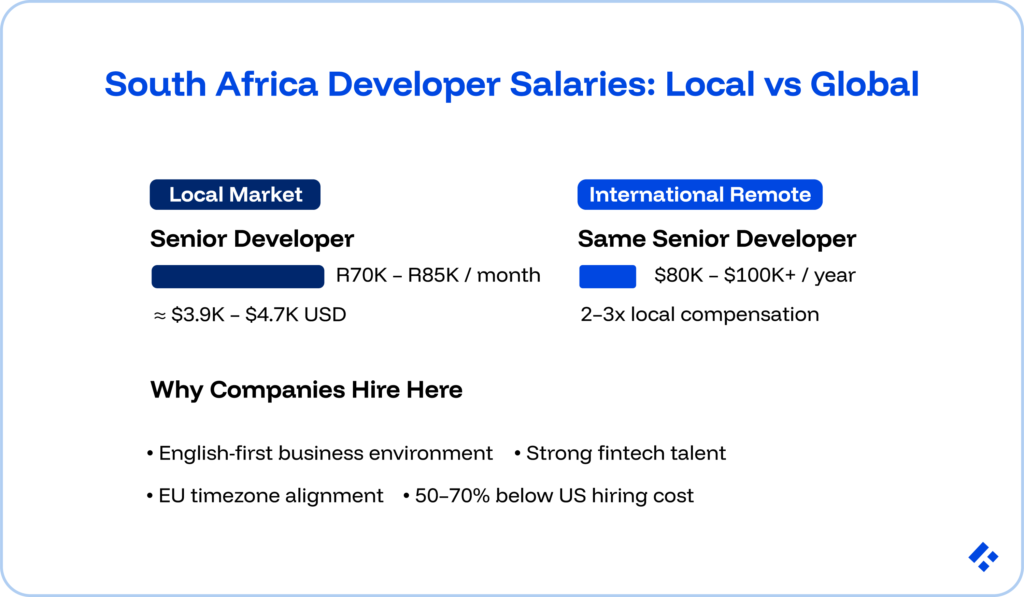
A senior South African developer with strong backend skills might earn R70,000 to R85,000 per month locally, which translates to roughly $3,900 to $4,700 USD, depending on the exchange rate, or about $47,000 to $56,000 annually.
An equivalent senior developer in the US costs $150,000 to $200,000.
Since there have been some currency fluctuations in recent times, the salary data below reflects local ZAR-denominated compensation from our own experience, and multiple sources like PayScale, Glassdoor, Indeed, Jobted, and ERI SalaryExpert.
| Seniority level | Annual salary (ZAR) | Monthly (ZAR) | Approx. annual (USD) |
| Entry-level (0 to 2 years) | R270,000 to R400,000 | R22,500 to R33,333 | $15,000 to $22,000 |
| Mid-level (3 to 6 years) | R400,000 to R650,000 | R33,333 to R54,167 | $22,000 to $36,000 |
| Senior (7 to 10 years) | R650,000 to R1,000,000 | R54,167 to R83,333 | $36,000 to $56,000 |
| Senior specialist / Lead (10+ years) | R1,000,000 to R1,400,000+ | R83,333 to R116,667+ | $56,000 to $78,000+ |
For remote work for international clients, you can expect to at least double these figures.
Specialization, like with any other software developer, drives meaningful salary variation. Some stacks are just rarer or have a greater demand than supply, and the market rate reflects that.
| Specialization | Estimated monthly range (ZAR) |
| Cloud / AWS / Azure engineer (senior) | R80,000 to R120,000 |
| Full-stack developer (senior) | R70,000 to R100,000 |
| Java / Python backend developer (senior) | R65,000 to R95,000 |
| Frontend developer (React / Angular) | R45,000 to R75,000 |
| DevOps engineer (senior) | R75,000 to R110,000 |
| Mobile developer (iOS / Android) | R55,000 to R85,000 |
| .NET / C# developer (senior) | R60,000 to R90,000 |
| QA / Automation engineer | R35,000 to R60,000 |
Geography creates quite a big salary difference within South Africa. As with most other places, the dominant tech hubs pull away from the rest of the country quite significantly.
Cape Town typically pays the highest developer salaries in the country, thanks largely to its strong startup and scale-up ecosystem, and the presence of companies like Derivco, BBD, and numerous fintech startups has created genuine competition for senior engineering talent.
If you are looking for senior developers in Cape Town, the costs can approach or exceed R100,000 per month.
The city also attracts a higher concentration of international remote contracts, partly because its tech culture skews toward product-focused engineering rather than enterprise IT.
Johannesburg concentrates on financial services technology and enterprise software development.
Major institutions like Standard Bank, FirstRand, and Absa all run significant engineering operations there, and the demand for backend developers with financial systems experience pushes salaries upward.
Employer type and company profile drive significant salary variation beyond what seniority and stack alone explain.
Oracle is one of the highest-paying technology employers in South Africa, with Levels.fyi data placing average total compensation at ZAR 95,000.
AWS, Microsoft, and other major international technology companies operating locally follow a similar pattern, often pegging compensation closer to regional rather than purely local rates.
Local financial services companies, including Standard Bank, Absa, FirstRand, and Sanlam, also offer very strong compensation packages relative to the broader local market, particularly for developers with banking domain experience, cloud infrastructure skills, or payment systems backgrounds.
All of these institutions push the average prices of South African developers higher than those that you might find in surrounding areas, but they also contribute to the quality of developers.
South Africa leads African developer salaries by a fair bit, as we already mentioned. Here’s what you can expect from the region:
| Country | Approximate average annual salary (USD) |
| South Africa | $19,000 to $27,000 (local); $69,000 avg. (international remote) |
| Morocco | ~$12,000 to $20,000 |
| Kenya | ~$6,000 to $18,000 |
| Tunisia | ~$5,500 to $15,000 |
| Nigeria | ~$3,000 – $15,000 |
There are a couple of other actors you need to consider when hiring developers in South Africa, outside of strictly cost savings.
The popularity of the country with the US and European markets means you are probably going to be competing with some other international companies, especially for the kinds of developers you will likely be looking at.
Where exactly you will need to start your search is going to depend on your specific needs.
Cape Town, for example, tends to produce more product-oriented engineering talent, Johannesburg more enterprise and financial systems depth.
If your product needs fintech or payments domain experience, the Johannesburg talent pool may be better-matched. If you need product-focused full-stack development, Cape Town tends to offer stronger options.
Time zone planning also matters more for US teams than European ones, as we already mentioned.
A South African developer at UTC+2 creates a workable overlap with European teams and a challenging but manageable situation with US East Coast teams, provided you build async communication habits into the workflow from the start.
Hiring software developers is an incredibly affordable option considering the quality of the talent that you get, the international experience, and the English proficiency.
However, if you are based in the United States, you will need to be very careful to set up asynchronous communication standards to ensure that you manage the time zone gap efficiently.
At Trio, our developer vetting covers both technical depth and domain-specific experience.
We focus on fintech, and the South African developers we work with tend to bring relevant context around payments, compliance, and financial data handling rather than requiring orientation on what those requirements actually mean in practice.
To find out more, book a budget consult.