

Hire by Technology
SERVICES



Fintech outsourcing costs vary by region, role, and domain expertise. Understanding the costs before you dive into the hiring model is critical for you to make sure that it is the right choice for your company and project.
At Trio, our LATAM nearshore engineers run $40–$80/hr ($7K–$14K/month). US-based in-house fintech engineers, on the other hand, cost $180K–$220K/year fully loaded.
Compared to standard software development, the fintech domain premium adds 10–12% over the rates you may generally expect. However, these rates come with good reason.
Hiring a general developer and then investing in their compliance training means you will have 4–8 weeks of reduced productivity. The risk of them making costly mistakes also needs to be factored in.
Let’s take a closer look at what actually affects all of these numbers, and where you could potentially cut costs. We’ll cover regional and role-based rate benchmarks, and more.
If you are ready to start your own fintech outsourcing and want to find out more, get pricing.
Developer engagement rates for fintech roles vary considerably by region. A big reason for that is simply the difference in the cost of living in those regions. It doesn’t necessarily mean that there is a decrease in developer quality.
Let’s take a look at the rates that we are witnessing in the 2026 market rates for experienced engineers with fintech expertise. These values represent the totals you can expect to pay through a staff-augmentation agreement, including things like vendor rates.
US-based (onshore):
| Seniority | Contract Rate | Annual Salary |
| Junior (1–3 years) | $80–$120/hr | $80K–$110K |
| Mid-level (3–6 years, fintech-experienced) | $120–$160/hr | $110K–$160K |
| Senior (6+ years, compliance-aware) | $150–$200/hr | $130K–$180K |
| Principal / Staff | $180–$250/hr | $160K–$220K |
LATAM nearshore (Brazil, Mexico, Argentina, Colombia):
| Seniority | Engagement Rate |
| Junior | $25–$40/hr |
| Mid-level | $40–$60/hr |
| Senior | $60–$80/hr |
| Principal / Staff | $75–$95/hr |
Eastern Europe (Poland, Romania, Ukraine):
| Seniority | Engagement Rate |
| Junior | $30–$45/hr |
| Mid-level | $45–$70/hr |
| Senior | $65–$90/hr |
| Principal / Staff | $80–$110/hr |
Asia-Pacific (India, Philippines, Vietnam):
| Seniority | Engagement Rate |
| Junior | $15–$30/hr |
| Mid-level | $25–$45/hr |
| Senior | $40–$65/hr |
Based on these figures, we can very clearly see that LATAM nearshore senior rates ($60–$80/hr) run approximately 40–50% below equivalent US contract rates ($150–$200/hr).
This represents an incredible opportunity for you, since this region operates in US time zones.
Related Reading: African Developers for Cost-Effective Web Development
The values we mentioned above represent the cost of staff augmentation. However, if you are hiring an in-house developer, then it’s important to note that most US salary figures don't tell the full story.
There are a couple of additional costs that you need to factor in:
First-year total:
| Cost Component | Amount |
| Base salary | $150,000 |
| Employer burden (30%) | $45,000 |
| Recruitment (annualised over 2-year tenure) | $15,000 |
| Onboarding productivity loss (90 days) | ~$37,500 |
| First-year annualised total | ~$247,500 |
| Steady-state (Year 2+) | $210,000–$240,000 |
On average, LATAM nearshore rates run at about $60–$80/hr for a senior fintech engineer, a full-time equivalent engagement (2,080 hours/year) runs:
In most cases, this rate covers all of the vendor margin, like their employer taxes, benefits administration, HR overhead, and compliance vetting.
| Cost Category | US In-House | LATAM Nearshore |
| Annual base/engagement cost | $130K–$180K salary | $125K–$166K engagement rate |
| Employer burden (benefits + taxes) | $33K–$54K | Included in the rate |
| Recruitment cost (annualised) | $15K–$22K | $0 |
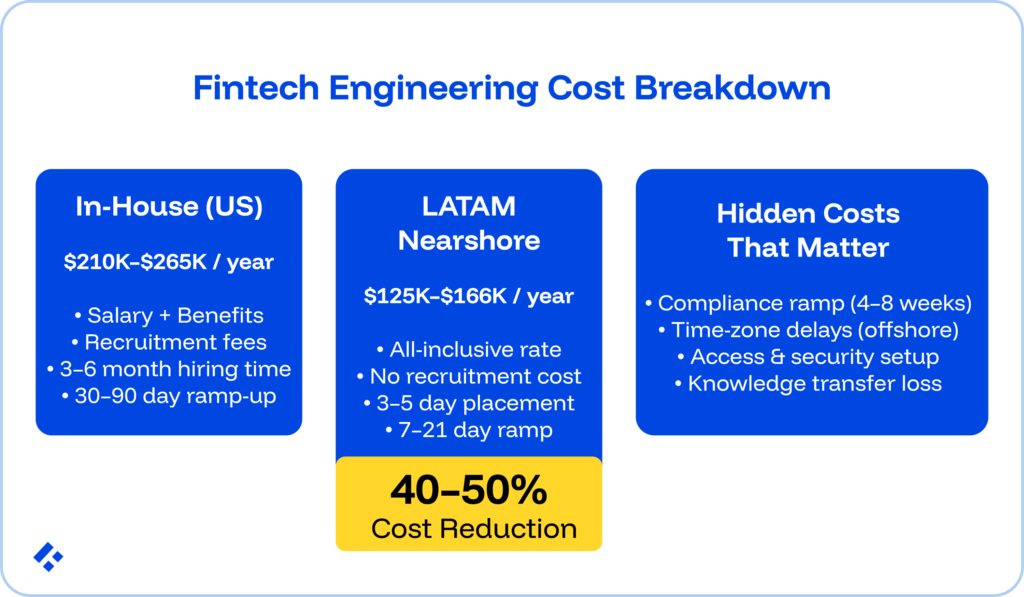
| Time-to-placement | 3–6 months | 3–5 days |
| Onboarding ramp (productive velocity) | 30–90 days | 7–21 days (pre-vetted for fintech) |
| Fully-loaded Year 1 cost | $210K–$265K | $125K–$166K |
| Savings vs. US in-house | Baseline | 40–50% lower |
While the immediate cost savings are quite apparent, an additional advantage here is time-to-placement.
From what we have seen, this tends to be more urgent for fintechs facing regulatory deadlines than the cost differential.
Fintech engineers don't map directly onto general software engineering rates.
The main reason for this is the compliance requirements in regulated financial products. PCI DSS, KYC/AML, SOC 2, and open banking regulations all require domain experience that most software engineers haven't accumulated.
This means fintech specialists are genuinely more scarce, playing a role in the increased price.
The 10–12% premium over general software rates reflects this reduced talent pool of engineers who have built payment systems or KYC pipelines in production, and the risk of engaging a generalist who will learn on a production-regulated system.
When a fintech engages a technically strong engineer without fintech domain experience, bringing that engineer to productive velocity on compliance-sensitive work tends to take 4–8 weeks.
This is the case regardless of whether you choose in-house hiring, staff augmentation, or offshore project teams.
A staffing partner that pre-screens for fintech domain competency eliminates this ramp.
Several cost categories appear consistently in real fintech outsourcing engagements but never show up on a vendor's rate card.
For offshore engagements with 8–12 hour time-zone differences, you end up without much overlap in working hours.
Fintech work benefits greatly from daily syncs on compliance-critical features. LATAM nearshore eliminates this cost by running in US time zones. While the region may be more expensive than somewhere like India, this tradeoff tends to make up for that.
Fintech codebases operate in PCI DSS-scoped environments with role-based access controls.
Making sure that you provide the external engineer with appropriate access requires documented onboarding procedures, access control review, and even background verification in some cases.
A good starting point is to budget approximately 1–2 weeks of compliance team time per new external engineer.
When an engagement closes, the institutional knowledge they accumulated around things like compliance-sensitive systems, like KYC state machine behaviour, ledger reconciliation edge cases, and PCI DSS access control rationale leaves, too.
This risk sits lower with dedicated team models and higher with high-rotation freelancer arrangements.
Managing an outsourced engineering team requires vendor management time from the fintech's side.
This management is made up of things like performance monitoring, sprint review participation, contract administration, and escalation handling.
Budget roughly 5–10% of the engagement cost as internal management overhead.
Five inputs determine the total cost of a fintech outsourcing engagement.
Three scenarios where in-house makes sense despite the cost difference:
For these situations, the hybrid model, where you use in-house hiring for architecture and core compliance roles, and take advantage of nearshore staff augmentation for implementation and specialist sprints, produces the best cost-quality outcome for most growth-stage fintechs.
At Trio, our LATAM developers are available for between $40–$80/hr and $7K–$14K/month. This rate includes everything involved in getting pre-vetted fintech engineers.
There are no additional costs.
Placement speed means 3–5 days from engineering brief to vetted profiles, which even removes the cost of the lost time that you would eventually need to deal with.
To find out more specific costs for your project, and to discover if we have the right people for you, book a budget consult.