

Hire by Technology
SERVICES



Senior React developer salaries are genuinely hard to pin down. Different platforms tend to provide different numbers because each platform captures a different slice of the market.
Glassdoor pulls from self-reported compensation, ZipRecruiter aggregates active job listings, and Levels.fyi focuses almost exclusively on big tech and Silicon Valley-caliber roles.
Understanding why the numbers differ is critical to give you a good idea of what you will actually end up paying, so you can plan appropriately and ensure that you bring all of the skills onto your team in the most affordable manner.
The alternative is costs that take you by surprise, increasing the time it takes to find the right people, or forcing you to sacrifice a skillset that would have greatly benefited you.
In industries like fintech, especially, this often leads to failure later, due to poor user experience and a loss of trust.
What you pay a senior React developer depends on the industry, company stage, funding level, location, and whether you're competing with fintech firms, large enterprises, or FAANG-adjacent companies for the same candidates.
Let’s break down what senior ReactJS developers actually earn in 2026, what drives salary variance, and where the fintech market sits relative to the broader range.
At Trio, our senior-level React Developers with production experience in fintech go for anywhere from $40-$80, depending on your needs.
Salaries vary by platform and methodology, so the honest answer involves a range rather than a single figure.
According to Glassdoor, the average salary for a senior React developer in the US sits at $141,000 per year, with the typical range running from $111,000 at the 25th percentile to $181,000 at the 75th percentile.
Top earners at the 90th percentile report up to $223,718 annually.
ZipRecruiter data from early 2026 is slightly different, and puts the average somewhat lower at $128,400 per year, with the majority of senior React developer salaries falling between $109,000 and $144,000. Their 90th percentile figure is $167,500.
The most useful interpretation that we can make from this information is that, for a genuinely senior React developer in the United States, a realistic total compensation range sits between $120,000 and $175,000 for most roles.
Big tech and well-funded fintech companies will likely push well beyond that ceiling.
Experience contributes a great deal to overall React developer compensation. However, we have noticed that the trajectory tends to plateau at the senior level unless the developer moves into engineering management or a staff/principal track, or they move into industries like fintech.
Based on what we are seeing in the market at the moment, the estimated median total pay for React developers in the United States breaks down as follows, according to experience level:
Advertised senior positions typically require seven to ten years in practice, which is where the higher figures estimated by ZipRecruiter and Glassdoor truly start to appear.
For big tech positions tracked by Levels.fyi, the 90th percentile can reach a total compensation of around $305,000 when total compensation when RSUs and bonuses are factored in.
Location remains the single strongest predictor of React developer compensation in the US. The gap between San Francisco and mid-market cities is substantial and hasn't narrowed significantly despite the shift toward remote work.
Senior React developers in San Francisco and Palo Alto earn $152,000 to $230,000 in base salary, with total compensation at FAANG-level companies reaching $280,000 or more when RSUs and bonuses are included.
New York City runs $133,000 to $218,000 for seniors, with strong demand from financial services and media technology. Seattle ranges from $168,000 to $210,000, Boston from $158,000 to $195,000, and Austin from $148,000 to $185,000.
Outside these primary markets, you can expect compensation to drop dramatically, which reflects the significant proportion of roles in lower-cost-of-living markets.
Remote-first companies that pay roughly national-average rates, instead of paying location-adjusted rates, are incredibly attractive to developers working in these lower-cost areas.
We have already alluded to several reasons why developer salaries vary so significantly. To assist in your hiring decisions, let us look into them in more detail:
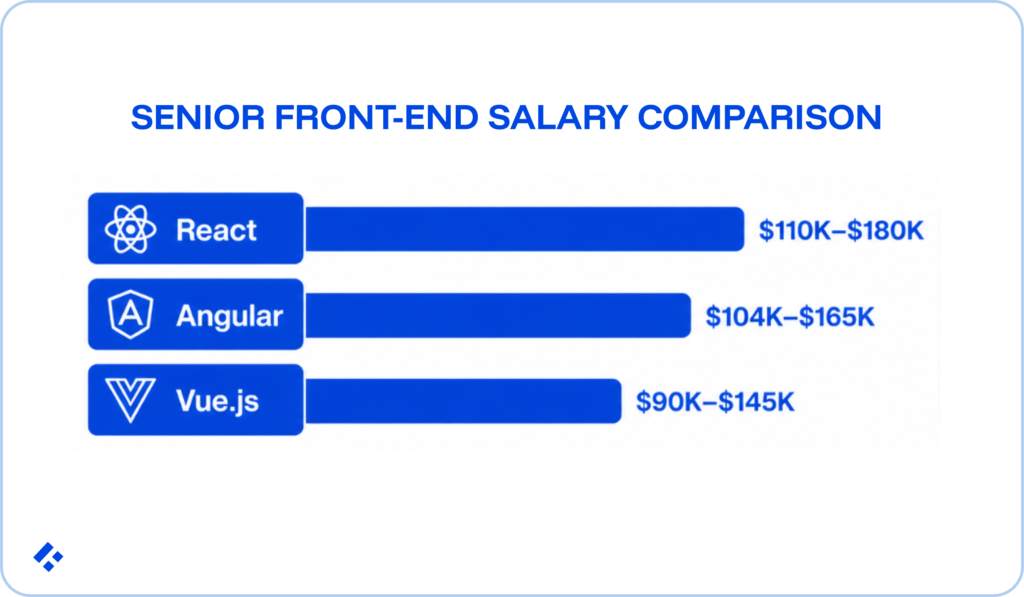
React developers cost more than those in any other front-end frameworks. This is primarily because React roles remain more numerous and competitively priced.
Using Glassdoor data as a consistent baseline across front-end technologies:
| Technology | Average Salary Range (US Senior, 2026) |
| React | $110,676 to $180,002 |
| Angular | $104,000 to $165,000 |
| Vue.js | $90,000 to $145,000 |
A large reason for this cost difference is the larger React talent pool and proportionally higher number of well-funded companies requiring React expertise. Likewise, Vue is not used very commonly.
Angular sits between the two, with a slightly smaller premium over Vue.
Financial services, including fintech, pay more than the broader technology sector for React developers.
It is one of the highest-paying industries for React developers, with developers easily earning more than $200,000 in our experience.
The premium reflects the fact that React developers in fintech typically need TypeScript proficiency at a level that general web development roles don't require.
Financial codebases also carry compliance obligations that make type safety a genuine production concern rather than a preference.
Real-time data handling, WebSocket management, and state architecture for high-frequency updates are skills that appear in trading platforms, portfolio dashboards, and live financial data products.
Payment system integrations, KYC flow architecture, and compliance-aware frontend development are also concentrated in fintech. A senior React developer who has built a PCI DSS-scoped payment flow understands constraints that most React developers have never encountered.
For fintech companies specifically, the combination of these skill requirements, combined with the fact that they are competing for talent against larger financial institutions, tends to push effective compensation above the general React developer average, particularly in New York and San Francisco, where the density of fintech employers is highest.
The US talent market for senior React developers is competitive and expensive.
One approach that works well for many growth-stage fintech companies is nearshore staff augmentation from Latin America.
From what we have seen, software developers in Latin America earn roughly $53,000 to $63,000 when they are employed remotely by US companies.
Argentina and Uruguay lead the region at $63,163 and $61,732, respectively. Mexico, Colombia's Medellín market, and Brazil round out the primary hiring markets.
At Trio, senior fintech React developers are sourced from LATAM at a bill rate of $40 to $80 per hour, depending on seniority and specialisation. That equates to roughly $83,000 to $166,000 annualised, for engineers with production React experience in financial services contexts.
This is as much as a 40%-60% savings rate compared to hiring a similar role in the United States.
The practical advantage over offshore alternatives in Asia is time zone overlap.
LATAM developers typically share four to eight hours of the US working day, which facilitates real-time code reviews, same-day architectural decisions, and pair programming sessions.
For fintech companies under compliance deadlines or executing a rapid product build, that overlap matters more than the marginal cost difference between LATAM and offshore rates.
If regulators start having questions about why specific decisions were made, questions can be answered in real time.
Related Reading: Fintech Outsourcing Cost Guide: What it Actually Costs to Build a Fintech Engineering Team
Senior developers are an asset to your product roadmap in ways that junior and mid-level engineers typically are not.
For a fintech company building or scaling core infrastructure, payment systems, or compliance-critical interfaces, the cost of a wrong hire or a slow-moving team compounds quickly.
The real question is whether the cost of not hiring one, or hiring the wrong one, is higher.
In fintech specifically, where a production bug in a payment flow can trigger regulatory scrutiny and customer trust issues, the answer tends to be yes.
Senior React developers hired through Trio come pre-vetted for fintech domain knowledge alongside technical capability. Placement typically takes three to five days from brief to engineer onboarding.
If you're looking for senior React developers who understand the constraints of regulated financial environments and can contribute from their first sprint, reach out for a budget consult.