

Hire by Technology
SERVICES

The financial world moves faster than most legacy systems can handle.
We’ve seen firsthand how some established lenders still run critical operations on infrastructure built decades ago, patched together over time and held together, in some cases, by institutional memory rather than sound architecture.
The long-term problem that is created is that even small integrations can eat months of engineering time and cost far more than they would have otherwise. There is also an increased chance of problems.
Meanwhile, digital-first competitors are launching full lending platforms in a fraction of the time, with noticeably better user experiences. We’re talking about getting the majority of features done in weeks.
Traditional banks and larger institutions, by comparison, operate on product rollout cycles of four to six months. That creates an incredible gap that competitors could easily take advantage of.
API-first banking solves this problem directly.
In summary, lenders design their entire infrastructure around them from day one to create platforms that can connect systems, automate manual processes, and adapt to meet the demands of users or shifts in regulations without the legacy software needing to be rebuilt from the ground up.
At Trio, our engineers build API-driven platforms for fintechs and financial institutions. We have seen firsthand how the right architecture can turn technical debt into a real opportunity.
The fintech space requires nuance. Regulatory compliance needs to be met, and users expect services to have near-perfect uptimes. Having engineers who already understand that context changes what your team can ship. That’s where Trio’s fintech expertise comes in.
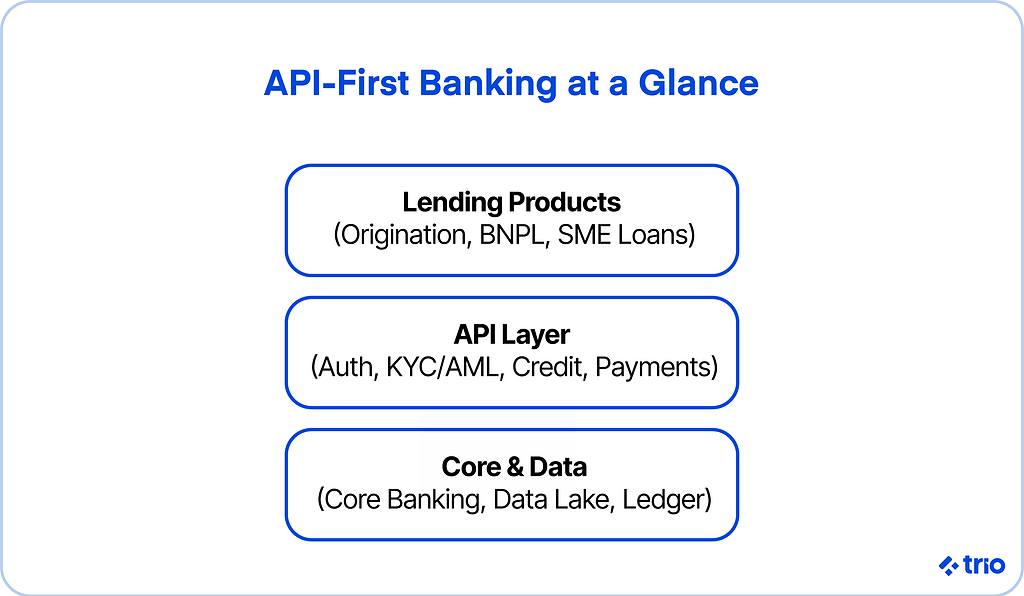
Simply put, an API-first approach means that every function of a banking or lending system gets designed to be accessed through an application programming interface (API).
Instead of building a platform first and adding APIs later, the APIs become the blueprint for how the system works from the start.
This may not sound like a big deal, but it matters quite a lot.
When your systems are ready to offer customer onboarding, KYC validation, or loan disbursement as modular services from day one, integrating them with external partners or internal tools becomes straightforward.
You don’t need to design middleware later, which you will then need to maintain. You also don’t need to keep creating one-off connectors, which you will need to rewrite every time something changes upstream.
Instead, services communicate through stable, well-documented interfaces. Adding a new credit scoring provider or connecting to an open banking data feed becomes a standardized integration, taking only a fraction of the time.
Traditional banking integrations were designed for a closed-system era, where interoperability was rare, and APIs were grafted onto monolithic cores after the fact.
Those point-to-point links tend to be very fragile, and even a small system change can mean weeks, or sometimes even months, of work.
In fintech, there is a lot more to consider than simply the difference between a couple of weeks and a couple of months between ideation and release.
Slower cycles mean you delay the process of getting new revenue in. In a sense, you are also at the mercy of your competition, which can implement those same features in a shorter period of time and may end up pulling some of your potential clientele.
In banking and lending situations, this often gives them the opportunity to gain the user’s trust, which converts them into a long-term customer.
Finally, a much larger proportion of your resources needs to go to recoding, which means that your cost of development is greater overall, taking resources away from other places that could benefit you.
If you are a relatively new company, trying to break into the already competitive fintech industry, speed becomes invaluable in giving you an upper hand.
This cost also has practical implications for how lenders should think about vendor partnerships and staffing. If the underlying architecture cannot support fast iteration, the talent and tooling built on top of it will underperform regardless.
APIs allow systems to communicate by creating reliable, two-way data exchange across core platforms. In order to better understand API-first banking, let’s take a look at some of the examples of how these APIs are used in modern banking and lending.
Modern lending depends on a network of systems: core banking software, CRM tools, credit bureaus, payment processors, and compliance platforms.
Without APIs, keeping these synchronized would be incredibly tedious and involve things like batch file transfers and manual uploads, which would put you at risk of a bunch of errors.
With an API-first model, data flows in real time.
When a customer submits a loan application, that data can move from the CRM to the core system, trigger a credit check through a bureau API, and feed into a risk model, all without manual intervention.
Loan origination involves some of the most resource-intensive processes in lending.
Customer data validation, eligibility checks, underwriting models, and regulatory review all require real-time data movement that manual or batch-based systems struggle to support.
API-driven origination lets lenders validate customer details instantly, update risk profiles dynamically, and, in some cases, they can even trigger approval decisions as soon as conditions are met.
This is not just faster than following up on all of this information automatically, but also creates an auditable decision trail with less human intervention, meaning there is less opportunity for personal bias.
Credit risk models produce better outputs when they run on better data, which APIs allow lenders to pull in real-time from multiple sources simultaneously.
Some of the sources we have seen considered include credit bureaus, open banking feeds, transaction histories, utility payment APIs, and payroll data.
With the rise of AI in credit underwriting, even more unconventional data is becoming usable as well.
The result is that, rather than relying on a static credit report from weeks ago, underwriters see a current and complete picture of the borrower’s financial health.
This kind of real-time access also supports more accurate pricing and faster decision-making, which matters especially in high-volume or thin-margin lending categories like BNPL and SME credit.
Related Reading: Alternative Data for Credit Underwriting
We have already alluded to many of the benefits of an API-first approach when discussing the use of APIs in fintech above. These include faster product launches, reduced operational costs, improved customer experience, and easier scaling without constant rearchitecting.
When systems are modular, your teams can move faster without breaking things.
APIs let you experiment with new financial products or integrations without disrupting core services.
Connecting to accounting software like QuickBooks or Xero for a small-business lending product, for instance, becomes a matter of using a standardized API rather than commissioning a custom connector that risks affecting your other features.
Every manual step in a lending process carries a cost. Not only do you have to consider the time that it takes to do the task (consider API-automation is near-instantaneous), but you also have to consider the risk of potential error that occurs when actions are completed manually.
APIs can eliminate all of those costs by automating interactions between systems, whether that means something as simple as data entry or something as complex as credit checks.
The upfront investment in a proper API management platform may look like a lot, especially for smaller companies. But the long-term savings are in reduced errors and lower maintenance burden.
These systems also tend to scale very well if you set them up correctly, which makes them long-term investments that will hold up even as your user base grows.
With improvements in mobile apps and service offerings all around, borrowers expect near-instant feedback.
API-driven systems can deliver real-time application status updates and even features like digital contract signing, so your applicants no longer wait days to find out whether they qualify.
APIs also make it possible to offer self-service portals or embedded lending experiences through third-party apps. Think of something like Klarna that appears at checkout, without every online marketplace needing to invent and code their own version.
And because every decision generates a digital audit trail, compliance teams can monitor for bias or process deviations far more easily than they could in a manual environment.
Scaling with an API-first system means building once and deploying across contexts, whether that is a new geographic market, a new credit product, or a new partner integration.
For example, a regional lender that connects to local credit bureaus through a well-documented API can replicate that framework in a new jurisdiction with minimal code changes.
The customer experience stays consistent; only the data sources swap out. This means less money is needed in terms of coding cost, and your time-to-market is drastically reduced.
Automation in lending does not happen by accident. It comes from careful API design and thoughtful integration across the full workflow.
You can’t just shove a bunch of APIs together and hope for the best. Here is how you do it:
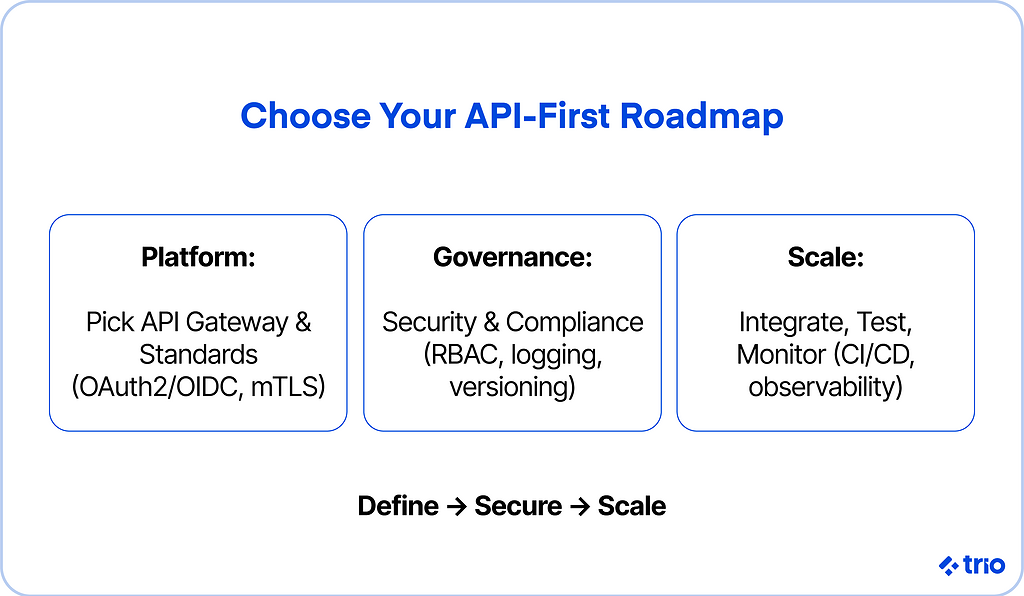
APIs can collect application data directly from digital channels, whether web, mobile, or embedded finance partners, and sync it instantly with your CRMs and decisioning systems.
This eliminates duplicate data entry and ensures every record arrives complete and standardized.
You then need to create integrations with credit bureaus and identity verification providers.
Through them, you can instantly use the information in the application to run KYC and AML checks. This should only take a couple of seconds.
These APIs should then return structured, machine-readable data that feeds directly into decision models.
Once credit and identity checks are complete, an API-first system can trigger underwriting logic automatically.
This means that approval decisions can push directly to disbursement systems, which initiate fund transfers or contract generation through connected APIs.
The entire chain, from application to funding, can run without a human touching data between steps.
Finally, APIs can integrate with communication platforms and accounting systems to manage repayment tracking and things like overdue payment reminders. These APIs should also link to internal dashboards for your own tracking purposes.
Including this last step means that your customers receive timely, accurate updates while internal teams maintain real-time visibility into portfolio health.
While an API-first model is great, and in many cases far easier to implement than more traditional, isolated development, it is not without its challenges.
Having skilled fintech developers on your team is one way to mitigate many of these potential issues, but it is still good to be aware of them.
Many banks and lenders still run on core systems built before cloud infrastructure existed.
While this infrastructure may still be functional in many ways, these often lack modern API support. The result is that developers are forced to rely on middleware or batch transfers that introduce delays and create data silos.
Instead of being a quick and secure solution, even a simple new partner integration can require months of testing.
One practical approach that our developers have adopted deal with this is to create an abstraction layer, often called an API facade, that exposes legacy functionality through modern API interfaces.
By doing this, our fintech experts have been able to modernize incrementally without tearing down the entire core system at once. It’s far from neat, but it buys time and reduces risk.
Every API endpoint represents a potential attack surface. This is bad in any industry, but financial data, rightfully so, sits among the most regulated categories in any jurisdiction.
Implementing OAuth 2.0, OpenID Connect, mutual TLS authentication, and a variety of other security measures have become standard regulatory practice, but governance often receives less attention than it deserves.
Governance here usually involves tracking which parties can access which APIs, and any information regarding that access.
Without it, lenders risk what security teams call zombie APIs, old API versions left active after a product change, that are no longer maintained and quietly become accessible to anyone who knows where to look.
We always recommend basic best practices like API keys and user-level access control. On top of that, you should run regular API discovery processes to catch anything that may have slipped through.
API gateways handle routing, authentication, and rate limiting across potentially hundreds of endpoints.
When you combine this with a microservices architecture, they give engineering teams the autonomy to build and deploy updates independently, without disrupting any other feature that you may have.
For example, you can update the credit scoring module without disrupting loan disbursement.
Beyond architecture, basic software development security considerations are important.
Version control prevents new updates from breaking existing partner integrations. Real-time observability tools catch latency spikes or failed transactions before customers notice them.
That’s why having senior developers on your team is so critical.
Buy Now, Pay Later products rewired consumer expectations around credit, and APIs sit at the center of that change. If you are creating any fintech product, the chances are quite high that buyers will expect these same services.
The process is very similar to the steps we have already discussed above.
When a customer selects a BNPL option at checkout, the entire underwriting process needs to be completed invisibly and in seconds.
APIs handle identity verification, soft credit checks, fraud detection, and risk scoring behind the scenes, while the customer sees a two-click approval flow.
Traditional credit models were not designed for short-duration, high-volume products like BNPL, which are at a far greater frequency, making hard credit checks inconvenient.
APIs make it possible to ingest real-time behavioral and transactional data, including purchase history and repayment timing, to feed adaptive credit models that improve with each transaction cycle.
This new, adaptive credit model comes with regulatory scrutiny worth paying attention to.
APIs can help automate the compliance layer here, running affordability checks and generating the required disclosures as part of the same workflow that processes the application.
BNPL appears to be moving more toward subscription-based and credit-as-a-service models.
Rather than discrete one-time financing, we might be looking at a future where lenders offer flexible spending accounts that sync across multiple merchants and platforms.
APIs make this possible by synchronizing credit limits, repayment schedules, user profiles, and even more information in real time, blurring the line between lending and personal finance management.
Open banking, the framework that requires banks to share customer financial data with authorized third parties via APIs, has changed how lenders and fintechs all over the world interact with customer data.
Open finance takes this further.
Where open banking focused on bank account data, open finance extends to all other parts of finance, including things like investments, insurance, pensions, and payroll.
As with all other aspects of financial technology, we cannot emphasize the importance of compliance and regulatory considerations enough when considering API-banking.
Different markets enforce different standards: the OCC's guidelines in the U.S., the FCA in the U.K., the RBI in India, and the EBA in Europe.
While each one of these has a myriad of different requirements, they all unanimously mandate secure data handling, clear audit trails, and demonstrable customer consent.
An API-first system makes compliance more manageable because every transaction, access event, and approval generates a log automatically.
All the financial APIs that our developers help implement typically employ TLS 1.3, AES-256 encryption, and tokenized authentication to protect data in transit and at rest.
But you need to consider much more than that.
Data minimization, role-based access controls, anonymization, and automated access logging all contribute to a defensible compliance posture.
Related Reading: Engineering Principles for Building Resilient Fintech Solutions
APIs can automate much of the compliance workload, taking the stress off your team when audits roll around.
In these automation pathways, real-time transaction data feeds directly into AML monitoring systems, and KYC databases update automatically when new verification data arrives.
The result is on-demand audit reports, generated through the same API layer used for day-to-day operations.
API-first banking is already incredibly innovative. But, as always, the fintech industry does not stand still. We are seeing some emerging technologies, taking the industry even further.
AI models trained on live API data can assess borrower behavior and optimize pricing dynamically.
The combination of well-structured APIs and machine learning pipelines creates lending systems that sharpen their own performance over time.
We need to note that this brings its own challenges, though. Every automated decision needs to remain explainable and auditable.
Smart contracts can automate loan disbursements and things like repayment triggers, or even collateral releases based on predefined conditions.
When connected through APIs, these systems offer near real-time transaction visibility to both lenders and borrowers.
We have already witnessed some digital lenders experimenting with blockchain-based instruments for SME financing and trade settlements, though widespread adoption in consumer lending is probably still going to take some time.
So, what if you decide that an API-first strategy is the way forward for your fintech? Starting correctly is the best way to ensure long-term success.
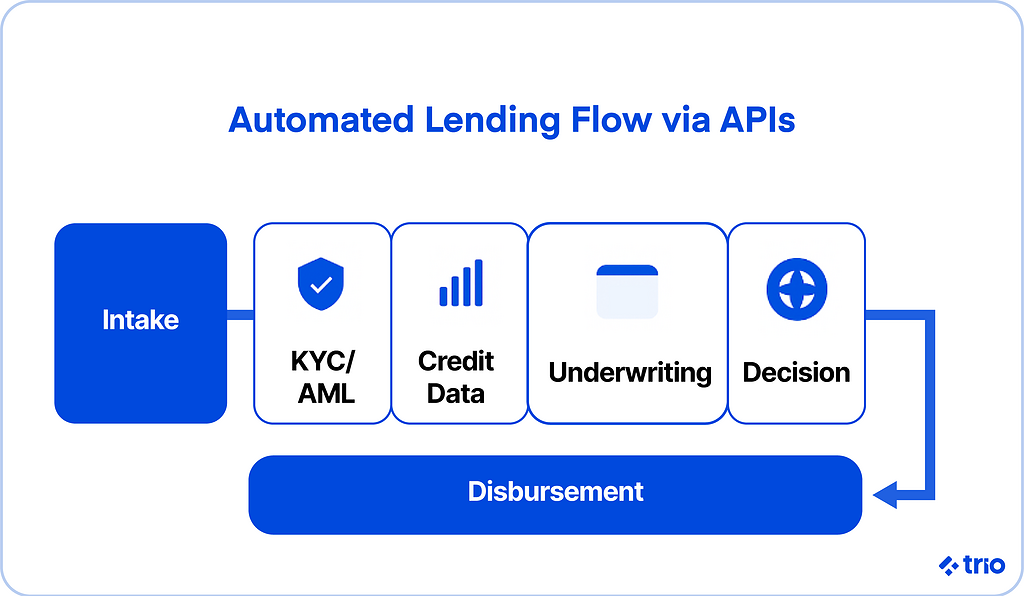
Architecture should follow strategy, so make sure not to get started with anything until you have a solid plan and have consulted with experts to ensure that the plan is viable.
Your API design needs to reflect your business goals. A platform built to optimize for partnership velocity looks different from one built to minimize regulatory risk.
API management platforms like Apigee, Kong, and AWS API Gateway each carry different strengths. Some are more secure, while others are easier to integrate with legacy technology.
The right choice depends on your existing stack and where you expect the highest integration complexity.
This is why fintech solutions are rarely one-size-fits-all. Evaluating these tools against your specific legacy environment and partner ecosystem, rather than against benchmark features alone, tends to produce better outcomes.
Retrofitting security and compliance into an existing API layer costs far more than designing them in from day one.
This applies to both engineering overhead and regulatory credibility.
Our developers have also noted that compliance stakeholders tend to trust systems where controls were designed as core features rather than added after an audit flagged their absence.
Once deployed, APIs require the same ongoing attention as any critical piece of infrastructure.
You need to be testing them constantly to ensure that they still meet your needs and that they are still secure. The industry constantly changes, so even just standing still puts you at risk.
API-first banking represents a real structural shift in how financial systems get built and maintained. If you are struggling with a failing legacy system, APIs are a great way to push your product forward without rebuilding it from the ground up.
If your product is still relatively new, API-first banking is still a great option as it allows you to get services onto the market quickly, with minimal development requirements, while allowing you to adapt as your client base grows.
At Trio, we have helped fintech companies turn ambitious API-first goals into working, scalable platforms.
Our fintech-specialist engineers can join your team through staff augmentation, bringing both domain knowledge and technical depth. Alternatively, our experts can develop entire products.
Request a consult!
API-first banking means designing your financial platform around APIs from day one, rather than adding them in later when you may not be able to make connections as secure, or when development may take longer.
Implementation timelines for an API-first approach vary significantly. The main factor affecting how long it takes is your starting point, with modern fintechs being able to go live within a few weeks. Legacy systems tend to take longer as developers struggle with outdated technologies.
API-first systems generate an auditable digital trail automatically, which makes on-demand audit reporting straightforward and supports real-time AML monitoring and automatic KYC database updates.
BNPL products depend on API-driven workflows to complete identity verification, soft credit checks, fraud detection, and risk scoring in the seconds between a customer selecting a payment option and seeing an approval decision. This allows checkout to stay fairly seamless.
The most widely deployed API management platforms include Apigee (now part of Google Cloud), Kong, and AWS API Gateway. Each one is slightly different, and the right choice depends on your existing infrastructure.