


 Read Client Stories




 Alex Kugell
 Key Takeaways
- A version control system records every change made to a project’s files over time, letting a team track exactly what changed, when, and who made the change.
- The three broad types (local, centralized, and distributed) differ mainly in where the project history lives and how much a single point of failure matters.
- Git remains the dominant distributed system by a wide margin, though centralized systems like Subversion and enterprise tools like Perforce still serve real, specific use cases.
- For regulated fintech codebases specifically, a VCS is the mechanism that produces the audit trail a regulator or examiner will eventually want to see.
- Choosing the right VCS matters less than choosing the right workflow and access controls around it.
Software teams make use of VCSs to collaborate, trace code changes, and manage risk in a variety of industries where mistakes can cost a lot, like fintech.
However, with numerous options available, it can be challenging to select the best version control system for your software project. For most companies, Git is a great option, but there are some exceptions.
Let’s examine what version control systems are, the various types currently available, and how to choose the right one for your development process.
At Trio, we have a team of fintech software developers who have worked on a diverse range of regulated projects. They are familiar with using tools like version control systems and a variety of others to ensure auditability.
What is a Version Control System?
A version control system (VCS) records every change that you make to a file, or a set of files, over your entire project.
They are often used for release points, making it easy to determine which version is live. They can be used for anything related to tracking and managing, though.
Types of Version Control Systems
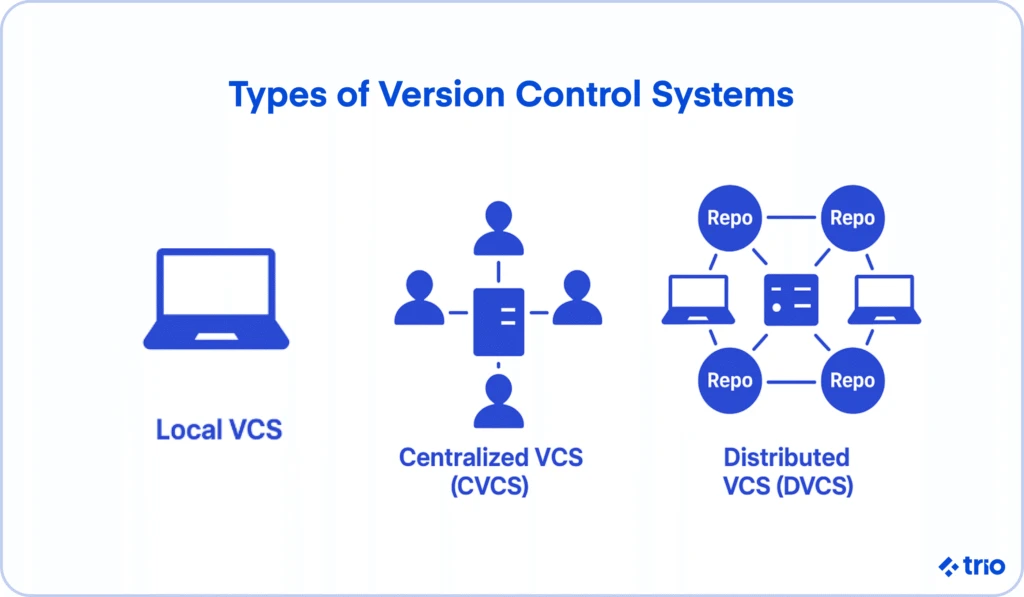
There are three main types of VCSs: local, centralized, and distributed.
Local Version Control
Local systems only track the files from your developer’s computer.
They are fast and straightforward, but since they don’t examine the entire code, they aren’t widely used in software development projects that require collaboration.
Unless you are working on a passion project all by yourself, these won’t be of much use to you.
Centralized Version Control Systems (CVCS)
Subversion (SVN) is a good example of a centralized system. This form of version control relies on keeping your project history on a single server.
Since everything is in one place, it’s easy to manage your team’s control and access. However, you also lack a failsafe. If something happens to your server, everything grinds to a halt if something goes wrong.
Distributed Version Control Systems (DVCS)
Git and Mercurial are the two most common distributed systems.
Every developer holds a full copy of the project’s history locally, which means the team isn’t dependent on one central server staying online, and branching or merging can happen without a network connection at all.
Git specifically has become the de facto industry standard, used by the overwhelming majority of professional software teams and nearly all open-source projects. Git is also the option we recommend most for fintech teams.
Its branching model, the speed of local operations, and the ecosystem built around it, and the tooling that plugs into each, are the main reasons it’s displaced most of what came before it.
Enterprise and Specialized Systems
For very specific situations, you may need to look at a smaller set of tools that are designed to serve specific use cases outside typical web and application development.
Perforce (Helix Core) is probably the most common in game development and large binary-heavy codebases, where Git’s design struggles with huge individual files.
Team Foundation Version Control, tied to Microsoft’s ecosystem, still appears inside organizations already standardized on Azure DevOps.
How to Choose the Right Version Control System
For the overwhelming majority of software teams today, the choice is between Git and, in specific enterprise or binary-heavy contexts, something like Perforce.
A few factors are still worth weighing deliberately rather than defaulting without thought.
- Team size and collaboration model: A distributed system handles concurrent work from many contributors far better than a centralized one, since branching and merging don’t bottleneck through a single server.
- Existing tooling and integrations: CI/CD pipelines, code review tooling, and deployment automation are overwhelmingly built around Git today, which makes it the default unless a specific, real constraint points elsewhere.
- File types and repository size: Very large binary assets, common in game development or certain data-heavy pipelines, are a genuine case where Git’s design shows weaknesses, and a tool built for that specifically, like Perforce, can be the better fit.
- Learning curve: Git has a real learning curve for less experienced teams, though the ecosystem of tooling and documentation around it has narrowed that gap considerably compared to a few years ago.
Why Version Control Matters More in Regulated Fintech Work
For most software teams, a VCS is a collaboration tool. For a team building regulated financial products, it’s also something closer to a compliance system.
Every commit is a timestamped, attributed record of exactly who changed what, and why, if commit messages are written with any discipline. That record becomes the evidence a security review, an audit, or an incident investigation actually depends on.
This changes what matters in a VCS choice for regulated work.
Signed commits, so authorship can’t be spoofed, matter more than they would on a typical consumer app.
Branch protection rules that enforce genuine code review before anything reaches a production branch also matter more, since separation of duties is often a real compliance requirement.
Access logs that show who could have seen sensitive code, not just who committed to it, matter more too.
Git remains the right default for almost every fintech team, since it changes how seriously the configuration around it gets treated.
A team that’s ramping up on a regulated codebase for the first time often discovers that the git history itself is one of the most reliable ways to understand why a piece of legacy logic exists the way it does, a genuine, if unglamorous, form of institutional memory.
This is the kind of information that an industry expert can pass along to help you prevent costly regulatory issues later. Our developers at Trio can help you choose the best version control system and more.