

Hire by Technology
SERVICES

While all teams can expect some sort of difficulty in general tech hiring, financial technology has a whole other set of obstacles. In fact, there are many factors that make it hard to hire fintech engineers, and most of them compound each other.
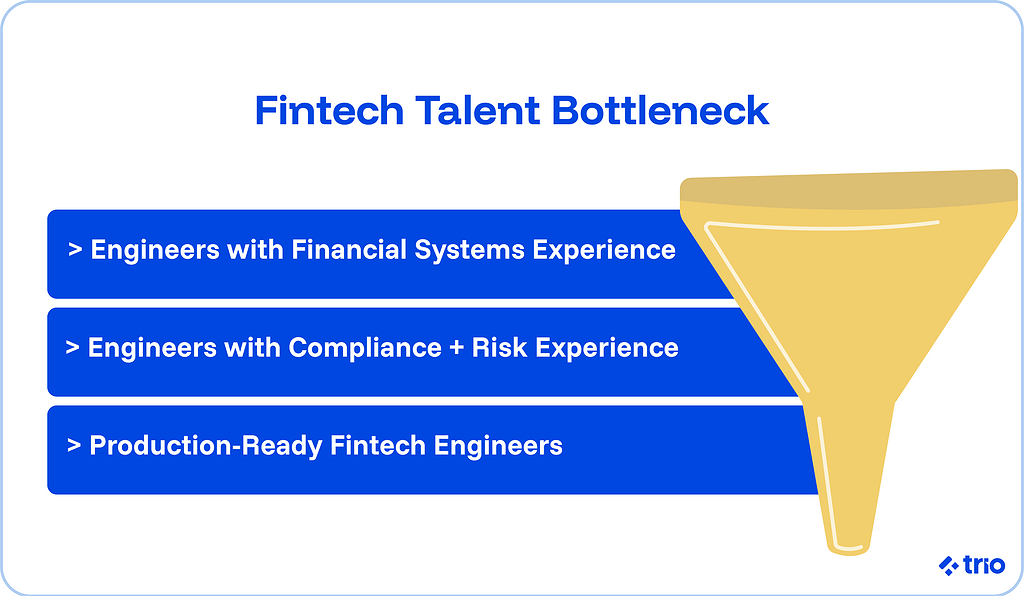
When engineers need both great technical skill and familiarity with regulated environments, the pool gets small very quickly. Everyone competing for the same top talent makes the bottleneck even tighter.
If you are struggling to find fintech talent, we can help. Our existing talent pool of pre-vetted developers means that we can get you portfolios in as little as 24 hours.
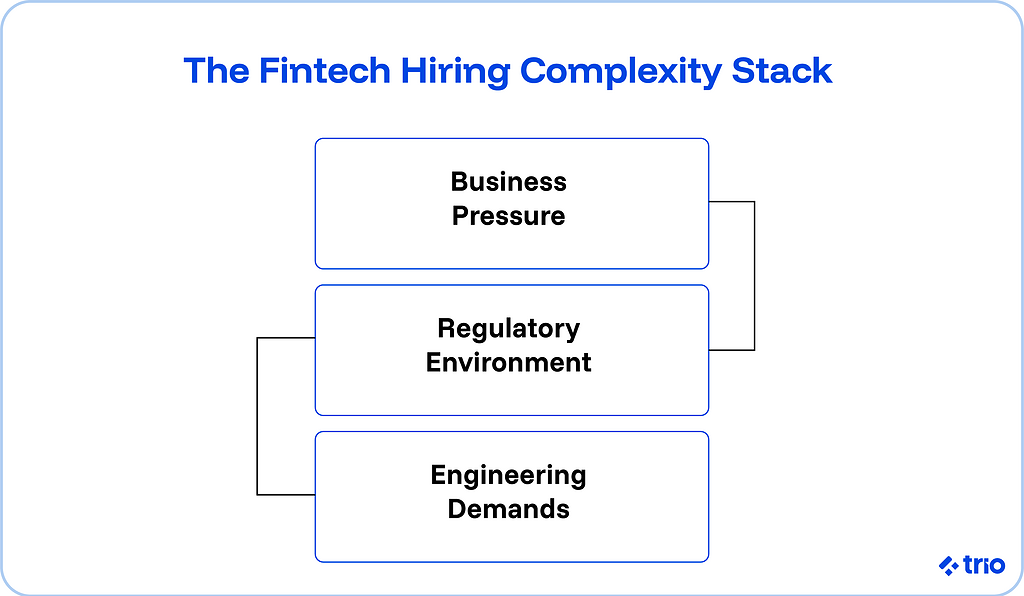
A strong generalist developer can be a great asset to conventional tech companies, but fintechs very rarely see the benefits without increasing their risk.
Financial technology blends backend engineering, security expectations, data protection requirements, and regulatory pressure.
What this means is that fintech engineers need to be generally good coders, and also understand how financial data moves, why certain logs matter, and where the risks hide.
You might find someone who can build large systems but has never touched KYC, incident response, or transaction patterns. Or someone who knows data science but hasn't worked in a domain where one mistake can harm customer trust.
Fintech compliance is complex and varies depending on a bunch of different factors. It’s not just something you can skim during onboarding, and teams feel the impact when an engineer needs weeks of context before writing reliable code.
Modern fintech stacks are also complex, as products rely on multi-cloud infrastructure, advanced observability, and automation across internal services.
Add in fraud scoring, embedded financial technology, and integrations that shift constantly, and you get a stack that demands real experience.
As fintech roles become increasingly specialized, the talent pool continues to shrink, and you end up competing for a very limited number of developers with massive banks and brokerages.
We have seen this problem coming up more frequently over the last few years.
Fintech firms now need engineers who can work on AI-powered features like fraud detection models, real-time risk scoring, and generative models, as well as the massive amounts of sensitive data that these systems process.
A lot of challenges arise from ensuring they are compliant and explainable to regulators.
MLOps experience is one of the most difficult skills to source.
Add in emerging requirements around model governance, bias testing, and observability, and the skill set starts to look genuinely rare.
Blockchain experience adds another dimension to firms operating in crypto infrastructure or digital asset settlement.
What this means is that the companies that were already struggling to hire fintech engineers a few years ago may now need to fill roles that didn’t even exist, and find developers who have learned those skills.
Traditional recruitment processes just don’t meet the requirements of these companies.
We have already covered how strong regulatory knowledge shrinks the talent pool since engineers must understand frameworks that change frequently, privacy policy standards, data protection rules, and audit expectations.
Even seasoned engineers sometimes hesitate to join the space because the margin for error feels razor-thin. In financial software, a bug could freeze withdrawals, misroute funds, or disrupt interest calculations.
Engineers must handle systems with strict uptime expectations and collaborate closely with compliance and product managers.
Another issue you may not yet have considered here is that this further minimized talent pool means that if you hire the wrong person and need to rehire for the position, you face the same challenges again.
On top of this, if you figure out that you have hired the wrong person too late, building compliance into your systems retrospectively can be incredibly expensive, and you are at risk of not only regulatory fines but loss of user trust, which results in overall lower income.
As remote hiring expands thanks to an increase in technological facilitation, companies compete with teams in LATAM, Europe, and Asia for the same people.
Candidates know they can negotiate aggressively. Once you factor in banks, insurance groups, and larger fintech firms with wider budgets, startups or smaller companies with limited budgets don’t stand a chance.
If your sourcing relies heavily on job descriptions posted to LinkedIn or traditional recruitment pipelines, finding suitable candidates can also take a lot longer.
The pool of candidates with actual fintech experience stays small, and they tend to be recruited directly. Top candidates may not even be looking for new work, but still get offers.
Equity structures add another wrinkle. Many fintech startups offer stock as part of the package, but a standard four-year vesting schedule with a one-year cliff means candidates weigh that carefully against the guaranteed higher salaries provided by
One thing that we have noticed is that, in cases of conventional hiring, engineers leave faster than most leaders expect.
The pace of incident response, shifting roadmaps, high-pressure delivery, and even just the general competition for these devs drives churn higher than at more established tech companies.
This means that all the other difficulties that make hiring difficult and time-consuming compound.
To combat this, a lot of companies are focusing on further opportunities for their developers, creating progression in the company, rather than out of it.
Engineers who see room to grow stay longer, which means training programs function partly as a retention tool, not just an onboarding expense.
Related Reading: Fintech Recruitment Reshape
Fintech has a reputation for constant motion. The industry is always shifting, whether that’s in terms of incident response, rapid product updates, or shifting roadmaps. The expectations on developers to keep up can eat into work-life balance.
This definitely isn’t a universal issue, but in some cases, it encourages skilled fintech engineers to look at other industries.
It is important to be aware of the impact that work culture has on a developer’s overall well-being and productivity, as well as their future in the industry.
Hiring in-house is, in many ways, ideal for fintech firms. You have full control of everything, and developers are focused strictly on your project.
But maintaining momentum when the search takes months is difficult.
Some fintechs choose to outsource or augment their tech teams. This is a great way to keep shipping while you continue long-term hiring.
Engineers at Trio, for example, already understand regulated environments and compliant workflows and have real-world experience in similar projects in the domain. This means that onboarding becomes quick and predictable.
The great thing about alternative hiring models like these is that you don’t have to commit to them permanently.
A common pattern we see is that companies bring in fintech-vetted engineers to stabilize delivery during a critical window, or they outsource features their in-house team does not have the capacity for, then go back to hiring in-house later.
Related Reading: Fastest Way to Hire Engineers for Fintech
A specialized development partner is incredibly valuable as they often allow you to bypass the issues that make it so challenging to hire fintech engineers.
Trio focuses entirely on fintech and vets engineers for real experience with payments, lending, banking, identity, and fraud detection. New developers join with minimal friction, which shortens ramp time and keeps product delivery moving.
If you want to find out if a partnership with us will fit your product, book a discovery call.
Hiring fintech engineers is difficult because these roles require technical depth plus working knowledge of compliance, financial data flows, and regulated environments. That combination keeps the pool of suitable candidates genuinely small.
Fintech engineers need strong software engineering skills paired with an understanding of financial systems, risk, security expectations, and compliance workflows. This combination is uncommon, which drives hiring challenges.
Fintech recruitment is more competitive because fintech companies compete with banks, trading firms, and global tech companies for the same specialists. Few engineers have hands-on experience with regulated financial technology.
Hiring a fintech engineer often takes longer than standard tech roles because you're filtering for domain experience as well as technical skill. Most qualified candidates already field multiple offers.
Fintech companies struggle to attract top talent because many engineers prefer less-regulated environments with fewer constraints. Others seek higher compensation from finance institutions or large tech brands.
Fintech engineers are in short supply because only a small group has experience with payments, lending, identity, money movement, or fraud detection. Demand is rising faster than the talent pool.
Fintech engineering roles are harder to fill because the stakes are higher than in typical software jobs. Systems must remain stable, compliant, and secure, and that narrows the set of suitable candidates.
Companies hire fintech engineers faster when they simplify their process and source candidates with existing fintech experience. Reducing onboarding time and widening the search also makes a noticeable difference.
Startups struggle more with fintech hiring because they can't always match compensation from larger fintech firms or financial institutions. They also need engineers who can contribute immediately with minimal guidance.
Outsourcing fintech engineering can be a good option when hiring delays slow product delivery. Teams often use it to access engineers who already understand regulated environments and can begin contributing quickly.
Hiring a fintech engineer typically takes longer than a standard software role because domain experience narrows the field considerably. Most qualified candidates already field multiple offers by the time a search gets serious, so you could be looking at 4 to 6 months.
Yes, many teams hire a fintech engineer through a staff augmentation partner when in-house hiring takes too long or a project needs someone who can contribute immediately. You can always go back to in-house hiring later.
To recruit a fintech engineer effectively, think about basic hiring methods like LinkedIn job posts, but also target candidates with hands-on experience shipping software in regulated environments by looking at things like open-source projects.
Fintech companies struggle to retain engineers partly because the pace stays high and, without a visible growth path. Pressure to keep up with a rapidly shifting industry and poor work-life balance also play a role.