
Hire by Technology
SERVICES


Understanding the fintech product lifecycle matters whether you're a founder, product manager, stakeholder, or developer, since each stage carries different risks and requires different preparation.
If you miss that preparation, the cost usually shows up later in the form of an expensive rebuild.
Being aware of the steps you will have to follow to get your application from the original idea to servicing customers also allows you to hire the right people, without paying for talent you don’t need or facing hold-ups when you don’t have the right skillset.
Let’s break the fintech product lifecycle into five steps that are easy to understand, and put the process into perspective.
At Trio, we can help you find the right talent from our pre-vetted pool of LATAM fintech specialists. These developers, with guaranteed production experience, can be placed in as little as 3-5 days.
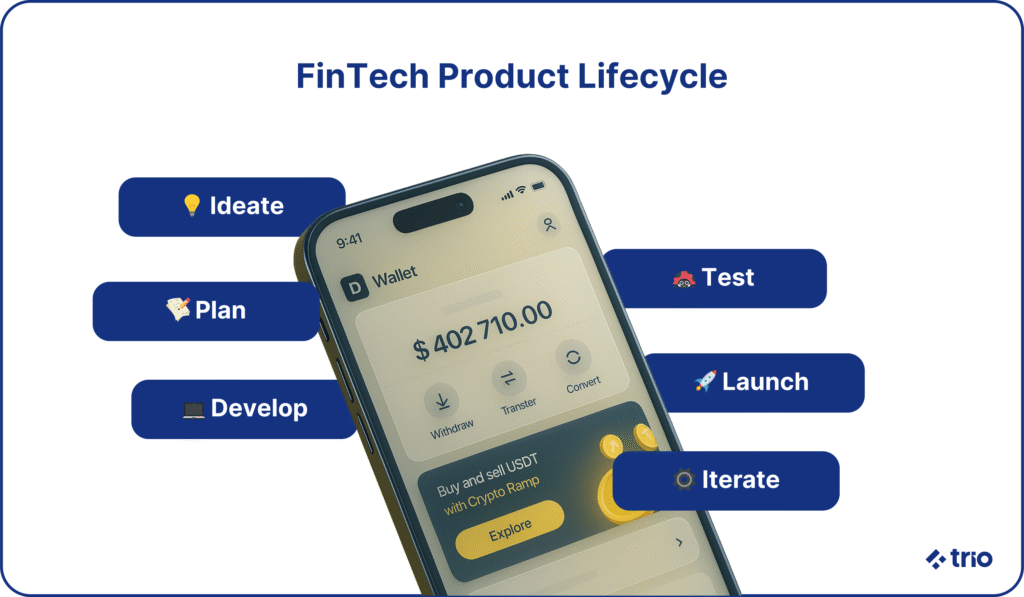
The fintech product lifecycle refers to the entire process of building and running a financial product, from the initial idea through development, market launch, growth, and eventually either continuous reinvention or decline.
If you are in the general tech sectors, you will notice that product development in fintech looks broadly similar on the surface.
What's different for fintech specifically is the amount of regulation woven through every stage.
When you are protecting sensitive financial data, that constraint touches architecture, feature design, and go-to-market timing all at once.
Let’s look at how you can break the entire fintech product lifecycle into five phases, and what each phase entails.
In the first step, you need to identify a genuine gap in the market and build a roadmap around it.
We recommend that your market research covers broad trends and detailed competitive analysis together. Regulatory requirements need attention here too, since building toward a specific market's rules from day one is considerably cheaper than retrofitting for them.
Interviewing prospective customers is a good way to validate the idea and helps get stakeholders genuinely aligned before real money gets spent building it.
Once market feedback confirms real demand, you can start building a minimum viable product covering the core problem.
Tech stack decisions here should prioritize security from the start, even in the most basic version. You also need to consider future scalability. Retrofitting either one later is expensive.
Agile practices (Scrum or Kanban), clear KPIs, and continuous testing, including integration testing across features and penetration testing specifically, matter even at this early stage.
You’ll also need to start keeping records of security and compliance testing. Doing this from the start avoids scrambling to produce evidence later when a partner or regulator asks for it.
Above all, compliance with frameworks like PCI DSS for transactions and GDPR for data privacy is non-negotiable here.
Once the MVP is validated, your focus can shift to a real go-to-market plan, scalability for a growing user base, and structured customer feedback loops.
For a lot of fintech products, growth might not mean something like a consumer app store launch at all. Instead, it could entail a strategic partnership with an existing bank to deliver a new service or modernize a legacy offering.
These partnerships are also popular because they can meaningfully help navigate the regulatory complexity of expanding into new regions.
As your product matures, the focus quickly becomes operational efficiency, continued compliance, security that evolves alongside new threats, and interface improvements driven by real usage data.
We like to utilize automated monitoring tools like Datadog and RegTech platforms like ComplyAdvantage or Alloy. They are useful for keeping pace with both performance and compliance obligations without constant manual oversight.
Every fintech product eventually sees growth slow. Naturally, acquiring new customers gets more expensive.
Watch for increased churn, stagnant engagement, and mounting competitive pressure as early signals.
From there, you have a couple of options. You could consider sunsetting the product, pivoting to a new direction, or pursuing a merger, acquisition, or IPO.
Financial modeling tools like Finmark or Pry help you evaluate pivot feasibility using real signals like churn rate, revenue concentration, and support ticket volume.
Whatever the decision, it’s critical that you keep users informed and get legal guidance on any sunset or merger process.
Managing a fintech product through its full lifecycle takes real cross-functional coordination.
A product development team handles backlog, sprint cycles, prototyping, and user testing.
Compliance experts track regulatory obligations at every step, especially as a product expands into regions with genuinely different rules.
Risk managers specializing in fintech help identify and mitigate technical, operational, and financial risk before it becomes a real incident.
Marketing and growth teams build acquisition strategy and measure ROI.
And underneath all of that, DevOps and technology specialists build the product itself and implement the monitoring that keeps it running, working closely with business intelligence and customer experience teams to turn raw data into decisions worth acting on.
Looking at fintech products that actually lasted reveals a consistent pattern. Most products that perform really well solved one problem well and earned trust before trying to expand.
Two risks show up repeatedly and deserve real attention at the architecture stage.
Most fintech products that are just starting out rely on banking partners, payment processors, or credit bureaus. Each one of these partnerships introduces exposure that has to be actively managed for the life of the product.
A vendor's own business troubles can become your product's problem with very little warning, leaving you scrambling for a replacement mid-operation, sometimes urgently.
Having a genuine contingency plan is worth treating as a first-class architectural decision.
Competitive pressure makes speed tempting, but skipping compliance leads to expensive fines and a loss of user trust.
You need to be breaking regulatory requirements into concrete product work early and using phased rollouts instead of one big-bang launch that has to get everything right at once.
AI now touches most stages of the lifecycle in some form. Personalization, for example, has become a baseline user expectation rather than a differentiator.
Automated underwriting, credit scoring, and fraud detection are standard tools during the growth and maturity phases specifically.
From what we have observed, it looks like AI adoption in financial services is relatively high, with a large majority of executives having a clear implementation plan already in place, concentrated on regulatory compliance, data protection, customer interaction automation, and risk management specifically rather than adopted indiscriminately.
Blockchain continues to support decentralized finance use cases where transparency and data integrity matter directly.
Across all of it, you want to focus on improving trustworthiness and regulatory compliance at each stage.
Sustainability has become part of this picture too. Turkey's Akbank launched a "Sustainable Deposit" product specifically directing commercial deposits toward green initiatives.
Liechtenstein's VP Bank built a similar offering called Sustainable Plus targeting eco-conscious investors directly.
As ESG-linked lending and deposit products grow, this is shaping up to be a genuine product category within the broader lifecycle.
The most reliable way to navigate the entire fintech lifecycle well is by working with developers who genuinely understand financial transactions and have shipped similar products before.
If you hire generalists, they will need to learn fintech's specific failure modes for the first time on your product, leading to mistakes.
Someone with real-world experience can flag a compliance gap or a missing feature before it becomes an expensive problem.
Those are exactly the kinds of developers we offer at Trio. To see if we have the right people for you, request a consult.