

Hire by Technology
SERVICES


Nearshore fintech development generally means that a North American company uses LATAM teams that share US time zones, making real-time collaboration and compliance reviews straightforward.
Offshore, on the other hand, means these same companies use teams in India, Eastern Europe, Africa, or Southeast Asia, often 8 to 12 hours removed.
The primary difference between nearshore vs offshore for fintech, other than the location, is that offshore costs less per hour, but nearshore typically delivers faster iteration cycles and lower coordination overhead for fintech teams managing compliance and active roadmaps.
Both models can work if you take the necessary precautions to minimize overall risk and ensure compliance with financial services regulations.
For most growth-stage US fintechs, nearshore wins on total value. But offshore has a legitimate role.
Nearshore outsourcing, for a US company, means partnering with a software development team in Latin America. Some common examples include Brazil, Argentina, Colombia, Mexico, and Chile.
The timezone difference between the US company and the nearshore developers usually sits between 0 and 3 hours, depending on exactly where they are located, so you can work together in real-time, like you would with a remote worker nearby.
Generally, English proficiency in these regions is also quite high, with Argentina leading all of LATAM in the EF English Proficiency Index.
And because the majority of LATAM financial services providers serve US fintech clients, many have built SOC 2 and PCI DSS alignment directly into their delivery frameworks.
Offshore outsourcing points toward India, the Philippines, Vietnam, Africa, or Eastern Europe. Timezone gaps run from 5 to 12 or more hours, which is great if you need support developers to take the night shift, but it complicates working on the same code.
Since the region we consider to be offshore is larger, there is a bigger talent pool. Hourly rates are also lower in some places.
Related Reading: In-House Development vs Outsourcing
The hourly rate comparison looks like a clear win for offshore if you take the numbers at face value.
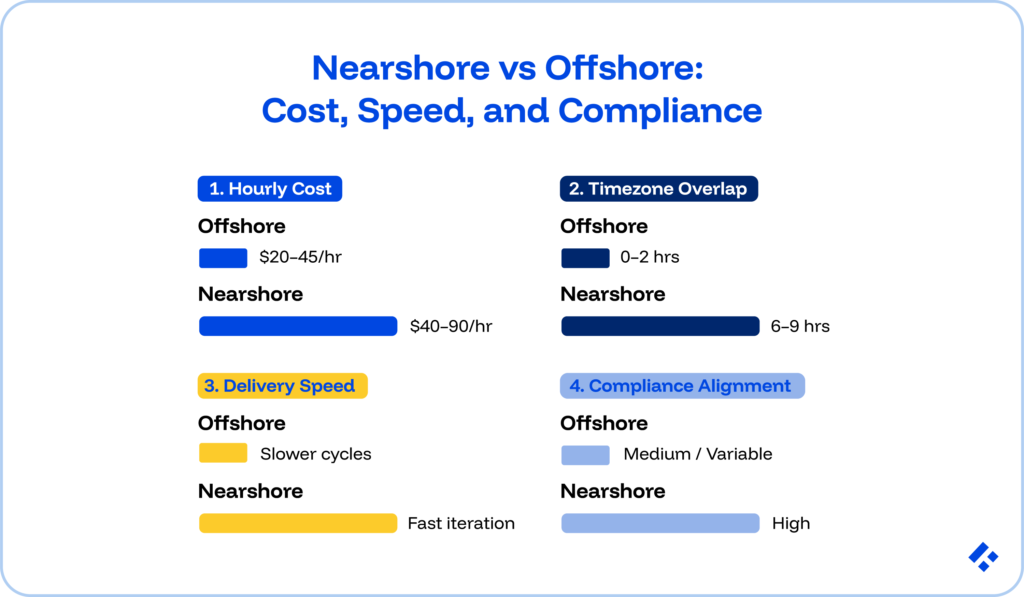
Senior engineers in India run roughly $20 to $45 per hour, with Southeast Asia sitting in a similar range.
LATAM developers, depending on country and seniority, typically come in at $40 to $90 per hour when hired through Trio, while Eastern European developers have been converging upward and now sit at around $45 to $80 per hour.
US-based senior developers still cost $120 to $180 per hour, which is why any offshore or nearshore development approach looks attractive by comparison.
And, if you consider the additional financial implications of office space, and things like benefits, the total savings skyrocket. Offshore can reach 60 to 70% savings, while nearshore savings are often more than $50.
Nearshore teams overlap most of their business day with US teams, so these developers just don’t get stuck and waste time like you might when working with an offshore team. This increased speed is incredibly valuable.
Here is a summary of the cost differences we have already discussed, as well as some other considerations you may not yet have considered.
| Cost Factor | Nearshore (LATAM) | Offshore (India/SE Asia) |
| Senior dev hourly rate | $40–$85/hr | $20–$45/hr |
| Timezone overlap with the US | 6–9 hours | 0–2 hours |
| Avg. sprint feedback delay | Same day | 1–2 day lag |
| Compliance rework risk | Lower (shared standards context) | Higher (different regulatory frameworks) |
| Cost savings vs US rates | ~41% | ~60–70% |
| Time to productivity (onboarding) | 1–2 weeks | 3–6 weeks |
| Travel cost for onsite visit | 3–8-hour flight | 15–24-hour flight |
Generic nearshore vs offshore is simple in terms of compliance and security. But when it comes to fintech teams, compliance is not a separate phase you plan around. It sits inside every sprint, every PR review, every deployment decision, and every line of code that is written.
Fintech products operate under PCI DSS, SOC 2, KYC/AML, GDPR (for any EU-facing functionality), and a growing patchwork of state-level US regulations.
The engineering work required to meet those standards needs to be done by people who understand what they mean in practice and who are able to keep up with any shifts that occur.
Offshore teams in India and Southeast Asia may have limited direct exposure to US regulatory standards unless the firm specifically serves US fintech clients. That does not make them incapable, but it does require more from the hiring company in terms of due diligence.
LATAM providers have historically had the majority of their revenue come from US fintech clients, and many have built SOC 2-ready practices, secure coding standards, and compliance documentation habits directly into how they deliver.
But that alignment is not universal, and it still needs to be verified.
There is also the audit documentation risk to consider.
Fintech teams need traceable, well-documented codebases for SOC 2 audits and PCI DSS assessments.
Offshore teams operating asynchronously can create documentation gaps that surface during an audit cycle.
For fintechs with US-only compliance requirements, nearshore LATAM generally presents fewer data handling complications than offshore in countries with meaningfully different privacy regimes.
Related Reading: Fintech Recruiting Agency Alternatives
Before hiring either nearshore or offshore partners, there are several questions you need to ask.
Fintech roadmaps rarely stay stable for long. Regulatory changes, fraud patterns, investor requirements, and product pivots mean requirements shift mid-sprint more often than any project plan anticipates.
Agile methodology depends on fast feedback loops, like the kind that can only be achieved through stand-ups, sprint reviews, and real-time unblocking.
That structure does not always work under async pressure.
With a 10-hour offshore gap, your India-based team codes while your product team sleeps. A blocking question surfaced in your evening can sit for a full day. A couple of issues can add up quickly.
Nearshore teams join your stand-up live. A question raised during planning gets answered in minutes. For compliance-sensitive flows like KYC onboarding or payment reconciliation, the real-time loop functions as a risk management mechanism.
Related Reading: Contract Developers vs Full-Time Engineers
Offshore development does not fail across the board. There are a couple of scenarios where offshore models work very well, such as when:
Some people still think that LATAM developers are less technically capable than US developers. There is no evidence of this.
The HackerRank 2023 Developer Skills Report showed LATAM overindexing in developer hiring trends at a time when North America and APAC were underindexing.
Many LATAM engineers hold advanced degrees from top-tier universities and have direct hands-on experience with the US fintech stack, like Stripe, Plaid, FIS, and Temenos integrations.
The difference between LATAM and Indian developer quality is not necessarily skill, either. Strong engineers exist in both regions. The question is which pool will work for you.
LATAM does carry a specific fintech advantage when you consider cultural alignment with US business practices, English technical fluency sufficient for architecture discussions and code reviews, and direct exposure to US regulatory environments.
There are a couple of steps you need to take if you are evaluating a vendor. We have already mentioned a couple of compliance questions, which you still need to consider, but these additional steps are essential to mitigate risks.
For nearshore specifically, also ask about the team's familiarity with the regulatory frameworks relevant to your product. A vendor who has never delivered a SOC 2-scoped engagement will require more hand-holding than your roadmap probably accommodates.
We have already covered the basics of when to choose nearshore vs offshore for fintech or general financial services. But here is an easy-to-follow matrix for simple decision-making.
Choose nearshore (LATAM) when:
Choose offshore when:
Both nearshoring and offshoring are great options. You need to think about what your team actually needs.
Trio places pre-vetted, compliance-ready fintech engineering services candidates from LATAM in 3 to 5 days. If you need to hire developers or need assistance with choosing the right hiring model for you, book a decision call.
The core difference between nearshore and offshore development for fintech in the United States is that nearshore developers in LATAM share 6 to 9 hours of overlap with US business hours, while offshore teams in India or Southeast Asia typically share 0 to 2 hours.
Offshore development is typically cheaper upfront, with senior engineers in India typically running $20 to $45/hr versus $40 to $90/hr for nearshore LATAM. For fintech teams running active sprints, however, the total delivery cost of nearshore development is usually more cost-effective.
Timezone gaps affect fintech outsourcing by turning small roadblocks into costly delays. Depending on the severity of the timezone difference, even simple questions could take a whole day to answer, which can add up over time.
Offshore developers can handle PCI DSS and SOC 2 requirements if they have direct prior experience with US-regulated fintech clients, but you need to verify that experience.