

Hire by Technology
SERVICES


AI adoption in financial services has moved past the experimental stage at this point.
As much as 80% of financial firms are using it in some way at this point. But we’ve noticed that only a small share of institutions describe their AI deployment as genuinely transformational.
That means that, while adoption is broad, transformation is still rare.
Let's look at everything you need to know about AI's true impact on Fintech, so you can prepare for any potential challenges and identify opportunities for you to utilize the new tools available to you to push your product ahead of the competition.
At Trio, our expert fintech developers can help you integrate and create new AI tools effectively, so you can reap the most benefits possible, without creating regulatory issues down the road.
The clearest, most current picture comes from the Cambridge Centre for Alternative Finance's 2026 Global AI in Financial Services Report.
This report was extensive, covering 628 institutions across 151 jurisdictions.
It found 81% of financial services firms adopting AI at some level, with 40% reaching advanced stages of adoption ("scaling" or "transforming").
The problem is that only about 14% of institutions in the Cambridge survey see their AI deployment as transformational to strategy and competitive advantage, indicating that there is a real execution gap.
We have seen firsthand how most institutions have adopted AI somewhere in their operations, but relatively few have gotten to the point where it's reshaping how the business competes.
Fintechs are pulling ahead of traditional institutions on this specific measure since they are dealing with less legacy code, which makes it easier to move past pilot projects into deployment.
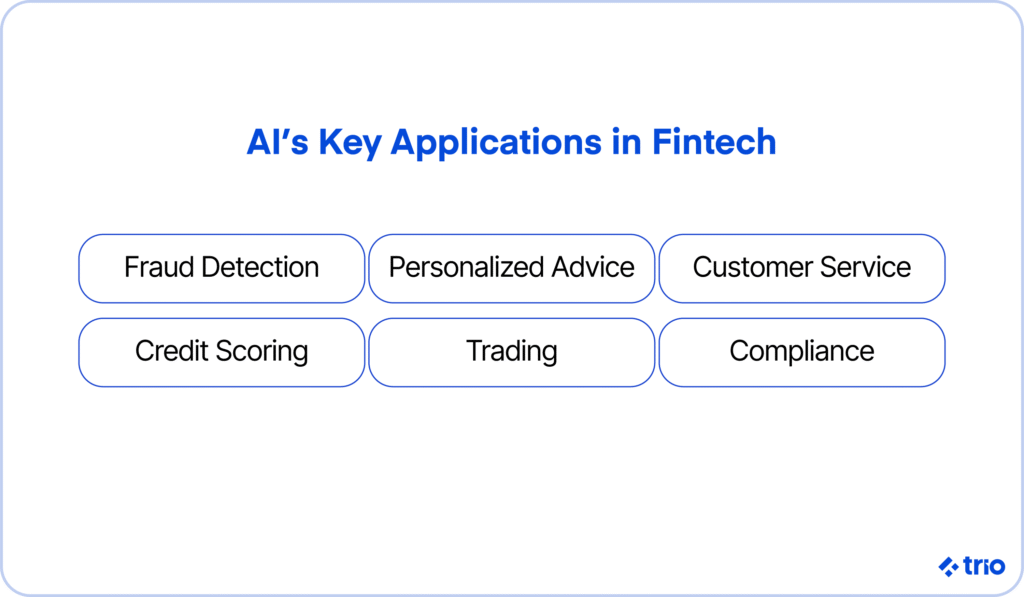
One of the biggest issues in fintech specifically is being able to explain the decisions made by AI models to auditors, and to ensure that they are fair.
Complex models remain genuinely difficult to fully interpret, and as these models are being used more frequently, financial institutions increasingly need to explain credit, fraud, and risk decisions to both regulators and the customers affected by them.
A model that performs well but can't produce a defensible explanation for a specific decision creates real regulatory exposure.
This is part of why the adoption-versus-transformation gap persists.
At this point, there is no way for us to deny that AI has had a massive impact on fintech, but it also isn’t everything.
Measurable gains exist in specific, well-scoped applications, like fraud detection especially. In these areas, we’re seeing massive adoption.
But the gap between adoption and transformation is real.
If your team is building AI into a fintech product, you need to look deeper into claims instead of just taking them at face value.
For AI to transform your competitive position, you need the same domain-specific judgment that fintech development requires, including knowing which decisions carry regulatory weight and which ones a black-box model can't safely make.
Our AI developers at Trio specialize in fintech and can help you make the right decision for your project.