Fintech teams are usually strong when it comes to building features. Where things often wobble is the emotional side of the relationship.
Your users trust you with their money, so even a small mistake in your fintech customer service workflow can create fear.
You have probably seen it yourself. A slow response time during account verification. A fraud alert that feels too vague. A chatbot that cannot understand a basic question.
Little issues like these may increase customer churn faster than any competitor can.
Fintech companies also operate in a landscape where rising customer expectations are reshaping customer support every year. Someone always promises faster onboarding or a smoother banking flow.
If your customer journey feels uneven, a more polished competitor is only one search away.
The good news is that a thoughtful service model, a consistent human touch, and smart AI-powered assistance can help fintech companies give customers a positive customer experience without overwhelming the support team.
At Trio, we see this often. A little clarity and better engineering may completely change how customers feel when using your services. That’s why we take pride in the expertise of our developers, which allows them to provide the best possible fintech development.
What Customer Experience Means in Fintech
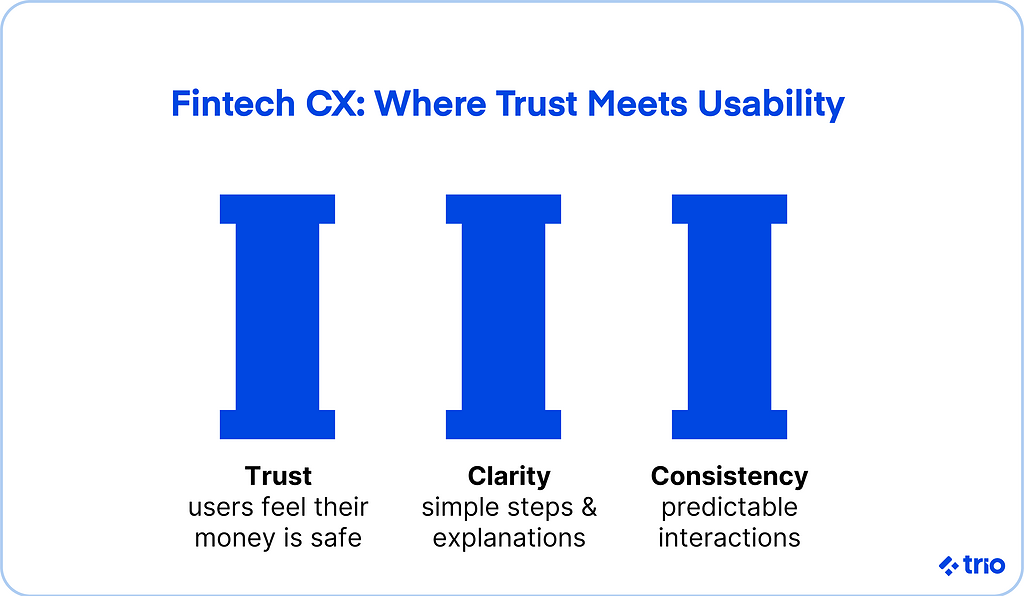
Customer experience in fintech is a mix of emotions, trust signals, and functionality.
Your user experience must do more than move money. It needs to show users that their information is safe and that your financial service is dependable every time they open the app.
Even simple customer interactions can shape the complete customer relationship. A smoother login. A friendlier explanation of a required document. A short in-app note telling users what to expect next.
These moments form the foundation of customer loyalty and customer satisfaction.
Defining Fintech Customer Experience
Fintech customer experience may look similar to CX in other industries on the surface, but the stakes are high.
People do not want to guess. They want a predictable, straightforward process with excellent customer service and clear language.
The best fintech brands appear calm and competent.
They explain why identity checks matter. They keep instructions light and keep friction low. Most importantly, they make customers feel safe while still moving fast.
Why CX Matters More in Fintech Than Anywhere Else
A glitch in a shopping app is mildly annoying. A glitch during a transfer feels like money is at risk.
That emotional difference is what makes customer experience fintech such a sensitive category.
When you operate in the fintech industry, any moment of confusion becomes a moment where trust can slip. Poor customer guidance or vague error messages create doubt quickly.
A strong fintech customer experience reduces these fears by offering transparency and support during critical steps.
Mapping the Fintech Customer Journey
A complete customer journey is not linear. Users move between excitement, confusion, urgency, and relief. The fintech support teams that we have worked with see this daily, and each stage of the customer journey needs different support.
Awareness, onboarding, daily use, issue resolution, and long-term advocacy all have their own risks.
Onboarding usually carries the heaviest drop-off rate. Issue resolution tends to have the strongest emotional weight.
When you understand these stages, you can personalize customer messaging, reduce churn, and provide customers with a smoother experience across the customer journey. It may also increase customer lifetime value without major product changes.
Designing High-Touch Customer Support Systems for Fintech Companies
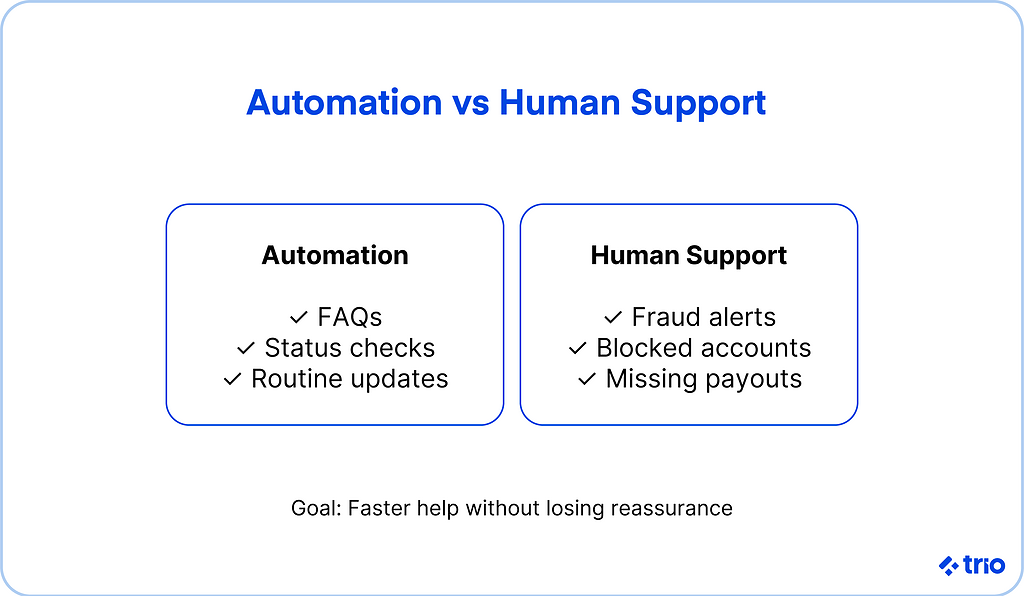
High-touch customer support is about understanding when a customer needs reassurance and when automation is enough.
You combine personalized support with AI-powered workflows to keep service quality steady while still giving users a human touch during sensitive moments.
This balance helps fintech companies maintain high customer satisfaction even when volume grows.
Building Trust at Every Touchpoint
You build trust by giving clear expectations.
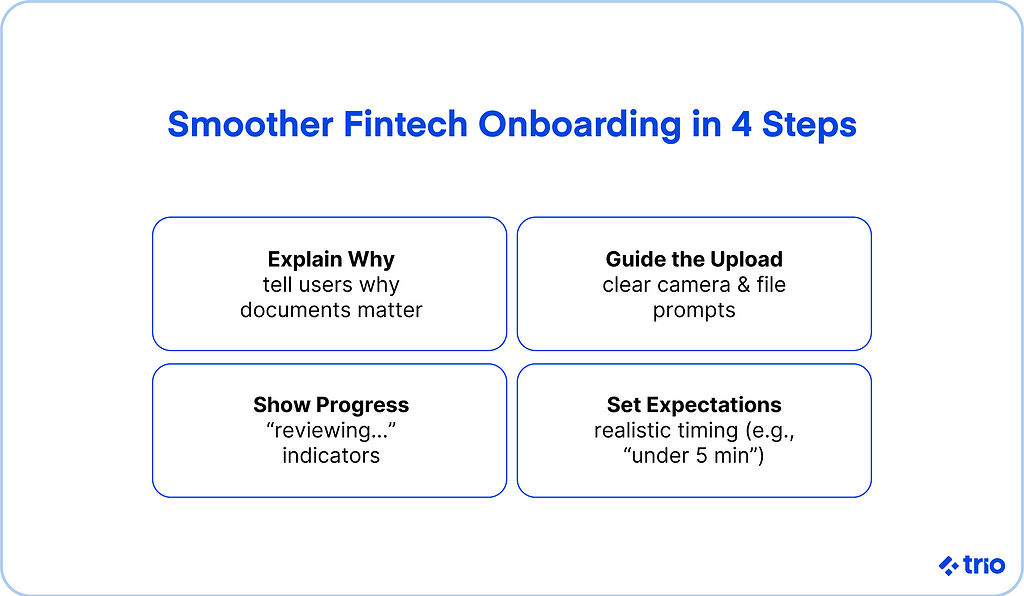
Users want to see progress bars, simple copy, and helpful nudges. They want to understand why a step matters. These cues help users settle into the process instead of fighting it.
Trust also grows through consistency. If every interaction feels predictable, customers relax and stay engaged.
Human Backed Reassurance in High Risk Interactions
Fraud alerts, blocked accounts, missing payouts, and unfamiliar logins are moments when automation may not feel comforting. A quick escalation to a human agent can make customers feel understood.
Many fintech users expect a calm voice or a clear message during stressful situations.
Human support reassures them that their money is not lost. Even small human interventions can resolve customer queries faster than automated loops.
Personalized Support at Scale
Personalized service matters more in fintech because financial habits differ widely. A freelancer managing weekly payouts wants different guidance than a crypto trader or a retiree.
Analytics help fintech teams segment users and adjust explanations, timing, and channel preferences based on customer behavior.
When personalization is done well, customers feel that the product is built for them instead of a generic user base.
Best Practices for Exceptional Customer Service in Fintech
Exceptional customer service in fintech comes from clear language, quick resolutions, and predictable workflows.
Best practices vary, but they usually focus on simplicity and removing friction.
Shorter forms, automated document scanning, and proactive alerts help prevent customer inquiries before they even appear.
A strong feedback loop also helps fintech companies improve faster. When you collect customer feedback regularly, you see patterns your team may overlook.
These improvements help fintech companies avoid poor customer outcomes and create excellent customer service without scaling the support team endlessly.
AI and Automation for Fintech Customer Support
AI is becoming a core part of fintech customer service. It is not meant to replace humans. Instead, it helps fintech companies streamline repetitive tasks, shorten response time, and support human agents during complex interactions.
AI can be helpful, but it needs thoughtful implementation. Overuse may frustrate users. Underuse may overwhelm support teams.
How AI Is Transforming Fintech Customer Experience
AI-powered chatbots can answer common questions, check balances, guide users through verification steps, and help fintech users get immediate answers.
They make it easier to resolve customer queries instantly, especially during high-volume periods.
This kind of automation is often the first step in reshaping customer support across the fintech landscape.
Intelligent Ticket Routing and Fraud Aware Support
Machine learning can flag risky behavior, identify urgent customer needs, and route cases to the right human agent.
This creates a more complete customer view and reduces the chance of missing something serious.
Fintech support teams benefit because they spend more time solving real problems instead of triaging tickets manually.
Real Time Personalization Powered by AI
AI may also help personalize customer interactions. Nudges, reminders, and tailored insights help users stay informed. It is a small touch, but it can increase customer engagement and improve the overall customer experience.
Fintech companies that use personalization lightly and respectfully tend to build lasting customer trust.
Automating Operational Support Without Losing the Human Touch
Document extraction, identity checks, and rule-based workflows are easy to automate. This frees the support team to handle sensitive conversations that require empathy.
When done well, automation gives customers a seamless experience without removing the human touch they expect during stressful moments.
Streamlining Fintech Onboarding for Higher Conversions
Onboarding shapes the early experience in fintech. It often decides whether a user stays or leaves.
Slow verification, unclear messaging, or extra steps may cause churn before the customer even explores the product.
Clearer guidance and better UX often reduce friction more than big feature launches.
Why Onboarding Determines Customer Lifetime Value
A strong onboarding flow sets the tone for the entire relationship. Users judge the experience based on how smooth or clunky their first interactions feel.
Fintech companies that get onboarding right tend to increase customer acquisition and customer retention at the same time.
Eliminating Common Drop-Off Points in Fintech Onboarding
Document uploads, identity checks, and unclear steps often cause frustration. Users may not say anything. They just leave.
A small explanation (like why a document is needed or how long a review usually takes) helps fintech companies prevent unnecessary churn.
UX Tactics to Streamline KYC and Improve Completion Rates
Progressive disclosure, gentle microcopy, and better camera prompts help users get through KYC without second-guessing the process. It may seem minor, yet even tiny improvements can increase completion rates.
Good user experience in fintech is often simple ideas executed consistently.
Support Models and Communication Infrastructure for Fintech Customer Service
Your service model influences how customers feel every time they reach out. A thoughtful structure helps fintech support teams respond quickly while keeping service quality stable.
Choosing channels and workflows that match customer needs can reduce friction across the customer journey.
Implementing an Effective Service Model for Fintech Companies
A hybrid approach is usually the most practical.
Some tasks are fine for outsourcing. More sensitive issues stay in-house.
A clear structure prevents delays and helps the support team focus on the most important customer interactions.
Choosing the Right Channels for Fintech Customer Support
Live chat works well for quick questions. Email can handle more detailed customer inquiries. WhatsApp is familiar to many users. In-app messages reduce context switching.
Offering a mix lets customers pick the channel they trust most.
Support During Critical Moments and Outages
Incidents happen to every fintech company. What matters is how you communicate. Even brief updates help customers feel informed instead of abandoned.
Honesty, short messages, and visible progress calm customers during stressful events. Transparency becomes a key part of the overall customer experience.
Future Trends Shaping Fintech Customer Experience
The fintech landscape is moving toward personalization, tighter security, and deeper automation. Customer expectations keep rising, and many teams are reshaping customer support to match them.
You may see more voice-based banking, simpler onboarding, and smarter AI-powered personalization in the coming years.
Even with all this change, one thing remains constant. Fintech users want clarity and trust.
More Personalization Across the Customer Journey
AI helps fintech companies personalize customer messaging and tailor recommendations. This makes onboarding, payments, and support feel more responsive.
Users appreciate feeling understood without being overwhelmed.
AI-Driven Automation and Smarter Support Workflows
Automation will likely become more connected to real-time analytics. Fintech customer service may predict needs based on customer information instead of just reacting.
Support teams will spend more time solving meaningful problems instead of repeating steps.
Compliance First UX and Invisible Fintech Experiences
Regulations keep increasing. Good UX must now blend compliance with simplicity. This is one area where powerful fintech engineering helps a lot.
Invisible UX is also becoming more common. Users complete tasks without noticing the complexity behind the scenes.
Conclusion
Fintech customer experience matters because every interaction shapes trust. When customers feel understood and supported, they stay longer and use your services with confidence.
A mix of AI-powered automation, thoughtful UX, and real human support helps fintech companies improve customer satisfaction without overwhelming their teams.
Better customer engagement creates better outcomes, and a simpler service model makes it easier to resolve customer queries quickly.
If you want guidance in building a more stable or scalable system, Trio can help fintech companies create a smoother customer experience from onboarding to long-term retention.
If you require support from an engineering team that understands the fintech industry, please don’t hesitate to contact us.
FAQs
What is fintech customer experience?
Fintech customer experience is the complete emotional and functional journey a user has with your product, covering onboarding, daily use, support, and trust.
Why does customer support matter so much in fintech?
Customer support matters so much in fintech because people need reassurance when money is involved, and even small delays can create anxiety or churn.
How do you design high-touch support systems for fintech?
You design high-touch support systems for fintech by mixing clear communication, fast escalation paths, and automation that supports humans instead of replacing them.
What role does AI play in fintech customer service?
AI in fintech customer service handles repetitive tasks, speeds up routing, and provides real-time help while keeping human agents available for sensitive issues.
How can fintech companies reduce onboarding friction?
Fintech companies reduce onboarding friction by simplifying ID steps, explaining requirements clearly, and using small UX cues that guide users through KYC smoothly.
What channels work best for fintech customer support?
The channels that work best for fintech customer support are usually in-app chat, email, and WhatsApp, since users prefer quick, familiar ways to reach help.