

If you’re building or scaling a fintech product, you already know that hiring fintech developers takes longer than hiring almost any other type of software engineer.
The gap between what a typical developer knows and what a fintech developer must understand is wide enough that even strong engineers can struggle to find their footing.
That lag becomes expensive fast, especially when your roadmap depends on features tied to risk, payments, security, compliance, or real-time transactions.
Plenty of companies try to speed things up by casting a wider net. They jump into job boards, ping recruiters, or experiment with freelance platforms. Some get lucky. Most don’t.
The delays show up in onboarding, product quality, audit readiness, and the confidence of the leadership team itself.
And because fintech rarely gives you the luxury of learning in a low-risk environment, the cost of guessing is far higher than in other industries.
If you’re looking for the fastest way to hire engineers for fintech without sacrificing quality or compliance, you’re in the right place.
Whether your roadmap slipped after a key engineer left, a new enterprise deal just changed your timeline, or a compliance deadline is now three months away, we’ll walk you through how hiring actually works today.
We will also look at what slows teams down, and what your options look like if you want talent that fits everything a fintech developer must bring to the table.
Key Takeaways
The fastest way to hire engineers for fintech is to look for people who already have all the right skills, so you have to do as little training as possible.
A specialized fintech partner like Trio can connect you with the right people in less than a week, minimizing time to hire even further.
The Fastest Way to Hire Fintech Developers
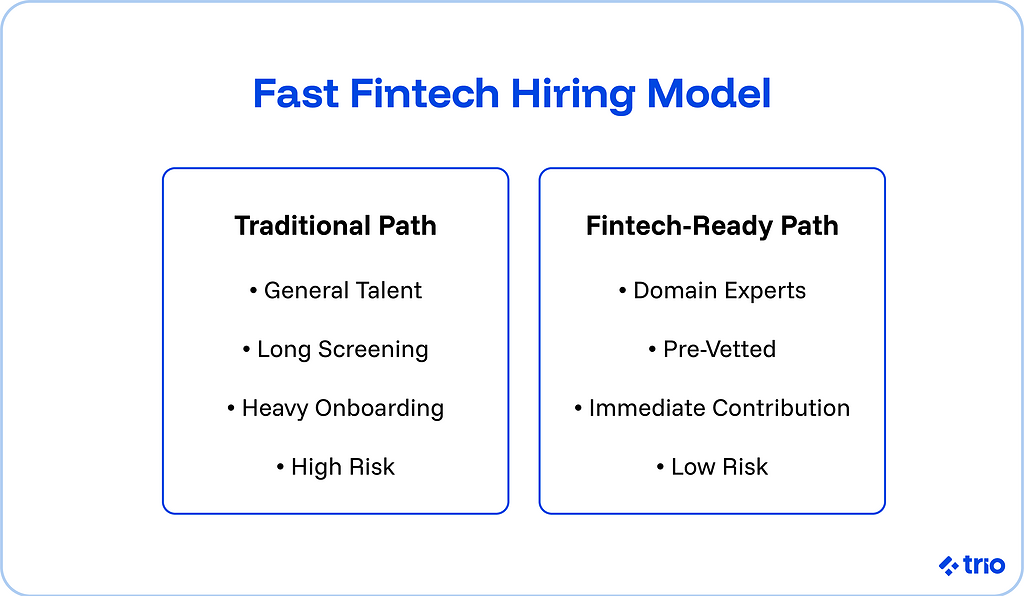
Speed matters, but not in a vacuum. The fastest way to hire fintech engineers is to avoid training people on the job and instead bring on fintech developers who already understand the landscape.
This means:
- candidates who know how fintech systems interact
- developers with experience in blockchain or payments, when needed
- people who understand risk mitigation, fraud detection, and real-time transactions
- engineers who can integrate quickly into your workflow
- specialists who understand how to build secure systems in regulated industries
When you hire fintech software developers with this level of expertise, onboarding shrinks dramatically. You also sidestep the hidden cost of tech debt that accumulates when developers learn fintech on your dime.
You skip weeks of conceptual training. You avoid explaining what an audit trail looks like or why a ledger entry must remain immutable. Instead, your new engineers start contributing from day one.
There’s also a significant quality advantage.
Developers with experience in fintech make fewer mistakes when dealing with sensitive operations.
They understand how to prevent compliance issues before they happen. They avoid shortcuts that could break regulatory alignment or cause a payment failure that damages user trust.
The fastest hiring method is ultimately the one that brings you people who know the domain so well that onboarding becomes almost frictionless.
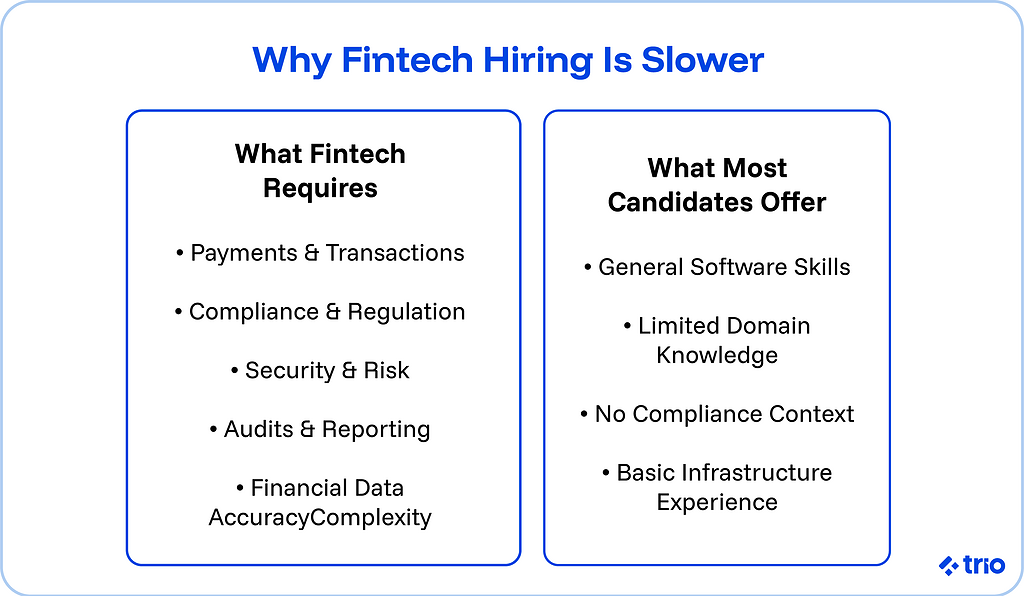
Why Hiring Fintech Engineers Takes So Long
When teams talk about hiring fintech developers, they tend to mean developers who understand financial software in a practical sense. Not just one-off integrations, but the foundations that make fintech engineering so demanding.
That includes things like:
• Handling real-time money movement
• Navigating regulatory compliance and gdpr constraints
• Building secure infrastructure for sensitive financial data
• Collaborating with product teams that must audit every workflow
• Integrating with payment systems or digital wallet features
• Supporting fraud detection logic and identity verification
A typical software developer may need several weeks of onboarding just to get familiar with the risk posture of a fintech app.
And that’s before they tackle the deeper work that deals with transactional accuracy, regulatory compliance requirements, and the complexities of financial data flows.
There’s also a talent shortage.
In 2025, the World Economic Forum’s Future Jobs Report ranked fintech engineers as the second-fastest-growing profession, but the fintech industry has grown faster than the supply of engineers who understand how financial systems actually behave at scale.
More companies want fintech developers for hire than the market can currently supply, which means qualified talent has many options and little incentive to move quickly through traditional interview pipelines.
A final reason hiring fintech engineers is slow is that many teams start with generalist hiring channels.
These channels aren’t built to assess fintech expertise. Instead, they surface candidates who check standard technical boxes even though they might lack experience in fintech systems, payment gateways, audits, or risk-sensitive environments.
The result is an interviewing loop that is largely unsuccessful most of the time and frustrates both potential employers and your existing team.
What You Actually Need When You Hire a Fintech Developer
If you peel away the job descriptions and recruiter templates, what you really want is someone who can contribute quickly without absorbing weeks of institutional knowledge before they become useful.
You want a fintech developer who understands financial software at both a code level and a business level.
Here’s what tends to matter most:
1. Practical fintech experience
A developer with experience in fintech has likely built or maintained systems that move actual money.
They’ve seen the failure modes that don’t show up in textbooks and are familiar with the industry and the latest best practices. They know how a small mistake can cascade across ledgers, accounts, or data pipelines.
2. Awareness of audits and compliance workflows
Developers don’t need to be compliance officers, but they should know why a system must remain compliant, how audit trails are generated, how to design features with regulatory compliance in mind, and what the industry standards in terms of RegTech and similar software usage are.
That awareness protects you from silent technical debt, or big mistakes that only show up once your product is live, resulting in major repercussions like fines and even losing your reputation.
3. Ability to integrate into a development team quickly
You don’t have time for an engineer who needs months of onboarding.
You want someone who can integrate into your workflow, understand your tech stack, and collaborate with product and risk teams without constant babysitting.
Some learning curve is to be expected as they familiarize themselves with your software. But you don’t want to teach from the ground up.
4. Understanding of fintech infrastructure
Fintech apps are rarely simple.
They may include internal services written in different languages, multiple APIs for payments and identity verification, a risk engine, a ledger, and orchestrated workflows to manage compliance.
Developers must navigate this environment with confidence, which they can only really do if they have worked in similar environments before.
5. Awareness of user trust
Fintech products are held to a higher standard. Even minor errors can shake user trust, attract regulatory scrutiny, or interrupt payment flows.
A fintech developer with real-world experience feels that pressure and treats stability as part of the craft.
When you look at this list, it becomes obvious why simply hiring a software developer isn’t always enough.
You need someone who brings fintech expertise, not just coding experience.
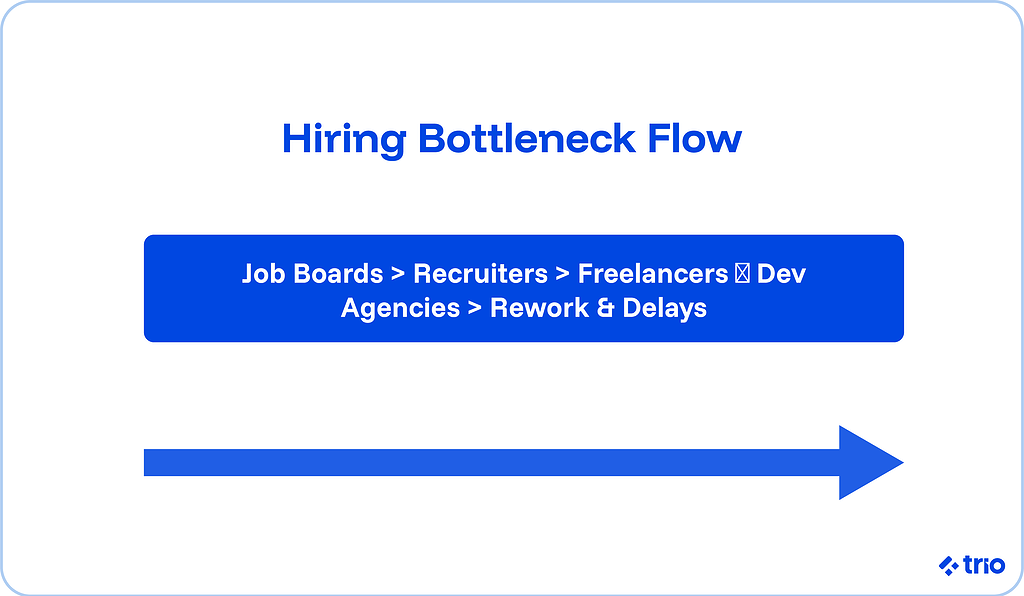
The Hiring Channels Most Teams Try First (and Where They Slow Down)
Teams have a handful of common options when they want to find and hire fintech developers.
Each one has tradeoffs in speed, cost, consistency, and onboarding effort.
Job Boards
Job boards attract quantity, not specificity. You’ll get applications, but most applicants will be generalists hoping to pivot into fintech.
There’s nothing wrong with that, but you’re the one who absorbs the onboarding risk.
You spend weeks sifting resumes and interviewing people who look good on paper but haven’t dealt with real-world financial software.
Freelance Marketplaces
Freelance fintech developers exist, but the search is unpredictable.
You may find someone skilled, but short-term freelancers often lack the context your fintech app needs.
And because many are part-time or juggling other gigs, long-term stability becomes uncertain.
Teams also struggle to manage time zone differences, onboarding complexity, and continuity across sprints.
Related Reading: How to Hire Developers Without Recruiters
Traditional Software Development Companies
Many software development companies are excellent at general engineering, but fintech is a different environment.
Without direct experience with compliance-heavy systems, even a seasoned team may need a long ramp-up period.
That slows you down during the exact moments when you want to accelerate your fintech build.
Dedicated Development Teams
Dedicated development teams can work well if they’re built around fintech. If not, you’re effectively paying for training.
A dedicated team without fintech knowledge may be competent in code yet unfamiliar with the nuances of payments, settlements, ledger accuracy, or regulatory compliance.
That mismatch shows up early in planning sessions and grows larger over time.
Across all these paths, the biggest slowdown happens when engineers require weeks or months to understand the business domain.
You’re not just hiring someone who can code. You’re hiring someone who must navigate a regulated environment with accuracy, consistency, and a clear understanding of how financial systems behave.
How Specialized Fintech Partners Speed Up the Hiring Process
This is where domain-specific partners become useful. Instead of sourcing generalists and hoping they can adapt, some companies offer access to engineers who have already been vetted for fintech expertise.
One example is Trio, which focuses exclusively on fintech-ready engineers who understand compliance, risk, identity, lending, payments, and financial data flows.
Our engineers are evaluated for their ability to integrate quickly into regulated environments and support teams through auditing, scaling, and shipping sensitive product features.
Because the talent pool is already filtered for fintech experience, the time it takes to find a match is dramatically shorter.
You speak with engineers who already know the basics of financial software development and can navigate your fintech platform without extended hand-holding.
When your team is under pressure, this difference can shift your entire roadmap.
Related Reading: Hiring Fintech Developers: Roles, Skills, and Where to Find Them
What the Hiring Process Feels Like When It’s Actually Fast
You may be used to hiring cycles that stretch across several weeks or months.
Teams search for candidates, interview endlessly, negotiate, and then wait out notice periods. But when you work with fintech specialists, hiring feels noticeably smoother.
Here’s what that experience usually looks like:
1. You define your business goals clearly
Rather than producing a long job description, you explain the systems you’re building, the tech stack, and the regulatory environment.
The partner translates that into developer criteria.
2. You review a very short list of candidates
Instead of sifting through hundreds of resumes, you evaluate one or two fintech developers who match your needs precisely.
Their previous work already lives within fintech, so the interview feels like a peer-to-peer discussion rather than a screening session.
3. Integration happens quickly
Your new engineer joins your workflow without friction.
The developers understand what a fintech audit requires.
They’re familiar with the constraints around GDPR or regulatory compliance, and they can parse payment data or evaluate an API integration with realistic expectations.
4. You adjust capacity without drama
In fintech, things shift quickly.
Priorities change when regulations shift or when you secure a new enterprise customer.
A flexible model that allows scaling your development team without hiring delays becomes a significant advantage.
Trio is one of the few companies built around this idea, offering fintech engineers who are screened specifically for domain knowledge and who integrate smoothly into existing teams.
You get fintech specialists, not generic contractors.
Understanding the Cost to Hire Fintech Developers
Costs vary considerably based on experience level, tech stack, region, and the complexity of your fintech product.
Teams sometimes fixate on hourly rates or salaries, but the higher cost often comes from delays.
A few examples:
- Missing a release window because a feature requiring payment system integration takes twice as long
- Discovering compliance gaps late in the build because developers lacked expertise
- Rewriting features that were designed without an understanding of financial workflows
- Burning budget on onboarding instead of real progress
A fintech engineer who can hit the ground running may appear more expensive at first glance, but they typically reduce your overall risk, compress timelines, and eliminate the need for repeated rework.
When you think about the cost to hire, consider the value of hiring speed and domain fit, not just the rate itself.
How to Choose the Best Fintech Developers for Your Project
Choosing the best fit goes beyond technical skills. Developers must understand the environment in which your fintech app operates.
They should recognize the tensions between speed, compliance, and user trust. They should be able to collaborate with risk, product, legal, and engineering teams without overwhelming your workflow.
Here are some questions that help filter candidates effectively:
- Can they describe real-world financial software they’ve built or maintained?
- Do they understand how to keep systems compliant?
- Have they worked with APIs related to payments, identity verification, or digital wallets?
- Can they talk through a moment when they prevented a compliance or security issue?
- Do they understand how financial data flows through your type of fintech platform?
- Can they adapt to your time zone or communication style?
You’re trying to hire the right fintech developer who aligns with your business goals and understands what makes your system unique.
The most successful teams often look for developers with experience in fintech because they reduce uncertainty.
They also help you make informed decisions during planning, since they’ve already navigated the kinds of problems you’re likely to face.
Why Fintech Expertise Shapes Success More Than Speed Alone
Speed matters, but what really determines the success of your fintech product is expertise.
Every fintech system, regardless of its niche, balances risk, compliance, user trust, and operational accuracy. You want engineers who understand why certain requirements exist instead of treating them as arbitrary constraints.
Fintech experts contribute more than code. They influence architecture decisions, help identify regulatory risks early, and support the long-term stability of your fintech platform.
They understand how to build secure systems that withstand audits and scale with increasing transaction volume.
This is why hiring fintech engineers is not only about timing but also about quality.
When you hire fintech developers with a relevant background, you compress onboarding, protect your roadmap, and reduce the hidden risks that can derail your fintech success.
Final Thoughts
The fastest way to hire engineers for fintech is to bypass the slow, unpredictable talent funnels and bring on specialists who already understand how fintech works.
Hiring fintech developers with real-world experience in financial software development gives you momentum from the moment they join your team.
You gain engineers who understand audits, compliance, payments, risk, and the technical and business context your app depends on.
If you want to accelerate your fintech roadmap, build secure systems, and reduce onboarding time, book a discovery call.
FAQ
How do I hire fintech developers quickly?
Hiring fintech developers quickly means finding specialists who already understand financial software. Doing this means you avoid long onboarding and let them contribute right away.
What skills should a fintech developer have?
The skills a fintech developer should have usually include experience with compliance, financial data flows, secure systems, and real-time payment or identity workflows. On top of those niche-specific skills, they need to be able to code accurately and communicate well with a team as well as management.
Why is hiring fintech engineers so slow?
Hiring fintech engineers is slow because most developers lack fintech domain experience, so teams spend weeks filtering generalists who need heavy onboarding, or they need to train people for months before they can meaningfully contribute.
What’s the fastest way to vet fintech engineers?
The fastest way to vet fintech engineers is to screen for real fintech experience rather than general coding ability, focusing on compliance awareness and financial systems. A portfolio that can be explained is a great start.
Are freelance fintech developers a good option?
Freelance fintech developers can work in some cases, but their availability and depth of financial software experience often vary more than those of full-time specialists. This means they will take time to learn your software, without you being able to capitalize on that lost time.
How much does it cost to hire fintech developers?
The cost to hire fintech developers depends on experience, tech stack, and region, though delays from poor hiring fits often cost teams far more. At Trio, our fintech developers range from about $50-$90 per hour, depending on these factors.
Do fintech developers need compliance knowledge?
Compliance knowledge is essential for fintech developers because financial systems must remain secure, auditable, and aligned with regulations that may differ from region to region.
Can general software developers adapt to fintech?
General software developers can adapt to fintech over time, but most require weeks of onboarding due to unfamiliarity with risk, audits, and sensitive workflows. They are also far more likely to make mistakes and overlook things senior fintech developers would not have missed.
What’s the biggest mistake teams make when hiring fintech engineers?
The biggest mistake teams make is assuming technical skill alone is enough, which often leads to compliance issues and delays. Developers need real experience with up-to-date industry standards and regulations.
How do I know a fintech developer is the right fit?
Knowing a fintech developer is the right fit comes from seeing real-world fintech experience, clear communication, and the ability to integrate smoothly into your team. Working with a team like Trio, which custom-places developers based on experience, can help ensure success.