

The Federal Reserve’s FedNow Service is a 24/7/365 instant payment system. It marks one of the biggest shifts in how money moves across the U.S. payment network.
Banks, fintechs, and other financial institutions are now adjusting to the new standard of instant payment delivery, which requires them to have services available at all times.
If you work in payments or financial services, the question isn’t whether to adopt real-time payments, but how to do it intelligently.
Fintech software development has always been a challenge, thanks to regulatory and security pressures. Having experts on your team can be incredibly beneficial.
Key Takeaways
- Becoming a FedNow certified service provider, or integrating through one, requires passing a formal testing and certification process.
- FedNow lets eligible depository institutions send and receive payments in seconds, around the clock, with recipients gaining immediate access to funds.
- Unlike the RTP network, which launched in 2017 but remained largely limited to larger institutions, FedNow aims specifically to extend real-time payment access to community banks and credit unions across the U.S.
- The service runs on ISO 20022, which carries richer transaction data than older messaging standards and reduces the manual reconciliation load.
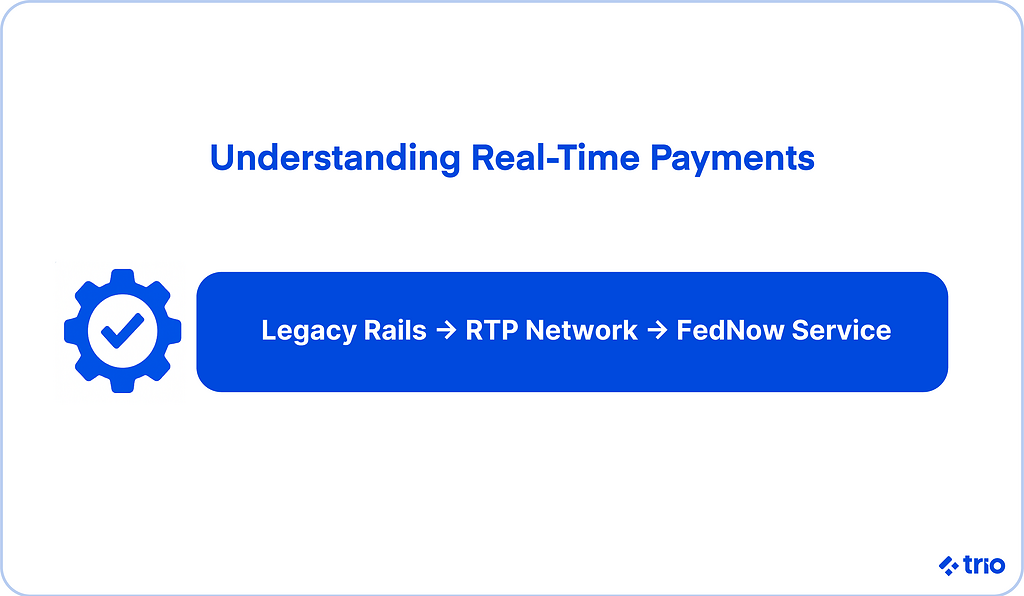
Understanding Real-Time Payments
When people hear “real-time,” they often think “fast.”
But in banking, instant usually refers to funds that clear and settle in seconds, not hours or days.
With real-time payments, both sender and receiver have immediate access to funds, and transactions operate 24/7/365.
Why Instant Payment Matters
Instant payment functionality improves liquidity management and provides all parties involved with faster access to funds.
The benefits, in terms of better cash flow and fewer delays, are incredible.
On the customer side, instant confirmation also plays a major role in building trust, and that trust drives usage.
Key Features of Modern Instant Payment Services
The FedNow Service runs on the ISO 20022 messaging standard, which improves data transparency and reduces reconciliation friction.
Real-time monitoring and layered fraud controls are also key features, as they help banks operate securely in an always-on environment. And because these payments are irrevocable, it is more important than ever to ensure that they are legitimate.
That last point tends to catch teams off guard.
With ACH, which is what fintechs are used to, you have a return window. With FedNow, you don’t.
If you have a fraudulent transaction that clears, the money is gone.
That raises the bar significantly for KYC and real-time fraud detection, all of which need to work at sub-second speeds without creating friction for legitimate customers.
The U.S. Instant Payment Landscape Before FedNow
Until recently, the U.S. market relied on legacy systems that struggled to keep up with time-sensitive payment needs.
The RTP network from The Clearing House made progress, but access remained limited to larger institutions. Smaller banks and credit unions didn’t really have an affordable way to join.
The FedNow® Service aims to close that gap by enabling a broader range of institutions to connect directly with the Federal Reserve’s instant payment platform.
From what we have already seen, it looks like it is going to democratize access to real-time payments across the U.S. financial ecosystem.
If the FedNow Explorer resource is any indication, the Federal Reserve intends to make onboarding educational, with clear learning materials and technical guidance.
Still, adoption of the FedNow Service will vary among institutions participating in the FedNow.
Some community banks are still taking a very cautious approach, waiting to see how early adopters perform. Others, particularly fintechs, are moving fast, leveraging the service to deliver seamless customer experiences and improve market agility.
FedNow vs. RTP: What Actually Differs
Both FedNow and RTP settle payments instantly, 24/7, and both use ISO 20022 for their payment services to their customers.
But they differ in ways that matter depending on your institution’s size, existing relationships, and integration path for payment services to their customers.
RTP launched in 2017 and has a head start in terms of transaction volume and some enterprise use cases.
But its user base is mostly made up of larger banks and credit unions that already have The Clearing House relationships. Transaction limits on RTP currently sit at $10 million per payment, making it well-suited to high-value B2B use cases.
FedNow raised its transaction limit to the same number late in 2025.
Its most meaningful differentiator is that FedNow connects directly through the Federal Reserve’s existing infrastructure, which already has relationships with virtually every U.S. depository institution.
That reach likely matters more to community banks and credit unions than it does to the large institutions already on RTP.
Preparing for the FedNow Service
Getting ready for FedNow is not a one-step process.
It requires planning. To do this effectively, you’ve got to have a clear understanding of your institution’s infrastructure and goals.
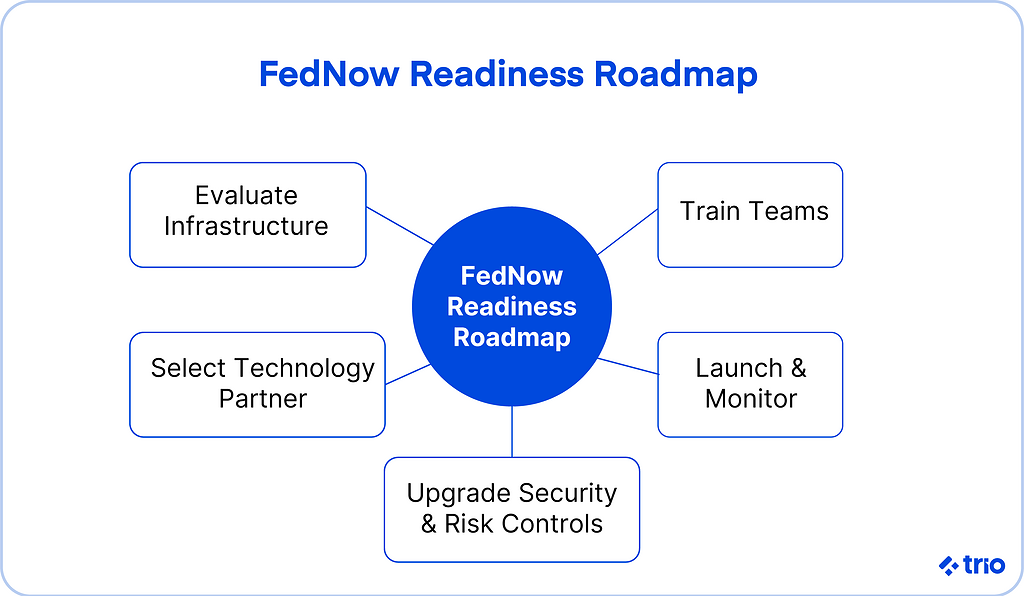
Readiness Steps for Financial Institutions
- Evaluate Your Infrastructure: Start with an internal analysis of how your core systems handle payments today. Many banks may find they need to modernize their middleware or switch to service providers who can support continuous, real-time operations.
- Select a Technology Partner: Integration with the FedNow network will depend on API quality and security. An outsourcing company like Trio can help design or customize those integrations, connecting legacy systems with the modern standards that FedNow requires.
- Upgrade Security and Risk Controls: Instant transfers mean risk moves just as quickly. Fraud detection tools and AI-based monitoring. Payment services to their customers are becoming standard components of real-time systems.
- Train and Enable Teams: Institutions participating in the FedNow Service will need specialized training to effectively utilize the platform. It’s easy to underestimate this part. Staff must understand new workflows, timing expectations, and what to do if a transaction fails. The right learning resources can make or break early adoption.
When we provide developers, you can rest easy knowing they are fully trained, not only in FedNow requirements, but in everything fintech.
The FedNow Certified Service Provider Ecosystem
One aspect of FedNow that doesn’t get enough attention is the certified service provider model.
If you don’t have the technical resources to connect directly to FedNow, you can now do so through a certified third-party service provider, which has completed the Fed’s testing and certification process.
The Federal Reserve maintains and regularly updates lists of participating financial institutions, settlement agents, liquidity providers, and certified service providers on its website, ensuring transparency for all participants.
Just remember that, if you are considering the certified service provider route, you should budget time for formal testing with the Fed’s certification environment before going live. Skipping or rushing that process tends to surface issues at the worst possible moment.
Overcoming Early Challenges
Every new payment system faces hurdles.
For the FedNow Service, the main challenges have been interoperability with existing payment rails and real-time fraud management.
Education will continue to play a major role in helping customers and small businesses understand why instant payment is more than a convenience.
Related Reading: Real-Time Rail Modernizing the Canadian Payment System
Strategies to Accelerate Adoption
If you want to lead the way, we recommend that you design the customer experience around that speed rather than just processing payments faster.
One pattern we’ve seen work well is starting with a single high-value use case, such as payroll or insurance disbursements, where the speed benefit is immediately tangible to the individual end user using the FedNow Service.
Building around that use case lets you validate your infrastructure, work out authentication and fraud tooling, and demonstrate ROI before expanding to broader payment types.
Use Cases for Instant Payments
The FedNow Service has opened the door to a variety of real-time payment applications.
For Consumers
Think of peer-to-peer transfers that land in seconds, or bill payments that settle instantly, no more “pending” notifications.
This could dramatically change how customers manage money day to day.
For Businesses
Faster payroll and vendor payments free up working capital and improve accounting efficiency.
The result is that businesses not only see reduced costs but also less manual reconciliation.
Account-to-account transfers also stand out as a particularly strong early use case.
Many consumers currently move money between accounts at different banks by initiating an ACH transfer, waiting one to three business days, and managing the gap. FedNow collapses that to seconds.
For Government
The public sector stands to gain, too.
Instant refunds, emergency disbursements, or benefit payments can be delivered in real time, making the process more transparent and responsive for citizens.
The Future of Real-Time Payments in the U.S.
The FedNow Service may signal a broader shift in how the U.S. approaches money movement.
In other markets, institutions and their service providers have seen significant advancements in payment services to their customers. Instant payment systems have become a national infrastructure.
The U.S. appears to be heading in the same direction, albeit with its own timing and regulatory complexity.
The trajectory from here seems likely to involve higher transaction limits, expanded use cases like request-for-payment flows, and closer integration between FedNow and RTP as interoperability conversations mature.
As service providers expand offerings, innovations in AI-driven fraud prevention and cross-border functionality will likely shape the next chapter.
Financial institutions that prepare early will be best positioned to grow with the market rather than chase it later.
Related Reading: Building Resilient Fintech Solutions
Conclusion: The Road Ahead for Financial Institutions
The FedNow Service represents a new foundation for how financial services operate across the U.S.
If your organization wants to stay relevant, start by assessing your readiness and finding a partner who understands both the technology and the business case.
At Trio, we’ve helped fintechs accelerate their payments journey by developing flexible, compliant, and customer-centered solutions.
If you’re preparing for FedNow or want to explore how real-time payments could strengthen your company’s offering, request a consult.
FAQs
What is the FedNow Service?
The FedNow Service is an instant payment infrastructure operated by the Federal Reserve. It allows eligible U.S. depository institutions to send and receive payments in seconds on behalf of their customers, 24 hours a day, 365 days a year.
How does FedNow differ from the RTP network?
FedNow and RTP both deliver instant payments around the clock, but FedNow connects through the Federal Reserve’s existing relationships with virtually every U.S. depository institution.
How do banks and fintechs prepare for FedNow integration?
Banks and fintech can prepare for FedNow integration by auditing their core banking platform for always-on processing capability, upgrading fraud detection to work pre-authorization rather than post-transaction, and either connecting directly or working through a Fed-certified service provider.
What does it mean to be a FedNow certified service provider?
To be a FedNow certified service provider means that you are a third-party technology company that has completed the Federal Reserve’s testing and certification process, qualifying you to support payment processing for participating financial institutions that connect to FedNow through you.
What are the main use cases for FedNow real-time payments?
The main use cases for FedNow real-time payments include account-to-account transfers, payroll disbursements, bill pay, insurance claim payouts, and government benefit distributions.