


 Read Client Stories





 Alex Kugell
 Key Takeaways
- Payment workflows are usually the first part of a fintech stack to break under hyper-growth, since transaction volume, compliance checks, and third-party API calls all compound at once.
- Microservices architecture lets you scale the specific service under load (a payment gateway during a spike, for instance) without scaling or risking the entire system at once.
- Infrastructure as Code (IaC) turns environment setup from a manual, error-prone process into something reproducible and auditable, which matters directly for compliance evidence, not just operational convenience.
- Legacy systems built primarily for stability and compliance genuinely resist scaling, and the fix is usually a phased approach that isolates the parts under the most load first.
- Having engineers who’ve scaled payment infrastructure before matters, since compliance and growth velocity pull in different directions and someone without fintech-specific experience tends to solve for one at the expense of the other.
Scaling fintech infrastructure can be challenging, but it is crucial to the success of any company in the financial services industry.
Without infrastructure that can securely handle large spikes in transaction volumes, you risk failures that could negatively impact your reputation in the long term.
So how do you scale payment workflows, APIs, and real-time payment processing?
Let’s look at all of these, since they are usually the parts of a fintech stack that break first under real growth. We’ll cover not only how you can go about scaling your fintech infrastructure for hyper-growth, but how to do so while staying compliant.
In our years working across fintech startups and established firms, we’ve seen that cloud-native infrastructure, treated deliberately rather than as an afterthought, is what actually holds up.
Our expert developers can not only help you set up your cloud-native infrastructure correctly, but also bring other insights from their production fintech experience that can set you up for success long-term.
Why Scaling Payment Workflows Is Different From Scaling General Infrastructure
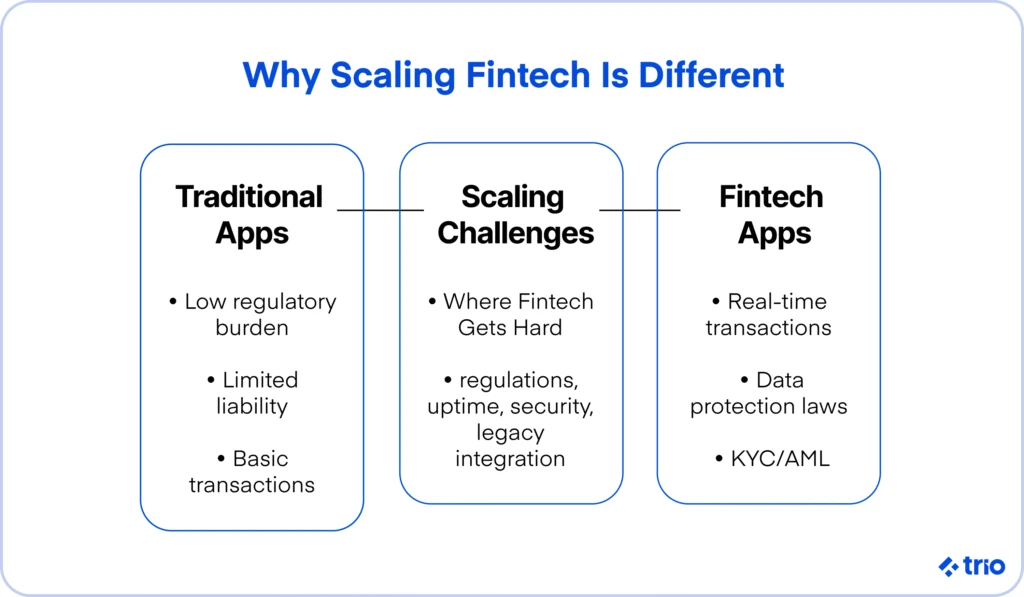
The constraints of legacy systems shape a lot of the problems typically associated with scaling.
These systems are built for stability and compliance, which is almost the opposite of scalability. We see this a lot in legacy platforms that are a few years old and carry real technical debt.
A complex banking system designed to pass an audit reliably wasn’t necessarily designed to handle a 10x spike in transaction volume without falling over.
The reality is that compliance, growth velocity, and technical debt pull against each other constantly in fintech specifically.
One of the more common traps that our developers have encountered is when a team optimizes purely for speed during a growth spike, then discovers the shortcuts taken to hit that speed created a compliance gap that surfaces months later during an audit or a regulatory review.
However, the reverse trap is just as bad. Teams can be so cautious about compliance that they can’t ship fast enough to actually capture the growth they’re trying to scale for.
How to Scale Payment APIs and Workflows Specifically
- Move to cloud-native infrastructure deliberately: Cloud solutions genuinely are the most reliable path to scalable fintech infrastructure, but data residency requirements, PCI DSS scope, and third-party risk obligations under frameworks like DORA all need real attention during a cloud migration.
- Use microservices to isolate what’s under load: This has become close to standard for fintech scalability specifically because it lets you scale one service independently without touching or risking the rest of the system. The alternative, a monolithic architecture that has to scale as one unit, is consistently the most expensive scalability mistake fintech teams make.
- Treat Infrastructure as Code as a compliance tool: IaC turns environment setup into something reproducible, version-controlled, and auditable. For a regulated payment workflow specifically, that auditability matters as much as the operational speed it buys you.
- Design for event-driven processing where transactions need to react in time: Tools like Apache Kafka show up consistently in scalable fintech platforms because payment systems need to process and react to transactions immediately, without creating bottlenecks.
- Bring in engineers who’ve actually done this before: You can build the best fintech product in the world, but it’s no use if you aren’t prepared to address the unique challenges the industry throws at a scaling system specifically.
What This Looks Like in Lending and Investment Platforms Specifically
The same core problems show up with a slightly different shape outside pure payments processing.
Lending platforms scaling payment workflows need to handle disbursement and repayment processing that spikes around specific dates and events.
Since you aren’t dealing with a smoothly distributed load, you need to change how you think about capacity planning.
Investment platforms scaling payment APIs need particular attention to settlement timing and reconciliation accuracy under load, since a scaling failure here can mean an incorrect balance a customer is looking at.
Whatever the specific vertical, the underlying discipline is the same: scale the component under load, keep compliance evidence intact through the process, and bring in people who’ve navigated this specific tradeoff before.
At Trio, we pair companies with developers who’ve worked on similar payment-scaling projects before. Their fintech expertise means they can help you make informed infrastructure decisions.
Our staff augmentation and outsourcing models also mean you can focus on scaling your product without carrying the commitment of a long-term hire before you know exactly what capacity you’ll need.