
If you run a fintech company, you already feel the tension between speed, compliance, and budget.
Regulations move fast. Customer expectations move faster.
Meanwhile, building an in-house engineering team can take forever, especially when you need senior backend talent or cloud engineers who understand financial data flows and banking integrations.
That is why many fintech leaders weigh three approaches to outsource software development: offshoring, nearshoring, and onshoring.
Each model has strengths, and each can create headaches if you choose it for the wrong stage or project type. Your job is to choose the one that fits your current reality and product priorities.
We’ve spent many years connecting companies with developers through all of these hiring models, allowing them to hire experts who understand industry nuances.
Based on this experience, let’s look at the practical differences between fintech development offshoring, nearshoring, and onshoring.
What Offshoring, Nearshoring, and Onshoring Mean in Fintech
Fintech software development has extra layers of complexity.
You deal with all the issues that you would have in regular development projects, and then you handle sensitive financial data, anti-fraud controls, identity verification, regulated payment flows, and third-party audit expectations.
Where your software development team sits affects your data security, agility, and regulatory comfort.
Offshoring
Offshoring means hiring engineers in distant geographical regions, often far from your time zone.
For example, if you are a North American tech company, offshore outsourcing might mean hiring software developers in Eastern Europe or Asia.
It has long been a popular choice because of cost savings and access to massive talent pools in these places.
Offshore development can support large feature backlogs, legacy system modernization, and tasks with clear specs.
Time zone differences, however, may slow agile cycles when rapid iteration is required.
And in fintech product development specifically, governance matters.
You need confidence that your offshore team can follow secure coding practices, handle financial data controls responsibly, and document systems properly for audits and regulators.
Nearshoring
Nearshore outsourcing means hiring talent in nearby or neighboring countries that share similar time zones and business hours.
For U.S. companies, that often means Latin America or Canada. You get meaningful cost efficiency without losing real-time collaboration.
This approach aligns naturally with fintech, where product, risk, and engineering teams often need to collaborate closely throughout the day to refine flows like onboarding, transactions, and compliance triggers.
Onshoring
Onshoring keeps development talent within your country. For many companies, it is the first alternative to building an in-house team.
It brings the highest familiarity with local regulations and business practices, and it minimizes communication friction, which might come with offshoring and nearshoring.
Many fintech teams start here when building foundational systems.
The challenge is cost.
Onshoring can eat runway quickly, especially in major tech hubs.
Some companies use onshore architects and leaders while nearshoring execution work to cut development costs while minimizing misunderstandings in critical work.
Pros and Cons of Offshoring for Fintech
Offshore software development has a clear place in the fintech outsourcing market, and plenty of global banks rely on it.
It just needs structure and strong product leadership.
When offshore works well
Offshoring tends to shine when your product requirements are stable, and your internal team already owns architecture and priorities.
If you value predictable development throughput and need to scale quickly without blowing through budget, offshore can be a practical move.
Teams with strong documentation habits often find it easier to hand work off across time zones and maintain momentum.
When offshore becomes difficult
The model becomes harder when requirements shift frequently or when collaboration and iteration are central to your delivery style.
Time-zone gaps slow decisions and sometimes create a subtle drift in understanding. Without strong compliance oversight, security and documentation can slip.
But this doesn’t mean you need to write offshoring off completely.
Instead, it means that outsourcing asks for structure, and the timing of when you introduce it matters.
Pros and Cons of Nearshoring
Nearshore software development has become increasingly attractive for fintech because it blends collaboration, familiarity, and efficient scaling.
It is also the sort of software outsourcing we recommend the most often.
When nearshore shines
Nearshoring tends to work best when you expect product requirements to evolve and want engineers who can work alongside you in real time.
It fits teams that value cultural compatibility, clear communication, and a working style similar to U.S. or European engineering environments.
Companies building fraud detection systems, onboarding workflows, loan origination platforms, card programs, and internal financial tools often find nearshore teams feel almost indistinguishable from internal hires.
The limits of nearshore
Nearshoring does cost more than traditional offshore models.
And while Latin America offers exceptional engineering talent, certain ultra-niche skill sets may still be easier to find globally.
For the majority of fintech SaaS products, though, nearshore teams strike a comfortable balance between collaboration, efficiency, and depth of experience.
Pros and Cons of Onshoring
Onshore development offers proximity, full cultural alignment, and minimal regulatory ambiguity.
Where onshore fits
Onshore teams are ideal when you are building core financial infrastructure or handling highly sensitive data.
Close proximity helps when compliance scrutiny is intense or when engineering leadership needs direct involvement in daily execution.
Early-stage fintechs often start this way because trust and clarity come first.
Challenges with fully onshore teams
As strong as onshoring can be, it is expensive.
Competition for talent is fierce, hiring cycles are long, and scaling quickly can become nearly impossible if you are facing venture timelines or pressure from investors.
Many teams eventually blend models to ease cost and hiring constraints.
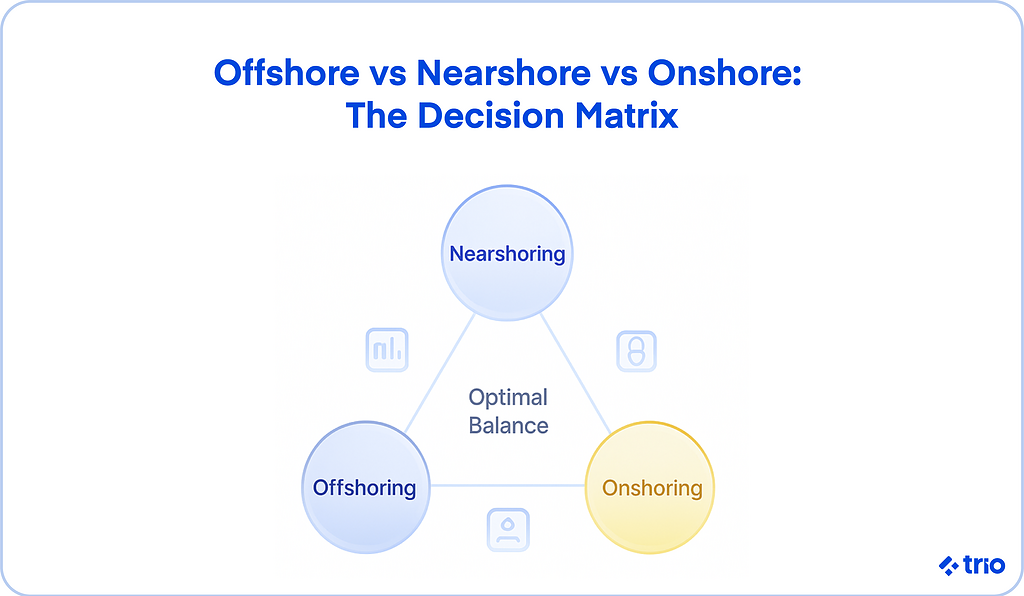
Nearshoring vs Offshoring vs Onshoring: A Practical Way to Decide
You can take a simple approach when evaluating where your development team should sit.
If regulatory assurance and control are your top priorities, onshoring is often the safest call.
If you want real-time collaboration without overextending your budget, nearshoring usually delivers the best fit.
And if you have mature processes, strong internal leadership, and want to maximize cost efficiency, offshoring may serve you well.
There is no rule that says you must pick one forever. Many fintech companies combine models as they scale and tighten processes so they can stay ahead.
Example Scenario
Imagine you are rolling out a lending platform.
Early on, you may rely on senior onshore engineers to define your underwriting logic and infrastructure, since accuracy and auditability matter.
Once that structure is set, you might bring in a nearshore team to build user interfaces, internal dashboards, and borrower flows in lockstep with your product and compliance functions.
Later, as the system stabilizes, offshore support can be used for automation and lower-risk backend tasks.
This layered approach gives you flexibility, protects core intellectual property during crucial phases, and stretches engineering budget without slowing delivery.
Common Mistakes Fintech Teams Make When Outsourcing
A frequent issue is outsourcing before you clearly define risk and regulatory requirements.
Some teams also assume offshore partners can run agile cycles without guidance, which rarely works in early product stages.
Budget pressure leads others to pick the lowest bid instead of the right partner, only to spend months untangling tech debt or misinterpretations later.
And occasionally, teams underestimate onboarding time, treating outsourced developers like ticket-takers instead of product collaborators, never making them feel like they are truly part of the team.
Questions to Ask Before Choosing a Partner
A few thoughtful questions go a long way in selecting the right fit.
- Ask about security and access control practices first, since fintech carries unique obligations.
- Clarify whether developers are familiar with financial data compliance standards, not just general best practices.
- You also want to understand time-zone overlap and how communication works day-to-day.
- And it helps to ask about onboarding, because the first month often reveals whether a partner integrates or stays at arm’s length.
Partners who answer with real examples usually deliver stronger outcomes than those who rely on general statements.
How Fintech Teams Outsource Well
Outsourcing software development requires extending your engineering culture.
Success tends to follow when teams share documentation habits, communicate frequently, and treat product context as a core asset rather than an afterthought.
Fintech adds an extra layer, including secure development environments, audit trails, and clear responsibility for compliance.
Many fintech teams choose Trio for this reason.
Our nearshore engineers work in similar time zones, understand financial data environments, and plug into your sprint cadence and tooling.
We work with seasoned fintech experts who have experience on international teams, preventing cultural differences.
Their geographical proximity allows them to operate like remote in-house developers, just without the hiring overhead or slow recruiting cycles.

Conclusion
There is no single right answer to software development outsourcing in fintech.
Onshoring keeps control tight when the stakes are highest. Offshoring works well once structure and clarity are solidified. Nearshoring, for many, becomes the most practical path for real-time progress and sustainable growth.
If you want a development partner who already understands fintech complexity and works in your time zone, Trio can help.
With vetted nearshore fintech engineers, strong communication habits, and secure delivery processes, you can scale engineering capacity without slowing down your roadmap or sacrificing trust.
Hiring fintech developers does not need to feel like a battle. You can scale confidently, protect quality, and stay focused on building the financial products that matter.
FAQs
What is the difference between offshoring, nearshoring, and onshoring in fintech?
The difference between offshoring, nearshoring, and onshoring in fintech is where your software development team is located and how closely they work with your business hours, culture, and compliance requirements.
Is nearshore software development better than offshore for fintech?
Nearshore software development is often better than offshore for fintech because similar time zones and cultural alignment make compliance, iteration, and real-time product work smoother.
When does offshoring make the most sense for a fintech company?
Offshoring makes the most sense for a fintech company when you have mature processes, clear requirements, and want cost savings while scaling engineering capacity.
Why do fintech companies prefer nearshore developers?
Fintech companies prefer nearshore developers because real-time communication and shared business hours help maintain security standards, agile delivery, and fast decision-making.
When should a fintech choose onshore development?
A fintech should choose onshore development when working on core financial infrastructure or highly regulated systems where local oversight and tight collaboration matter most.