

Fintech companies rely on a growing network of third-party vendors. These partnerships help you move faster, expand your product, and meet customer expectations without building everything yourself.
The problem is that each vendor introduces new vendor risks, and those risks rarely stay isolated.
When a cloud provider goes down, or a data partner has a breach, the fallout tends to land on your business, not theirs. It feels unfair, but this is how regulators see it, and how customers experience it.
The situation becomes even more complicated when multiple integrations, API connections, and service providers sit between you and your users. A simple outage can snowball into compliance concerns, customer frustration, and a fair amount of internal stress.
There is a more stable way to handle this. When you develop a clear vendor risk management program and treat vendor oversight as part of your normal operations, you reduce the volatility that comes with depending on third parties.
Let’s walk you through how fintech teams can manage risk without slowing down growth. If you need seasoned fintech developers who can help you understand the risk you are opening yourself up to and how to deal with that risk, we connect companies with affordable talent through staff augmentation or outsourcing.
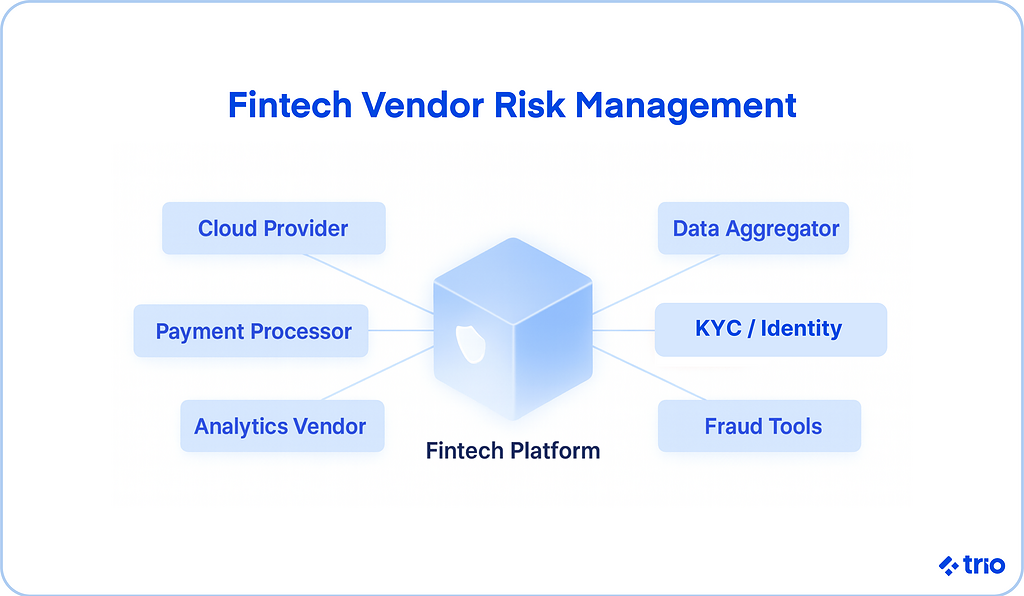
Why Vendor Risk Matters in Fintech
Fintech operates in a space where sensitive information, financial services, and real-time transactions meet high customer expectations.
This combination makes vendor oversight a central part of any serious compliance and risk management strategy.
Even if you outsource certain functions, regulators expect your business to maintain control over the level of risk and understand how third parties interact with your systems and your customer information.
Some of this pressure comes from the nature of financial technology.
Fintech companies process large amounts of sensitive customer data, and that data passes through third-party systems more often than users may realize.
A small error in one area can ripple into unexpected places, which is why vendor management and compliance are so tightly connected in this industry.
Understanding Vendor Risks in Fintech
If you are building or updating a vendor management program, it helps to start with a realistic picture of the risks vendors can introduce.
Vendor risks describe any threat created by a third-party vendor relationship that affects your business, your customers, or your compliance posture.
These risks tend to hit harder in fintech because financial institutions and fintechs operate under strict regulatory scrutiny. Even a brief service disruption can appear to regulators as a sign of weak oversight.
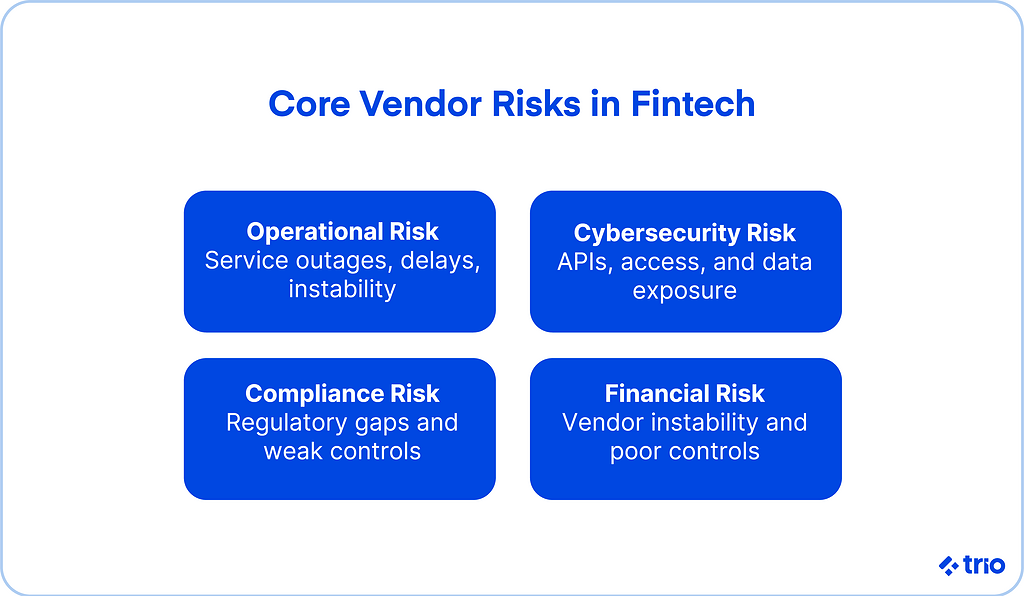
Core Risk Categories
A few types of vendor risks show up repeatedly in financial services and community banks.
- Operational risk may include outages or slowdowns that interrupt critical services.
- Cybersecurity risks often involve API vulnerabilities or access control issues.
- Compliance risk comes from vendors who cannot meet your regulatory requirements.
- Financial risk can emerge if a vendor appears unstable or has poor financial controls.
- Reputational risk develops when a vendor incident damages customer trust.
Each of these risk types affects a different part of your business, which is why risk assessment and ongoing oversight matter so much.
High-Risk Vendor Types in Financial Services
Some third-party vendors naturally present a higher level of risk.
Cloud providers hold large amounts of sensitive customer information. Payment processors sit at the center of your financial transactions. Data aggregators collect and store information that may move across borders, creating questions about data residency.
There is also the less visible risk of third parties, meaning your vendor’s vendors.
These subcontractors may have access to customer information even though you never interact with them directly.
A surprising number of incidents start in these hidden layers, which is why many financial institutions now ask for detailed supply chain information during due diligence.
Building a Fintech Vendor Risk Management Program
A vendor risk management program should give you a structured, repeatable process for evaluating vendors and understanding the risks associated with them.
You might design it differently depending on the size of your team, but the fundamentals stay the same. You identify risks, assign ownership, review controls, and monitor changes over time.
A good program also helps you show regulators that you understand your vendor relationships and have clear vendor oversight.
Core Components of an Effective Program
An effective vendor management program usually starts with governance. You define who approves vendor partnerships, how reviews happen, and what documentation you keep.
This may feel administrative, but regulators often begin their audits by checking whether these responsibilities are clearly assigned.
You also need policies that explain how you evaluate third parties, how often you review them, and what steps you take if the vendor’s risk level changes. These policies outline your risk management process and create consistency across teams.
Lifecycle management completes the picture. Vendors should move through onboarding, periodic reviews, and offboarding, and each stage needs its own controls.
Risk Assessment Techniques
Before onboarding a vendor, you will likely assess inherent risk and residual risk.
Inherent risk describes the level of risk presented before any controls are applied.
Residual risk takes into account what the vendor has already put in place, such as their cybersecurity standards or audit reports.
Vendor tiering is another common technique.
A vendor supporting your payment engine will not be reviewed the same way as a low-risk scheduling tool. Tiering helps you prioritize time and attention where they are most needed.
The goal is not to score every vendor perfectly. Instead, you want a reliable way to evaluate risk that helps you manage it long term.
Frameworks and Standards
Many fintech companies map their programs to established frameworks.
Options like NIST and ISO 27001 provide guidance on cybersecurity and information security.
The FFIEC handbook remains important for financial institutions and community bankers, while SOC 2 reports offer insight into a vendor’s internal controls. PCI DSS is still required for payment data.
These frameworks help you speak a common language with regulators and customers. They also make vendor onboarding easier because you can evaluate vendors against a known set of criteria.
Best Practices for Managing Third-Party Vendor Risk
Vendor risk management becomes much easier when you build strong habits into your vendor onboarding and review process.
While every fintech team structures things differently, several patterns tend to show up in programs that actually work.
Evaluating and Onboarding Vendors
When you evaluate a new vendor, you are trying to understand their internal processes, their approach to security and privacy, and their reliability over time.
Thorough due diligence may include a look at audit reports, penetration testing results, customer references, or detailed architecture diagrams.
Contractual agreements should support your risk management strategy by defining roles and responsibilities. They may outline how incidents are handled, how data is encrypted, and what happens if a service provider cannot meet their obligations.
Strong contracts make vendor relationships far easier to manage later.
Structuring Strong Vendor Relationships
Once you bring a vendor on board, communication and clarity make a big difference.
Service level agreements should match your business needs and not just reflect industry norms. Rather than relying on generic uptime percentages, you might specify response times for incidents or define requirements for data handling.
Some fintech teams use a mix of KPIs to monitor vendor performance, such as latency for API calls or time to resolution for technical issues.
The more realistic your expectations are, the better the vendor relationship tends to work.
Continuous Oversight
After a vendor is active in your environment, ongoing oversight becomes part of your management program. Periodic reviews may appear simple at first, but they often reveal changes that matter.
A vendor may add new subcontractors, migrate to a new hosting region, or modify access to customer information.
Risk dashboards help you track these changes without getting lost in individual documents.
They also make audit preparation easier, especially when regulators ask how you manage third-party vendor risk across multiple service providers.
Cybersecurity’s Role in Vendor Risk
Cybersecurity is usually the area that creates the most stress for fintech companies.
It is not just about breaches. Even minor configuration issues can put sensitive customer information at risk, which is the kind of incident regulators pay close attention to.
I have seen teams underestimate how much access a vendor actually has. A simple API integration may grant broader permissions than intended, or a vendor may store logs in a region that raises compliance concerns.
These kinds of surprises are common and worth reviewing early.
Key Cybersecurity Risks
Some vendor risks appear frequently. API vulnerabilities, credential theft, shadow IT within vendor environments, and cloud misconfigurations continue to show up in breach reports across financial services.
These vulnerabilities make it easier for attackers to move laterally, especially when access controls are not well monitored.
The biggest challenge is that these issues often go unnoticed until something breaks.
Strengthening Vendor Security Controls
To manage these risks, many fintechs now expect minimum security controls.
Zero-trust access, multifactor authentication, encryption policies, and detailed logging can reduce security risk significantly. These requirements are often non-negotiable because they protect both you and your vendor from common attack patterns.
It may feel awkward to request this level of detail during vendor onboarding, but service providers working with financial institutions should understand the need.
Cloud and SaaS Considerations
Cloud and SaaS platforms provide huge advantages, although they can also create new challenges.
Multi-tenant environments, data residency rules, and subcontractors add layers of complexity.
If you are working with a provider that uses several third parties, you want to understand how those sub-processors handle sensitive customer information.
This is one of the areas where transparency makes your oversight much easier.
Compliance and Regulatory Expectations
Compliance teams and regulators take a close look at third-party vendor relationships because these partnerships play such a big role in how financial institutions operate.
Regulatory requirements usually focus on oversight, vendor onboarding, data handling, and business continuity plans.
If you work in fintech, community banking, or embedded finance, you may notice that each regulator emphasizes slightly different rules. Still, the expectations around third-party risk management overlap more than they differ.
Having developers who understand these unique requirements of the fintech industry is essential. That is why many companies come to Trio.
Oversight Requirements
Authorities such as the OCC, CFPB, FCA, MAS, and EBA often request proof that your vendor management program includes risk assessment, vendor oversight, and ongoing monitoring.
Some fintechs also follow guidance that aligns with interagency guidance on third-party relationships.
The point is not to follow every rule perfectly. Instead, you need to show that you understand your third parties and manage risk thoughtfully.
KYV Requirements
Know Your Vendor processes work similarly to KYC. You want to verify who the vendor is, how they operate, and whether they follow security and privacy best practices.
You may also check how they store customer information, where they host data, and what subcontractors are involved.
These reviews sometimes feel repetitive, but they help you maintain compliance and demonstrate reasonable oversight.
Preparing for Regulatory Audits
Regulatory audits become much easier when you keep consistent records.
Control mapping, versioned policies, and audit trails help inspectors understand your vendor relationships without digging through disorganized files.
Most teams learn quickly that preparation saves a huge amount of time.
Advanced Approaches to Vendor Risk Management
As fintech companies grow, vendor ecosystems become more complicated. You might rely on a mix of cloud services, identity solutions, fraud tools, embedded banking partners, and software vendors.
At some point, manual vendor oversight stops being scalable.
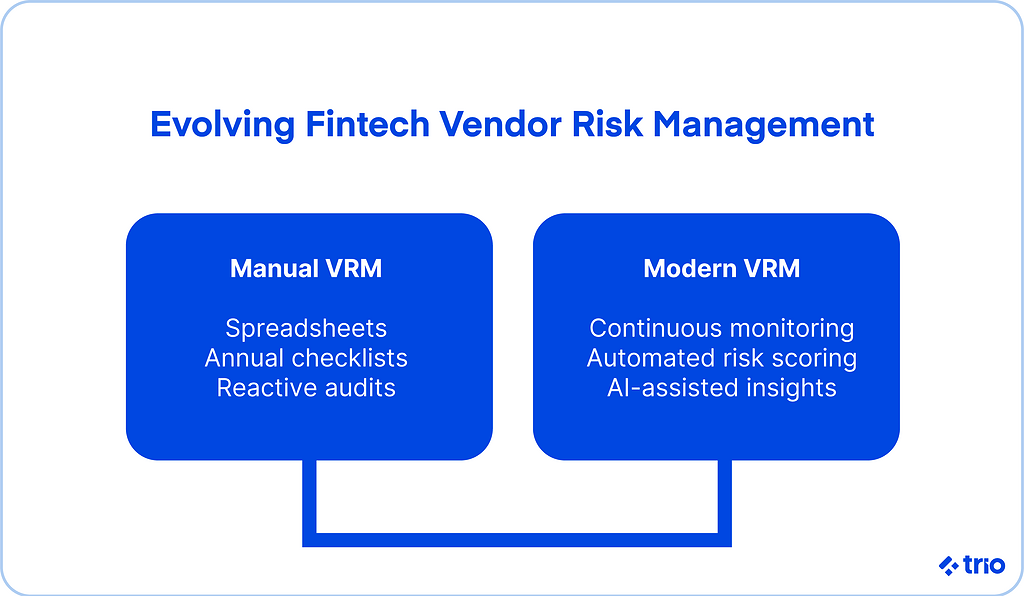
That is where more advanced vendor management strategies begin to help.
Continuous Monitoring and Automated Scoring
Continuous monitoring tools watch for changes in a vendor’s external attack surface or cybersecurity posture. They may pull information from threat intelligence feeds or public security reports, giving you an extra layer of visibility.
This information is not perfect, but it allows you to react faster when something looks unusual.
AI and Machine Learning Applications
AI-based tools can sometimes identify behavioral patterns that hint at potential cybersecurity vulnerabilities. The goal is not to fully automate risk assessment, but to support your team’s decision-making with additional signals.
For larger fintechs, these tools may reduce the amount of manual review needed and highlight risk trends earlier.
Operational Resilience and Contingency Planning
Operational resilience has become a focus across financial services.
Failover vendors, backup service providers, disaster recovery strategies, and business continuity plans help you stay functional when a vendor experiences an outage or security incident.
Most businesses never expect to use these plans, but when you do need them, the preparation shapes how quickly you recover.
The Future of Fintech Vendor Management
Fintech partnerships continue to increase as companies move toward modular, API driven systems. AI vendors, LLM integrations, and composable banking platforms suggest that reliance on third-party vendors will grow even faster.
Alongside this growth, the risks presented by cloud concentration, supply chain vulnerabilities, and API dependency may become more significant.
Fintech companies will likely need stronger third-party risk management programs, especially as regulators adopt new rules around operational resilience and information security.
Related Reading: Microservices Architecture for Fintech
Conclusion
Vendor partnerships help fintech companies move quickly, but they also introduce a level of risk that needs consistent management.
A thoughtful vendor management program combines clear governance, practical due diligence, steady oversight, and modern cybersecurity standards. It may take time to build, but it strengthens your ability to manage third-party vendor risk and helps you meet regulatory expectations without slowing down your product.
If you are working through vendor onboarding challenges or want support building a more confident risk management strategy, Trio’s team is ready to help you navigate the details. Get in touch to hire fintech developers!
FAQs
What is vendor risk management in fintech?
Vendor risk management in fintech means assessing and controlling the risks presented by third-party vendors. This includes operational, cybersecurity, and compliance risks that affect financial services.
Why is managing third-party vendor risk important for fintech companies?
Managing third-party vendor risk is important because fintech companies rely on vendors for critical services. A failure or breach can impact customers, compliance, and financial stability.
How do fintechs evaluate vendor risks before onboarding?
Fintechs evaluate vendor risks before onboarding by using risk assessments, reviewing audit reports, and checking cybersecurity controls. This helps determine the level of risk the vendor presents.
What vendor risks are most common in financial services?
The vendor risks most common in financial services include operational outages, cybersecurity vulnerabilities, and compliance gaps. These risks can disrupt services or expose sensitive customer information.
What frameworks help guide vendor risk management programs?
Frameworks that help guide vendor risk management programs include NIST, ISO 27001, SOC 2, PCI DSS, and FFIEC guidance. These standards outline controls for security and oversight.
How often should fintech companies review third-party vendors?
Fintech companies should review third-party vendors based on their level of risk. Higher-risk vendors usually require quarterly or annual reviews.
What is KYV (Know Your Vendor) in fintech?
KYV, or Know Your Vendor, means verifying the vendor’s identity, security practices, and compliance obligations. It helps ensure the vendor is trustworthy and suitable for a financial institution.
How does cybersecurity influence vendor management?
Cybersecurity influences vendor management because weak controls at a vendor can expose customer data. Fintechs review access, encryption, logging, and API security to reduce this risk.