

 Read Client Stories





 Alex Kugell
 Key Takeaways
- Freelancers offer genuine speed and flexibility advantages for fintech, which tend to hold up for isolated, non-compliance-touching work with short, defined timelines.
- Fintech engineering properties like compliance continuity, ledger integrity, PCI DSS scope management, regulatory deadline coordination, and audit trail ownership should all be factored into your decisions.
- A dedicated fintech engineering team needs three things that not all dedicated team models provide. They need to be familiar with embedding rather than delivery, fintech domain experience, and stable composition over time.
For general software projects, freelancers offer genuine value since they tend to be faster to start, have lower commitment, and give you access to specialist skills on demand.
Fintech delivery changes the calculation since you need to take into account things like compliance continuity, ledger integrity, PCI DSS scope management, regulatory deadline coordination, and audit trail ownership.
In these cases, having engineers who keep cycling through your company is not the best option, as it often creates compliance gaps and issues that show up during audits.
Instead, there is real value in hiring a dedicated team that builds knowledge of your project and recalls decision-making reasoning. These developers can be closely managed, allowing you to set up documentation protocols.
We’ll take a deeper look at freelancers vs dedicated teams for fintech delivery, including everything you need to know to make the best decision based on your specific circumstances.
How the Freelancer Model Works and Why It’s Appealing
A freelancer model is extremely flexible. You hire a developer who works as a contractor, making no long-term commitment, and only paying them by the hour, or by the specific project or feature.
The incredible flexibility means there is no single way to do a freelancer contract. Instead, you tailor the agreement to suit both parties.
Speed to start is one of the biggest advantages here, since a freelancer can be engaged for days. Structuring a dedicated team engagement, in contrast, takes longer, involves more process, and requires a clearer upfront definition of scope and composition.
When a specific, well-defined task arises, you reach out to someone with the skills to take care of that specific task, and they do it.
Skill specificity also holds up. Fintech engineering is a very wide industry, and no single team holds every specialty.
A freelance iOS developer for a mobile wallet launch, a freelance data analyst for a one-time credit model validation, or a DevOps engineer brought in for a specific infrastructure migration can fill genuine gaps without permanent headcount commitments.
For early-stage companies with uncertain product-market fit, the ability to scale down matters as much as the ability to scale up. Freelancer engagements end when the work ends, which is a real structural advantage when the product roadmap hasn’t stabilised yet.
The problem isn’t that these advantages are fake. The problem is that fintech engineering carries five properties that each degrade when delivery gets spread across independent contractors who don’t accumulate shared context. Understanding those properties changes how the trade-off looks.
Related Reading: Staff Augmentation vs Agency vs Consultancy
5 Fintech Properties That Make Freelancers Unsuitable for Fintechs
While freelance developers definitely provide value, especially for smaller companies, there are some factors in the fintech industry specifically that you need to think about very carefully before making a decision.
1. Compliance Continuity
Financial engineering systems sit on top of a lot of regulatory obligations that don’t shift between features, sprints, or engineer rotations.
A KYC/AML workflow carries defined state transitions that must be implemented correctly, documented, and maintainable by whoever touches the code next. A PCI DSS-compliant payment system carries data handling requirements that every engineer working on the system needs to maintain.
When you hire a freelancer to build part of this system and move on, they take their knowledge of why specific implementation decisions were made with them, meaning you may never know which regulatory requirement drove them.
The same is true regarding any practical accountability for whether those decisions were correctly implemented.
If the old developer did not prepare thoroughly, then a new freelancer inheriting that work gets an opaque codebase they do not understand, and they start changing things that create regulatory gaps later.
A dedicated team accumulates compliance knowledge as the system grows. They can also onboard any new team members, explain things that may not be clear, review pull requests for compliance-relevant changes, and serve as the institutional memory an auditor needs.
2. Ledger Integrity and Institutional Memory
Financial systems accumulate technical debt differently from product applications since bugs don’t just affect user experience, but can instead surface as serious issues like ledger discrepancies.
These bugs tend to stay silent in the short term, but even the tiniest issues can compound quickly when you are dealing with millions of transactions.
A rounding error on a single transaction, for example, may appear invisible. Applied across 50 million transactions over a year, it becomes a reconciliation gap that triggers a finance team investigation and potentially draws regulatory scrutiny.
Preventing these bugs requires deep architectural knowledge.
Your software developers need to have a solid understanding that monetary amounts require DECIMAL rather than FLOAT, that double-entry invariants need enforcement at the database constraint level rather than the application layer, and that idempotency keys must be persisted before payment requests get made.
These aren’t framework conventions that a skilled general engineer applies automatically and are often only learned from first-hand experience working with more senior developers on these projects.
A rotating freelancer pool doesn’t usually accumulate this knowledge.
3. PCI DSS Scope Management
As we have already mentioned, PCI DSS defines a cardholder data environment, the systems, people, and processes that store, process, or transmit payment card data.
The scope of that environment determines the scope of a PCI DSS audit.
As a general rule, anyone with access to cardholder data or to systems that process it falls within PCI DSS scope.
Freelancers complicate that since any developers who join your team typically need access to development environments that connect to payment data systems. When the engagement ends, that access must be formally revoked across every system, credential, and shared access point.
This is simple in theory, but in practice, revocation tends to happen quite inconsistently. A former freelancer’s credentials anywhere can be a serious audit finding when a Qualified Security Assessor examines the access control records.
A dedicated team maintains defined, stable access to defined systems. Onboarding and offboarding events are fewer, more deliberate, and easier to document and deal with.
4. Regulatory Deadline Coordination
DORA’s implementation requirements carry specific dates. Section 1033 runs tiered compliance deadlines by institution size. A PCI DSS remediation plan has scheduled audit review dates.
Meeting those deadlines requires coordinated engineering effort across multiple workstreams simultaneously, and that coordination depends on a shared team context.
Everyone needs to have a shared understanding of the deadline landscape and what is required from them in terms of deliverables.
A freelancer pool working on independent contracts doesn’t naturally provide this.
Independent contractors without shared context don’t necessarily develop this view organically.
Fintech team augmentation is a better option in this case, which keeps a stable core team in place throughout a compliance build, while providing the ability to scale your team up and down as required.
5. Audit Trail Ownership
When a regulator or auditor asks who wrote a specific piece of code, when, why a particular design decision was made, and who reviewed it, the answer needs to be traceable.
You will need things like
- A git commits history, names, and authors.
- A pull request review records the reviewers.
- A deployment log records when code went live.
The problem with a rotating freelancer pool is that the people are probably already gone by the time the audit happens.
When they have moved on, they have no obligation to respond to questions about their implementation decisions, no continuity with the current team, and no accountability for the downstream consequences of their design choices.
A dedicated team maintains continuity of ownership, which functions as a risk management property.
Where Freelancers Actually Make Sense in Fintech
Freelancers work very well for isolated, well-defined tasks with no compliance touchpoint.
This could be something like a frontend engineer building a marketing landing page, a designer creating UI components for a non-regulated product feature, or a data analyst running a one-time cohort analysis that doesn’t touch fintech-specific systems.
Augmenting a dedicated team for a specific capability gap also works cleanly, as we have already mentioned. The dedicated team provides the compliance continuity; the freelancer provides the specific skill.
Discovery work and early-stage prototyping are other great uses of freelancers.
Pre-regulatory fintech prototypes and proof-of-concept builds carry no compliance obligations. A freelancer can move faster than a dedicated team in this stage, and the institutional knowledge costs don’t accrue the same way.
Related Reading: Contract Developers vs Full-Time Engineers
Cost Comparison of Freelancers vs Dedicated Teams for Fintech
The freelancer case looks strongest when the comparison runs on hourly rates alone.
Senior freelancers at $80–$150/hr for six months versus a dedicated team at $7,000–$14,000/month for the same period looks like the better option upfront.
However, when it comes to fintech specifically, you need to think about factors like:
- Compliance remediation: Compliance gaps that are picked up in audits often lead to major remediation costs.
- Context reconstruction: the incoming engineers spend weeks reconstructing the context needed to work safely on that system.
- Coordination overhead: Managing a pool of independent freelance developers on a compliance-deadline-driven build requires extensive project management efforts.
A dedicated team’s monthly arrangement includes institutional knowledge, compliance continuity, and coordination as part of the structure rather than as separate line items that the freelancer model does not address upfront.
Related Reading: Reduce Engineering Backlog in Fintech
What a Dedicated Fintech Engineering Team Actually Looks Like
A dedicated team is quite a vague term that covers a range of models, and not all of them address all of the fintech-specific issues we have mentioned.
For fintech delivery specifically, a dedicated team is distinguished by its ability to embed into your project, by the fintech domain experience of all the developers, and by general stability over the duration of the engagement.
Unlike outsourcing, where the focus is on product delivery and nothing else, an embedded dedicated development team works within your sprint cycles, participates in your standups, reviews pull requests in your repository, and accumulates genuine knowledge of your system architecture over time.
That embedding produces the compliance continuity and institutional memory that the freelancer model loses on every rotation.
Since the team is made up of engineers who have built payment systems, KYC workflows, and data pipelines in regulated environments, the engineers bring the domain conventions that prevent the silent bugs described above.
But that final requirement of stability is essential since the dedicated team’s value for compliance continuity depends on engineers staying on the project long enough to accumulate the institutional knowledge that makes the model different from a freelancer rotation.
Trio’s dedicated fintech engineering teams embed directly in your engineering culture, carry domain pre-vetting across the disciplines regulated financial engineering requires, and start contributing to the first sprint within three to five days of the initial brief.
The Decision Framework
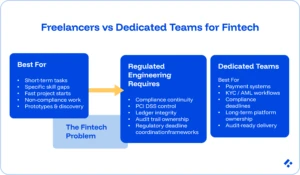
The choice between freelancers and a dedicated team for fintech delivery reduces to two questions.
Does the workstream touch a compliance system, payment data, ledger infrastructure, or regulatory reporting pipeline?
If yes, a dedicated team is the better choice. Compliance continuity, ledger integrity, PCI DSS scope, regulatory deadline coordination, and audit trail ownership all apply to this workstream.
If not, freelancers may be genuinely appropriate. Isolated tasks without compliance touchpoints benefit from the freelancer model’s speed and specificity without carrying the regulatory downside.
Does the workstream require more than three months of continuous engineering effort?
If yes, a dedicated development team is the way to go. The institutional knowledge advantages of stable team composition compound significantly past the three-month mark.
If not, freelancers may work, but only with explicit compliance access controls established upfront and documented handoff requirements enforced at the end of each engagement.
Related Reading: Best Nearshore Dev Partners for Fintech
Building Fintech That Survives an Audit With Trio
Features need to survive regulatory examination, produce auditable records of who made which decisions, maintain financial data integrity under production transaction volumes, and not leave compliance gaps when individual engineers move on.
A dedicated team doesn’t guarantee any of those outcomes on its own.
For fintech products that touch regulated financial engineering, whether payments, KYC/AML, ledger infrastructure, open banking, or fraud detection, Trio’s developers are pre-vetted by industry experts and embedded directly into your team.
Start with a full team or hire senior engineers as you need them. Since they are all Trio’s engineers, you minimize the risk of not having any access to purely freelance talent later in audits.
Book a decision call.