

Hire by Technology
SERVICES


Scaling software development teams in fintech can get quite messy. As your roadmap expands, bandwidth thins, hiring fintech developers becomes more difficult, and critical work (KYC/AML features, PCI tasks, etc.) starts slipping.
Hiring the perfect fit can stretch into months, and in the meantime, competitors appear to ship faster with smaller internal teams. At the same time, outsourcing your talent pool comes with its own risks.
Fintech engineering team staff augmentation offers a middle path. Instead of handing an entire project to a dedicated team of outsourced developers, you augment your fintech team by embedding vetted specialists who work inside your process and tools. You maintain control over direction while acquiring the exact skills you’re missing, whether that’s payments integrations, fraud modeling, or mobile engineering.
Let’s look at everything you need to know about fintech team augmentation and how you can scale without losing control.
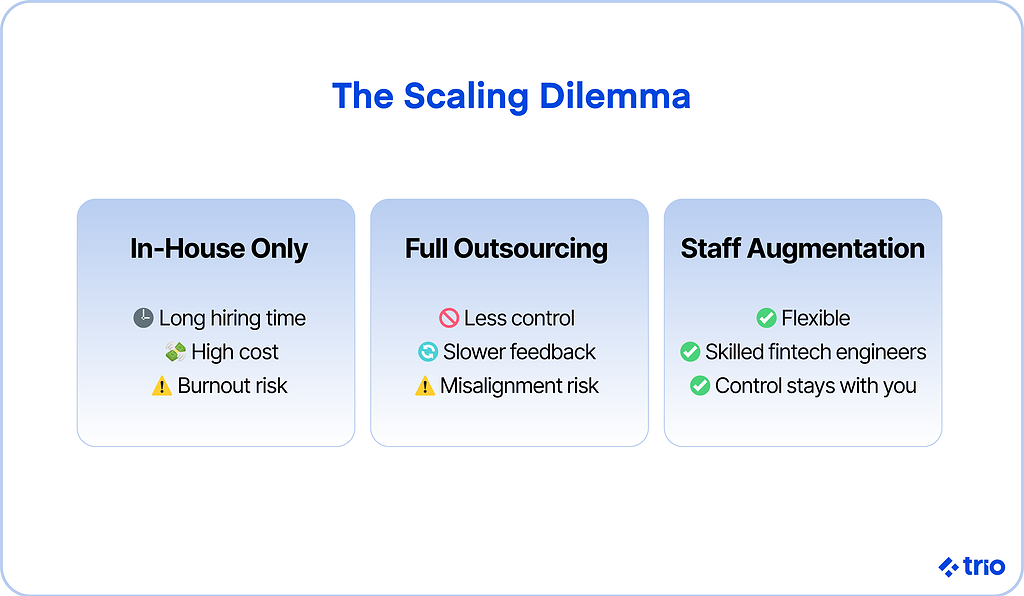
Team augmentation in fintech sits somewhere between hiring full-time staff and outsourcing an entire project.
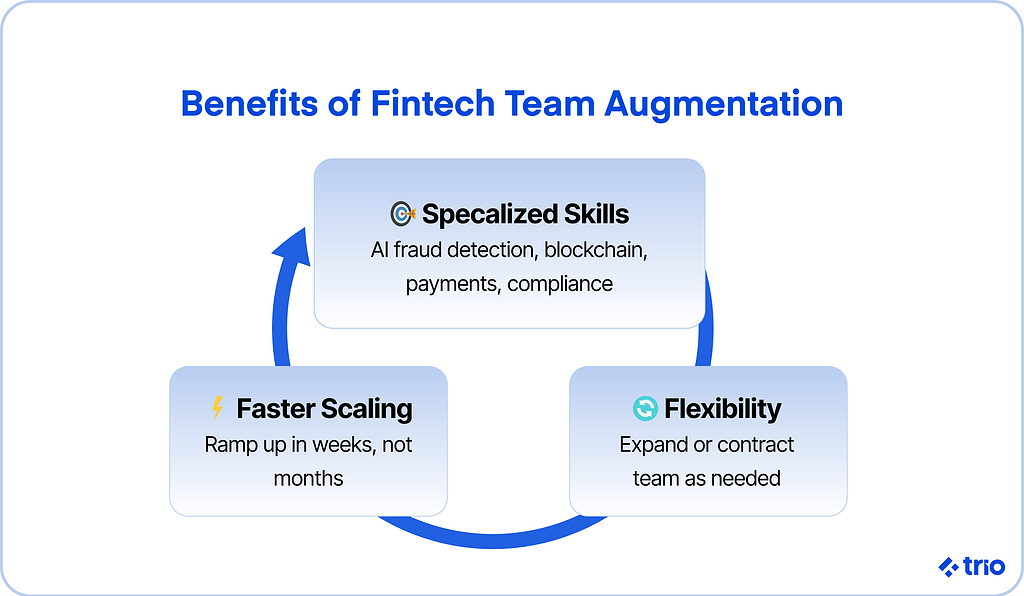
Team augmentation is essentially a staff augmentation model that lets fintech companies plug in external talent where they need it most.
The idea is that, instead of building a bigger in-house team or handing everything off to an agency, you temporarily extend your team with people who already have the skills you’re missing, usually through a hiring firm that offers staff augmentation services.
The hiring model works well for many and is expected to reach $857.2 billion by 2031. But, is it the right option for you?
With Trio, that might mean bringing on a compliance-focused backend developer or a mobile engineer who’s already familiar with payments APIs.
The key difference is that these people don’t swoop in to deliver a project and then disappear. They work alongside your own developers, attend the same standups, and help chip away at the same backlog.
That integration is what allows you to keep control while filling the gaps that might otherwise stall your roadmap.
Related Reading: IT Staff Augmentation: What Is It and How Does It Work?
The benefits are more apparent if you’ve ever spent months trying and failing to hire a senior fintech engineer. Team augmentation means you can:
It’s also worth pointing out what hiring an augmented team does not allow.
Team augmentation won’t replace the need for long-term hiring if you’re building a core engineering culture.
But for periods of intense growth or crunch-time delivery, it can be the difference between shipping on time and missing market opportunities.
Outsourcing often means handing over an entire project to another company.
That approach can work, but it comes with trade-offs: less day-to-day visibility, slower feedback loops, and a real risk of misalignment with your product vision.
Team augmentation, by contrast, keeps the project in your hands.
You’re still the one steering the roadmap. The additional fintech talent adds velocity, working under your managers and alongside your staff.
If you are a fintech firm founder, that distinction matters, especially when compliance or security concerns make it uncomfortable to send everything to an external team.
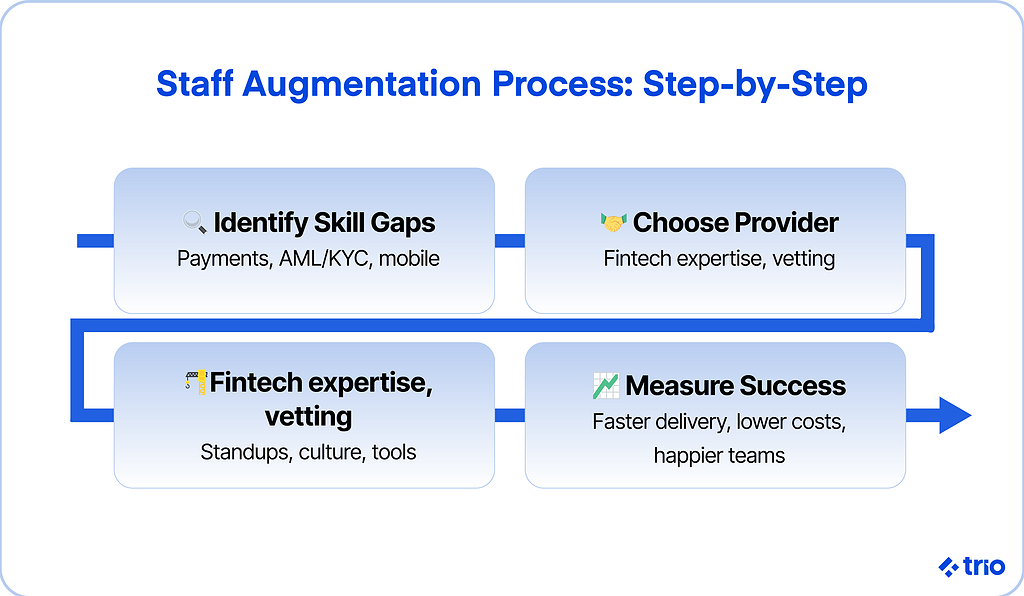
Staff augmentation, at least with a high chance of success, is a process, and skipping steps increases the risks of misalignment, wasted money, or unhappy teams. A rigid formula won’t always work, but it can guide you to ensure your hires meet your company’s needs.
Not every provider is equal in the fintech market, and a bad fit can cost more than doing nothing. You’ll want to weigh a few factors:
Case studies and references are helpful, but you’ll also want to test whether their process for sourcing and screening talent matches your project requirements.
Some providers shuffle resumes; others pre-vet with technical interviews and scenario testing. That difference will likely matter when timelines are tight.
Even the most qualified engineer needs a proper ramp-up to ensure they fit into your extended team. Without thoughtful onboarding, those hires won’t be immediately effective, and you risk mistakes caused by miscommunication.
At a minimum, introduce new staff to your culture, development workflow, and current priorities. Pair them with an internal mentor who can explain how things are done, as well as why.
Set clear channels for daily communication. Engineers who understand context contribute sooner, and you spend less time revisiting avoidable missteps.
You can’t just expand your tech team without thinking through whether they actually need depth in payments, compliance, or data science. The result will be more people, but the same bottlenecks.
Start by identifying what’s slowing you down.
Is it a missing skill set, like React Native or blockchain audits? Or is it the need for someone who understands how KYC/AML rules shape product design?
Fintech teams in particular may need engineers familiar with PCI standards, fraud detection models, or banking APIs.
Getting specific about gaps matters so you don’t risk filling seats with generalists when what you really need are specialists who can move the roadmap forward.
Choosing a provider requires great care, especially with all the options available in the software development industry. You’ll want to know:
Pricing transparency and cultural fit are critical, too.
Remember to run due diligence on individuals as you would otherwise.
Run technical interviews. Set small coding challenges that reflect your stack. Check whether they’ve worked on similar fintech projects, not just enterprise apps in general.
It’s also a good idea to pay attention to communication.
Someone who’s technically sharp but can’t collaborate in your daily standups is unlikely to accelerate delivery.
We ensure that all our developers possess the necessary soft skills to excel in your team. If we identify a gap, we provide the training to fill it.
Not every role benefits equally from augmentation. Some positions require long-term continuity and deep product ownership, while others lend themselves to short bursts of specialized expertise.
In fintech, a few areas tend to stand out.
Design is critical in finance because if users don’t trust your interface or find it confusing, they’ll abandon it fast.
Augmenting your team with designers experienced in user research, accessibility, and financial workflows can help close that gap.
Most fintech companies eventually hit a wall where feature demand outpaces backend and frontend capacity.
Augmented engineers here can help you catch up, whether it’s building real-time transaction processing, integrating with banking APIs, or smoothing out clunky dashboards.
This is one of the most common uses of augmentation because it directly affects delivery speed.
Regulations like PCI DSS, PSD2, or GDPR come with serious consequences if not considered.
Augmenting with security engineers or compliance specialists can save painful remediation later. You also avoid shutdowns and loss of trust later.
Data science is easy to underestimate until fraud detection fails or credit scoring models start producing noise.
Augmented data scientists and ML engineers can help build models that actually fit financial data, from anomaly detection in payments to customer personalization.
These roles are more challenging to hire for permanently, which makes them prime candidates for augmentation.
Bringing in augmented engineers is just the start of speeding up your software development project.
As we have already mentioned, how you fold them into your workflows will make the difference between smooth acceleration and added friction.
The process usually begins with communicating where you are short on skills and what kind of expertise will actually move the roadmap forward.
Once that’s defined, a partner can help you source and screen candidates.
From there, augmented engineers join your existing team, not as outsiders running a parallel track, but as contributors embedded in your day-to-day development cycle.
We’ve already discussed how daily standups, sprint planning, and code reviews are where alignment happens.
Regular check-ins ensure that both internal and external engineers are working towards a common goal.
It’s tempting to think of augmentation as a quick fix, but companies that treat it as an ongoing collaboration tend to see better results.
Many of our developers have been with their assigned companies for years.
Without clear reporting lines or communication channels, augmented staff can focus on technically delivering, but not be aligned with company goals.
A smoother path often includes:
When engineers feel like part of the team rather than bolt-on labor, you get stronger collaboration and fewer misunderstandings.
Managing augmented engineers isn’t wildly different from working with in-house staff, but there are a few nuances.
Set expectations clearly at the start: what success looks like, how feedback is delivered, and what the boundaries are.
Regular performance reviews help catch issues early.
And don’t underestimate the power of recognition. Even short-term engineers contribute more when they know their work is valued.
Done well, AI can speed up development, tighten security, and even lighten the compliance burden.
The catch is that most in-house teams don’t have deep AI expertise, which is where augmentation can fill the gap.
AI is often used to handle the repetitive or error-prone tasks that take up developers’ time, like scanning code for vulnerabilities, generating unit tests, or spotting anomalies in transaction flows.
For fintech companies, those efficiencies may translate into faster release cycles and fewer compliance headaches.
Augmented engineers who already know their way around AI tools bring an added edge since they can integrate fraud detection models, automate parts of the credit scoring process, or fine-tune risk management systems.
Code review assistants can flag issues before they reach QA. RegTech platforms are starting to cross-check code and data handling against frameworks like PSD2 or PCI DSS in near real time.
Even testing platforms now use AI to auto-generate cases you might not think of manually.
These tools don’t replace oversight, but they can shift engineers’ time toward building rather than babysitting systems.
Looking ahead, AI will likely move beyond support tasks into more complex and critical applications.
This might include generating usable code blocks, simulating customer behavior, or running compliance checks continuously in the background.
That doesn’t mean every fintech needs an AI-first team today. Still, it does suggest that having access to augmentation partners who can supply AI-capable engineers will become a competitive differentiator.
Let’s take a look at where fintech team augmentation actually made a difference, and where it might for you.
Take Poloniex, a global crypto exchange.
They were struggling to find senior mobile developers in the U.S. to bring their iOS and Android apps up to speed with the web platform. Instead of dragging out a six-month hiring cycle, they added vetted engineers through augmentation.
The result? Faster delivery, lower costs, and mobile apps that finally matched customer expectations.
Talking about speed or flexibility sounds nice, but what founders and CTOs really want to know is whether augmentation moves the needle. The good news is, you can measure it.
Some of the most evident signs include:
Tracking these KPIs consistently doesn’t just prove ROI, it gives you the confidence to scale augmentation up or down without guesswork.
Scaling software development in fintech is always a balancing act. You’re under pressure to ship faster, stay compliant, and keep teams motivated, all while struggling to attract senior talent.
Traditional hiring often can’t keep pace, and complete outsourcing can feel like giving up control.
Staff augmentation offers a middle path. By embedding experienced engineers into your team, you close skill gaps, accelerate delivery, and stay in the driver’s seat.
Case studies from companies like Poloniex show what’s possible: faster launches, compliance handled on schedule, and growth unlocked without ballooning headcount.
You don’t need 20 in-house engineers to scale effectively. You need the right engineers at the right time, working alongside your team.
Staff augmentation helps you get there, giving fintech companies the bandwidth and expertise to stay agile in a fast-moving market.
If you’re ready to explore how staff augmentation can accelerate your roadmap, book a staff augmentation consultation.
Team augmentation in fintech involves embedding external engineers into your in-house team to close skill gaps and accelerate delivery, without outsourcing entire projects.
Staff augmentation differs from outsourcing because staff work as part of your existing team, while outsourcing delegates an entire project to a separate provider.
Fintech companies should use staff augmentation when facing growing backlogs, compliance deadlines, or MVP-to-scale transitions where hiring full-time talent would take too long.
Accountability works best when augmented engineers receive the same treatment as internal staff, including clear sprint ownership, inclusion in code review cycles, and regular one-on-ones.