

Generative AI in fintech refers to AI systems that create anything: text, synthetic data, financial scenarios, code, and simulations. The important thing is that they create, rather than simply classify or detect.
From our time in the fintech industry, we have seen generative AI being used more and more. Applications include document automation (JPMorgan, Goldman Sachs), LLM-powered advisory tools (Morgan Stanley), AI customer service agents (Klarna), synthetic data for underwriting, and agentic AI for multi-step financial workflows.
As you can imagine, with major financial firms already utilizing the technology, many fintech companies already run some form of AI.
Machine learning handles fraud detection, credit scoring, and recommendation engines across the industry. What sits in a different category entirely, though, appears to be generative AI: systems that produce outputs rather than classify inputs.
At Trio, we place pre-vetted senior engineers from Latin America with fintech companies that need to build these systems fast, matched on domain experience and hand-picked for your project.
Key Takeaways
- Generative AI creates outputs (documents, code, synthetic data, financial scenarios) while traditional ML classifies or scores. The two solve different problems and rarely substitute for each other.
- Fintech amplifies the value of GenAI more than most sectors, because the industry runs on dense unstructured documents, rare-event data problems, and a heavy regulatory documentation burden.
- Agentic AI appears to be the next meaningful shift, moving GenAI from assistive to autonomous multi-step workflows.
- The primary bottleneck to building GenAI in fintech is talent, since senior engineers with both LLM expertise and fintech domain knowledge are rare and expensive.
What Makes Generative AI Different from Traditional AI in Fintech
Traditional ML in fintech gets trained on historical data to classify, detect, predict, or rank.
A fraud detection model, for example, classifies a transaction as normal or anomalous. A credit scoring model outputs a default probability. The model produces a decision or a number, derived from patterns it already saw during training.
Generative AI, on the other hand, produces new content or data that didn’t previously exist.
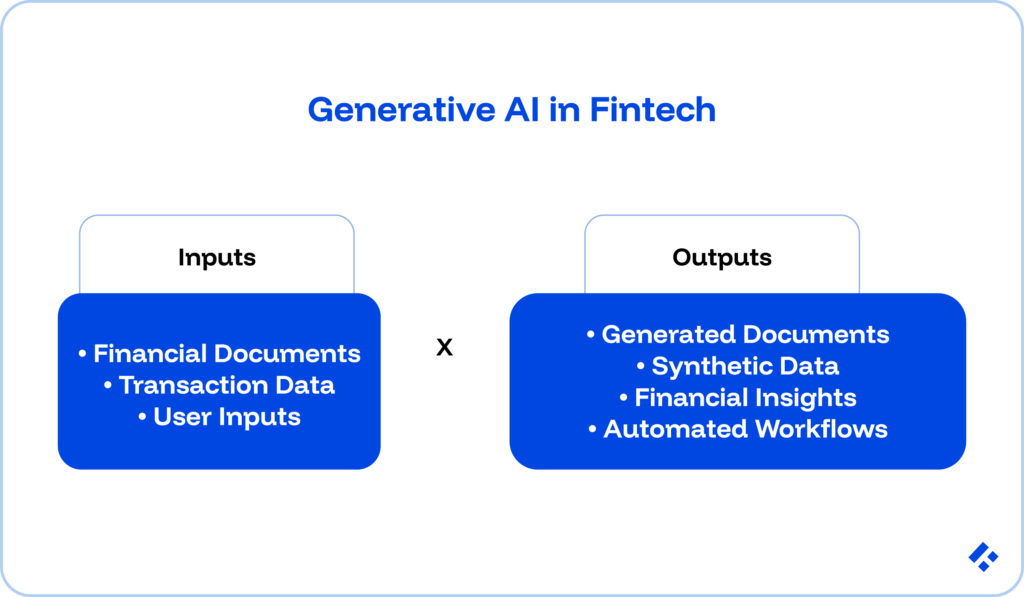
In the financial field, you could feed a GenAI model a borrower’s bank statement PDF, and it can extract income patterns, flag seasonal cash flow gaps, and draft a conditional approval letter.
The practical implications of that distinction are massive:
- GenAI processes unstructured data (contracts, earnings call transcripts, scanned KYC documents) that standard ML pipelines can’t cleanly ingest.
- When real data for rare events (fraud patterns, defaults, market dislocations) isn’t available, GenAI can generate synthetic training examples rather than leaving models undertrained.
- Because GenAI’s primary interface is natural language, it becomes useful to non-technical staff like compliance officers, analysts, and relationship managers.
Why Fintech Gets Unusually High Returns from GenAI
We have already seen that some sectors benefit more from GenAI than others. There is no indication that this is going to change any time soon. Fintech appears to sit near the top of that list, with projections putting it at $7.28 billion by 2029 (up from $1.13 billion in 2023).
This could be due to a couple of different reasons.
Document density is probably the biggest driving force. Financial services run almost entirely on documents like loan agreements, compliance filings, research reports, KYC packages, pitch books, and regulatory disclosures.
There are very few industries out there that need to process as much unstructured text at that volume, and GenAI performs best exactly where text density gets highest.
Then there is the rare event problem. Fraud attack patterns, credit default scenarios, and liquidity stress events are rare by design. A fraud detection model trained on the 0.1% of transactions that turn out fraudulent tends to underperform when novel attack patterns arrive.
GenAI can be used before you ever go live to generate thousands of realistic synthetic examples of rare events at scale, which could produce stronger training data than historical records alone can provide.
On top of all of that, GenAI can assist with regulatory documentation volume. Every product change, model update, and onboarding decision generates required documentation.
The model validation reports, AML records, adverse action notices, and audit trails all add to the document density issue we have already mentioned, but they also take an incredible amount of time to be generated.
These documents are mandatory, largely templated, and deeply time-consuming to produce. GenAI can take on a significant share of that drafting work, which frees compliance and legal teams for the decisions that actually require human judgment.
7 Generative AI Use Cases in Fintech
Now that you understand why fintech is such a great candidate for generative AI, let’s look at some specific use cases like document generation, synthetic data creation, LLM-powered knowledge retrieval, and agentic workflows.
1. LLM-Powered Knowledge and Research Tools
Financial advisors and analysts sit on top of enormous libraries of internal research, policy documents, and client records that are practically inaccessible.
The files are often scattered across PDFs, legacy databases, and filing systems that have no conversational interface.
LLM-powered knowledge tools let employees query that institutional knowledge in plain English and get synthesized answers back, rather than hunting through folders.
The Morgan Stanley deployment offers probably the clearest example. Their “AI @ Morgan Stanley Assistant” gave 16,000+ financial advisors access to roughly 100,000 annual research reports through a plain-English query interface.
Building these tools requires a retrieval-augmented generation (RAG) architecture, embedding pipelines, a document chunking strategy, and output guardrails to catch hallucinated financial figures.
From what we have seen, getting the hallucination mitigation right tends to take longer than the initial build.
2. Generative AI Customer Service Agents
The Klarna deployment has become the most-cited real-world GenAI customer service example in fintech, and the specific numbers hold up to scrutiny. Launched in January 2024, the agent handled 2.3 million conversations in its first month, covering about two-thirds of Klarna’s total customer service volume.
After initial rollout, though, Klarna identified a quality drop on complex queries and reintroduced human agents for Level 2 and Level 3 support.
This suggests that a path to sustainable AI in customer service going forward is going to involve a hybrid model where AI handles high-volume, routine queries at scale and humans take the edge cases, the disputes, and the emotionally sensitive conversations.
3. Document Automation and Contract Generation
As we mentioned above, every loan origination, regulatory filing, and M&A due diligence process generates documents. Historically, lawyers and analysts drafted those documents from scratch, or from templates that still required significant editing.
GenAI can produce a solid first draft of a loan agreement, compliance disclosure, or pitchbook section in minutes, which frees the human reviewer to focus on accuracy and judgment rather than formatting and boilerplate.
JPMorgan’s COiN platform processes 12,000 loan agreements in the time that previously required 360,000 hours of annual lawyer review.
Goldman Sachs’ GS AI Assistant cuts pitchbook preparation from days to a matter of hours, with analysts reporting roughly a 50% reduction in preparation time.
Document automation requires financial document parsing pipelines, prompt engineering calibrated to legal vocabulary, and output validation frameworks.
But, even though the potential benefits here are incredible, hallucinated numbers or incorrect contract terms create real liability. Our engineers have commented that the validation layer needs more attention than the drafting layer.
4. Synthetic Data Generation for Model Training
Generative models (specifically GANs and diffusion models) can produce realistic synthetic financial datasets like transaction records, fraud patterns, credit default scenarios, and market stress events.
You can then use those synthetic datasets to train ML models on scenarios that rarely appear in production data, or that carry too much privacy risk to use directly.
Fraud attacks and loan defaults are rare, which means ML models trained purely on historical data tend to underperform on novel patterns. And new product launches or regulatory changes sometimes require model testing before any real transaction data exists.
Even if you did have enough information, training fraud models on real customer transaction data creates GDPR and CCPA exposure that many teams would rather avoid.
5. Compliance and RegTech Automation
ML already flags suspicious transactions well. Where compliance teams tend to struggle is with documentation.
A team processing 500 AML alerts a day can identify the flagged cases in seconds with an ML tool, then spend hours writing the required SAR narratives, case summaries, and audit records.
GenAI takes on the drafting work, which likely produces a more meaningful productivity gain than any detection improvement would.
6. AI-Augmented Credit Decisioning and Underwriting
Traditional ML credit scoring works well on structured data like bureau outputs, income figures, and payment histories, but it can’t easily read a bank statement PDF and extract the income seasonality, recurring expense patterns, or cash flow gaps that a human underwriter would notice.
LLMs fill that gap, and can also generate the plain-language decision rationale that adverse action notices require under ECOA and FCRA.
Explainability in this context isn’t just good practice, though. SR 11-7, ECOA adverse action requirements, and FCRA disclosures make model auditability a compliance requirement.
7. Code Generation and Engineering Productivity
Fintech engineering teams need to build new AI-powered products while simultaneously maintaining and migrating legacy financial infrastructure, some of which runs on COBOL-era systems that predate the engineers maintaining them.
Legacy migration is among the most expensive and risky projects in financial services. GenAI code generation tools can significantly accelerate both sides of that workload.
But there are some issues to be aware of. PII must stay out of external model prompts. AI-generated code in payment processing and authentication flows needs an explicit security review.
Compliance-sensitive logic also needs validation against regulatory requirements before it ships.
It is important that you use a fintech-specific ML specialist in all of these cases to ensure that you don’t make a costly mistake.
Agentic AI: What Comes After Assistive GenAI
The use cases above mostly fall into what we might consider the “assistive” category. In other words, they make individual tasks faster.
Agentic AI sits a step further, with systems being able to execute multi-step workflows on their own, with minimal human intervention at each stage, rather than just at the end.
This already exists, but it’s definitely still in the early stages.
Autonomous credit underwriting agents can retrieve an application, pull bureau data, read bank statement PDFs, generate a credit decision with compliance-ready rationale, draft the approval or adverse action letter, and route the whole package to a human for final sign-off, without an analyst touching it in between.
Compliance case management agents detect an AML alert, retrieve the transaction history, generate a case summary, cross-reference sanctions lists, draft the SAR narrative, and deliver a complete case file to the compliance officer.
Anthropic’s Claude Financial Analysis Solutions, launched in 2025, was built specifically for this type of financial agentic workflow: due diligence, competitive benchmarking, portfolio analysis, and investment memo generation, all with full audit trails.
The engineering challenge here is to make sure that these systems have failure handling that degrades gracefully, escalation design that loops humans in at the right moments, audit logging that satisfies regulatory requirements, and security architecture that prevents agents from triggering unauthorized financial actions.
Related Reading: AI Integration and Data Bias: Responsible AI in Fintech
The Engineering Stack GenAI in Fintech Actually Requires
The GenAI fintech engineering stack runs deeper than most fintech engineering work, and the specialized nature of it tends to surprise teams that haven’t done it before.
- LLM infrastructure: covers model selection (proprietary versus open source involves real tradeoffs on cost, privacy, and customization), fine-tuning pipelines, RAG architecture, and vector database management across tools like Pinecone, Weaviate, or pgvector.
- Hallucination mitigation: financial documents, credit decisions, and compliance filings cannot contain invented facts. Building output validation frameworks, confidence scoring, and adversarial testing pipelines requires dedicated engineering attention.
- Unstructured document pipelines: for fintech involve PDF parsing, OCR for legacy formats (scanned loan applications, decades-old contracts), financial entity extraction, and a chunking strategy designed around LLM context windows.
- Compliance and explainability: ECOA adverse action requirements, FCRA disclosures, and SR 11-7 model risk management guidance all create enforceable requirements around auditability.
- Security for financial data in LLM contexts: PII cannot appear in prompts sent to external models. Prompt injection attacks on financial systems can carry real financial consequences.
Related Reading: Best Languages for AI Development
Hiring GenAI Developers in Fintech
Senior GenAI engineers with fintech domain experience generally charge around $141,000-$226,000 base in the US market, with search timelines averaging 5-7 months.
This means that the hiring delay is probably a bigger issue than the actual cost or availability of the developers.
Trio helps companies get around these delays by placing pre-vetted GenAI engineers with demonstrated fintech domain experience in your team within 3-5 days, through fintech staff augmentation and other hiring models.
These are engineers who have built RAG systems, LLM pipelines, and synthetic data infrastructure for financial applications before, which cuts the ramp time that comes with learning fintech on the job.
Final Thoughts
Building any of these use cases requires GenAI engineers who know fintech, a combination that’s genuinely hard to hire for through standard channels.
The bottom line is that you need experts on your team to help you push ahead of the competition, or even just to stay up to date with the rapidly changing nature of the industry.
If you need expert developers with fintech experience, hand-picked based on your requirements, we can help.
Request a consult.
Frequently Asked Questions
What does generative AI in fintech actually mean?
Generative AI in fintech refers to AI systems that produce new content rather than classify existing data. In financial systems, this new content includes drafted loan agreements, synthetic transaction records, simulated market scenarios, or compliance documentation.
How does generative AI differ from the AI most fintech companies already use?
Most fintech teams use AI to classify or predict based on historical data. Generative AI produces new content from unstructured inputs.
What engineering skills does a team need to build GenAI in fintech?
The core engineering skill requirements to build GenAI in fintech span RAG architecture, vector database management, financial document parsing, hallucination mitigation frameworks, and model explainability for regulatory compliance.
What does agentic AI mean in a fintech context?
Agentic AI, in a fintech context, executes multi-step workflows autonomously, without manual intervention at each step. Early deployments exist, but the governance and audit requirements make production deployments slower to ship than the demos suggest.
Is GenAI in fintech worth building now?
The enterprises that appear to be gaining competitive distance (JPMorgan, Morgan Stanley, Klarna) started building their GenAi for financial technology 18-24 months ago. On top of that, the specialized engineering talent required to build it correctly in regulated environments remains genuinely scarce, which argues for moving sooner rather than later.