
Hire by Technology
SERVICES


Regulators around the world tightened oversight through 2024 and 2025, and enforcement is shifting a great deal.
AML, KYC, and sanctions penalties alone totaled $3.8 billion globally in 2025, down 18% from $4.6 billion in 2024, but that decline masks a real shift. While US penalties fell 58%, EMEA fines rose 767%, and APAC fines rose 44%.
New reporting obligations are also surfacing.
The reality is that this is an uncomfortable position to be in as a fintech. Innovation thrives on speed and experimentation, but regulation demands documentation, accountability, and structure.
Instead of slowing down, the goal should be to get smarter about regulatory compliance and to build frameworks that evolve alongside the rules themselves.
At Trio, our engineering teams design scalable architectures where compliance isn't a last-minute fix but is built into the product from the ground up.
If you are interested in developers with industry experience who understand global fintech regulations, our team can assist through staff augmentation and outsourcing.
Book a compliance-ready consult.
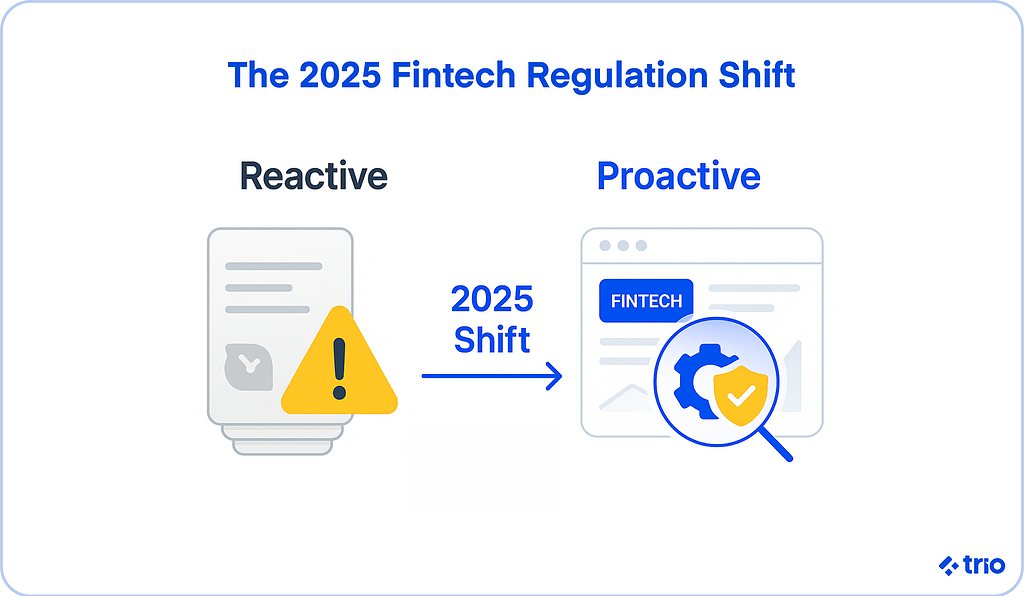
Regulation in fintech has become both broader and more granular.
You're no longer just dealing with financial licensing or anti-money-laundering rules. You also need to consider things like cybersecurity, data ethics, environmental impact, and even algorithmic accountability.
Consumers, investors, and governments alike have seen what happens when financial technology outpaces its safeguards, whether it’s as simple as payment apps mismanaging funds or as complex as AI developing biases no one notices. Regulators are responding quickly and becoming less forgiving.
For you, this means compliance needs to be built into your applications from the ground up.
Traditional finance regulation was built around stable institutions, banks, insurers, and brokerages with physical locations.
Fintech is, in many ways, upending those assumptions. Your platform might move money across jurisdictions instantly, integrate third-party APIs, or use AI to approve loans in real time, none of which fits neatly into legacy rules.
Since the industry itself can change so quickly, its oversight needs to be fluid.
This is a big reason why regulations often tell you what outcome to achieve (like protecting consumer data or preventing fraud) but not exactly how.
In the United States, the Office of the Comptroller of the Currency (OCC), the Federal Reserve, the FDIC, and the Securities and Exchange Commission (SEC) dominate oversight, with individual states adding another layer through their own licensing regimes.
The UK continues to set a high bar through the Financial Conduct Authority (FCA), while the European Union is moving ahead with sweeping frameworks like MiCA for crypto-assets, PSD3 for payments (previously PSD2), the General Data Protection Regulation (GDPR) as a multi-nation privacy policy, and DORA for operational resilience.
In the Asia-Pacific region, Singapore's Monetary Authority (MAS) and India's Reserve Bank (RBI) are defining what responsible open finance looks like, while Australia's Consumer Data Right (CDR) pushes for greater data portability.
We’re also seeing a lot of emerging markets in Latin America and Africa that are experimenting with hybrid regulatory sandboxes to balance inclusion with consumer protection.
Regulation is no longer confined to financial soundness. You're now expected to demonstrate resilience across a wider spectrum: data protection, cybersecurity, operational continuity, and even environmental and social governance.
Governments want transparency and traceability across every digital transaction as part of their overall risk management, which means that you are going to need to ensure auditability and explainability in everything.
Regulators are no longer content with broad principles or good intentions.
They expect to see operational evidence that your systems, processes, and teams are aligned with established rules.
That shift has turned certain components of fintech regulation into non-negotiable foundations for doing business.
Depending on your product type (payments, lending, digital banking, or investment services), you're likely to need one or more licenses before you can even onboard customers.
What complicates matters is that fintech business models often cut across regulatory categories.
A single platform might require payment processing approval in one country, a money-lending license in another, and a data-protection registration somewhere else. Even the process of applying can be unpredictable; some jurisdictions take months to assess, others years.
In practice, this means you need a licensing strategy that evolves with your roadmap.
You're responsible for understanding the purpose behind transactions, monitoring for suspicious patterns, and reporting anomalies in near real time.
This expectation is accelerating the adoption of AI-driven AML monitoring and biometric KYC solutions.
They promise better accuracy, but also raise new challenges around bias and explainability. The key is balance: your compliance tech should enhance human oversight, not replace it.
What's changing is the pressure for continuous due diligence that involves ongoing identity validation, where user profiles are re-verified automatically as behaviors shift.
Considering the amount of sensitive information you are dealing with, it’s no surprise that you're now expected to prove not only that your systems are secure, but that your entire data lifecycle, from collection to deletion, respects user consent and legal boundaries.
The EU's GDPR remains the global benchmark, but frameworks like California's CCPA, Brazil's LGPD, and Singapore's PDPA are shaping regional expectations.
The trend is toward convergence: privacy-by-design and encryption-at-rest are becoming baseline rather than best practice.
Cybersecurity, meanwhile, is evolving from IT hygiene to a regulatory mandate.
The Digital Operational Resilience Act (DORA) in the EU, for instance, requires you to maintain detailed incident-response protocols and demonstrate resilience testing.
Payment infrastructure is where compliance and technology collide most visibly. Regulators now look closely at settlement times, chargeback handling, fraud detection, and how quickly you can recover from a system failure.
A brief outage, even one that is entirely out of your control, can disrupt thousands of payments and trigger regulator inquiries within hours. That's why redundancy, backup systems, and auditable reporting mechanisms are no longer optional.
Some jurisdictions have codified these expectations.
In the UK, the FCA's operational resilience framework requires critical business services to remain within defined “impact tolerances.”
In the U.S., the Federal Reserve's guidance on third-party risk pushes fintechs to vet every vendor that touches their transaction flow, a topic significant enough that it gets its own section below.
Open banking regulation aims for users to be able to share their financial data securely across institutions through standardized APIs.
This principle is being expanded under PSD3 in Europe, the UK's Open Banking Roadmap, and Australia's Consumer Data Right.
As a fintech, you need compliant data-sharing APIs, as well as strong consent frameworks, encryption standards, and clear liability protocols. If a breach occurs after you've shared data with a third-party provider, regulators want a clear contractual answer for who's responsible.
Most fintechs don't run their own bank charter. It’s just too expensive and resource-heavy, so they partner with a sponsor bank, or they plug into a vendor's ledger, KYC engine, or payment rail.
Regulators hold the bank responsible for what happens inside that partnership, which means your fintech's compliance posture is effectively part of your bank partner's compliance posture too.
On September 11, 2026, the OCC, the Federal Reserve, the FDIC, and the National Credit Union Administration jointly proposed new interagency guidance on third-party risk management. If finalized, it would replace the 2023 Interagency Guidance.
Rather than tightening the screws further, the agencies want oversight to scale with actual risk, moving away from what they've acknowledged became a checklist-driven approach that treats every vendor relationship the same regardless of how much harm it could realistically cause.
What this means for a fintech evaluating partners or being evaluated as one:
Compliance is quickly becoming a strategic asset.
We've seen firsthand how the fintechs that invest early in scalable compliance frameworks win trust, attract investors, and expand faster into new markets.
When users hand over their data or their paycheck, they're extending faith that your system will protect them, making trust essential to maintain.
Regulators view that same trust through a different lens, requiring proof of sound governance, transparent reporting, and consistent adherence to law.
One of the best ways to earn trust on both ends is by publishing clear data-handling policies, responding promptly to regulator requests, and communicating security practices publicly, all of which contribute to credibility.
Even small steps, like publishing third-party audit results or listing compliance certifications, could provide some improvement as they signal maturity.
Many of the forward-thinking fintechs we work with want to use compliance as part of their product differentiation.
Automated transaction monitoring, transparent fee structures, and user-controlled data permissions all translate directly into customer confidence. In turn, this can accelerate business deals.
Institutional partners and enterprise clients increasingly prefer vendors that demonstrate strong governance frameworks.
Regulators worldwide have become quite aggressive in issuing fines, suspensions, and public reprimands.
A single case, like the FTX matter that produced a $12.7 billion penalty in 2024 alone, can outweigh years of smaller actions, and firms in fast-growing categories like digital assets remain disproportionately represented in the largest fines.
On top of all of that, loss of trust spreads faster than any formal sanction. Once customers associate your brand with negligence, or regulators list your name in an enforcement bulletin, rebuilding credibility becomes an uphill battle.
Solving compliance is about designing smarter systems that evolve as the rules do.
When you treat compliance as an architectural function rather than an administrative one, it becomes a growth enabler instead of a constraint.
Regulators are rethinking how oversight should work in a digital, data-driven economy.
Regulators increasingly expect real-time visibility into your systems.
This shift toward continuous monitoring, already evident in financial crime prevention, transaction reporting, and now third-party oversight, is spreading into cybersecurity, data governance, and consumer protection.
Static compliance snapshots just can't capture dynamic risks, but a shift to real-time monitoring tools can flag suspicious activity, compliance breaches, or data anomalies as they occur.
You’ll need to invest in architecture that supports live reporting and automated alerts.
New tools lean on machine learning for credit scoring, fraud detection, and investment recommendations; regulators are insisting on greater explainability.
If your model denies a user a loan, you may soon need to explain why in terms a non-specialist can understand.
The EU's AI Act is leading the charge here, with high-risk rules for credit scoring now phased to apply from December 2027, and similar requirements are emerging in the UK, Singapore, and the U.S.
You need to be able to serve clients no matter where they live, but regulators are tightening control over how and where user data travels.
Data localization rules, which require information to stay within national borders, are expanding in markets like India, Brazil, and China.
At the same time, other jurisdictions are emphasizing data portability, the user's right to move their information freely between platforms. These goals often conflict, forcing you to reconcile contradictory demands: keep data local, but make it portable.
This means you will probably need to architect systems that process data locally but synchronize globally through controlled APIs.
Environmental, Social, and Governance (ESG) disclosure is being regulated more.
For example, some financial institutions are now expected to demonstrate that their products and investments align with sustainability goals.
For fintechs, this translates to new reporting expectations, tracking the environmental footprint of digital transactions, measuring social impact, or verifying the ethical sourcing of data and vendors.
There is an opportunity here, since transparent ESG disclosures can attract mission-driven investors and open access to “green” financing programs.
Governments are launching national ID schemes, blockchain-based identity registries, and interoperable credentials designed to make onboarding faster and safer.
This is a double-edged sword since stronger identity verification can reduce fraud, but it also raises questions about data control and interoperability.
If your app connects with external identity providers, you'll need airtight consent management and compliance with whatever local identity laws apply.
Artificial intelligence is becoming an indispensable tool to help you ensure compliance.
The RegTech sector has exploded in recent years, offering tools that can help you manage everything from AML screening to API auditing.
But what this is affecting most is scalability.
Instead of bolting on separate systems, modern RegTech platforms integrate directly with your core architecture, feeding data into unified dashboards, which ends up reducing duplication, simplifying audits, and providing real-time assurance across multiple jurisdictions.
We’re also seeing many fintechs that now run “compliance control centers” built from RegTech components, giving executives and regulators alike a clear view of compliance health.
The next few years will determine how much control fintechs retain over their innovation cycles and how well they adapt to synchronized global standards.
We’re already seeing the start of a global harmonization, with bodies like the Financial Stability Board and IOSCO pushing shared frameworks for cyber resilience, AML, and operational continuity.
Hopefully, this is going to lead to fewer conflicting requirements over time, even if it comes with higher expectations for precision.
The industry is moving toward continuous oversight, ethical transparency, and shared accountability across borders, and toward third-party relationships, as we've seen this year, being judged by their actual risk rather than treated uniformly.
For you, the opportunity lies in building systems and cultures that treat compliance as part of innovation.
Trio has seen firsthand that when compliance becomes a design principle rather than an afterthought, fintechs grow faster, attract more trust, and withstand market volatility with confidence.
If you need the developers to make sure you are compliant with all existing regulatory frameworks and that you are ready to navigate the future with ease, get in touch to see if we have the right fintech developers for you.