

 Read Client Stories




 Alex Kugell
 Key Takeaways
- Go’s core appeal for a developer is concurrency (goroutines and channels), a small standard library surface to learn, and a compiler that catches mistakes most dynamic languages let through.
- The most defensible learning path runs basics, then a real project, then concurrency and tooling, in that order.
- Go 1.26, released February 2026, is the current major version. Interview questions increasingly touch its newer garbage collector and generics changes.
- US salary data for this role ranges roughly from $110K to $140K across major aggregators, with senior cloud-infrastructure specialists well beyond that.
- Go is common in fintech backends specifically (payments APIs, ledger systems, fraud pipelines) because of its performance under concurrent load.
Go, often called Golang because the go.dev domain wasn’t available when the project started, has become one of the more dependable paths into backend and infrastructure work.
We’ve seen it become incredibly popular in recent years, especially in industries like fintech.
This could be because the language itself is simple by design, but it’s also important to note that the ecosystem around it (cloud-native tooling, high-throughput services, and fintech backends) rewards developers who go past the basics.
Let’s take a look at what the role of Golang developer actually involves, the skills worth prioritizing, and a realistic path from the first line of Go to job-ready.
To connect with skilled Golang developers with production experience working with enterprise-level fintech software development companies, request talent.
What Is Golang and Why Become a Golang Developer
Golang is an open-source language Google released in 2009, designed by Robert Griesemer, Rob Pike, and Ken Thompson.
One of the biggest appeals of Go is that it’s statically typed and compiled, which catches a category of bugs at build time that dynamically typed languages only surface at runtime.
On top of this, the syntax stays deliberately minimal.
Go skips inheritance and several features found in more verbose languages, which shortens the learning curve but also forces a different way of structuring code, which is built around composition and interfaces rather than class hierarchies.
Automatic memory management (garbage collection) removes manual allocation from the picture entirely.
In our experience, the feature that usually decides whether someone sticks with Go is concurrency.
Goroutines, lightweight threads managed by the Go runtime rather than the OS, make it realistic to run thousands of concurrent operations without the overhead of traditional threading.
This is also why our developers like to use Go for cloud infrastructure. This sentiment seems to be universal, as Docker and Kubernetes are both written in Go, and companies handling high-throughput payment or event systems tend to reach for it for the same reason.
Golang Developer Roadmap
A workable path to becoming a Go developer looks roughly like this, in order:
- Learn the fundamentals: Syntax, data structures (slices, maps, structs), and control flow. This part is genuinely fast to pick up if you’ve used any C-family language before.
- Build something real: A small API, a CLI tool, anything that forces you past tutorial code. This is where the standard library actually starts to click, and where gaps in understanding surface.
- Learn concurrency properly: Goroutines, channels, and the sync package. This is the part of Go that’s genuinely different from most languages, and it’s also where interview questions concentrate.
- Pick up the tooling: go test, pprof for profiling, go mod for dependency management, and enough of the go fix modernizer (new as of Go 1.26) to keep code current as the language evolves.
Never skip step two. Whether you are building your skillset or looking for a developer, real experience is essential.
Mastering Golang Development Tools and Techniques
Go’s command-line tooling covers most of what a developer touches day to day: go run, go build, go test, go fmt, go get, and go mod. Knowing when to reach for each one is arguably the most essential factor.
Packages are Go’s organizational unit. Everything lives in one. Naming conventions matter more here than in languages with heavier module systems, since Go’s tooling leans on convention rather than configuration.
For APIs specifically, the standard library’s net/http package handles most needs without a framework, though third-party routers like gorilla/mux or chi are common once route complexity grows.
Interfaces in Go are satisfied implicitly. This means a type doesn’t declare which interface it implements; it just needs the right methods.
While this takes some adjustment if you are coming from languages with explicit interface declarations, it’s also what makes Go’s composition model work as cleanly as it does.
Advanced Concepts and Best Practices
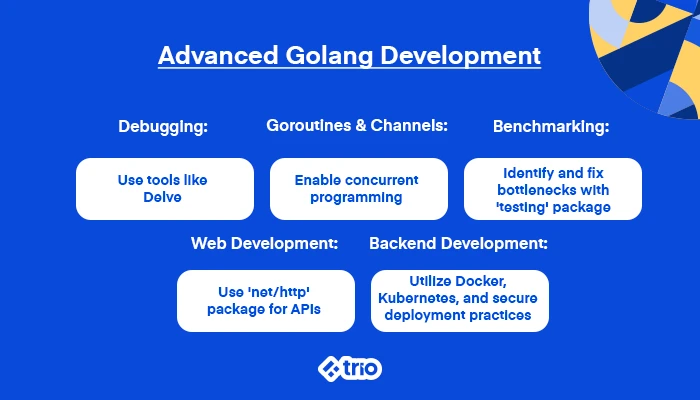
- Debugging: Delve is the standard debugger for Go, supporting breakpoints and variable inspection. Explicit error handling (checking every returned error rather than relying on exceptions) is as much a debugging practice as a language feature, since it forces failure modes into the open early.
- Concurrency in practice: Goroutines and channels do the heavy lifting, but you still need to know about failure models like goroutine leaks (a goroutine that never exits, quietly consuming memory) and race conditions from an unsynchronized shared state. The context package is the standard way to propagate cancellation across a tree of goroutines.
- Benchmarking: Go’s built-in testing package supports benchmarks directly. A function prefixed with Benchmark, run through go test -bench, gives you real numbers instead of guesses about where time is going.
- Backend and web development: Go’s performance and concurrency model make it a strong fit for backend services generally, and specifically for systems that need to hold up under concurrent load, APIs, event processing, and payment infrastructure. Containerization with Docker and orchestration with Kubernetes are standard here.
Most Important Golang Developer Skills
Outside of pure language proficiency, there are a few areas that separate a job-ready Go developer:
- Cloud-native fundamentals: Working knowledge of AWS, GCP, or Azure, plus Docker and Kubernetes, since most Go roles sit inside cloud infrastructure.
- Microservices architecture: Service decomposition, inter-service communication patterns, and data consistency across services, since Go’s concurrency model is frequently the reason a team chooses it.
- Performance profiling: Comfort with pprof and benchmarking to find actual bottlenecks rather than guessing at them.
- Current language features: Go ships roughly two major releases a year, and Go 1.26 specifically introduced a new default garbage collector and changes to generic type constraints. Staying current is essential.
Building a Golang Career
Contributing to open-source Go projects is a great way to demonstrate skill, since the code and the review discussion are both public.
GitHub is the default place to find projects that need help, and a documented contribution history tends to carry more weight in interviews than a portfolio of solo projects.
Networking, through meetups, conferences, and Go-specific online communities, is consistently cited as one of the more reliable paths to a first Go role, since a fair share of hiring happens through referral before a job ever gets posted publicly.
Job boards (LinkedIn, Indeed, Glassdoor) remain useful for volume, and going directly to a target company’s careers page works when you already know where you want to land.
If you’re building toward fintech specifically, Go’s concurrency model and performance under load make it a common choice for payment processing, ledger systems, and fraud detection infrastructure, which means fintech-specific experience (even from personal projects) tends to stand out on a resume aimed at that industry.
Related Reading: Golang Development Company
Final Thoughts
Go rewards developers who build real things early rather than staying in tutorials, and who take concurrency seriously rather than treating it as an advanced topic to defer indefinitely.
The language itself is stable and won’t demand constant relearning, but the ecosystem around it (cloud infrastructure, tooling, and the standard library’s evolution) does reward staying current.
If you’re looking to hire Golang developers rather than become one, particularly for fintech-specific backend work, that’s a different problem with a different answer, and one we can help with directly.