

Fintech companies feel a particular kind of pressure when it comes to a product roadmap.
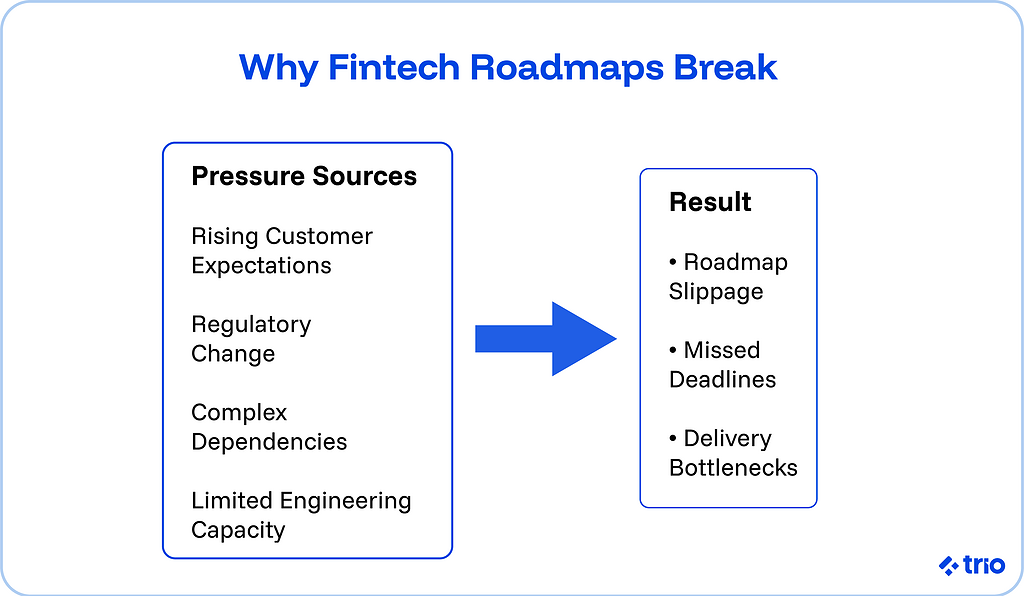
Customer expectations keep rising, compliance is always shifting, and the business wants faster delivery without a matching increase in time and resources.
Most product leaders probably recognize the moment when the roadmap looks good in theory but starts slipping once it hits real constraints.
It may appear that hiring more high-level engineers is the only way out. After all, more people should mean more throughput, which should mean fewer missed deadlines.
The trouble is that hiring in fintech takes time.
A new developer needs access approvals, security onboarding, and a crash course in the product vision, regulatory constraints, and complex dependencies.
Even strong hires need weeks before they can move the needle. Meanwhile, your product roadmap keeps growing.
Suppose you’ve felt that tension, you’re not alone.
We’ve seen it on small product teams and on larger ones, and the pattern is surprisingly consistent.
The good news is that you can still hit roadmap deadlines without hiring if you adjust how you create a product roadmap, how you prioritize work, and how your team executes (agile development).
Let’s look at a practical, modern product approach that a product manager or engineering leader can apply right away.
These ideas draw on product management best practices and on Trio’s experience helping fintech teams build a product roadmap that aligns with business goals and avoids the pitfalls of timeline roadmaps.
If you want to hire experienced fintech developers to assist with your own roadmap, with the skills to be productive from the first few days, we can assist through hiring models like outsourcing and staff augmentation.
Why Traditional Deadline-Driven Roadmaps Fail Small Fintech Teams
It helps to start with why timeline roadmaps aren’t doing teams any favors.
A typical timeline roadmap, at least the ones we have seen in smaller companies, often looks more like a long list of features with estimated dates than a guiding product strategy.
On paper, it reads clean and organized. In practice, it’s usually rigid and fragile.
Timeline roadmaps assume stability. Fintech rarely offers that.
Regulatory changes show up without warning. A banking partner updates an API with tighter constraints. Fraud patterns change and require a different flow.
All of this happens while the product team is still trying to hold to the dates on the top of your roadmap.
The trap of rigid timelines and feature lists
Once a date is attached to a deliverable, people naturally treat it like a promise.
That isn’t necessarily wrong, but it becomes a problem when teams attach dates too early or without enough confidence in the level of detail.
A timeline roadmap forces the team to commit before it understands customer pain points, technical risk, dependencies, or hidden work that may surface later.
It may suggest control, but in many cases it simply masks uncertainty.
How rigid deadlines create ripple effects that slow everything down
Fintech teams working under a long string of hard deadlines often end up dealing with unintended consequences.
One late integration can cause a chain reaction that affects the next initiative in the roadmap. Teams rush to hit the next milestone, cut a corner, or skip testing.
That pattern eventually leads to missed deadlines, more defects, and slower overall product development.
The irony is that the more a company pushes to meet a deadline, the more likely it becomes to miss the next one.
Why hiring is rarely the quick fix it appears to be
Hiring new engineers sounds like the obvious solution, but most product managers know that onboarding in fintech takes time.
Security training, data-handling protocols, domain knowledge, and compliance practices all require careful attention.
Even the most talented engineer needs time to learn how a payment flow is structured or why a specific risk rule exists.
If your immediate challenge is a product roadmap slipping today, hiring won’t meaningfully accelerate the next few cycles. A product team often ends up with more coordination overhead instead of more output.
The real opportunity isn’t simply adding more people. It’s building a product roadmap that aligns with business objectives, keeps everyone on board, and avoids the pitfalls of overcommitment.
Shift to an Outcome-Oriented Roadmap
A more reliable approach starts with changing how you think about a product roadmap.
Instead of using a timeline roadmap filled with specific features, consider a lean roadmap centered around outcomes.
This idea isn’t new, and teams that adopt modern product thinking often find it surprisingly effective.
An outcome-oriented roadmap focuses on what the business objective is and how the team can support it. It encourages everyone to think of your roadmap as a communication tool instead of a fixed list of features.
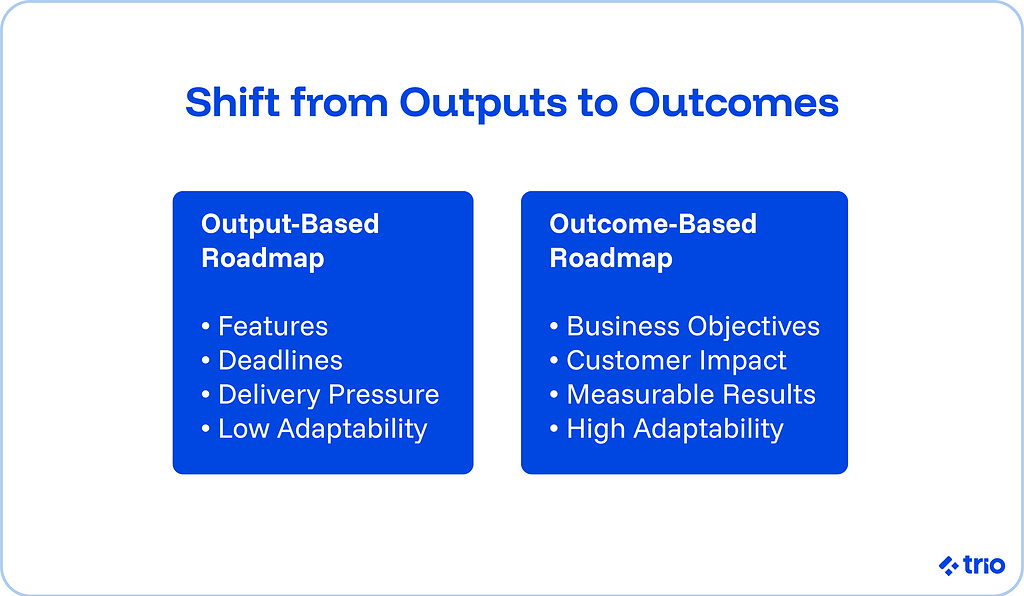
Replace feature delivery with measurable outcomes.
A list of features usually hides how the work contributes to strategic goals.
For example, a feature like “Add a new fraud alert screen” doesn’t capture whether the real business objective is to reduce false positives or to increase approval rates.
When a product team clarifies outcomes first, it becomes much easier to decide which initiatives matter and which ones can wait.
This approach creates a product roadmap that aligns with business goals instead of filling up space with specific features that may not address customer pain points.
Why outcomes work better than outputs
Outcomes give teams room to find the right solution.
A product manager may suggest one design, but through discovery, the team finds a simpler deliverable that achieves the same result. That flexibility improves predictability and reduces wasted work.
The team also gets a clearer view of whether the roadmap is achieving its intended results.
You can use OKRs to measure whether an outcome was met and adjust if needed. This tends to keep the roadmap grounded in reality rather than guesses.
Examples of fintech-friendly outcomes
To make this concrete, here are a few outcomes that appear often in fintech:
- Increase document verification pass rates
- Lower time to fund a loan
- Improve card authorization stability during peak traffic
- Reduce manual reconciliation steps in the dashboard
Each one connects directly to a business objective and invites the team to uncover the simplest initiative that will move the needle.
Use a Now Next Later Roadmap for Flexibility and Focus
Once you shift to outcomes, you need a roadmap format that supports it.
Many modern product teams use the Now Next Later structure.
It feels simple, but it removes the pressure of timeline roadmaps and lets you communicate priorities without a rigid timeline at the top.
This approach appears frequently in product management circles because it provides clarity without tying work to arbitrary dates.
Why this structure fits small teams especially well
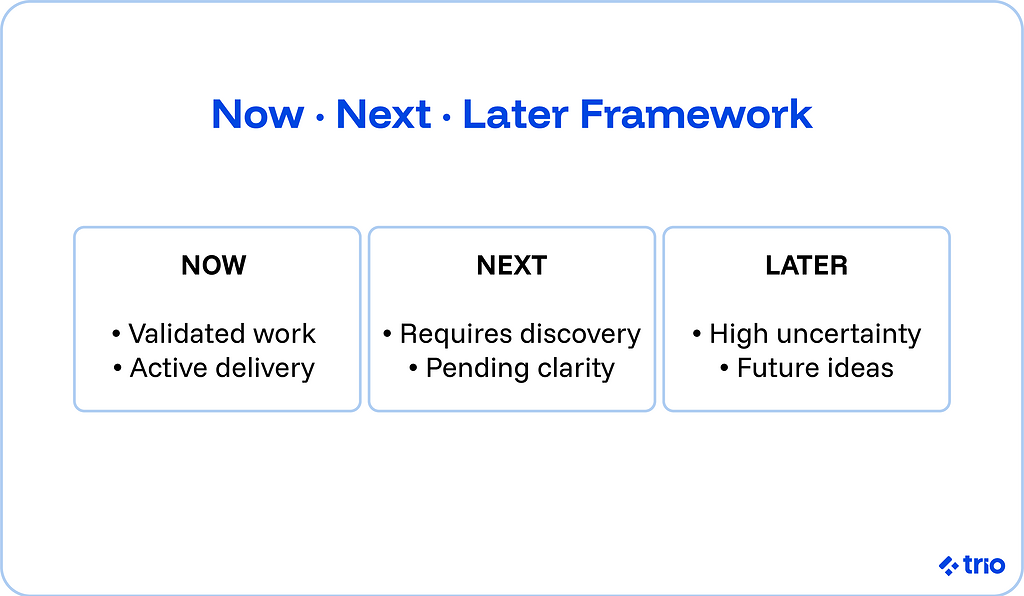
A Now Next Later product roadmap helps because it organizes work by priority and confidence.
There’s room for uncertainty, which is something fintech teams face nearly every week. You still give stakeholders visibility into the product vision and product strategy, but you avoid moving forward without enough information.
The lack of fixed dates doesn’t mean the team avoids commitment. It simply means the product manager chooses the right time horizons for commitments instead of making them too early.
Breaking down the three time horizons
- Now: These initiatives have been validated. The team understands the dependencies, the scope, and the customer pain points. This is active work.
- Next: This is the space for work that appears promising but isn’t ready for the top of your roadmap. You may need more discovery, user feedback, or technical research before committing.
- Later: This category holds ideas that may be worth exploring but carry uncertainty. A roadmap like this avoids treating everything as urgent, which is a common trap.
How does this structure reduce the need for more engineers
A lean roadmap of this kind naturally limits parallel work, which is one of the biggest sources of slowdown.
The team can finish an initiative before starting the next one, freeing up capacity and avoiding the stress of juggling too many deliverables.
It’s also easier to get everyone on board because the roadmap provides a shared view of what matters now versus what can wait. That keeps everyone aligned and avoids unnecessary escalations.
Translate Strategy Into Execution Without Increasing Headcount
A product roadmap, even a great roadmap, only helps if execution stays focused.
Hitting deadlines requires consistent habits within the product team and the engineering group. Trio has seen this firsthand when supporting fintech clients.
The strongest product roadmapping decisions only hold up if the day-to-day work is steady.
Break work into slices that surface risk early.
Large projects hide risk. We have watched teams underestimate an integration because it looked simple in the roadmap template, only to run into issues with authentication, inconsistent API responses, or third-party delays.
Smaller slices help the team find these headaches earlier, not three weeks before a deadline.
Thin slices also make it easier to adjust if an initiative turns out to be more complex than expected.
Prioritize by value instead of noise.
Most teams know that prioritization matters, but it’s surprisingly easy to fall back into a list of features the loudest stakeholder asks for.
Instead, consider how each initiative supports the business objective or OKR. Ask whether the work will move a key result or solve a meaningful customer pain point.
Even one cycle of this kind of discipline usually reveals things that can be removed completely.
Use engineering practices that speed up delivery.
Small product teams can work quickly when their environment supports them.
Teams build momentum when they automate testing in areas that cause frequent regressions or set up a development dashboard that handles common tasks.
Practices like continuous integration, reusable components, good test coverage, and a consistent definition of done all reduce friction.
A product manager rarely drives these directly, but a product roadmap to coordinate work benefits from them.
Plan using real capacity, not ideal guesses
One habit that makes a big difference is planning based on real velocity.
A product team that consistently ships a certain number of tasks or points won’t magically double output. Planning that way almost always leads to missed deadlines.
Using real capacity keeps the roadmap format honest. You avoid overcommitting and maintain enough buffer to address surprises.
When Hard Deadlines Matter and How to Meet Them Without Hiring
Some deadlines aren’t negotiable.
Regulatory requirements, partner migrations, and compliance deadlines appear regularly in fintech products.
A lean roadmap can still support these needs without turning into a rigid timeline roadmap.
Identify which dates are real commitments.
If a banking partner is sunsetting an API version, the date is fixed. If your compliance team needs an AML update before a review, that’s fixed.
These are the exceptions, not the norm, but they do exist and shouldn’t be handled casually.
The team should understand that a handful of deliverables carry true deadlines, and everything else is structured around them.
Separate roadmap planning from release planning
A product roadmap communicates direction. A release plan communicates timing. When teams mix them together, every initiative starts looking like a deadline.
Creating a roadmap separate from the release plan makes the roadmap more stable. The release plan carries the milestone dates and the timeline.
This keeps expectations clear and ensures your product is headed toward measurable outcomes without the noise of premature commitments.
Use milestones sparingly
When everything has a milestone, nothing feels important. Mark only those items that truly depend on specific timing.
This helps teams stay calm and gives them the right level of detail to make decisions.
Keep a Small Team Aligned and Accountable Without Hiring
A small product team can deliver at a surprising pace if it stays aligned.
When everyone understands why something matters, how it connects to strategic goals, and who owns which deliverable, things move more smoothly.
Revisit priorities every week.
The Now Next Later roadmap makes it easier to have shorter conversations about what matters.
Even a fifteen-minute check-in helps the team course-correct.
This kind of light process often works better than a long planning meeting every quarter.
Keep feedback loops short.
Short feedback loops help you find issues early.
Whether it’s a small internal demo, a beta test with a subset of users, or a quick stakeholder review, the idea is simply to catch problems before they become expensive.
It also ensures your product roadmap, which aligns with reality, stays current.
Encourage cross-functional collaboration
Fintech relies on more than product and engineering.
Compliance, design, risk, security, and operations all influence product decisions.
A product roadmap to coordinate across these groups helps everyone understand what’s happening and how their work fits into the big picture.
We have noticed that teams that involve these roles early almost always avoid surprises later.
Where Trio Fits Into a Lean Roadmap Without Growing Headcount
While this article focuses on how to build a roadmap without hiring, some teams eventually need more support.
Trio helps companies extend their product team with experienced engineers who already understand modern product development practices.
These developers are familiar with product management workflows, fintech compliance, scalable architecture, and the technical constraints that often slow down product roadmapping efforts.
Extend your team without permanent overhead.
Trio offers specialized engineers who integrate quickly.
They don’t need months of onboarding to operate safely in a regulated environment.
This lets companies add capacity temporarily without expanding headcount.
Fintech experience that reduces risk
Many Trio developers have built payment flows, lending systems, fraud detection tools, or secure onboarding experiences.
That background means they can move immediately into initiatives that matter. It also improves the quality of product decisions because they understand what is realistic.
Predictable delivery supported by practical habits
Trio engineers follow habits that support a lean roadmap, such as documenting edge cases, clarifying dependencies early, and raising questions before they turn into blockers.
They understand how a roadmap helps the team maintain focus and how to keep everyone aligned across disciplines.
Common Pitfalls That Cause Teams to Miss Deadlines
Even with a strong roadmap, a product team can still fall into patterns that slow things down.
Recognizing them early helps avoid unnecessary friction.
Treating Now, Next, and Later like a timeline
If someone treats the Next column like a commitment to specific timing, the roadmap loses its flexibility.
Remind stakeholders that it’s a way for people to understand priority, not timing.
Letting the Later bucket grow endlessly
A Later category needs a review every so often.
This keeps it useful and avoids overwhelming the product manager with too many ideas.
Setting too many deadlines
If every initiative becomes urgent, the roadmap forces the team to split attention.
This often results in missed deadlines, inconsistent product development, and frustration.
Building features without clear outcomes
When an initiative lacks a measurable outcome or key result, the team can’t tell whether the work is finished or if it supports the product vision.
This leads to unnecessary iterations.
Ignoring technical debt entirely
You don’t need to fix every issue immediately.
Still, a product manager should understand that completely ignoring technical debt makes future cycles harder.
Conclusion
Hitting roadmap deadlines without hiring more people is possible when the roadmap format changes and the team focuses on outcomes.
A product roadmap provides direction, but a lean roadmap rooted in outcomes and a Now Next Later structure helps teams make decisions confidently.
By planning with real capacity, keeping feedback loops short, and focusing on collective priorities, a small product team can deliver consistently even in a complex fintech environment.
And if you eventually need help with a specific initiative or integration, Trio can offer focused engineering support that blends into your workflow without long onboarding delays.
Get in touch!
FAQ
How do you hit roadmap deadlines without hiring more engineers?
Hitting roadmap deadlines without hiring more engineers comes down to limiting scope, using a lean roadmap, and keeping priorities tight enough that the existing team can deliver with confidence.
What is a lean roadmap, and why does it help?
A lean roadmap helps because it focuses on outcomes instead of long feature lists, so teams avoid overcommitment and can adjust as they learn more.
How do you create a product roadmap that small teams can actually follow?
Creating a product roadmap that small teams can follow means choosing a lightweight roadmap format, clarifying outcomes, and reviewing priorities regularly.
Why do timeline roadmaps fail in fintech?
Timeline roadmaps fail in fintech because fixed dates rarely survive compliance changes, partner updates, or unexpected technical constraints.
What’s the benefit of using a Now Next Later roadmap format?
Using a Now Next Later roadmap format keeps the team focused on what matters today while letting future work remain flexible until you have enough information.
How do OKRs fit into a product roadmap?
OKRs fit into a product roadmap by linking initiatives to measurable results, which keeps work aligned with business goals instead of arbitrary dates.
How can a product manager keep stakeholders aligned without adding headcount?
A product manager keeps stakeholders aligned by sharing a clear roadmap, shortening feedback loops, and making sure everyone understands why priorities shift.