

Fintech leaders understand the struggle to put together a team that understands payment rails, regulatory requirements, and data sensitivity without pushing burn rate to unsustainable levels.
For most growth-stage fintechs, staff augmentation delivers faster time to market while maintaining full control of the product roadmap. It embeds pre-vetted specialists into your team within days without the overhead of full employment, such as healthcare benefits. And, it has the added benefit of providing the flexibility to scale your team up and down as you need it.
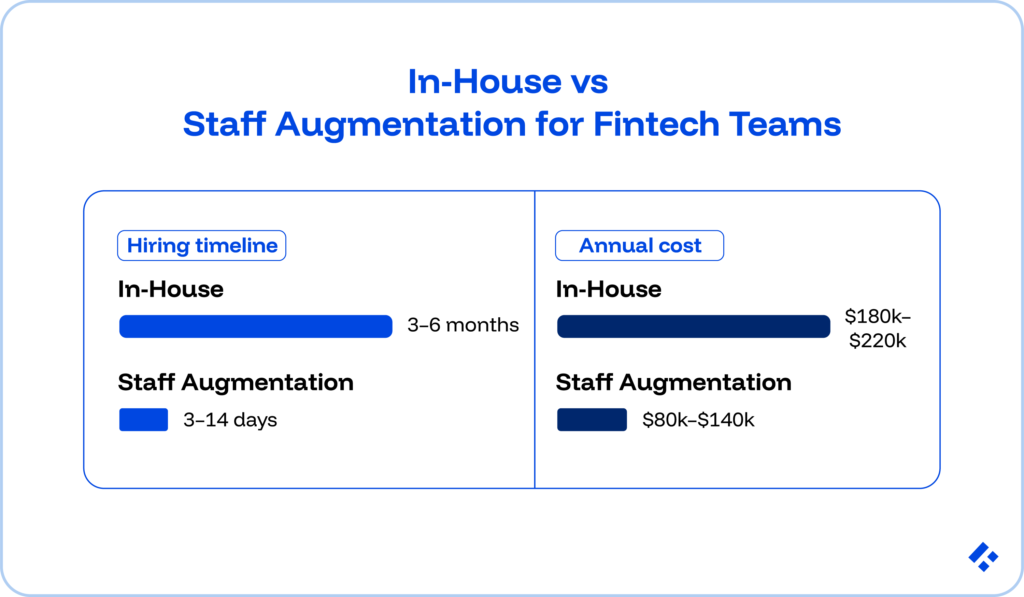
Whereas in-house hiring gives fintech companies full control, but it comes with some serious downsides. It typically requires 3–6 months and consumes resources that could be spent elsewhere.
Both in-house hiring and staff augmentation offer real tradeoffs, and neither deserves a blanket endorsement without context. Let’s break down everything you need to know about in-house vs staff augmentation for fintech with a numbers-first comparison, so you can decide which hiring model is the right fit for you.
What In-House Hiring Actually Costs a Fintech Company
Getting accurate cost expectations early helps you make the best decision for your fintech based on the resources that you have available.
Cost Breakdown of U.S. Fintech Specialists
Senior fintech developers in the U.S. cost roughly $129,000 per year (ZipRecruiter), with some salaries exceeding $159,000.
That figure tends to understate the real cost considerably. You need to factor in other out-of-pocket expenses, such as benefits (typically 18 to 25% of base salary), recruiter fees ranging from 15 to 25% of annual salary, onboarding overhead, and the 3 to 6 months a senior role commonly sits open.
Based on these estimates, largely based on what we have seen in the industry, the all-in annual cost of a single senior fintech engineer lands somewhere between $180,000 and $220,000.
Cost of Leaving Roles Open
Fintech roles also require specialists in PCI DSS, KYC/AML compliance, payment systems integration, security best practices, and more. You don’t want a generalist who will need to learn on the job.
The talent pool for compliance-ready software engineers gets even narrower when you consider real-world domain experience, and your hiring process has to reflect that.
A 3-month vacancy for a payment integration, for example, becomes a direct threat to a sprint timeline or a regulatory deadline. Often, this leads companies to make hasty decisions that backfire and put them even further behind.
The Hidden Costs of Building an In-House Fintech Team
All of this leads to three hidden costs that can be difficult to quantify: retention risk, compliance training burden, and hardware or HR overhead.
Retention risk occurs because of the high demand for a very niche skillset, which means that developers often field multiple competing offers. When an engineer leaves, they also take institutional knowledge with them, which your new hire will need to spend time learning.
Compliance training burden adds another layer. If you find a skilled engineer who might be able to complete all the technical tasks, but with limited fintech experience, you may need to spend as much as 4 to 8 weeks to reach productive velocity on compliance-sensitive code.
Skipping this isn’t an option either. Things like PCI DSS and KYC/AML shape architecture decisions, access control patterns, and the audit trail your next SOC 2 assessment will scrutinize.
Any gaps can result in fines and loss of trust in your user base.
Hardware, licensing, and HR overhead can accumulate quickly. Security tooling, compliance monitoring software, legal review of employment agreements, and benefits administration all arrive with full-time employees.
This is one of many areas where staff augmentation stands out.
Related Reading: Contract Developers vs Full-Time Engineers
How Staff Augmentation Works in Fintech
In staff augmentation, you get external engineers through an external partner, who join your existing team structure, working inside your sprints and using your tooling, without requiring benefits, recruiter fees, or the HR cycles that come with a direct hire.
Your engineering team and managers direct the work and own the architecture.
This hiring option is particularly attractive in fintech, where there are concerns around data sovereignty, regulatory accountability, and IP ownership, and where you may feel more comfortable with managing projects closely than outsourcing entire features.
Staff Augmentation vs Outsourcing vs Dedicated Teams
These three models get conflated often, so let’s ensure that you understand the differences.
Outsourcing hands off a project or function to an external team that manages delivery with minimal day-to-day involvement from you, with lower management overhead but significantly less control over how decisions get made.
Staff augmentation, as we have already mentioned, embeds individual software engineers inside your existing development team, giving you full control, but you also need to manage them on your end.
A dedicated fintech engineering team consists of a full pod of remote developers, often including a tech lead and project manager, that operates as an extension of your organization rather than as an outside vendor.
For fintechs managing active compliance obligations, either the augmentation model or the dedicated team model tends to be non-negotiable.
In-House vs Staff Augmentation: Direct Comparison
| Dimension | In-House | Staff Augmentation |
| Time to hire | 3–6 months average | 3–14 days with a specialist firm |
| Average cost (senior dev) | $180K–$220K all-in/yr | $80K–$140K/yr (no benefits/overhead) |
| Compliance expertise | Must train or wait to hire | Pre-vetted for PCI DSS, SOC 2, KYC/AML |
| IP & code ownership | Full ownership | Full ownership (contract-based) |
| Team control | Full (direct management) | Full (you direct the work) |
| Flexibility to scale | Slow — involves HR cycles | Fast — ramp up/down monthly |
| Culture fit | High (built over time) | Moderate — depends on partner vetting |
| Risk if an engineer leaves | High — knowledge loss | Lower — partner provides replacement |
When In-House Hiring Is the Right Choice for Fintechs
In-house development has some real advantages, and there are definitely some situations where it is the more suitable option.
Building in-house makes the most sense when institutional knowledge functions as a genuine competitive edge. In other words, this is the kind of hiring you’ll want to do when you don’t want these developers to go to other companies.
This could be things like cutting-edge payment routing logic, product engineers working on critical decisions, those working on compliance edge cases, and more. Transferring this information also takes time, so you don’t want to just add someone in halfway through a project.
Runway matters too. If your organization has 12 or more months of stable funding and isn’t facing an immediate delivery deadline, you can afford the time it takes for in-house hiring.
The higher long-term cost of in-house development often reflects a deliberate investment in stability and long-term architecture ownership.
Roles like lead architect and founding engineer also belong in-house regardless of the cost differential. These roles require someone with deep technical expertise embedded in the company culture, capable of making judgment calls that shape the product for years.
When Staff Augmentation Wins for Fintechs
Staff augmentation is great to address the gap that occurs when funding exists, and the roadmap has momentum, but the hiring process can’t keep pace with delivery expectations.
It’s also a great option for compliance sprint deadlines (SOC 2 prep, KYC build-outs, PCI audit cycles), post-funding hiring surges where time to market matters more than permanence, and engineer backfill during attrition where an open seat blocks a critical initiative.
In practice, savings are significant. From what we have been able to see, staff augmentation can drop software development costs by 30 to 50% compared to in-house equivalents, so if you are a startup struggling with resources pre-launch, it’s a viable way to cut costs.
And, of course, we have already mentioned how it offers a faster path to capacity than any recruiting cycle will.
The Case for Nearshore Fintech Staff Augmentation
Nearshoring, or augmenting your staff with developers from another nearby country, can compound these benefits, but also introduces some new challenges.
Timezone alignment with U.S. teams separates nearshore LATAM remote developers from offshore regions, like Africa.
Working in the same or adjacent time zones eliminates the coordination overhead that makes offshore arrangements frustrating in practice, such as async delays and 24-hour feedback loops on a simple code review.
Nearshore rates typically run 40 to 60% below domestic hiring costs, making this even more cost-effective than regular staff augmentation.
On top of that, you get access to an even broader talent pool. Brazilian and broader LATAM software engineers increasingly arrive with fintech domain expertise already in place, which reduces the compliance ramp-up time.
However, dealing with developers from other regions can introduce language barriers and differences in work culture. Nearshoring to LATAM minimizes these issues since most developers are fluent in English, and if you are hiring from a firm, they probably have international experience.
However, it’s best to access these things before making your final decision.
How to Evaluate a Staff Augmentation Partner for Fintech
Not all staff augmentation firms carry the same quality bar, and the differences matter more in fintech than in the generic software development market. Here’s what to evaluate before signing anything:
- Vetting depth. What percentage of applicants actually pass their screening process? Trio’s placement success rate sits at 97%, which suggests a meaningful screening bar rather than a volume-first sourcing model.
- Fintech domain specificity. Do their software engineers know Plaid, Stripe, FIS, or Temenos? Have they shipped PCI DSS-compliant systems before, or will your engagement be their first exposure to a regulated payment environment?
- Time-to-placement SLA. A staffing partner should be able to tell you, in days, how long placement takes. Trio’s typical onboarding timeline runs 3 to 5 days.
- Developer retention. High churn on the partner side carries a real cost. Every time an augmented engineer cycles out, institutional knowledge leaves with them. Trio holds a 95% developer retention rate.
- Contract flexibility. Early-stage fintechs should not be signing 12-month lock-ins with a staffing partner. Monthly contracts give you the ability to ramp up during a sprint push and ramp down when the initiative closes.
- Compliance accountability. Can the partner document their engineers’ familiarity with SOC 2, KYC/AML, and relevant payment security standards?
Related Reading: Fintech Recruiting Agency Alternatives
Verdict: Which Model Is Right for Your Fintech?
There are a couple of practical elements you can think about to make your final decision on which hiring model is right for you. Here are a couple of questions to ask yourself.
Need to ship in 30 to 90 days? Staff augmentation. The hiring process for in-house talent simply can’t clear that timeline reliably.
Building a 5-year core team with stable funding and no immediate delivery pressure? In-house development makes sense. The long-term cost runs higher, but institutional knowledge and cultural continuity compound.
Need a full engineering pod without the overhead of building it from scratch? A dedicated team gives you the structure of an internal development team without the HR and benefits overhead.
Somewhere in between? A hybrid model works is definitely an option! There is no reason why you can’t use in-house for core architecture and long-term roles, with staff augmentation covering specialist sprints, compliance build-outs, or capacity gaps.
Conslusion
Both in-house and staff augmentation are great hiring models for fintech when compared to more generic outsourcing, as they allow you to manage the project and ensure compliance when done correctly.
However, not every model is right for every fintech. Choose in-house hiring if you have the time and resources. Utilize staff augmentation to take advantage of cost-benefits and reduced hiring time.
If you are ready to start hiring and want to get in touch with vetted fintech experts who won’t need to learn about industry standards from scratch, we can help.
Book a decision call.
FAQ
What is staff augmentation in fintech?
Staff augmentation in fintech means embedding external, pre-vetted engineers directly into your existing development team. These developers, usually hired through an agency like Trio, work inside your sprints, use your tools, and report to your technical leadership, allowing you to keep full control of architecture, IP, and product direction.
How much does it cost to hire a fintech developer in 2025?
U.S.-based senior fintech developers command median base salaries of $129,000, with the total cost of employment, once benefits, recruiter fees, and overhead are factored in, typically running you anywhere from $180,000 to $220,000.
Is staff augmentation better than in-house for fintech startups?
For speed and cost control, staff augmentation is usually better than in-house development for growth-stage fintech startups, where hiring cycles routinely outlast delivery deadlines. That said, in-house development carries real advantages for core roles.
How quickly can you hire a fintech developer through staff augmentation?
Through a firm like Trio, you can hire a fintech developer through staff augmentation in 3 to 5 days from initial scoping to a placed engineer.
What is the difference between staff augmentation and outsourcing?
Staff augmentation embeds external engineers inside your team structure, with your technical leadership directing the work and retaining full control over architecture and delivery. Outsourcing transfers an entire project or function to an external team that manages its own process.