


 Read Client Stories




 Alex Kugell
 Key Takeaways
- The average fintech salary in the US sits at approximately $123,495 annually, with most professionals earning between $85,000 and $165,000 depending on role and experience level.
- Senior and leadership roles regularly exceed $200,000 when equity is included.
- For employers, the three specialist roles that appear most consistently as growth bottlenecks are risk engineering, payments scaling, and infrastructure reliability.
- For people starting a career in fintech, the most accessible entry points appear to be financial analyst roles, junior software development, and compliance analyst positions.
- Fintech career advancement tends to happen faster than in traditional financial institutions, partly because the industry’s growth rate creates roles faster than the talent pool fills them.
- Hybrid skill sets, where professionals combine regulatory fluency with technical execution, appear to command the highest premiums.
Generalists might prove enough to code, patch systems, and handle basic risk controls in the early days of your project. However, when complexity rises, hiring generalists creates issues across your fintech products.
Payment failures that frustrate customers, regulators asking more challenging questions, and systems buckling under peak loads can stall growth, trigger fines, or unsettle the board on the eve of a big funding round.
Risk engineers, payments scaling experts, and infrastructure specialists could be the difference between stumbling at scale or sailing through due diligence.
If you run a scaling fintech and need to understand which specialist roles to hire and when, keep reading. This information is also invaluable when exploring a career in fintech and wanting to understand the salary ranges, career paths, and skills that actually matter.
At Trio, we connect fintech companies with the specialist engineers they need. Since our talent pool is made up of pre-vetted engineers, we can place people in as little as 3-5 days. To make sure you get the right people on your team to help you ensure secure, scalable applications, request talent.
Understanding Fintech, Its Impact, and the Career Opportunity
At its simplest, fintech covers the intersection of financial services and technology.
It is a very broad field that spans everything from basic digital wallets to the complex rails that facilitate real-time payments, blockchain-based settlements, and AI-driven fraud detection.
In the past, fintech often meant moving fast and assembling solutions to stay ahead of a very competitive industry and reputable institutions like massive global banks.
However, fintech has changed in recent years as many financial applications have seen incredible success and growth to service large quantities of users.
There has been a greater emphasis on scalable reliability, compliance, and resilience.
Is Fintech a Good Career Choice?
The short answer is yes, particularly for people who can bridge finance and technology.
There are a couple of factors that make it a very attractive option for software developers:
- Salaries tend to run above basic software development roles, and there is often an equity upside for fintech specifically that you won’t even get at larger banks.
- Skills developed in fintech transfer well if you ever decide to move on from the industry.
- The pace of regulatory and technological change means career advancement can happen faster than in more static industries, as long as you are able to stay up-to-date with these developments.
The trade-off involves genuine complexity and pressure. Fintech roles may pay well, but they carry accountability.
You are dealing with users’ money, as well as other sensitive personal information. Mistakes can lead to massive fines and might even be enough to sink the company you are working for, increasing stress levels.
Growth of Financial Technology and the Career Outlook
Global payments volumes have climbed into the trillions, with real-time transactions accounting for an incredible $5.3 trillion.
Open banking regulations are also shifting rapidly.
We’ve watched them push firms into new integrations, and customer expectations for faster services show no signs of slowing.
The career outlook for fintech professionals reflects this momentum. Job growth runs at 11-12% annually, outpacing most industries.
That momentum creates opportunity, but also exposes weak points. You may need to devote an incredible amount of time and energy to stay on top of changes in even one part of the industry, so you will likely need to specialize.
Fintech Salary Guide: What to Expect Across Roles and Levels
Salary expectations shape career decisions, and the fintech sector offers meaningful premiums over equivalent roles in traditional financial institutions.
Here are realistic benchmarks based on Glassdoor and our observed industry data from 2025 and the first part of 2026.
Entry-level fintech roles:
- Fintech Analyst / Junior Financial Analyst: $65,000-$85,000
- Junior Software Developer: $70,000-$95,000
- Compliance Analyst: $60,000-$80,000
Mid-level specialist roles:
- Risk Engineer: $110,000-$145,000
- Payments Scaling Engineer: $120,000-$155,000
- Data Scientist (Fintech): $115,000-$150,000
- Compliance Manager / AML Specialist: approximately $99,000 median, rising to $130,000+ in multi-jurisdiction roles
- Cybersecurity Engineer: $120,000-$160,000
Senior and leadership roles:
- Senior Blockchain Developer: $150,000-$200,000
- Fintech Product Manager: $180,000-$272,000
- ML / AI Engineer (Fintech): $160,000-$220,000
- Fintech Leaders, Strategists, and Consultants: $300,000-$800,000+ including equity
Geographic location affects these ranges massively, and it is this fluctuation that we take advantage of here at Trio.
San Francisco, New York, and London command the highest base salaries, but remote-first fintech companies and fintech teams built with LATAM or African talent are able to access highly skilled developers at far lower costs.
At Trio, skilled fintech specialists from these regions can be hired at between $40 and $90 per hour, with no additional costs related to benefits or overhead.
Related Reading: Women in Fintech Engineering
Fintech Career Paths: From Entry Level to Senior Specialist
A career in fintech rarely follows a single linear trajectory. Since the industry is constantly adapting, the most valuable professionals tend to develop a core technical or functional skill and then layer in adjacent domain knowledge over time, keeping it up to date.
Here’s how the main tracks tend to look in practice.
Starting a Career in Fintech: Entry Points
The most accessible entry points for people new to fintech appear to be:
- Financial Analyst at a fintech startup: provides exposure to how financial products get built and evaluated, often with a clearer path to more specialized roles than equivalent positions at traditional banks
- Junior Software Developer: front or back-end development roles at fintech companies build the product fluency that later enables specialization in payments engineering, API security, or platform infrastructure
- Compliance Analyst: entry-level compliance work covering KYC reviews, AML transaction monitoring, and regulatory documentation builds the regulatory literacy that becomes extremely valuable at senior levels.
Graduate programs in financial technology, such as Pace University’s MS in Financial Operations and Technology or the Georgia FinTech Academy programs, are a good route for people coming from adjacent fields like traditional finance or computer science.
A business administration background combined with data analytics skills also opens several mid-level fintech paths without requiring a specialist MBA.
Career Progression: From Junior to Senior Fintech Roles
We have already mentioned how career advancement in fintech tends to happen faster than in traditional financial institutions.
A junior developer who builds fluency in payment rail architecture and settlement systems can progress to a payments scaling specialist within three to five years.
An entry-level compliance analyst who develops multi-jurisdiction AML experience tends to become a very hard-to-find specialist within the same timeframe.
There are also a good number of really great exit opportunities.
Skills developed in fintech transfer well to traditional financial institutions, consultancies, and tech companies.
Top Fintech Career Paths: Specialized Roles in Scaling Fintechs
As a general rule, we have found that the more specialized the skill set you need, the more difficult it becomes to find developers who combine technical depth with risk management acumen and the soft skills to operate in a regulated environment.
These specialists also command significantly higher salaries, which reflects genuine scarcity in the market.
Risk Engineering as a Fintech Career Path
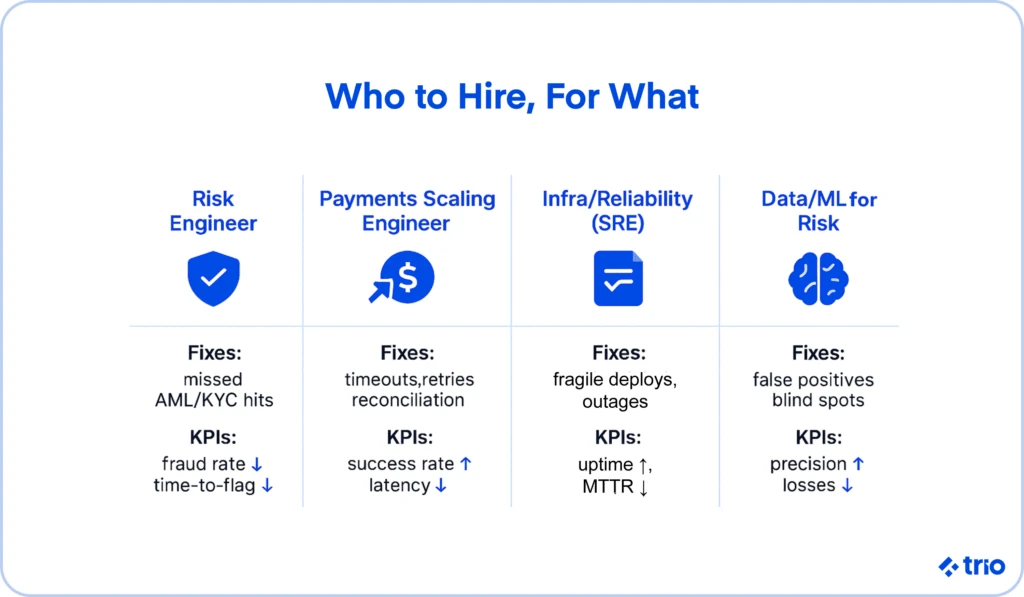
Risk engineering is in high demand due to rising fraud losses, missed AML alerts, and regulatory consequences, which represent problems most companies can’t afford.
A risk engineer’s role involves anticipating these vulnerabilities and building systems that close them before they widen. This combines coding fluency with regulatory literacy in a way that generic software engineering backgrounds rarely produce on their own.
- When to hire (employers): The first significant fraud incident, entering a new financial product category, or preparing for IPO-level audits.
- Career entry point: Data science or software development backgrounds with an interest in fraud detection or risk modeling. Data analytics fluency tends to be a prerequisite.
- KPIs: fraud detection rate, loss ratios, time-to-flag suspicious activity.
Payments Scaling Engineering as a Fintech Career Path
At a large scale, even small percentages of payment failures snowball into angry customers, social media complaints, and nervous investors.
Payments scaling engineers ensure every transaction clears quickly and reliably, even during volume spikes. This requires depth in real-time payment rails, settlement systems, and API resilience, not just generic backend experience.
- When to hire (employers): Expansion into new markets, crossing volume thresholds of hundreds of thousands of daily transactions, or when downtime creeps into uptime reports.
- Career entry point: Backend or API development with an interest in payment systems. Software engineering backgrounds with fintech product exposure provide the most direct route.
- KPIs: payment success rate, latency, and reconciliation accuracy.
Infrastructure and Reliability Engineering
Infrastructure specialists keep your systems standing under pressure. They design for uptime, redundancy, and fault tolerance.
- When to hire (employers): Downtime eats into SLAs, deployment slows due to fragile systems, or expansion requires multi-cloud or global infrastructure.
- Career entry point: Cloud engineering or DevOps backgrounds. Fintech-specific regulatory context, including how compliance requirements shape infrastructure decisions, tends to differentiate strong candidates from those with equivalent general infrastructure experience.
- KPIs: uptime percentage, mean time to recovery, deployment frequency.
AI, Machine Learning, and Data Science Roles
AI and machine learning specialists now appear consistently near the top of every fintech hiring priority list, driven by fraud detection, credit risk modeling, and regulatory reporting automation.
These roles tend to sit at the intersection of data science and domain knowledge.
A machine learning engineer who understands how a credit model interacts with AML regulations produces more defensible outputs than one who optimizes purely for model performance metrics.
- Career entry point: Data science, statistics, or quantitative research backgrounds. Fintech-specific experience with transactional data tends to accelerate progression significantly compared to ML experience in other industries.
Cybersecurity Specialists
Fintech cybersecurity engineers perform threat-hunting across SOC alerts, run vulnerability assessments on APIs and mobile apps, and build incident response playbooks aligned to PCI-DSS and SOC 2 controls.
Container security, zero-trust architecture, and AI-powered SIEM tools have become expected skills rather than differentiators at senior levels.
Certifications like CISSP or GIAC GSEC tend to accelerate career progression toward security architecture and CISO tracks, where compensation can exceed $200,000, including equity.
Fintech Product Management
Fintech product managers need to be able to consider factors like technical requirements, regulatory constraints, and customer experience.
They need strong communication skills, project management experience, working knowledge of regulatory constraints, and UX sensibility.
This role carries some of the highest compensation in the sector, which can likely be attributed to the vast array of skills that they need.
Skills Required for Fintech Jobs
Many skills are relatively unique to the fintech industry, spanning both technical and non-technical categories.
Many of these allow specialists to step into a complex environment and deliver from day one, instead of learning on your dime.
In-Demand Technical Skills for Fintech Careers
There are the basics, like Python or SQL fluency, but the skills that differentiate fintech candidates include:
- Designing systems that process millions of payments with minimal latency
- Building data pipelines that keep compliance dashboards current in near real time
- Hardening APIs against both performance bottlenecks and security threats
- Blockchain technology knowledge for DeFi and smart contract roles
- Machine learning model development for fraud detection and credit risk
- Cloud-native infrastructure expertise in AWS, GCP, or Azure
These skills matter most when paired with a clear understanding of the financial rails and regulatory environment underneath.
Compliance and Risk Skills
On the compliance side, the skills to prioritize cover:
- Direct experience with AML and KYC in multiple jurisdictions
- Familiarity with RegTech platforms and how to integrate them
- Comfort working alongside engineers, not just auditors, so controls don’t become bottlenecks
Navigating the Fintech Hiring Market
The gap between what candidates claim on a CV and what fintech teams actually need is where most hiring processes stall.
It’s easy for anyone to list blockchain or AI on their profile, but when it comes to production fintechs, very few can demonstrate how that skill scales a real payment system or survives a regulatory audit.
Risk, payments, and infrastructure are some of the most valued parts of the industry because everything else hinges on those three aspects.
We often see these roles become the bottlenecks as companies cross into late-stage growth.
Interviews should press on specifics:
- Ask about volumes they’ve supported, not just systems they’ve touched
- Request examples of how they handled conflicting requirements across regions
- Push for evidence of outcomes like lower fraud rates, improved uptime, and cleaner
You need some level of experience in the fintech field in order to vet correctly. This is where a partner like Trio comes in.
We have the in-house talent to be able to vet developers properly. They are then hand-picked by those same experts, based on your requirements.
Conclusion
Fintech engineers need industry experience, regardless of the specific career path.
When hiring, you need risk engineers who know how to prevent fraud before it happens, payments specialists who have kept transactions clearing at volume, and compliance experts who are able to reassure both regulators and your board.
For individuals, the fintech career path offers salaries above traditional finance equivalents, faster advancement, meaningful equity, and skills that transfer broadly across financial services and technology.
That’s where Trio fits in. We help fintechs of all sizes close talent gaps quickly, with specialists who understand the pressures of scale, compliance readiness, and board-level deadlines.
Our focus on hand-picking developers based on your specific requirements and making sure that our developers are thoroughly vetted by industry experts ensures that you get the right people from the start.