


Node.js is a JavaScript runtime environment that allows developers to perform both front-end and back-end web development. The 2022 Stack Overflow Developer Survey shows that Node.js is the second most wanted development framework among programmers.
Node.js simplifies the development of flexible and scalable servers while also enabling fast and lightweight JavaScript processing on the front end. Node.js allows developers to gain full-stack expertise rather than limiting themselves to conventional boundaries.
This article will show you how to design a Node developer job description and where to hire Node developers. You’ll also discover which Node.js interview questions to use to vet candidates.
It will also cover the necessary skills a Node.js developer should possess and the cost of hiring one. If you’re looking to get a new Node.js project off the ground or bolster your existing teams, you’ve come to the right place.
Why Use Node.js?
Node.js lends itself beautifully to building modern and future-ready real-time web applications that work seamlessly across devices.
Node.js differs from other frameworks due to the ecosystem around it. It is open-source, allows fast and flexible server-side development, and meshes well with JavaScript on the client side.
Besides having multiple performance and cost benefits, Node.js allows developers to build widely different applications, covering almost every industry and technology. The following are some of the benefits of using Node.js:
Performance
Node.js was developed by developer Ryan Dahl in 2009 on Google Chrome’s V8 JavaScript Engine. Node.js operates on an event-driven, non-blocking I/O model. This essentially means that it executes all functions asynchronously, without blocking any other request, making it efficient and lightweight.

Cost
Hosting and executing Node.js is much faster than comparable frameworks and uses less computational power, too, saving you precious dollars that can be better used in areas like talent recruitment and technological diversification.
Scalability
Node.js was built with scalability in mind. You can scale your applications both horizontally– adding additional machines– and vertically—upgrading existing machines. Developers can also utilize Node’s cluster module to better utilize the CPU to perform parallel processing.
Full-Stack Development
Developing in Node.js means you’ll be using a single codebase (JavaScript) for both client-side and server-side development. In addition to easier integration and communication, this also means less development overhead as you don’t need to hire developers from multiple disciplines.
SEO-Friendliness
Thanks to Node’s back-end rendering, websites benefit from increased visibility to search engines, boosting their SEO ranking. Node.js is, therefore, often picked by organizations to make webpages more SEO-friendly.
Cross-Functional Development
Node.js is widely used to develop APIs, IoT (Internet of Things) applications, real-time chatbots, and collaboration tools like Slack and Trello.
What Does a Node.js Developer Do?
Node.js developers are experts in building and maintaining network applications with Node.js. They should be skilled in JavaScript—both core JavaScript and its various libraries.
And Node.js developers rarely work alone. They often collaborate with front-end developers when integrating web-based applications, facilitating data exchange between servers and users, and developing back-end components.
The responsibilities of a Node.js developer can vary depending on the exact requirements of your project. But the broad responsibilities of an ideal hire can be summed up below:
- Write clean, robust, and reusable code
- Develop and maintain server-side components
- Integrate server-side and client-side components
- Identify the right data storage solutions
- Incorporate data protection and cybersecurity best practices
- Handle diagnostic testing, fix bugs, and provide technical support to users
- Document all software development processes
Also, don’t always go for the senior-most developers for every role. Highly-skilled developers might not work together as efficiently as you’d expect. Moreover, if you’re dealing with a small project, then developers with years of experience might be overqualified for your requirement.
What Are the Skills Needed for a Node.js Developer?
When you’re in the market to hire Node.js developers, you can’t just pick any Node developer who applies to the job. There are a variety of technical and soft skills that a potential hire should possess in order to stand out from the crowd.
Look for the following skills in your candidates when hiring developers for your Node.js development project:
Node.js Expertise
This is a given. Any potential hiree is expected to have a decent portfolio of Node.js projects on their resume. It is even better if they have contributed to the Node.js community with bug fixes and patches.
You would be bringing in an addition to your development team, and hence, prior expertise in working with teams and developing bespoke applications is a must.
Knowledge of Node.js Frameworks
Frameworks are indispensable to Node.js development as they extend Node’s features and capabilities. The Node.js developers you hire should be familiar with the frameworks in the scope of your current project.
HTML and CSS Expertise
For a JavaScript and Node.js developer, familiarity with technologies like HTML and CSS is a huge factor. These technologies come in handy while designing robust back-end programs that need to be integrated with front-end applications.
Familiarity with Asynchronous Programming
Node.js is a non-blocking, asynchronous development environment. Multiple functions can run simultaneously, allowing fluid and responsive client-side performance. Node.js developers should have considerable expertise in asynchronous programming concepts and technologies.
Proficiency in RESTful APIs
Node.js developers regularly encounter situations involving the integration of APIs between different projects. Knowledge of RESTful APIs allows them to better handle communication between multiple applications.
Problem-Solving Skills
Any Node.js developer should possess decent problem-solving skills, including error troubleshooting and syntax manipulation.
Teamwork
Teamwork is essential to a smooth and efficient development process. Node.js developers who understand this are open and collaborative in their approach and take individual responsibility for their job.
Communication
Excellent communication skills can do wonders for a Node.js developer’s performance on the team. It ensures that client-facing interactions go smoothly and that even peers and team members feel comfortable voicing concerns and feedback.
You can test the communication skills of candidates during interviews, group discussions, and simulated client meetings.
How Much Does It Cost To Hire Node.js Developers?
Typically, the average hourly rate in the United States is from about $49.28 to about $58.23 per hour, according to ZipRecruiter.
This varies depending on a variety of factors, but top earners like senior developers usually end up making around $156,000 annually.
The 75th percentile of earners is around $132,500 per year. More junior developers earning around the 25th percentile will usually make an average yearly salary of around $102,500.
Glassdoor estimates this range to be slightly higher, with an estimated total pay of around $141,315. It also places the 75th percentile at around $179,000 and the 25th percentile at $113,000.
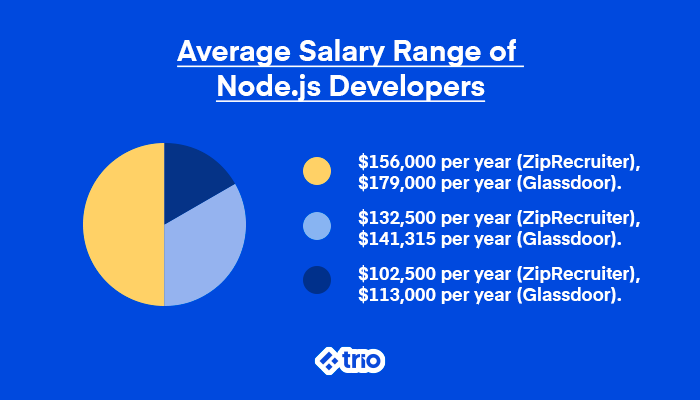
Factors influencing the average salary of Node.js developers
There are three main factors that influence your potential developer pay. These are your experience, your location, and whether or not you have any specialized skills.
If you have more years of experience with Node.js development, your hands-on experience will increase your expected total pay.
Your location may influence the overall job market and your expected cost of living. If you reside in a tech hub like California, you will be in high demand and have relatively high expenses, so you can expect a higher salary.
Specialized skills like experience in full-stack development or the ability to use tools like React JS or Angular for front-end development can increase your perceived value.
United States
According to Ziprecruiter.com, the average salary for a senior Node.js developer is $119,500 a year in the United States. The most experienced Node developers or software architects will likely cost you upwards of $150,000 a year.
For short-term projects of, say, 6 months, you should calculate your costs on an hourly basis. In the U.S., a senior Node developer will cost you around $67,500 for 6 months.
South America
Node.js developers cost considerably less in South America than they do in the U.S. This is due to regional and economic factors. Senior developers in South America will cost you $100,000 a year, and mid-level developers, around $76,000 a year.
A short-term project of 6 months will see you shell out around $48,500 per senior developer.
Eastern Europe
Compensation figures in Eastern Europe do not differ much from those in South America. A senior Node.js developer in Eastern Europe is likely to cost you around $100,000.
For a short project of around 6 months, you’re likely to see a cost of $55,000 per senior developer.
Asia
Node.js developers in Asia are some of the most affordable in the world. For a 6-month Node.js development project in Asia, you can expect the costs to be around $35,000 per senior developer.
Node.js Developer Job Description Template
Once you’ve scoped your Node.js development project, determined the development budget, and arrived at the hiring stage, what’s the next step?
You can’t just wander aimlessly in the market and hope to hire the best Node developers available. You need a formal and comprehensive job description that communicates the skills and responsibilities the candidates should possess.
You can look at the following job description as a template and modify it for your specific project:
Company Introduction
< Write a short and catchy introduction about your company. Make sure to provide information about your culture, perks, and benefits. Mention office hours, remote working possibilities, and anything else that you think makes your company interesting. >
Job Description
We are looking for a Node.js developer for a client-server project. You will be responsible for developing the server-side of the application, designing the application logic, and maintaining the databases. You will manage the interchange of data between the server and the users and ensure high performance and responsiveness to requests from the front end. You will also be responsible for integrating the front-end elements built by your co-workers into the application. Therefore, a basic understanding of front-end technologies is necessary.
Responsibilities
- Integrating user-facing elements developed by front-end developers with server-side logic
- Writing reusable, testable, and efficient code
- Designing and implementing low-latency, high-availability, and performant applications
- Implementing automated testing platforms and unit tests
- Implementing security and data protection
- Integrating applications with data storage solutions (may include databases, key-value stores, blob stores, etc.)
- Following the Scrum workflow and completing tasks from the team backlog
- Assisting with the creation and development of feature requirements
- Reporting issues with the code and improving upon them
- < Add other responsibilities here that are relevant >
Skills And Qualifications
- 5+ years of programming experience;
- 3+ years of JavaScript and Node.js experience
- Experience with REST, WebSocket, MySQL/PostgreSQL, MongoDB, Redis
- Experience with Docker and AWS Infrastructure
- Knowledge of Node.js frameworks (such as Express, StrongLoop, etc, depending on your technology stack)
- Understanding of asynchronous programming and its quirks and workarounds
- Experience with server-side templating languages (such as Jade, EJS, etc, depending on your technology stack)
- Familiarity with server-side CSS preprocessors (such as Stylus, Less, et, depending on your technology stack)
- Basic understanding of front-end technologies, such as HTML5 and CSS3
- Knowledge of accessibility and security compliance (depending on the specific project )
- User authentication and authorization between multiple systems, servers, and environments
- Integration of multiple data sources and databases into one system
- Awareness of differences between multiple delivery platforms, such as mobile vs. desktop, and optimizing output to match the specific platform
- Proficient understanding of code versioning tools, such as Git
- Ability to write readable, well-documented code
- Intermediate (or higher) English skills
- < Make sure to mention other frameworks, libraries, or any other technology related to your development stack >
- < List education level or certification you require
Beginner Node.js Interview Questions
These focus on fundamentals, mental models, and everyday Node.js usage.
What is Node.js, and what are its primary uses?
Expected signals
- Mentions that Node.js runs JavaScript outside the browser using V8
- Understands common use cases like APIs, web servers, real-time apps, CLI tools
- Shows awareness that Node favors I/O-heavy workloads over CPU-heavy ones
Take-home / live-coding add-on
- Build a tiny HTTP server that returns JSON on one route and text on another
Explain the key features of Node.js.
Expected signals
- Talks about non-blocking I/O and the event-driven model
- Mentions the single-threaded event loop in practical terms
- Brings up npm and the ecosystem, not just runtime internals
Take-home / live-coding add-on
- Refactor a blocking file read into a non-blocking version and explain the difference
What are the advantages of using Node.js for server-side development?
Expected signals
- Connects performance to non-blocking I/O and V8
- Mentions scalability for real-time or high-concurrency apps
- Notes the benefit of using JavaScript on both client and server
Take-home / live-coding add-on
- Explain which parts of a simple app would benefit from Node and which might not
How does Node.js handle I/O operations differently from traditional web servers?
Expected signals
- Explains blocking vs non-blocking I/O in plain language
- Understands that Node doesn’t wait for I/O before handling the next request
- Avoids claiming Node “does everything in parallel” without nuance
Take-home / live-coding add-on
- Given two endpoints, one slow and one fast, show how Node keeps both responsive
Describe a real-world scenario where Node.js would be the preferred choice.
Expected signals
- Picks something like chat, notifications, streaming, or APIs
- Explains why concurrency and low-latency I/O matter there
- Avoids vague answers like “any website”
Take-home / live-coding add-on
- Sketch a simple real-time feature, for example a basic chat or live counter
Explain the event loop’s role in Node.js.
Expected signals
- Understands that the event loop schedules async callbacks
- Can explain how Node handles many tasks on one thread
- Avoids mixing up the call stack, queue, and threads
Take-home / live-coding add-on
- Predict the output order of a small script with setTimeout, promises, and sync logs
Compare synchronous and asynchronous programming in Node.js.
Expected signals
- Explains sequencing vs non-blocking execution
- Gives a practical example, usually file or network I/O
- Understands why async improves throughput, not raw CPU speed
Take-home / live-coding add-on
- Convert a synchronous function to async/await and explain what changed
How does Node.js handle concurrent operations?
Expected signals
- Mentions the event loop and callback or promise queues
- Understands that concurrency comes from non-blocking I/O, not multiple JS threads
- Keeps the explanation practical rather than theoretical
Take-home / live-coding add-on
- Simulate multiple requests hitting an endpoint and explain what happens
What are the phases of the event loop?
Expected signals
- Can name at least the major phases: timers, poll, check, close callbacks
- Understands roughly what happens in each phase
- Doesn’t need to recite internals perfectly, but shows the mental model
Take-home / live-coding add-on
- Place logs in timers, promises, and I/O callbacks and discuss execution order
How do you create and manage modules in Node.js?
Expected signals
- Knows that a module usually equals a file
- Uses require or import and module.exports or export
- Understands why splitting code into modules helps maintainability
Take-home / live-coding add-on
- Split a single-file script into two modules with a clean interface
What is the difference between built-in and external modules?
Expected signals
- Can name examples like fs or path vs Express or Lodash
- Knows external modules come from npm
- Understands why you’d prefer built-ins when possible
Take-home / live-coding add-on
- Replace a tiny custom helper with a built-in module function
How do you import and export functionality in Node.js?
Expected signals
- Shows basic CommonJS or ES module syntax correctly
- Understands default vs named exports at a high level
- Can explain what gets shared between files
Take-home / live-coding add-on
- Export a utility function and use it in a second file
Explain the purpose and use of npm in Node.js.
Expected signals
- Mentions dependency management, scripts, versioning
- Understands package.json at a basic level
- Knows the difference between local and global installs
Take-home / live-coding add-on
- Add a dependency and a script to package.json and run it
What are some commonly used Node.js libraries, and what are their functions?
Expected signals
- Can explain what Express, Lodash, or Mongoose actually do
- Shows awareness of choosing tools for specific jobs
- Avoids listing names without context
Take-home / live-coding add-on
- Build a tiny Express API with one or two routes
Mid-Level Node.js Interview Questions
These focus on shipping real applications, running them in production, and keeping them healthy.
How do you implement load balancing in Node.js?
Expected signals
- Mentions the cluster module or an external load balancer like NGINX
- Understands why multiple processes matter on multi-core machines
- Can talk about basic trade-offs, not just tools
Take-home / live-coding add-on
- Run a Node app in cluster mode and log which worker handles each request
What are effective caching strategies in Node.js applications?
Expected signals
- Mentions in-memory caches, Redis or Memcached, and HTTP caching
- Understands what kind of data fits each approach
- Shows some awareness of cache invalidation problems
Take-home / live-coding add-on
- Add a simple in-memory cache to an endpoint and measure the difference
Describe how you handle errors in a Node.js application.
Expected signals
- Talks about try/catch with async/await, promise error handling, and middleware
- Understands the difference between operational errors and programmer errors
- Mentions logging and not crashing the process unnecessarily
Take-home / live-coding add-on
- Add centralized error handling to a small Express app
What security measures do you implement in Node.js applications?
Expected signals
- Mentions input validation, authentication, HTTPS, and basic hardening
- Understands that security starts with data coming into the app
- Avoids claiming any single library “makes it secure”
Take-home / live-coding add-on
- Add basic request validation and authentication to one endpoint
How do you deploy a Node.js application to production?
Expected signals
- Talks about environment variables, build steps, and process managers
- Mentions tools like PM2, Docker, or cloud platforms
- Understands the difference between dev and prod configs
Take-home / live-coding add-on
- Write a simple production start script and explain what it changes
How do you optimize Node.js performance using worker threads?
Expected signals
- Understands that worker threads help with CPU-bound tasks
- Can explain why they don’t replace async I/O
- Shows awareness of overhead and when not to use them
Take-home / live-coding add-on
- Move a CPU-heavy calculation into a worker thread
What tools do you use to profile Node.js applications?
Expected signals
- Mentions Node’s built-in profiler or Chrome DevTools
- Understands CPU vs memory profiling at a basic level
- Focuses on finding bottlenecks, not just collecting data
Take-home / live-coding add-on
- Profile a slow function and explain where time goes
What are the best practices for structuring a Node.js project?
Expected signals
- Mentions separating routes, controllers, services, and configs
- Understands why structure helps teams and long-term maintenance
- Avoids rigid “one true structure” answers
Take-home / live-coding add-on
- Reorganize a messy project into a clearer folder structure
How do you organize your code for better readability and maintainability?
Expected signals
- Talks about small modules, clear naming, and consistent patterns
- Understands that readability reduces bugs and onboarding time
- Mentions documentation or comments where needed
Take-home / live-coding add-on
- Refactor a long function into smaller, named helpers
What are the principles of modular design in Node.js?
Expected signals
- Mentions single responsibility and clear interfaces
- Understands encapsulation and reuse
- Avoids tightly coupled modules
Take-home / live-coding add-on
- Split one feature into two cooperating modules with a clean boundary
Describe your approach to testing in Node.js (unit, integration, end-to-end).
Expected signals
- Understands the purpose of each test level
- Mentions tools like Jest, Mocha, or similar
- Shows a pragmatic approach, not “test everything the same way”
Take-home / live-coding add-on
- Write one unit test and one simple integration test
How do you implement continuous integration and delivery in Node.js projects?
Expected signals
- Talks about automated tests on every push
- Mentions pipelines using GitHub Actions, GitLab CI, or similar
- Understands the difference between CI and CD in practice
Take-home / live-coding add-on
- Sketch a simple CI pipeline that runs tests and builds the app
Senior Node.js Interview Questions
These focus on internals, performance tuning, memory behavior, and large-scale system thinking.
Explain the garbage collection mechanism in the V8 engine.
Expected signals
- Understands young vs old generation heaps
- Can explain scavenge and mark-sweep-compact in plain terms
- Connects GC behavior to real performance or memory issues
Take-home / live-coding add-on
- Analyze a memory-heavy script and explain what GC would struggle with
How do you manage memory in a Node.js application?
Expected signals
- Talks about avoiding leaks, watching object lifetimes, and monitoring usage
- Mentions tools or built-in memory inspection methods
- Understands how closures and global references can cause trouble
Take-home / live-coding add-on
- Find and fix a simple memory leak in a sample app
Describe how async_hooks can be used to enhance performance in Node.js.
Expected signals
- Understands that async_hooks tracks async resource lifecycles
- Can explain use cases like tracing, debugging, or context propagation
- Acknowledges overhead and careful use in production
Take-home / live-coding add-on
- Add basic async context tracking to log request IDs across async calls
How do you implement load balancing in Node.js, and what trade-offs do you consider?
Expected signals
- Compares cluster vs external load balancers
- Mentions failure modes, restarts, and zero-downtime deploys
- Thinks in terms of systems, not just code
Take-home / live-coding add-on
- Design a simple multi-instance setup and explain how traffic flows
What caching strategies do you prefer in large-scale Node.js applications, and why?
Expected signals
- Compares in-process caches, Redis, and CDNs
- Talks about consistency, invalidation, and data freshness
- Shows experience with real trade-offs, not just theory
Take-home / live-coding add-on
- Propose a caching layer for a high-traffic endpoint and justify the choice
Where To Find Node.js Developers?
It’s important to know where to look when hiring Node.js developers. There are multiple platforms available for you to search for the best Node developers in the market. Knowing which platforms are worth your time is essential to making the process as effective as possible.
Below are some platforms that you can consider to hire the best Node.js developers in the market:
Posting your job on LinkedIn allows you to access a huge pool of candidates from around the world. The professional social network has no dearth of skilled candidates who know how to market themselves.
But there’s a flip side to it. Hiring from LinkedIn can be a time-consuming process as you need to filter from a huge set of candidates and spend considerable resources both before and during the hiring process.
Job Boards
Job boards like Indeed and Monster also enjoy hundreds of thousands of users who’re hunting for exciting job opportunities. You can multiply visibility for your project by posting it across multiple job sites.
But, again, the subsequent stages of filtering out candidates and interviewing them can quickly become time-consuming and costly.
Freelancing Platforms
Freelancing platforms like Upwork, Fiverr, and Freelancer are popular among freelancers and those looking for short-term projects. Posting your job listing on these sites will allow you access to well-reviewed and experienced candidates for your project.
But, again, you need to vet the shortlisted candidates yourself, spending countless hours and dollars.

Outsourcing Agencies
You can also outsource your hiring process to a software development recruitment agency like Trio to help you streamline the entire exercise from start to finish. Trio connects you to extremely skilled and thoroughly vetted developers without the need to engage in a lengthy recruitment process.
Another great benefit when hiring Node.js developers from Trio is that you won’t have to incur hiring costs, which can amount to a significant percentage of a developer’s annual salary. Trio developers also receive excellent professional and personal support, which leads to increased job satisfaction and low turnover.
You don’t even need to handle HR responsibilities like payroll, benefits, and compliance. You can instantly hire committed, verified, and top-notch near-shore developers.
Conclusion
Hiring Node.js developers can become a lengthy and costly process, from designing job descriptions to interviewing and hiring candidates. Trio simplifies this process for you and helps you connect seamlessly with the best Node developers in the world.
Contact us today to know more about hiring Node.js developers at Trio and get started on your Node development project.


