

 Read Client Stories




 Alex Kugell
 Key Takeaways
- In fintech, the outsourcing model choice carries compliance consequences around compliance accountability, institutional knowledge, and architectural decision-making that stay inside your regulatory perimeter with staff augmentation.
- When DORA, ISO 20022, or a Nacha mandate arrives mid-engagement, a staff augmentation team pivots immediately; a traditional outsourcing vendor requires scope amendments, renegotiation, and weeks of delay.
- The five most common traditional outsourcing failure modes in fintech are black box codebases, compliance clauses without compliance culture, scope freezes, time zone decision latency, and post-delivery accountability gaps.
- Traditional outsourcing remains defensible for fintech work that sits entirely outside the compliance perimeter, like internal dashboards, marketing infrastructure, analytics pipelines over anonymised data.
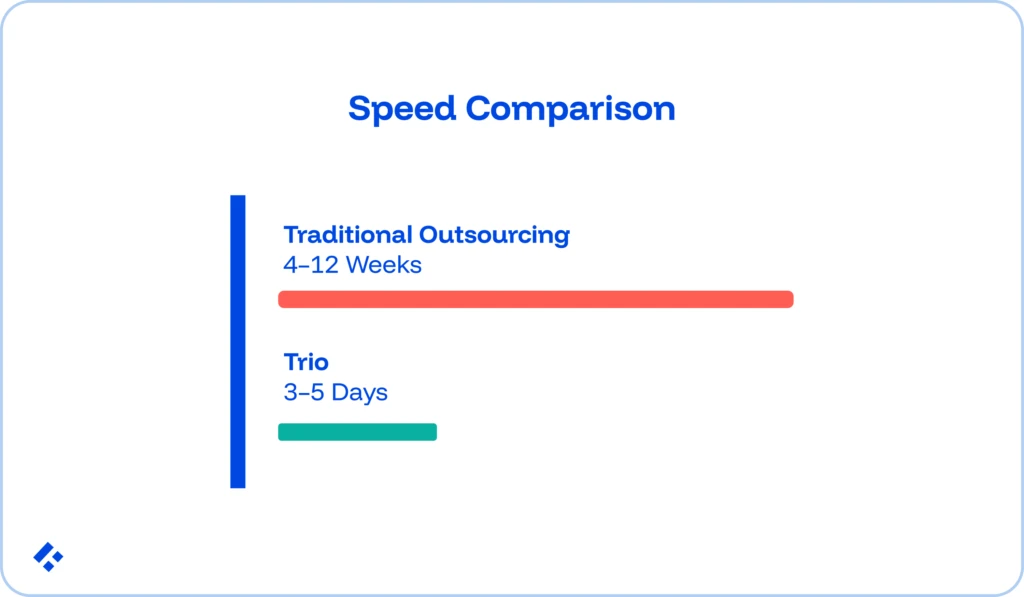
- Trio places pre-vetted fintech engineers in 3–5 days at $40–$80/hr, with transparent monthly pricing and no minimum term. A traditional outsourcing engagement typically takes 4–12 weeks to mobilise before meaningful work begins.
When outsourcing through traditional models, the vendor leaves after providing the final product. Often, something fundamental about how the system worked goes with them.
This does not happen because the engineers were bad, but because the model wasn’t built for what fintech actually requires.
Two outsourcing models dominate the fintech engineering decision: traditional project outsourcing and staff augmentation.
In traditional project outsourcing, you define a scope, a deliverable, and a deadline. The outsourcing provider assembles their own team, manages their own process, and delivers a finished product. Finally, you review the output and accept the outcome.
Through staff augmentation (Trio’s model), you bring one or more pre-vetted engineers into your team as embedded, dedicated collaborators. They work in your codebase, under your architecture standards, inside your sprint process, reporting to your engineering lead.
In fintech, your choice affects compliance accountability, regulatory exposure, and institutional knowledge retention. Let’s look at everything you need to know about Trio vs. traditional outsourcing, so you can make the best decision for your project.
Why the Outsourcing Model Choice Matters More in Fintech
In general software, the staff augmentation vs. traditional outsourcing decision primarily affects control and workflow. Both outsourcing strategies can produce acceptable outcomes for well-defined, non-regulated problems.
Fintech engineering doesn’t fit that description.
Three specific consequences make the outsourcing model choice structurally more important in regulated financial environments than anywhere else.
Consequence 1: Compliance accountability stays with you, not the outsourcing partner.
When a traditional outsourcing vendor writes your KYC pipeline or payment reconciliation system, their contract doesn’t transfer compliance accountability after delivery.
Your PCI DSS scope determination, your AML monitoring obligations, and your SR 11-7 model risk documentation remain your regulatory responsibility regardless of who wrote the code.
If a compliance finding surfaces 18 months after the outsourcing engagement closes, you own the remediation.
The engineers who built the system have moved to other engagements. The compliance reasoning behind specific architectural decisions exists only in the project documentation, if documentation was part of the original scope at all.
In Trio’s staff augmentation model, engineers work inside your compliance perimeter from day one.
They participate in your architecture reviews, understand the compliance reasoning behind each decision, and report to your engineering lead, not a vendor project manager whose primary incentive is scope completion rather than compliance accuracy.
Consequence 2: Institutional knowledge doesn’t survive contract termination.
A traditional outsourcing team that builds your payment system over six months accumulates something that doesn’t transfer with the codebase: why the idempotency key is generated client-side, what drove the KYC state machine’s specific transitions, and how the PCI DSS scope boundary was drawn.
When that contract ends, that knowledge walks out.
In fintech, this creates an audit risk that tends to surface at the worst possible moment. When a regulator asks why a specific architectural decision was made, “the outsourcing vendor made that call” doesn’t satisfy the question.
The decision belongs to you, so the reasoning needs to belong to you, too.
Related Reading: Trio vs Big Consulting: Speed, Cost, and Security
Consequence 3: Compliance-driven changes mid-engagement collide with fixed scope.
Traditional outsourcing contracts define a scope. Regulatory changes don’t respect scope boundaries.
DORA, effective January 2025, the Fedwire ISO 20022 migration in July 2025, and Nacha 2026 validation requirements are all good examples of deadlines that negatively affected several companies’ outsourcing projects.
Addressing a regulatory change requires scope amendments. Scope amendments require renegotiation. Renegotiation takes weeks.
All the while, the deadline doesn’t move.
In a staff augmentation model, the engineering team pivots with the compliance requirement because they sit inside your team, not inside a vendor’s delivery structure.
Related Reading: Best Platforms to Hire Fintech Developers
Eight Dimensions Compared
The table below compares Trio’s staff augmentation model against traditional project outsourcing across eight dimensions that fintech engineering teams identify as decision-relevant when considering how to outsource.
| Dimension | Trio (Staff Augmentation) | Traditional Outsourcing |
| Who manages the work | Your engineering lead | Vendor project manager |
| Codebase ownership | Engineers work in your repos from day one | Code delivered as a finished artifact; repo ownership varies by contract |
| Compliance accountability | An engineer operates inside your compliance perimeter | Compliance is a contract clause; accountability ends at contract termination |
| Institutional knowledge | Accumulates inside your team; stays when engagement ends | Accumulates inside the vendor team; departs when the contract ends |
| Time to start | 3-5 days from brief to engineer onboarding | 4-12 weeks (RFP, legal review, vendor mobilisation) |
| Pricing model | Transparent per-engineer monthly rate ($7K-$14K/month) | Fixed project price; scope changes carry penalties |
| Regulatory change response | Team pivots with compliance requirements; no renegotiation needed | Scope change requires a contract amendment; delays are common |
| Time zone | LATAM nearshore: 4-8 hours of US working hours overlap | Offshore (India, Africa, Eastern Europe): 6-12 hour gap; asynchronous by default |
The 5 Traditional Outsourcing Failure Modes in Fintech
Most fintech outsourcing failures come from a model mismatch. Teams structured for general software delivery are operating in a regulated environment that requires something fundamentally different.
We see these five failure modes repeatedly. If you’ve worked with a traditional outsourcing provider in fintech before, at least one of them will likely feel familiar:
- The black box codebase: The outsourcing vendor delivers the payment system, the engagement ends, and your internal team inherits code nobody on your side fully understands. The vendor’s engineers move to other projects. Debugging requires reverse-engineering undocumented decisions.
- Compliance clause versus compliance culture: The vendor’s contract says their outsourced team follows applicable regulations, but that’s not the same as engineers who understand PCI DSS scope implications, KYC ongoing monitoring requirements, or SR 11-7 model documentation standards at the engineering decision level.
- The scope freeze: A regulatory change arrives mid-engagement. Addressing it requires scope changes. Scope changes require renegotiation, which takes weeks. The deadline doesn’t wait for any of this.
- Time zone-induced decision latency: An offshore outsourcing engagement with a 12-hour time zone gap means architectural questions are answered the next day, code reviews get delayed 24 hours, and compliance clarifications are queued until the following business day. These issues accumulate into weeks of slippage.
- The accountability gap after delivery: A compliance finding may surface 12 months after the outsourcing project closes. The remediation timeline and cost fall entirely on you, with no recourse to the outsourcing provider whose contract closed cleanly.
When Traditional Outsourcing Still Works in Fintech
Traditional outsourcing has a legitimate place in fintech engineering. It works well when three conditions hold simultaneously.
The scope is genuinely fixed before work begins.
In practice, this is rare in fintech. Regulatory discovery, banking partner requirements, and integration complexity consistently expand scope beyond initial estimates.
When scope is truly stable, though (a well-defined internal tool, a clearly bounded data migration, a frontend feature that doesn’t touch the compliance perimeter), traditional outsourcing can deliver predictable outcomes at relatively predictable cost.
The deliverable doesn’t require ongoing institutional knowledge
A one-time data migration that produces a clean dataset doesn’t require anyone to retain deep knowledge of the compliance reasoning behind every decision.
The institutional knowledge advantage of staff augmentation matters far less here.
The outsourced scope sits entirely outside the compliance perimeter
Fintech companies build non-regulated systems such as marketing pages, internal dashboards, and analytics pipelines over anonymised data.
Traditional outsourcing for a scope that doesn’t touch payments, KYC, fraud detection, or the ledger carries none of the structural risks described above.
Decision Framework: Which Outsourcing Model for Which Scenario
Scenario 1: Building or scaling core fintech infrastructure (payment system, KYC pipeline, ledger, fraud detection). Trio’s staff augmentation model. These systems require engineers who accumulate institutional knowledge inside your compliance perimeter, participate in architecture reviews, and pivot when regulatory requirements change mid-build.
Scenario 2: Compliance deadline with a fixed, well-understood technical scope (ISO 20022 migration, Nacha account validation endpoint, DORA third-party risk documentation). Trio’s model, with a time-bounded engagement framing. The compliance deadline urgency is exactly the scenario where a 4-12 week traditional outsourcing mobilisation timeline becomes a blocker.
Scenario 3: Non-compliance-touching general software work (internal dashboard, marketing site, analytics pipeline over anonymised data). Traditional outsourcing is defensible when the scope is fixed, and institutional knowledge retention isn’t a requirement. Trio can serve this need, but the compliance-specific advantages apply less directly.
Scenario 4: Rapid team scaling during a product launch or funding-driven sprint, with compliance-touching scope. Trio’s augmentation model. The combination of 3-5 day placement, LATAM nearshore time zone alignment, and embedded team integration allows immediate productive contribution.
How Trio’s Model Works in Practice
Trio places pre-vetted fintech engineers into client engineering teams as embedded, dedicated collaborators. The process runs as follows:
- Days 1-5: Brief submitted, followed by an initial consultation, then vetted engineer profiles are received. Profiles include documented production fintech experience relevant to your specific stack and compliance context.
- Days 6-10: Engineers are selected, interviewed, and approved by your team. Trio handles employment, payroll, and benefits administration. Your cost is a transparent monthly rate: $7,000-$14,000 per engineer, depending on seniority and specialisation.
- Week 2: The engineer joins your Slack, your Jira, and your sprint. They work in your codebase, on your architecture, under your engineering lead.
- Ongoing: Monthly contracts with no minimum term. You can scale up with additional engineers as the roadmap requires or scale down when compliance sprints close.
If this sounds like the right fit for your project, book a decision call.