

A major U.S. clearing house was in the middle of acquiring a fintech startup with a consumer-facing investment platform, real customers in production, and a proven path to the B2B2C market the acquirer had been chasing.
The startup processed real trades. It worked well, and because of that, people were using it.
The problem came in with engineering capacity.
The acquisition hinged on delivering several genuinely complex financial features before a hard deadline. But not just any engineer could hop on the team to get the work done. Even experienced financial engineers had never shipped anything quite like it.
That’s when the CTO reached out to Trio.
We provided fintech experts who were able to meet quickly approaching deadlines and have become long-term tech partners.
If you need experts to ensure the success of your financial services development, you’re in the right place.
Why the CTO Chose Trio Instead of Other Engineering Staffing Partners
When the CTO was made aware of the M&A timeline when reporting to the board, he already knew who to call.
He’d worked with Trio at a previous company, an SEC-registered crypto investment advisory firm, where Trio had helped build a greenfield platform together from scratch.
That engagement, he says, produced one of the best teams he’d ever assembled. Well-managed, well-staffed, strong on delivery. So when a harder situation came along, it was only natural that he approached Trio as the sole staffing partner rather than spreading the risk across multiple vendors.
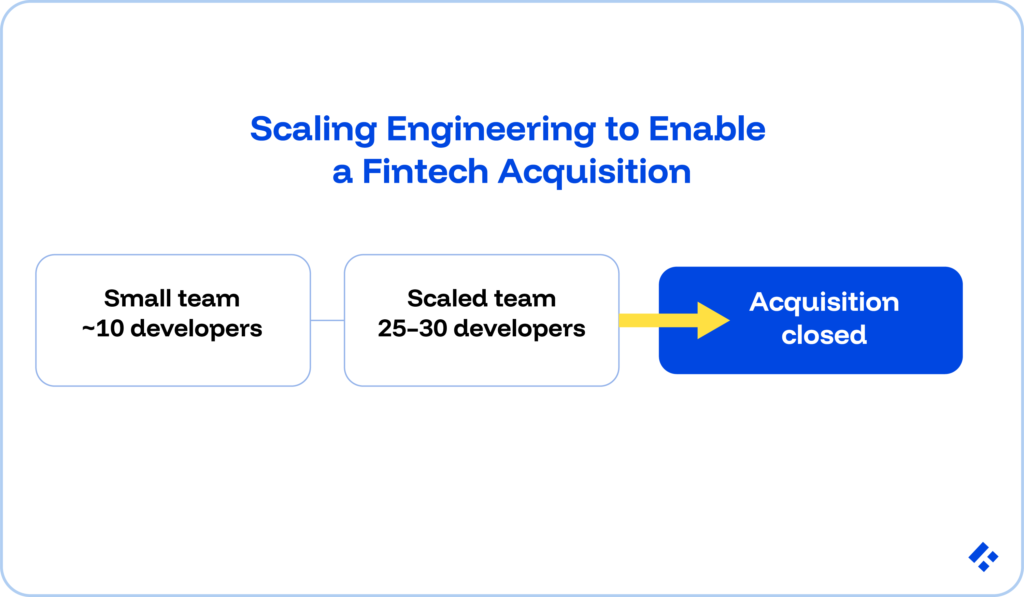
Within a few months, 25 to 30 developers had joined the team. They onboarded fast and integrated with the existing engineers without much friction, largely thanks to their previous experience working under such circumstances.
The Technical Complexity Behind Mutual Fund Trading and L3 Features
While staffing is an issue in and of itself, mutual fund trading carries its own regulatory logic, adding additional complexity.
The compliance and legal requirements around this asset class are distinct enough that the software can’t just mirror how equities work.
And layered on top of that were Level 3 mutual funds. These support international investment and bring a further tier of regulatory complexity that most developers, even experienced ones, rarely navigate.
The team was building features with no real precedent to follow internally. That probably would have been manageable with strong product direction. What they had instead was one product manager across more than 40 developers.
That ratio makes certain things impossible. Waiting for detailed specs, for instance.
What they needed were developers who would need to take the initiative, as well as be independent and autonomous.
What made that work was Trio’s culture around asking questions, and the way that was encouraged in the rest of the team. Getting up to speed fast required an environment where not knowing something wasn’t a problem.
Related Reading: Mergers and Acquisitions: Payment Integrations
How a Software Engineering Team Delivered Under Pressure Without Burning Out
The team, made up of many of Trio’s developers, knowingly took on technical debt. Corners got cut. The process wasn’t the best practice.
All of this was considered carefully, and each decision was communicated openly to the developers so they understood the context. It was a team effort of analyzing trade-offs.
That transparency meant that the engineers generally handled the imperfect conditions better because they understood why those conditions exist.
To further encourage the team, instead of measuring performance by features shipped or similar metrics, there was a focus on culture, collaboration, autonomy, and the kind of camaraderie that shows up when things get difficult.
The result was that developers were able to push through the difficult work, and eventually the acquisition closed.
Related Reading: How to Hit Roadmap Deadlines Without Hiring in Fintech
From Acquisition Sprint to Long-Term Platform Build
After the initial sprint, the team was able to take advantage of the flexibility provided by Trio’s staff augmentation hiring models, and it scaled back naturally to a core group of around 12 Trio developers. They’re still there.
Without needing to commit to a full workforce of 30+ developers, the firm can still take advantage of developers who have knowledge of the platform.
Their depth of institutional knowledge has turned out to matter more than anyone likely anticipated at the start, because those same engineers are now central to the next phase of the product.
The original stack ran on AWS. The parent company standardized on GCP.
Rather than migrate and patch, the decision has been made to rebuild, which opened up the chance to add new features and shed client-specific functionality that had accumulated over the startup years.
The final goal: a move toward something more like a commercial off-the-shelf product that a financial advisor, neobank, or retirement planning firm could pick up without heavy customisation.
The company is also looking at adjacent products like an advisory app and a robo-advisory platform, both drawing on the same technical foundation.
Staff Augmentation vs. Engineering Partnership
Yes, Trio’s hiring packages are similar to those of a typical staff augmentation firm. But the focus on long-term relationships changes the game, especially in the financial services industry, where trust is critical.
When you hire Trio’s developers, you build long-term relationships and a partnership.
The practical difference between those two things shows up under pressure.
A vendor relationship optimises for delivery within a defined scope. A partnership survives scope changes, timeline crunches, and the kind of ambiguity that comes with a one-PM-to-forty-developers situation.
If you are interested in a similar partnership for your firm, or simply wish to hire developers with a background in fintech and everything required for security and compliance, request a consult.
Frequently Asked Questions
How can you scale an engineering team quickly for time-sensitive acquisitions?
Scaling an engineer quickly, with talented engineers who can help you meet deadlines related to an acquisition, typically involves using one trusted staffing partner like Trio. Fragmenting your hiring across several vendors can increase risk, especially if you are unfamiliar with the vendor.
What is the difference between staff augmentation and an engineering partnership?
Staff augmentation treats external developers as short-term resources to be swapped in and out, while an engineering partnership embeds developers into the team culture for the long term.
How do you manage engineering teams with minimal product direction?
If you do not have the leadership resources to guide developers or do not have a clear product direction, the key is to employ engineers who can investigate requirements themselves, rather than waiting for detailed specs. This requires a very specific culture, like the kind found in fintech development firms like Trio.
How long does it take for outsourced developers to get up to speed on complex financial services platforms?
Onboarding time varies from partner to partner, and can usually take quite long if you are outsourcing for complex financial services platforms. However, if you are working with an industry-experienced partner, this can cut the process from months to days, as developers already have industry knowledge.