How to Hire Elite Software Developers in Mexico

More on this topic

Contents

Share this article

Mexico has become one of the most popular destinations for startups and growing companies thanks to the near-perfect time zone alignment with US business hours and the lower cost of living, allowing for far lower salaries.

But is Mexico the right option for you? And how do you go about it?

Let's walk through everything you need to know about how to hire software developers in Mexico so you can make an informed decision.

Are you ready to start your development project?

Request regional talent.

Key Takeaways

  • Mexico houses over 560,000 software engineers and graduates roughly 124,000 STEM professionals annually. That pipeline keeps growing.
  • Senior developer salaries in Mexico typically run $66,000 to $90,000 per year, compared to $150,000 to $220,000 for equivalent US-based hires.
  • Most of Mexico operates on Central Time (UTC-6), and developers in Guadalajara or Mexico City work on the same schedule as teams in Chicago or Dallas.
  • Mexico's participation in the USMCA trade agreement appears to offer stronger IP protections than most other LATAM outsourcing destinations.

Why Hire Software Developers in Mexico?

Before you jump straight into hiring, it’s helpful to take a look at why you might want to get people from Mexico on your team in the first place. The key benefits include cost efficiency, time zone alignment, talent pool, technical depth, and cultural compatibility.

Cost Efficiency

One of the main reasons our clients often decide to look at places like Mexico is the price.

Competitive salaries in Mexico run far cheaper than those in the US or Europe. This is largely just because the cost of living is lower there, and it does not mean that the quality of the output is affected.

Junior developers typically earn $24,000 to $28,000 per year. Mid-level developers come in at $42,000 to $66,000. Senior developers run $66,000 to $90,000.

Especially at senior levels, where U.S. specialists can earn more than $200,000, this can free up a lot of resources.

On top of that, if you hire a remote developer, you can also avoid many of the overhead costs associated with in-house employees, such as office space or benefits.

Time Zone Alignment

Most of Mexico operates on Central Time (UTC-6), meaning developers in Guadalajara or Mexico City work the same hours as teams in Chicago, Dallas, or Denver.

If your team is largely based on the East Coast, you will deal with just a one-hour difference.

This is incredibly attractive as it lets you do things like synchronous code reviews, sprint ceremonies, video calls, and the kind of casual back-and-forth in Slack that actually lets you deal with issues and blockers the moment they arise.

This proximity also makes occasional face-to-face visits more possible than if you were offshore.

A flight from many major US cities to Mexico City or Guadalajara takes three to four hours.

Talent Pool and Technical Depth

Mexico has many tech companies that contribute to a diverse talent pool of highly skilled developers. This means you should be able to find the right person, whether you need a general developer or someone with a more specialized background, like fintech.

Alongside the variety of IT companies, schools like UNAM, Tecnológico de Monterrey (ITESM), and IPN produce engineers who hold their own with graduates from strong US programs.

There is also a growing presence of companies like Google, Amazon, Oracle, and IBM in Mexico, which means that you can find developers who have worked on massive projects, not just small startups.

In terms of technical skills, Mexican software developers bring a variety of specialized skills, including JavaScript, Python, Ruby on Rails, and a range of mobile frameworks.

Hackathons and competitive programming have also encouraged strong problem-solving.

Cultural Compatibility

Mexico has genuine cultural similarities and strong business ties with the US, making it easier to integrate Mexican developers into your teams.

From what we have seen, Mexican developers often overlap with U.S. developers in terms of communication styles and business expectations.

Related Reading: Guide to Outsourcing Software Development to Argentina

Where to Find the Best Developer Talent in Mexico

Knowing where talent concentrates will save you time and help you set realistic expectations for your search.

As usual, the capital is a good place to look.

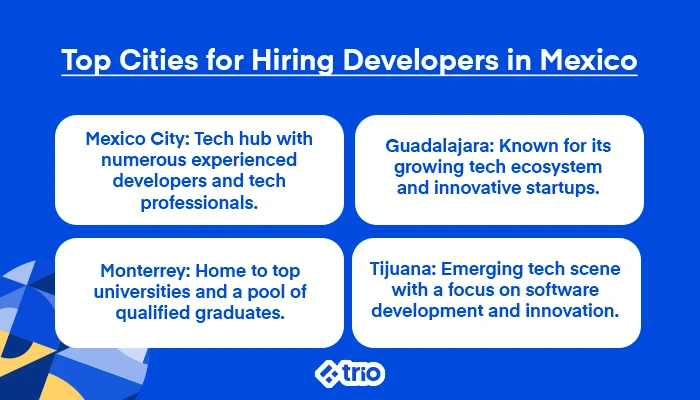
Mexico City holds the country's largest concentration of software companies and the deepest bench of senior developers with international client experience.

If you are looking for someone with a very niche skillset, the sheer quantity of developers makes it likely you’ll find someone here, but you’ll also pay more.

Guadalajara has earned the "Mexico's Silicon Valley" label. The city runs on a strong university ecosystem, including ITESM's Guadalajara campus, and hosts a growing concentration of tech multinationals and startups.

The industrial nature of the city also plays a role in skillset availability, with specialists in manufacturing and logistics aggregating here.

Monterrey rounds out the picture with a business-oriented culture and proximity to the US border.

Overview of top cities for hiring developers in Mexico including Mexico City, Guadalajara, Monterrey, and Tijuana.
Discover the leading Mexican cities to find top tech talent.

How to Source and Hire Developers in Mexico

If you are looking for developers, you can start with well-known job portals like LinkedIn, Glassdoor, and Indeed, along with tech-specific job boards such as Stack Overflow Jobs and GitHub Jobs.

This can be a very time-consuming and resource-intensive process, though.

Partnering with local recruitment agencies, who already have deep networks and can connect you with talented developers who meet your specific needs, can cut down on these resources significantly.

Trio works well for this, particularly for companies that want candidates pre-vetted for fintech development rather than sourced from scratch.

Networking events and meetups like tech conferences and hackathons can also connect you with skilled developers, but require a more ‘boots-on-the-ground’ approach.

Collaborating with educational institutions is also an option if you are looking for interns or junior candidates.

Engagement Models for Hiring Developers in Mexico

The model you choose shapes how much control you have, as well as how much management is required on your end.

  • Freelancers work well for short-term or project-specific needs. The trade-off is consistency, and they may not be available for future work.
  • Dedicated teams provide long-term commitment and deep integration with your business. But the initial setup takes more effort.
  • Staff augmentation lets you scale quickly and fill specific skill gaps without the overhead of full-time hiring.
  • Project-based outsourcing hands a defined scope to a vendor who manages it end-to-end. Management overhead drops significantly, but so does flexibility.

Key Factors When Hiring Developers in Mexico

So, what if you have a potential developer ready? Consider these factors before you finalize the hiring process to minimize your risk as much as possible.

Technical Assessment

It is critical that you evaluate technical expertise. Look at their portfolio, but don’t neglect coding tests and technical interviews so you can see what they do in real-time.

Focus on candidates' experience with the specific technologies your project requires, as well as with the industry.

When it comes to their code, also look at their understanding of the problem in general, and their use of new tools such as AI coding assistants.

Communication Skills

Assessing English proficiency and communication style matters as much as technical skills when hiring remotely.

You should be able to get a good idea of their English proficiency in written form as you schedule meetings and look at their portfolio notes, but in order to assess their speaking level, it is often best to schedule an in-person interview.

Cultural Fit

Generally, the cultural compatibility of most LATAM countries aligns with that of most U.S. companies.

But, in this step, you will want to assess their specific fit to your company's specific working style, rather than relying on generalizations.

Developers who align with how your team communicates and makes decisions tend to integrate faster and stay longer.

Work-life balance expectations also play a role in whether or not the developer decides to take your offer.

Legal and Compliance Awareness

Mexico's labor framework includes mandatory employer contributions and benefits. This can get complicated really fast if you hire directly and if you are not familiar with the legal requirements.

Working through an established partner like Trio, or using an Employer of Record (EOR) model, keeps you fully compliant with Mexican labor law without requiring you to become an expert in a foreign regulatory environment.

This is more important now than ever, with Mexico's 2021 outsourcing reforms tightening the rules considerably.

Under the current framework, if a developer works exclusively or primarily for your company over an extended period, the relationship may look like employment.

Challenges of Hiring Developers in Mexico and How to Handle Them

Of course, labor law compliance is one of the primary challenges you may encounter when hiring Mexican developers. But we have already mentioned that working through an established firm can assist with the legal side of things.

Another aspect of hiring in Mexico that we have seen throws clients off is the different salary benchmarking across cities.

Developer salaries in Mexico City run noticeably higher than in Monterrey or secondary cities. Underbidding a Mexico City candidate creates friction right from the start, and offering the higher rates to someone from a smaller location reduces your cost savings.

You need to do your research.

Vetting quality at scale can also be difficult, but it is incredibly important because of the large talent pool.

The spread between a strong senior developer and someone with a senior title on their resume can be significant. Be very cautious as you proceed through the interview process.

Conclusion

Mexico offers a combination of talent depth, cost efficiency, time zone alignment, and cultural compatibility that few other outsourcing destinations can match at this scale.

Getting the most out of it requires knowing where the best talent concentrates and having a plan to deal with the legalities that come along with hiring.

At Trio, we take care of all of that for you. Providing only a handful of portfolios that are guaranteed to match your requirements. We hire the developers, not you, minimizing legislative risk.

Talk to us.

Frequently Asked Questions

How much does it cost to hire a software developer in Mexico?

Hiring a software developer in Mexico typically costs between $24,000 and $90,000 per year, depending on seniority. This is almost 50% less than some U.S. developers, where senior positions can charge more than $200,000 per year.

How do I hire software developers in Mexico as a US company?

US companies can hire software developers in Mexico most reliably through a managed nearshore partner like Trio, who can take care of the legal side of the hiring process, and who already has a host of experienced developers on hand.

What are the best cities to hire software developers in Mexico?

Mexico City, Guadalajara, and Monterrey stand out as the three best cities for hiring software developers in Mexico. They are all quite large and provide many opportunities, attracting top talent.

Do Mexican software developers speak English?

English proficiency among Mexican developers varies more than in some other LATAM markets, but developers in major tech hubs who have worked with US-facing companies tend to communicate effectively thanks to their previous experience in English teams.

Is it legal to hire Mexican developers as independent contractors?

Hiring Mexican developers as independent contractors carries legal risk if the relationship resembles employment under Mexican law, especially after the 2021 outsourcing reforms tightened classification rules, but you can mitigate those legal risks by going through a hiring partner like Trio.

How does hiring developers in Mexico compare to other Latin American countries?

Compared to other Latin American countries, Mexico offers a very large talent pool and near-identical time zone alignment with most US offices. There are also USMCA IP protections that other LATAM countries don't match, but countries like Argentina beat Mexico in terms of general English proficiency.

Frequently Asked Questions

Related
Content

Best platforms to hire fintech developers

Best Platforms to Hire Fintech Developers

The best platform to hire fintech developers depends on a variety of factors, including fintech domain...

Software Developer in Santiago with Chilean Flag

Software Developer Salary in Chile

Chile sits at an interesting position in the LATAM developer market since developers earn a lot...

Software Developer in Argentina with Argentine Flag

Software Developer Salary in Argentina

Argentina has become incredibly popular for nearshore software development markets for US companies. You can hire...

Global map showing nearshore development connections

Nearshore Software Development Rates by Region and Seniority

Getting ready to scope out your project? If you’re budgeting for a nearshore development team, the...

Continue Reading