


 Read Client Stories





 Lace Brunsden

 Key Takeaways
- English proficiency gets oversold on this destination. Costa Rica scores 516 on the EF English Proficiency Index, 55th of 123 countries and inside the moderate band, down 18 points on the previous edition. Test it candidate by candidate rather than trusting the country's reputation.
- Costa Rica sits at UTC-6 all year and does not observe daylight saving, so your overlap shifts by an hour twice a year. It matches US Central in winter and US Mountain in summer. Confirm working hours in both teams' local times rather than assuming the offset holds.
- Costa Rica holds roughly 45,000 software engineers, which is a real pool but a small one next to Mexico's 563,000. Deep benches in a narrow stack are the constraint to test for.
- Published senior rates run anywhere from $31 to $120 an hour because some sources quote developer pay and others quote client billing, which carries a 20 to 40% partner margin. Establish which one a quote is before comparing it to anything.
- Use a consistent project brief and location-fit worksheet to distinguish confirmed requirements from unresolved assumptions.
Costa Rica puts roughly 45,000 software engineers inside a US-friendly working day, at senior rates that published sources put anywhere between $31 and $120 an hour.
It makes a genuine option for US product teams, but whether it suits your roadmap comes down to the specific team a supplier proposes, not the country.
This guide covers what Costa Rica actually offers, what the rates mean, where the time zone overlap breaks, and a worksheet for turning all of it into questions a supplier has to answer.
At Trio, we offer software developers of various skill sets, including niches like fintech, from across Latin America.
What outsourcing software development to Costa Rica means
Outsourcing software development to Costa Rica means engaging an external supplier whose proposed developers work from Costa Rica to complete agreed software work.
A lot of companies offer people all over the world, so make sure to confirm where the actual team operates, especially when a supplier recruits across several countries.
Nearshore software development describes external development in a nearby region relative to the client, and is a popular alternative to outsourcing since you don't need to deal with time zone differences.
For a US buyer considering Costa Rica, the practical question is whether the proposed team’s working hours support the collaboration the product needs. The nearshore label alone does not establish that fit.
It's important to keep in mind that location and engagement model answer different questions.
A supplier might offer developers who work under your engineering leadership or take responsibility for managing an agreed delivery scope.
Ask which arrangement the proposal describes. The broader engagement models sit behind that answer, and change your internal workload.
Costa Rica's talent pool, hubs and English, in numbers
CINDE, an investment-promotion organization, identifies software development among the activities in Costa Rica’s digital-technologies sector, alongside services including cloud, cybersecurity and user-experience design.
Their findings support Costa Rica as a potential location for software-development activity.
Here's what the numbers look like:
Talent pool: roughly 45,000 software engineers, based on estimates built from PROCOMER data. That is a real pool, but quite small when you consider that LATAM holds around two million developers in total, with Mexico near 563,000 and Brazil near 759,000.
Where the work clusters: San José, Heredia, Alajuela, and Cartago. For a remote engagement, the hub matters less than who is on the team, but it's very likely a supplier is recruiting from these locations.
North American orientation: a 2026 PROCOMER services-sector report puts about 86% of Costa Rican shared-services operations as serving North America, so working US hours is pretty normal for many developers there.
English: Costa Rica scores 516 on the EF English Proficiency Index, which places it 55th of 123 countries in the "moderate" band, and the score fell 18 points on the previous edition. Strong English exists in the tech sector, but you need to test each candidate individually.
While settling on a country gives you a region to explore, it does not establish whether a supplier has engineers available for your stack, whether those engineers understand your product domain, or whether their communication suits your team.
If you are in fintech, for example, finding general engineers, even if they are incredibly experienced, does not mean they will have experience with US regulations around cardholder data.
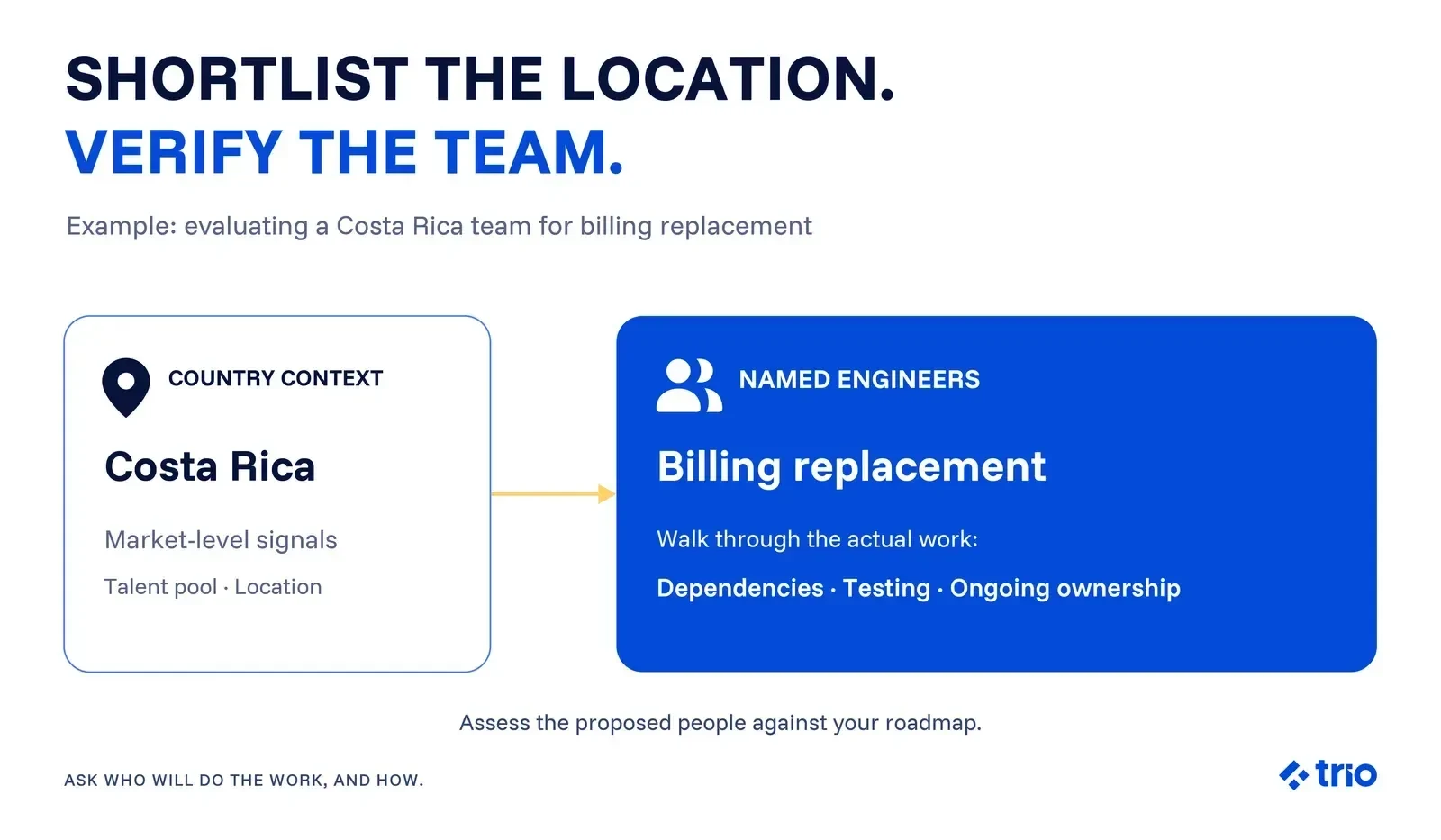
Move from country context to proposed-team evidence early.
For example, if your roadmap involves replacing a billing component, ask who would do that work and how they would approach dependencies, testing, and ongoing ownership.
Time zone overlap, and when it shifts
Costa Rica’s official local time is UTC-6, meaning six hours behind Coordinated Universal Time, but this does not always establish a supplier’s working schedule or availability during your business day.
Make sure working hours are actually aligned.
On top of that, keep in mind that Costa Rica does not observe daylight saving and the US does.
For the roughly four months of US standard time, from early November to mid-March, the country runs level with US Central. For the other eight months, once the US springs forward, it falls an hour behind Central and lines up with Mountain instead.
The best way to prevent any mistakes here is to request a dated collaboration window expressed in both teams’ local times. Confirm who attends planning, who can answer product questions, and what happens when a question arrives outside the shared window.
When Costa Rica could fit your roadmap
It might be time to consider Costa Rica when a supplier can demonstrate a suitable team and a workable operating arrangement.
The potential value comes from obtaining the capacity or expertise your roadmap needs under conditions your company can support.
Frequent product discussion: Confirm that the proposed engineers can participate in the discussions your work requires, using a representative conversation about an actual roadmap problem.
A defined capability gap: Request evidence relevant to the missing skill, such as an explanation of comparable work and the proposed engineer’s responsibilities in it.
Internal leadership available: If your team will direct the developers, name the engineering and product owners who can provide context, review work, and resolve priorities.
A feasible start: Ask which proposed people are available, when they could begin, and what dependencies could change that commitment.
We have found that it's essential to factor onboarding into your overall plan.
You need to make sure that someone briefs new team members, arranges secure access, and reviews initial results for quality and context.
Ask your internal owners to estimate that commitment before treating an external team as additional usable capacity.
When another sourcing option may fit better
It's always a good idea to keep alternative locations open if the proposed Costa Rica team cannot meet an essential collaboration window, demonstrate the required specialization, or offer credible availability.
Apply the same requirements to every option instead of assuming another country will solve the problem.
Internal hiring is also an option when building enduring product knowledge inside the company is a central objective.
If your immediate constraint is a lack of engineering leadership, adding developers who depend on that leadership leaves the constraint where it was. A proposal with delivery management could warrant evaluation, but its management scope needs to be explicit.
A helpful tool is treating project restrictions as early screening inputs.
Do utilize them, identify any requirements governing development location, system access, or sensitive data, then have the appropriate internal owners assess the proposed arrangement.
For regulated software, the criteria for choosing a custom software development company matter more than the country, since a location is not evidence of compliance.
Costa Rica is one of several outsourcing destinations worth putting side by side if your shortlist is still open. For the Costa Rica decision, focus your comparison on the requirements that could actually change the shortlist.
What it costs, and how to read a proposal
A Costa Rica software development outsourcing proposal should make clear what the supplier charges for and what your team must still provide.
When comparing proposals, make sure that you give each a fair chance by evaluating against the same scope, roles, working arrangements, and delivery responsibilities before comparing their headline fees.
Keep three cost concepts separate:
Employee salary concerns compensation for an individual employee.
Supplier fees concern the contracted service.
Total delivery cost, for your evaluation, should include those fees plus the internal effort and other expenses you expect to incur. A salary figure cannot establish the price of an outsourcing engagement.
Ask each supplier to identify the proposed roles, allocation, and billing basis. Clarify whether management, quality assurance, onboarding, tools, and post-release support appear in the quoted scope.
Record exclusions and assumptions, including how changes would be priced and who would approve them.
Toptal puts senior Costa Rican developers at $31 to $39 an hour. YuSMP, writing about the same market in 2026, puts senior client rates at $65 to $90. Gilzor has LATAM senior developers at $45 to $75, while Launch Day Advisors has senior nearshore at $60 to $120.
Those numbers measure different things. The low figures tend to describe what a developer earns. The high ones describe what a client is billed, which carries the partner's recruiting, management, benefits, and margin on top.
Near Contact puts that partner margin at 20 to 40%.
A location-fit worksheet for your shortlist
Project requirement | Evidence to request | Verification and shortlist implication |
|---|---|---|
Required collaboration hours | A dated schedule in both teams’ local times, naming participating roles and escalation contacts. | Check that the necessary people cover your required window. Compare alternatives if an essential window remains uncovered. |
Relevant technical and product skills | Proposed team profiles and a discussion of comparable work, including each person’s contribution. | Ask an internal technical owner to assess relevance to your roadmap. Keep untested capability claims unresolved. |
Availability for the planned start | Named proposed people, allocation, expected start dates and dependencies. | Check whether the commitment meets your staffing need. Treat a general talent-pool claim as insufficient. |
Delivery ownership | A written division of planning, technical direction, review, testing, release and support responsibilities. | Assign an internal owner to every responsibility retained by your company. Resolve gaps before accepting the operating model. |
Comparable proposal scope | Roles, allocation, billing basis, inclusions, exclusions and change assumptions. | Compare the same requested scope and identify additional internal effort before judging relative cost. |
Project-specific restrictions | Proposed work locations, subcontracting arrangements and relevant access or data-handling details. | Have the appropriate internal owners review the arrangement against project requirements. Keep eligibility unresolved until reviewed. |
Prepare a brief before requesting proposals.
The first step is always to write down the roadmap outcome, required skills, collaboration window, and intended start.
Name your internal product and engineering owners, identify project restrictions, and specify which delivery responsibilities you want a supplier to price.
Once you've done that, make sure to send the same assumptions to each prospective partner so their answers can support a useful comparison.
If external delivery remains a fit, use that brief to explore software outsourcing with Trio. We have a variety of delivery arrangements that could suit the project.
Talk to us.