


 Read Client Stories





 Lace Brunsden

 Key Takeaways
- Budget $64 to $76 an hour for a senior Polish engineer and $31 to $39 for a junior, going by Accelerance's 2026 survey of 60 outsourcing partners. Poland sits at the upper end of that European band.
- Expect two hours of shared working day with New York and none at all with the US West Coast, unless the supplier commits in writing to shifting its own people.
- Poland's English is genuinely strong. EF's 2025 index puts it 15th worldwide on a score of 600, though reading scores far higher than speaking.
- Article 74(3) of the Polish Copyright Act hands employee-written software to the employer, but a great deal of Polish development work is done by self-employed contractors, where that rule does not reach.
- Polish law voids a rights transfer that is not in writing and limits it to the uses the contract actually lists.
Software development outsourcing to Poland means buying development work from a supplier whose engineers sit there. But, while the term covers where the work happens and which country's law governs how the rights to it move, it doesn't cover much else.
What it leaves open is who directs the engineering, who reviews the code, and who is reachable at any given time by a US firm.
Those answers come from the engagement model and the supplier's actual staffing.
Let's look at everything you need to know when considering outsourcing software development to Poland.
At Trio, we place nearshore and offshore engineers with US-based teams. We can help connect you with the best developers for your specific requirements.
What does it cost to outsource software development to Poland?
Accelerance's 2026 survey of 60 outsourcing partners puts European rates at $31 to $39 an hour for junior engineers and $64 to $76 for seniors. Poland tends to sit at the upper end of that band rather than the middle, being the region's most established market.
For comparison, US contractor rates generally start around $80 an hour and run past $150 for senior work.
Hiring in-house instead, the Bureau of Labor Statistics put the median US software developer salary at $135,980 in May 2025, roughly $93 an hour once benefits are loaded in.
The savings against a US hire are real, though narrower than a lot of other offshore regions. Asia, for example, undercuts Poland by a wide margin.
A supplier fee also covers more than a salary.
Recruitment, contract administration, replacement cover when somebody leaves, and the vendor's own margin all sit inside the rate, which is why setting a Polish invoice against a US salary line understates what you are actually buying.
Just make sure that you watch what counts as billable.
Analysis, planning calls, code review, testing, and release work are usually chargeable, so a feature that looks like three days of coding can invoice as five. Ask for inclusions and exclusions in writing before comparing two quotes.
How much working-hour overlap does a Polish team share with the US?
Poland runs on UTC+1 in winter and UTC+2 in summer. US Eastern runs on UTC-5 and UTC-4. That leaves a six-hour gap for most of the year.
Against the US West Coast, the gap is nine hours, and on standard schedules the overlap is zero.
Clock changes also land on different dates in Europe and the US, so there are a few weeks each spring and autumn where that gap moves to five or seven hours.
From what we have observed, suppliers usually close the gap by shifting their own people.
This works, but it's a good idea to make sure the commitment names people and hours in the contract rather than appearing as flexible working in the proposal.
You also need to keep your product and requirements in mind. Two hours covers a standup and one review conversation but not incident response inside US business hours, a product still being figured out in real time, or a team that expects to grab somebody on Slack.
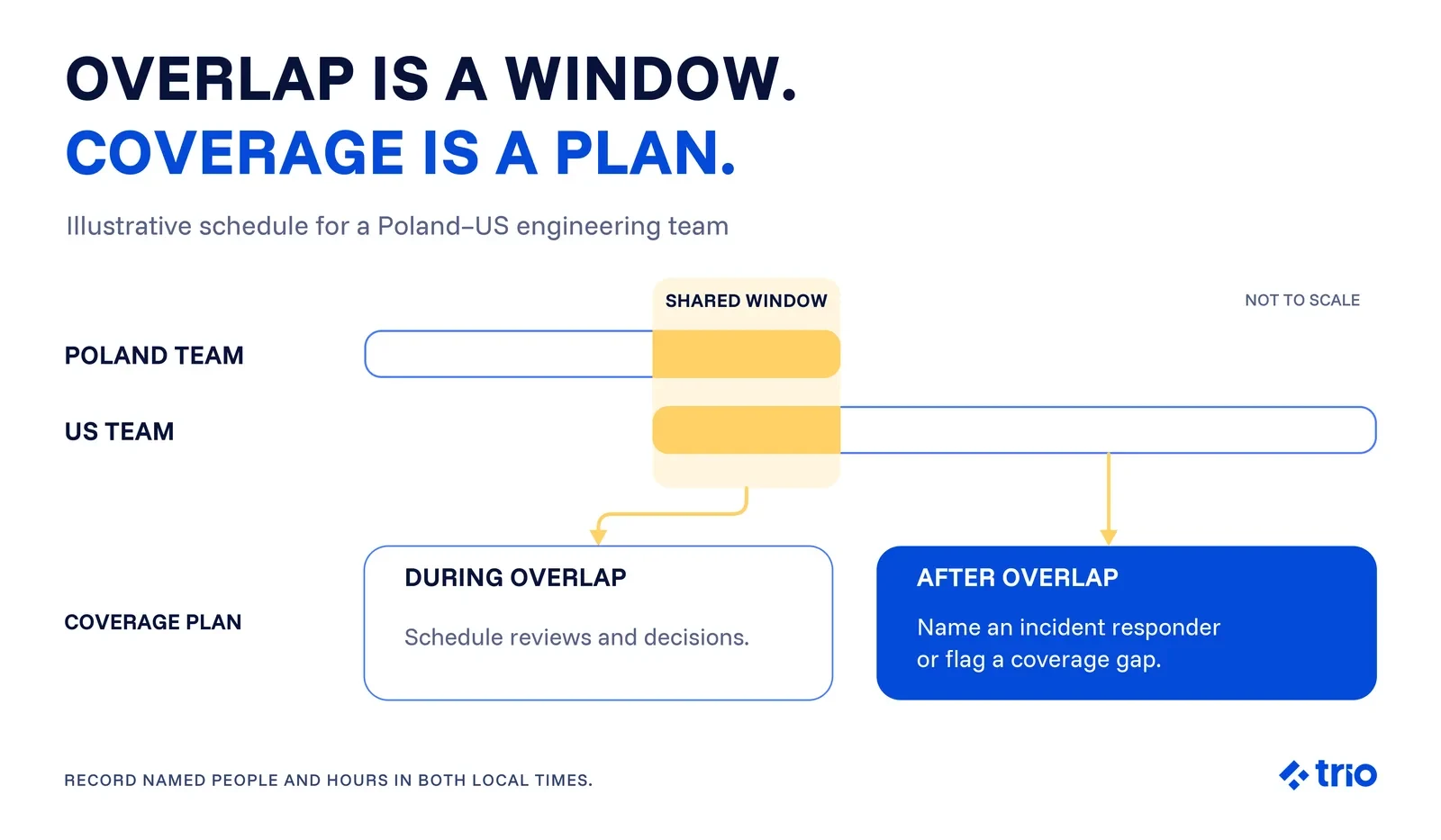
Where that is the shape of the work, a nearshore team in Latin America sitting one to three hours from US time zones is answering a different question than price is.
Is Polish developers' English good enough?
Yes, and by a wider margin than most outsourcing destinations manage. EF's 2025 English Proficiency Index puts Poland 15th in the world on a score of 600, in a ranking of 123 countries and regions.
The skill breakdown is the more useful part of that. Poland scores 612 on reading and 597 on listening, but 518 on speaking.
Written English is excellent; spoken English in a fast, accented, multi-party call is merely good. Written specs, recorded decisions and asynchronous review will run smoother than a crowded conference call, which happens to suit a two-hour window anyway.
How large is Poland's developer talent pool?
Published guides put the figure at anywhere from 300,000 to over 600,000 IT professionals.
A range that wide suggests the number is doing marketing work for those publishing it, rather than analytical work.
To combat this, ask the supplier how many engineers it employs directly, what the seniority split looks like, what attrition rate it had last year, and how many people are currently unallocated.
Who owns the code a Polish team writes?
Under Article 74(3) of the Polish Act on Copyright and Related Rights of 4 February 1994, the economic rights in a computer program created by an employee in the course of their employment duties belong to the employer, unless the employment contract says otherwise.
For software written by a supplier's actual employees, the chain starts in a helpful place.
The complication is how much Polish software work is not done by employees.
Self-employed contracting, known locally as B2B, is common across the Polish tech market, and Article 74(3) does not reach it.
Where a contributor is a contractor rather than an employee, nothing transfers automatically, and without an express assignment the recipient is generally treated as holding a license rather than ownership.
Two further rules decide whether the assignment you do have works.
It has to be in writing: Polish law treats a transfer of economic rights made in any other form as void, so an email trail or a clause buried in an online order will not carry it.
It has to list the uses: A transfer covers only the fields of exploitation the contract expressly names, which means a generic line about all intellectual property belonging to the client can transfer less than you assumed.
So the question to put to a Polish supplier is how each contributor is engaged, and whether the written assignment chain running from contributor to supplier to you is complete and names the uses you need.
Repository access proves nothing about that chain.
We recommend that you have a lawyer read it to be sure.
What does GDPR require if the team touches your data?
An EU address helps with transfers and helps with nothing else on its own.
Where the supplier processes personal data on your instructions, GDPR makes you the controller and the supplier the processor, and Article 28 requires a binding written arrangement covering the subject matter, duration, purpose, categories of data, and the security measures involved.
A processor also needs your written authorization before bringing in a sub-processor, which matters when a Polish supplier staffs part of a team through subcontractors.
Before granting access, settle which data is involved, who the actual processing parties are, and where the people doing the work physically sit.
Which engagement model fits?
Three arrangements cover almost every Polish proposal:
Model | What stays with you | What to pin down in the contract |
|---|---|---|
Staff augmentation | Product direction and all technical management, including review and release | Named engineers, allocation, skills, replacement terms |
Dedicated team | Business priorities and acceptance | Who leads engineering, plus planning, testing, release and continuity |
Managed project | Business decisions, context and acceptance | Scope, milestones, how changes are handled, support after delivery |
The trap is augmentation bought by a company with a product owner but no engineering lead.
Two more developers add capacity and leave the question of who decides architecture, reviews the work, and signs off a release exactly where it was.
When Poland is the wrong call
Four situations where a better Polish vendor does not fix the problem.
You need coverage inside US business hours: Two hours with the East Coast and none with the West is arithmetic, not a question of vendor quality.
You are optimizing purely for rate: South and Southeast Asia run at roughly half Poland's senior rates, and where the work is well specified and overlap genuinely does not matter, that gap is real money.
You have no internal technical leadership, and you are buying augmentation: Change the model or change the plan, because the country is not the variable here.
Your contributors will mostly be contractors, and nobody on your side will read the assignment chain: The rights position is fixable, but only before you sign.
What to bring to the supplier conversation
Give every supplier the same brief so the answers can be compared. Five things belong in it:
The product outcome, and what is in scope right now.
Your named product owner and technical lead, or the technical leadership you need the supplier to provide.
Required roles, allocation, and the collaboration hours you need, written in both teams' local times.
Everything you expect priced, including analysis, testing, release work, and support, with the exclusions written down.
Your rights and data questions: how each contributor is engaged, who holds the written assignments, and who accepts delivery.
Then ask for a start and delivery schedule tied to named people.
If you want to see how that answer compares against a nearshore one, bring the same brief to a software outsourcing conversation with Trio and find out which shape of team the work actually needs.