


 Read Client Stories




 Alex Kugell
 Key Takeaways
- Back-end development covers everything users cannot see, including server-side logic, databases, APIs, authentication systems, and the infrastructure that ties them together.
- In fintech, the back-end layer processes payments, enforces KYC/AML rules, maintains financial ledgers, and ensures that every operation produces an auditable record.
- The estimated median total pay for a back-end developer in the US is $120,000 per year.
- JavaScript and Python represent the two strongest starting points for back-end development in 2026. TypeScript is also mandatory in production fintech codebases.
- Back-end developers in fintech need knowledge of idempotency patterns for payment APIs, fixed-precision arithmetic for currency handling, stateful KYC workflows, and audit trail architecture.
Every time a customer logs into their neobank, initiates a payment, or passes a KYC verification check, something happens that they never see to facilitate the movement of money and data.
All of this belongs to back-end development. Hiring the wrong developer to create these systems can lead to issues that affect the product or service itself and also trigger major regulatory action.
Back-end developers build and maintain the server-side logic, databases, and APIs that power applications from behind the scenes. You will need one with industry experience in order to build a functioning, compliant financial application.
Let’s look at what a back-end developer actually does, the skills that distinguish strong candidates from average ones (especially in financial services), how much they earn, and what it takes to hire or become one.
At Trio, we place pre-vetted back-end engineers with fintech production experience in 3–5 days, so you can access the talent you need without extensive hiring times or ramp-up processes.
What Does a Back-End Developer Do?
Back-end developers build the part of an application that users never interact with directly, but that the product or service depends on.
Where front-end developers design the interface, creating things like the buttons, the forms, and the screens, back-end developers write the logic that determines what happens when a user presses a button or submits a form.
On a fintech product, the role of a back-end developer can be incredibly complex. The front end displays a “Send Payment” button. The back end validates the amount, checks the sender’s balance, calls the payment provider’s API, handles the response, writes a ledger entry, triggers a notification, and returns a confirmation.
Each of those steps involves code that a back-end developer wrote and maintains.
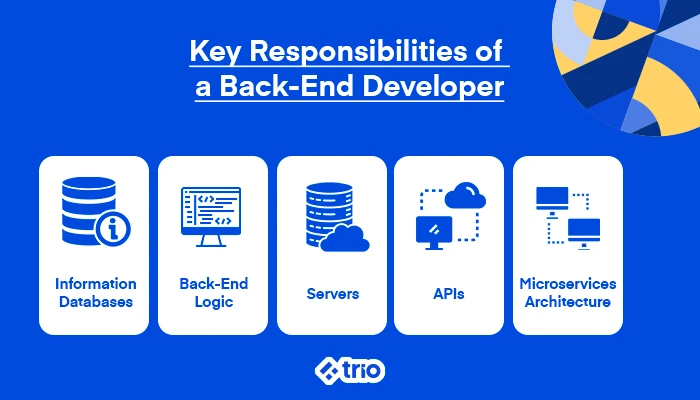
Their role can be split into several parts:
- Server-side development: Writing the logic that handles requests from the front end, processes data, and returns responses. This covers everything from authentication to business rules to third-party API integration.
- Database management: Designing schemas, writing queries, optimising performance, and ensuring data integrity. For financial data specifically, this means choosing the right storage type for each use case.
- API development: Building the interfaces that allow different parts of a system to communicate. In fintech, APIs also expose integration points for banking partners, payment providers, and KYC platforms.
- Authentication and security: Implementing login systems, managing tokens, enforcing role-based access controls, and protecting data from common attack vectors. This often touches audit logging, secrets management, and the access control documentation that compliance reviews examine.
- Performance and scalability: Ensuring that a system handles load gracefully, such as payment systems and database queries. Developers need to identify and resolve bottlenecks before they affect users.
- Testing and documentation: Writing unit tests, integration tests, and end-to-end tests to verify that code behaves correctly. Maintaining API documentation and technical guides so that other developers and banking partners can work with the system reliably.
Back-End Developer vs Back-End Engineer: Is There a Difference?
Often, the titles of back-end developer and back-end engineer get used interchangeably, but they aren’t quite the same.
A back-end developer typically focuses on building and maintaining specific applications or components, working within an existing architecture, and delivering features to a defined specification.
In other words, they are focused on the finer details and actually do a lot of the coding that ends up in your production application.
A back-end engineer, however, tends to operate at a higher level of abstraction. They are responsible for making architectural decisions, designing systems for scalability and resilience, defining API contracts, and selecting technologies.
They still code, but often take broader ownership of how a system evolves over time.
In fintech, architectural decisions made early have compliance and cost implications that play out months later. These decisions benefit from engineering-level thinking rather than developer-level execution.
Common examples of these kinds of decisions that our back-end engineers make all the time include whether to use a hosted payment page or build custom card capture, whether to model KYC as a boolean flag or a state machine, or whether to store currency amounts as floats or decimals.
Technical Skills Every Back-End Developer Needs
As with all other software development roles, there are certain technical skills that are unique to back-end developers, and some that overlap with other roles.
Programming languages
- Python is one of the most beginner-friendly back-end languages and the most versatile, with strong demand in data, AI, and financial analytics.
- JavaScript through Node.js dominates API development at most startups and growth-stage companies.
- Java retains a strong presence in enterprise financial systems, and you will encounter it in legacy environments.
- PHP powers a significant share of web infrastructure.
- Go has gained traction in performance-critical back-end services.
Most back-end developers specialise in one language and framework rather than spreading thin across many, so you need to specify what you are looking for when hiring.
Frameworks
Express.js (JavaScript) offers a minimal, flexible approach for Node.js backends. NestJS then builds on top of Express with a TypeScript-first architecture, which provides a better structure for larger codebases.
Django and Flask serve different ends of the Python complexity spectrum, with Django being used in many Fintech super apps, and startups often taking advantage of Flask’s incredibly flexible nature.
If you are working with Java, then it is likely that you are in an enterprise environment and will benefit from Spring Boot.
Likewise, Laravel (PHP) handles many content-heavy applications.
Databases
Proficiency in both relational and non-relational databases shapes how effectively a back-end developer can model data for their specific use case.
Relational databases like PostgreSQL and MySQL store structured data with strict integrity guarantees.
PostgreSQL, in particular, has become the standard choice for financial transaction data where ACID compliance ensures that debits and credits either both commit or both fail, and the NUMERIC/DECIMAL type stores currency amounts exactly, unlike floating-point alternatives.
Non-relational databases like MongoDB, Redis, and Cassandra handle unstructured data, caching, and high-throughput operations.
We often see Redis used in fintech for session storage, rate limiting, and distributed locking. MongoDB handles configuration data, notification templates, and other document-structured information that doesn’t require relational integrity.
APIs
Back-end developers need to be familiar with designing and building REST endpoints, handling authentication and authorisation, implementing rate limiting, and writing API documentation using tools like Swagger or OpenAPI.
They should also be able to use GraphQL for complex querying needs and WebSockets for real-time connections.
Security
Fintech requires strict security protocols such as authentication patterns (JWT, OAuth 2.0, session management), input validation, SQL injection prevention via parameterised queries, HTTPS enforcement, and secrets management using tools like AWS Secrets Manager rather than environment variables checked into version control.
Security practices also connect to compliance obligations, so developers need to prepare for a penetration test or QSA review, which will probe precisely these areas.
Cloud and DevOps fundamentals
Most production back-end systems run on AWS, GCP, or Azure.
Understanding how to containerise services with Docker, manage deployments, configure environment variables across staging and production, and monitor application performance has become a baseline competency for most back-end roles.
Version control
Git proficiency, including branching strategies, pull request workflows, and code review participation, is essential.
In fintech codebases with compliance audit requirements, clean commit history occasionally matters beyond engineering hygiene.
Fintech-Specific Back-End Skills
Several skills appear consistently on fintech back-end job descriptions that general development tutorials rarely address.
- Idempotency: A payment endpoint that receives the same request twice should process it once and return the same result both times. Implementing idempotency keys, checking for duplicate request IDs before processing, and returning previous results on retry prevent double charges and satisfy requirements that PSPs like Stripe make explicit.
- Fixed-precision arithmetic: JavaScript’s native number type uses IEEE 754 floating-point, which cannot represent certain decimal values exactly. 0.1 + 0.2 does not equal 0.3. Storing currency amounts as integers in minor units (cents for USD) or using PostgreSQL’s NUMERIC type prevents the precision errors that accumulate into material reconciliation discrepancies at transaction volume.
- KYC state machine design: Effective KYC systems track verification status as a stateful workflow (pending, under review, verified, failed, requires manual review, etc.) rather than a simple boolean. The state machine maintains an audit trail of who verified a customer, when, under what criteria, and what ongoing monitoring applies.
- Audit trail architecture: Certain back-end operations in regulated environments need tamper-evident log entries. Append-only log structures, separate from application logs, satisfy this requirement.
- Webhook handling: Payment providers, KYC platforms, and banking APIs all communicate through webhooks, which are POST requests sent to endpoints when events occur. Secure webhook handling requires signature verification (using HMAC with the provider’s secret key), idempotent processing, and appropriate response codes.
Soft Skills That Matter in Fintech Environments
Communication, problem-solving, and continuous learning are all among the most critical soft skills required for financial software development.
Back-end developers in fintech regularly explain compliance-adjacent technical decisions to non-technical founders, product managers, and occasionally auditors.
They often need to articulate why the KYC flow was built a particular way, or why a payment architecture decision carries PCI DSS implications, without relying too heavily on technical terminology. This affects both team alignment and audit outcomes.
Regulatory requirements also regularly arrive as constraints, not suggestions.
A back-end developer who treats compliance obligations as obstacles to route around creates technical debt that arrives as expensive findings. One who treats them as design requirements from the start produces systems that hold up under scrutiny.
Finally, the back-end development landscape shifts faster than most technical domains. Regulations shift, and payment providers update their APIs regularly. Back-end developers who don’t actively track regulatory and technical changes fall behind very quickly.
Tools of the Trade
- Development environments: Visual Studio Code handles most back-end development languages well and has become the most widely used editor in the market. IntelliJ IDEA and PyCharm offer deeper integration for Java and Python, respectively. Most back-end developers spend meaningful time in the terminal rather than relying on IDE features alone.
- Databases and query tools: pgAdmin and DBeaver for PostgreSQL management, MongoDB Compass for MongoDB, Redis Insight for Redis. Prisma and Sequelize as ORMs for Node.js applications.
- Testing: Jest for JavaScript/Node.js unit and integration tests. The Node.js built-in test runner can be used as a lightweight alternative. Mock Service Worker (MSW) for intercepting API calls in test environments. Postman or Insomnia for API testing during development.
- Collaboration: GitHub or GitLab for version control and code review. Docker for consistent development and deployment environments. Jenkins, GitHub Actions, or CircleCI for CI/CD pipelines. Notion, Jira, or Linear for project management.
How to Become a Back-End Developer
These days, there are many different ways to become a back-end developer.
Educational Path
A strict educational path, like a computer science degree, provides strong foundations in algorithms, data structures, and system design that accelerate progression to senior roles. The problem is that these can be expensive and take several years.
Bootcamps compress the practical skills into six months or less and focus on portfolio building, though they typically cover less theoretical depth.
Self-directed learning through platforms like Coursera and Udemy works well, but only if you have sufficient discipline.
The best option is to combine any learning with real project work.
Building a portfolio
A portfolio of projects that demonstrate real back-end work ultimately matters more than certifications.
For a back-end development role, projects should include APIs with authentication, database integration, and error handling; examples of test coverage. For fintech roles specifically, hiring companies look for any payment integration, KYC workflow, or compliance-adjacent feature work.
Open-source contributions in relevant projects add credibility.
The fintech-specific path
Getting the domain knowledge that separates a general back-end developer from a fintech-ready one typically requires production exposure in a financial services environment.
Working on payment integrations, handling PSP sandbox environments, building KYC workflows, or maintaining a transactional database under real load all accelerate that learning in ways that courses cannot replicate.
Back-End Developer Salaries
The median total compensation for a US back-end developer is $120,000 per year, according to Glassdoor. Entry-level developers earn around $90,000.
Experienced back-end engineers in tech hubs like San Jose and New York routinely earn more than the average, because of the higher cost of living in these areas and the increase in demand.
Financial services back-end roles with compliance domain experience add an additional 10–15% premium above general back-end benchmarks.
An efficient cost-saving practice is to hire through a LATAM nearshore model. Senior back-end developers through Trio’s LATAM nearshore model cost $40–$80/hr with US timezone overlap and pre-vetted fintech domain experience.
That translates to roughly $83,000–$166,000 in annual engagement cost depending on hours and seniority, representing a meaningful reduction from US domestic rates without the timezone friction of fully offshore arrangements.
Hiring a Back-End Developer for Fintech
The most common mistake in fintech back-end hiring is assessing general coding ability without assessing domain knowledge.
You need to look for someone who has written an idempotent payment handler, designed a KYC state machine, or worked in a PCI DSS-scoped codebase.
- Interview questions worth including for fintech roles include:
- How would you handle a payment webhook that arrives twice for the same event?
- Why would you avoid storing a currency amount as a float?
- Walk me through how you would design a KYC verification flow that satisfies regulatory audit requirements.
Trio eliminates the time and effort you typically need for sourcing and domain assessment.
Our pre-vetted back-end engineers with fintech production experience can be placed in 3–5 days, at rates around $40–$80/hr depending on your requirements, and with a replacement guarantee.