Hire by Technology
SERVICES



Vue.js is an open-source JavaScript framework for building user interfaces and single-page applications. It was created by a former Google engineer named Evan You and focuses on the view layer of an application.
One of the many reasons Vue is so popular is that the framework allows developers to adopt it incrementally, meaning you can start with a small enhancement on an existing page and scale up to a full application without rewriting your entire codebase.
Vue also continues to win over developers who find React's ecosystem overwhelming and Angular's learning curve steep. Vue 3 is now the default version, and despite being a few years old, the framework has only grown in adoption, which has allowed the ecosystem to mature and the community to deepen.
Let’s go into more detail about what Vue.js actually is, how its core features work, what it gets used for in production, and how it compares to React and Angular, so you can make an informed decision about whether it fits your project.
If you want to hire Vue developers for your next project or feature, we have pre-vetted developers in our pool that can be hand-picked based on your requirements, and start meaningfully contributing within 3-5 days of an initial consultation.
Created by Evan You, Vue.js is a model-view-viewmodel (MVVM) JavaScript framework built for constructing user interfaces and single-page applications. This was after he had used AngularJS at Google, and found the framework too heavy and opinionated for many use cases. His goal was to extract what he found most useful about Angular and build something considerably lighter.
Fun fact: The name comes from the French word for "view," which reflects the framework's original focus on the presentation layer.
However, the framework has not stayed stagnant since its original inception. Rather, that focus has expanded over the years as the ecosystem has grown to include official routing, state management, and server-side rendering tools.
But the core philosophy of staying approachable without sacrificing capability appears to have remained intact. The MVVM architecture that underlies Vue separates presentation logic from business logic. The view model layer acts as a mediator, reading data objects for display without tightly coupling the UI to the underlying data.
In practice, this separation means that your Vue applications are easier to test and maintain, even as they grow.
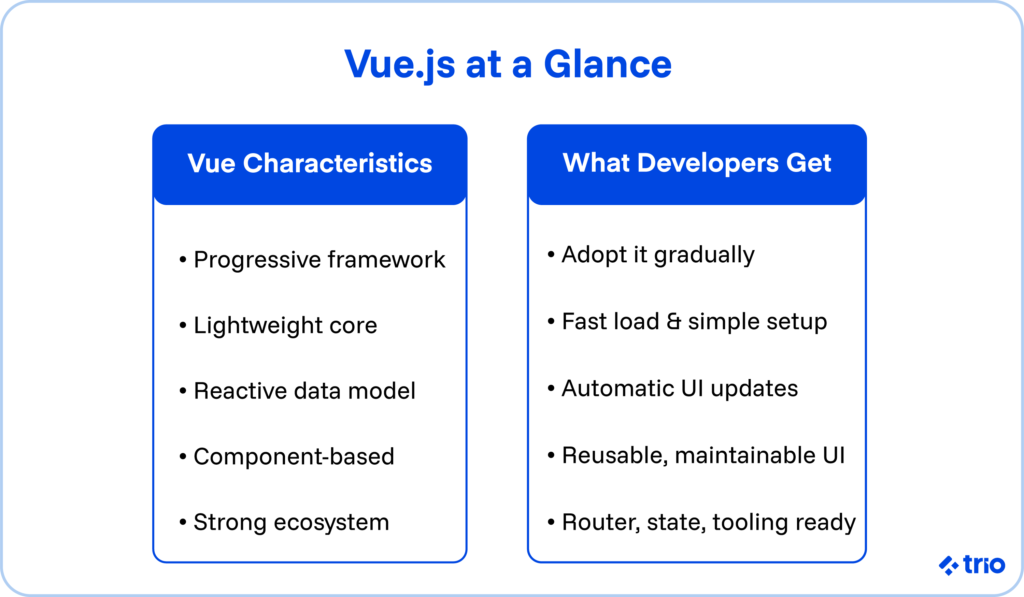
There are many core features that draw developers to using Vue instead of another JavaScript framework.
Declarative rendering lets you describe what the UI should look like based on your current data state.
Instead of your developers needing to deal with all the little details, Vue handles how it gets there.
The template syntax extends standard HTML with Vue-specific directives. This means that it is readable to anyone familiar with HTML, even before they've learned the framework in depth.
Vue's reactivity system tracks data dependencies automatically so that any change to reactive data leads to every component that depends on it updating automatically.
In our experience, this has been one of Vue's main selling points since the early days.
The alternative is, of course, manually managing DOM updates, which takes more code and introduces more opportunities for inconsistency.
Vue 3 rewrote the reactivity system using JavaScript Proxies, which improved performance even further and fixed edge cases that the older Vue 2 implementation couldn't handle cleanly.
Every piece of a Vue application or web page functions as its own component, so you essentially build smaller, self-contained units that get reused rather than duplicated, which keeps codebases more readable as they grow.
Unit testing becomes a lot more tractable because you can test how individual components behave in isolation.
Organization is also simplified as single-file components, written as .vue files, which keep the template, script logic, and styles for each component together in one place.
New developers joining your team can also find it easier to reason through than frameworks that split these concerns across separate files.
Directives extend plain HTML with reactive behavior through v-if handling conditional rendering, v-for handling list rendering, v-model creating two-way binding between form inputs and data, and v-bind dynamically binding attributes.
These are built in, but Vue also supports custom directives for cases where built-in behavior doesn't quite fit.
Our developers love to use two-way data binding through v-model specifically. Changes in the model update the view, and changes in the view update the model.
This removes the boilerplate of manually syncing input values to application state in things like form-heavy applications.
Vue uses a virtual DOM to manage UI updates efficiently. Rather than writing changes directly to the real DOM on every data change, Vue maintains an in-memory representation and applies only the necessary changes in batches.
Practically, this means that you will benefit from a more performant update process, particularly in applications with frequent data changes or large rendered lists.
As mentioned above, thanks to the increasing popularity amongst newer developers, Vue's official ecosystem has matured considerably since its early days.
While a lot of the older tools are still supported, understanding the current tooling helps avoid confusion when reading documentation or tutorials from different eras.
Here are some of the biggest changes:
Vue 3 also introduced the Composition API as an alternative to the original Options API. Either one of them still works in the latest version, so your developers will have to know the minute differences to choose the best one for your project.
In short, the Options API organizes component logic into named sections like data, methods, computed, mounted, and so on.
This can feel very intuitive for smaller components and tends to be the approach documented in older tutorials, and we have found that many teams who used it previously have just continued with it because it maps closely to the mental model they already have.
The Composition API, on the other hand, lets developers group related logic together regardless of what "type" of logic it is, using functions called composables.
Many devs find this a lot more readable and maintainable for larger components where a single feature might involve reactive data, computed values, methods, and lifecycle hooks, because related pieces stay adjacent rather than scattered across named sections.
Neither is strictly better, but the Composition API seems to fit large or complex components and teams that want to share logic across components through composables. The Options API is cleaner if you have simpler components or if you have more junior developers.
Vue's versatility makes it a really great option for many different use cases, but there are definitely some instances where we see it with incredible frequency:
There are a couple of notable companies running Vue.js in production for these very use cases, including Netflix and Google.
Vue is often compared to React and Angular, acting as a sort of middle ground between the two.
Angular is a TypeScript-based web application framework maintained by Google, and it takes a considerably more opinionated approach than Vue.
Angular required that developers use a specific architecture, a specific dependency injection pattern, and its own module system.
For large teams with many developers, that rigidity can actually help by enforcing consistency; however, for smaller teams that prefer flexibility, it often feels like overhead.
Angular's learning curve also runs a lot steeper than Vue's. Developers without prior experience with TypeScript or enterprise-scale frontend architecture typically need more time to become productive in Angular than in Vue.
The documentation is comprehensive but has historically been described as dense.
Vue tends to feel more approachable for developers who want structure without committing to a fully prescriptive ecosystem.
You get directives, reactivity, and component architecture without Angular's module boilerplate or its specific opinions about how services and dependency injection should work.
React is a JavaScript library. Technically, it is not a full framework. But it is focused on building UIs through components and JSX syntax.
JSX basically combines HTML, CSS, and JavaScript into a single syntax, which some developers find expressive, and others find harder to maintain.
React's ecosystem is enormous and has grown somewhat organically, meaning you'll typically need to make your own decisions about routing (usually React Router), state management (Redux, Zustand, Jotai, Context, or others), and tooling.
For experienced teams, that flexibility can feel empowering. For teams new to component-based frontend development, the number of decisions to make before writing application code can feel disorienting.
Vue provides a more curated set of official tools, and that consistency appears to be one reason it continues winning over first-time frontend developers and teams that prefer a more guided path.
The template syntax that Vue provides also stays closer to standard HTML, which helps to ease onboarding for developers coming from a primarily HTML and CSS background.
When hiring for a Vue.js project, a few technical and non-technical signals tend to distinguish developers who can contribute quickly from those who will need extended onboarding.
We have found that JavaScript depth matters more than Vue knowledge alone.
A developer who understands modern JavaScript, including ES6+ features like template literals, destructuring, arrow functions, and Promises, brings a foundation that makes Vue skills transferable and maintainable.
Vue-specific knowledge can be learned if the solid JavaScript fundamentals are already there.
Vue 3 familiarity is a good baseline to consider, though. Developers who only know Vue 2 may need orientation on the Composition API, Pinia, and Vite. It's worth asking specifically about Vue 3 project experience rather than Vue experience generally.
HTML and CSS proficiency are also still essential.
Vue's template syntax extends standard HTML, so weak fundamentals in either language produce weak Vue output regardless of framework knowledge.
Beyond technical skills, we always look for soft skills like time management and communication.
Hiring costs for Vue.js developers vary considerably by location and seniority, which makes location strategy one of the most practical levers for managing project budget.
In the United States, Vue developers earn between $88,500 and $157,000 annually, with an average of around $117,000.
In Latin America, the average annual salary for a mid-level Vue developer runs around $76,000, with senior developers at the higher end of the market approaching $100,000.
We provide LATAM developers in the fintech niche for between $40-$90 per hour, leading to a savings of 40%-60% for many companies, depending on their specific requirements.
If you're at the hiring stage, a clear job description tends to attract more relevant candidates than a vague one. The template below covers the core requirements and can be adjusted for your specific stack and seniority target.
[Company Introduction]
Write a short overview of your company, including culture, benefits, and what makes it an interesting place to work.
[Job Description]
We are looking for an experienced JavaScript developer with strong Vue.js skills to join our team. Your primary focus will be on developing user-facing web applications and components using Vue 3, following current best practices around the Composition API, Pinia, and Vite. You will write modular, maintainable, and well-tested code and collaborate closely with backend developers and UX designers.
[Responsibilities]
[Skills and Requirements]
The questions below help assess technical depth beyond what a resume can confirm. They tend to surface quickly whether a candidate has worked on real Vue applications or primarily followed tutorials.
Vue is a great middle ground between React and Angular. It is incredibly approachable for new developers and is a great option for simpler projects.
If you need skilled, pre-vetted Vue.js developers, placed in 3-5 days, we may have the right people for you.