

Hire by Technology
SERVICES



Fintech software developers have some of the highest salaries in tech, but these costs are essential because compliance adds a layer of risk that most industries never encounter. The pressure to make the right hiring decisions compounds quickly.
The most common options in software development are to either build an in-house team, outsource software development to an external partner, or find some middle ground.
Outsourcing occurs when you allow an external team to take full control of your product, or certain aspects and features. It takes the pressure off your shoulders, but you also can't make changes and have very little control.
In-house development gives you full control, which means you can pivot at any time, expand your scope, and interact with those developers on a day-to-day basis. However, with the increased control, you also have an increased management responsibility.
Many believe the first 20 engineers should always sit in-house. That instinct makes sense for a product handling sensitive financial data, but it often falls apart when you run the actual numbers against your runway.
Let's look at the key differences between in-house development and outsourcing, and a hybrid option in the form of staff augmentation.
We provide both fintech outsourcing and staff augmentation here at Trio, starting every engagement with a consultation to make sure you are choosing the right option for your project.
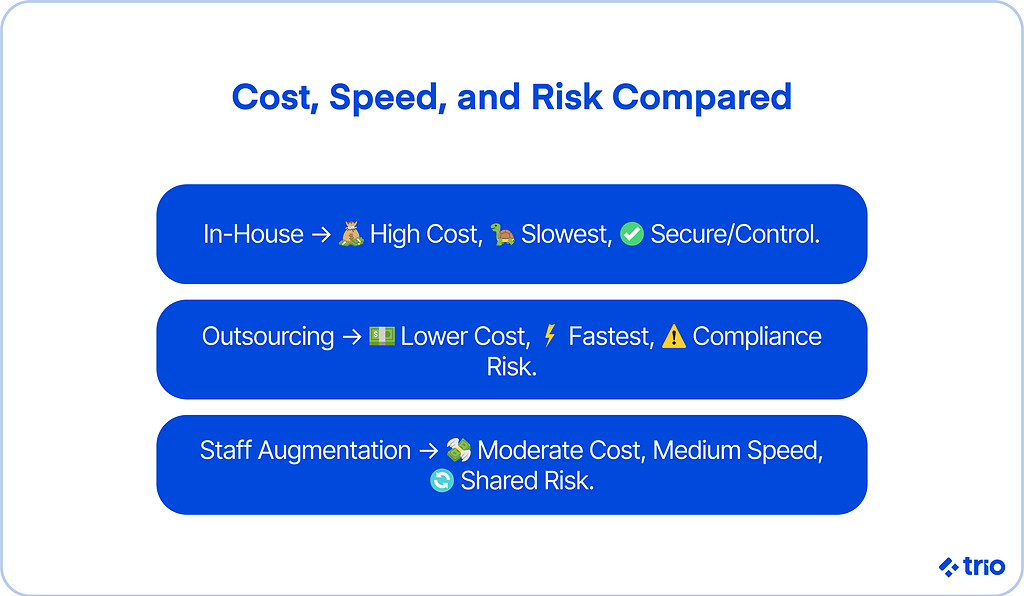
Before the details, here's how the three models compare on the factors that matter most for a fintech product.
| Factor | In-House | Outsourcing | Staff Augmentation |
| Speed to hire/deploy | Slow: 3–6 months to productive contribution | Fast: engineers available within weeks | Fast: typically 2–4 weeks, sometimes days at Trio |
| Cost (US fintech engineer) | $175,000–$200,000 all-in per engineer/year | $86,000–$154,000/year equivalent (LATAM nearshore) | Between outsourcing and in-house; no benefits or turnover overhead |
| Data security & compliance oversight | Tightest: full control over processes and audit trail | Weakest by default; depends heavily on the partner's fintech experience | Strong: external engineers work inside your infrastructure and processes |
| IP and institutional control | Full control and full responsibility | Limited; priorities ultimately sit with the vendor's business | High; engineers report into your team and roadmap |
| Best for | Core product, proprietary logic, regulated data flows | Non-critical features, short well-scoped phases | Specialized skills, compliance audits, scaling without permanent headcount |
Most fintech teams that we work with end up landing somewhere in the middle. They keep the core in-house and outsource the periphery.
In doing this, architecture, proprietary logic, and anything that touches regulated data stay with a permanent team, while execution-heavy work, integrations, and specialized skills go to an outsourcing or staff augmentation partner.
Before running numbers, it helps to define what each model actually involves, because the differences matter more than the labels suggest.
In its most basic form, in-house development means hiring engineers as full-time employees and making them part of your company.
These developers work alongside you, live inside your product culture, and focus exclusively on your roadmap.
Full control over quality and intellectual property comes with this model. So does a steep price tag.
Competitive fintech engineers in the US typically cost upwards of $110,000 in base salary alone, before benefits, equity, recruiting fees, onboarding time, and the infrastructure needed to keep them productive.
On top of that, we've seen it take weeks or even months to find these developers, depending on their expertise, which costs both resources and your time. And on top of that, you need the skills in-house to assess the developers.
For a seed-stage fintech with $2 to 3 million in the bank, a 10-person engineering team can consume most of your funding in a single year, and a wrong hire could be incredibly detrimental.
Related Reading: Hire Open Banking Developers
Outsourcing is, in many ways, the opposite of in-house hiring.
Rather than building the team yourself, you contract external development companies to deliver a specific product, feature, or phase.
There are three different geographic models that exist:
For US fintech companies, nearshore outsourcing typically means Latin America.
We primarily source our own developers for this reason, since the combination of time-zone overlap, technical depth, and cost savings tends to work better in practice than purely offshore arrangements.
In fintech, particularly, this is essential for teams where real-time code review and daily standups matter.
In theory, outsourcing offers a way to skip long recruitment cycles and get immediate access to specialized talent at lower hourly rates.
However, the hidden costs that many companies fail to account for tend to appear through miscommunications, rework, and the overhead of managing a team that doesn't share your institutional context.
Staff augmentation sits quite cleanly somewhere between in-house development and outsourcing, and acts as a hybrid solution that fits a lot of companies far better than either of the two extremes.
Rather than handing off the whole project, you embed external developers directly into your existing in-house team. They work alongside your engineers, inside your systems and processes, usually on contracts that run months rather than years.
For an early-growth fintech, this means that you can bring in a cloud security specialist for your first PCI DSS audit, for example, without committing to a permanent salary you'll carry long after the audit ends.
Hiring from a fintech-specialist firm that keeps a pool of pre-vetted developers on hand means you are also far more likely to hire the right person immediately, and you can onboard them rapidly.
At Trio, for example, we place developers within 3-5 days of an initial consultation.
It doesn't reduce costs as aggressively as full outsourcing, but it offers more control and avoids the delays that come with a new permanent hire.
Related Reading: Hire Fintech Developers
When you are hiring an in-house developer, salary is just one of many considerations.
Based on data from engineering hiring across the US and Western Europe, salary with taxes typically constitutes around 55 to 58% of total employment cost. The remainder breaks down approximately like this:
In practical terms, a senior fintech engineer with a $110,000 base salary may cost closer to $175,000 to $200,000 annually once you add these layers. Multiply that across 10 hires, and you're looking at $1.75 to $2 million per year before a single feature ships.
Outsourcing rates vary depending on where you are getting the developers from.
Through Trio, LATAM developers with strong fintech backgrounds typically bill at $45 to $80 per hour, depending on seniority and specialization. A full-time equivalent at 160 hours per month lands somewhere between $7,200 and $12,800 monthly, or roughly $86,000 to $154,000 annually.
Staff augmentation sits between these numbers. Hourly rates run higher than pure outsourcing, but the absence of other costs still tends to give you reasonable cost savings.
Related Reading: Financial Software Development Company Services
Control is one of the most critical factors you need to consider when hiring fintech developers.
Handling financial data, running payment infrastructure, or building lending products under regulatory scrutiny leaves little room for the kind of quality drift that can happen when external teams aren't well-integrated.
A full in-house development team gives you the tightest oversight since every line of code gets produced under your processes and your security policies.
When regulatory auditors ask for documentation or when a compliance finding needs immediate remediation, you have the developers who worked on those processes on hand.
The downside is that control can slow you down, especially as you grow, since internal approval processes and organizational overhead sometimes compound faster than the team itself does.
An outsourced partner may appear aligned during a sales conversation, but its priorities ultimately sit with its own business. Deadlines, resourcing decisions, and coding standards may diverge from yours unless contracts and oversight processes are established carefully at the start.
In fintech specifically, the biggest risk here is outsourcing to a partner without domain experience.
Frameworks like PCI DSS, SOC 2, GDPR, and CCPA need technical controls but also documentation, monitoring, and audit readiness.
A developer who doesn't know how regulators think may overlook details that later escalate into findings, fines, or product delays. This is also where we see that purely offshore outsourcing creates the most exposure for early-stage fintechs.
Staff augmentation reduces this risk because external engineers work within your infrastructure and follow your processes. They're still technically outsiders, but the integration runs deep enough to maintain alignment on security and compliance standards.
If you work through Trio, you'll probably have access to them later, too, so they can answer questions that you may not have thought to prepare for ahead of time.
The longer it takes to launch an MVP, the more cash is consumed on salaries, cloud bills, and compliance preparation before revenue arrives.
In-house hiring tends to run 3 to 6 months from posting to productive contribution for most senior fintech engineering roles. If the role is particularly niche, it may take even longer.
Posting, sourcing, interviewing, extending an offer, waiting out a notice period, and ramping someone up can each take longer than you may budget for in your initial hiring plan.
Once the team reaches full capacity, iteration tends to stay smooth because everyone shares context and works within the same processes. Getting there takes a while, though.
Outsourcing looks faster upfront. Vendors often have engineers available who can spin up work within weeks. If a board meeting or a product launch deadline creates pressure, that speed feels attractive.
But the time saved up front can disappear quickly if miscommunications or poor code quality force rework that derails the original schedule.
Staff augmentation, yet again, usually lands in between. Vendors can place engineers into your team within 2 to 4 weeks, which runs significantly faster than permanent hiring while maintaining more alignment than handing off work to an external team entirely.
Since we focus exclusively on fintech here at Trio, we can sometimes reduce that timeline to a matter of days, since our developers don't need a lengthy orientation on the domain basics before contributing.
In-house scaling takes time, as we have already discussed. Adding headcount means months of recruiting. Reducing it after a product phase ends means layoffs or keeping engineers occupied on lower-priority work.
The in-house model works best when development demand stays relatively stable, which it often doesn't at companies between funding rounds or product pivots.
Outsourcing scales up and down more easily, but risks uneven output as team composition changes. An outsourcing partner that rotates developers without warning can reset the institutional context that took months to build.
Staff augmentation lets you flex capacity without making permanent bets. You can bring in specialized skills for a specific phase, then wind down without the organizational weight of a reduction in force.
Demand for AI and ML engineers continues to outpace supply in fintech specifically, where the applications, fraud detection, credit scoring, transaction categorization, and real-time risk assessment require both technical depth and regulatory awareness.
These roles have some of the highest salaries in-house and expensive hourly rates through outsourcing vendors because developers need two sets of very niche skill sets.
Finding these people is often very difficult to do through conventional hiring, so staff augmentation or specialized outsourcing may offer a more practical path, particularly if you are just going to need them for one feature.
The same logic applies to DevOps and cloud-native engineering. CI/CD pipelines, infrastructure as code, and SOC 2 compliance controls have become standard expectations in fintech.
But you need to make sure that you are working with the right outsourcing or staff augmentation partner, since not all of them will have this niche talent on their team.
Most fintech companies benefit the most from using a mixture of all these hiring models, adjusting the mix as their stage and needs evolve.
A few signals tend to point toward keeping development in-house:
A few signals tend to favor outsourcing or augmentation:
In fintech, there is a place for all three hiring models. Each serves a different purpose, and most companies benefit from a mixture of each, depending on what they need.
At Trio, we specialize in fintech staff augmentation and outsourcing. Our developers have helped several companies develop features as rapidly as possible without sacrificing security, compliance, or code quality.
To see if we have the right fintech specialists for your project, book a staff aug consultation.


