

Hire by Technology
SERVICES


If you work in financial services, you need to innovate quickly, while still being able to handle sensitive customer information, respond to regulators, and manage manual compliance tasks while scaling.
Continuous fintech compliance automation and real-time audit capabilities help to keep FinTech companies audit-ready without slowing product delivery, and they spare your team from the panic cycles that tend to define audit season.
Let's look at how you can implement continuous compliance monitoring, automating real-time audits for your FinTech.
Our expert fintech developers have helped countless companies automate compliance workflows, giving teams the tools they need to scale long-term.
To find out if we have the right people for you, book a security-ready consult.
Compliance in a FinTech environment reaches beyond a SOC 2 sticker or a PCI DSS checklist. In order to stay compliant, you need to prove to a regulatory body that you have control and adhere to regulations across changing environments on a day-to-day basis.
A bank integration, a new cloud service, or even changing a permission in IAM can have some major compliance implications. Most fintech teams juggle SOC 2, PCI DSS, ISO 27001, and partner-specific regulatory requirements.
For EU-facing operations, which you may fall under if you start offering services in the region at any point in time, DORA adds ICT risk management and resilience testing obligations on top of everything else.
There may also be obligations tied to the General Data Protection Regulation or state privacy laws like the California Consumer Privacy Act. With this mix, the regulatory landscape shifts often and quickly, and traditional compliance methods rarely keep pace.
Continuous compliance helps you to protect customers and build trust with partners faster than any periodic audit cycle can. Banks, processors, and enterprise clients expect strong security controls and compliance. Many ask for evidence before signing anything, and that ask tends to come earlier in the sales cycle than fintech founders expect.
Real-time audit automation lets you deal with these issues systematically. Evidence gets collected automatically as part of normal operations, so when someone requests proof, you already have it. Faster due diligence cycles and less internal stress follow naturally from that. Catching compliance issues early also tends to be far cheaper than addressing them after a quarterly review.
We’ve noticed issues like small configuration drifts, misconfigured permissions, or even lapsed certificates become straightforward fixes when you spot them immediately. However, we have also seen firsthand how the same issues left undetected for weeks can turn into significant remediation projects or, worse, regulatory findings.
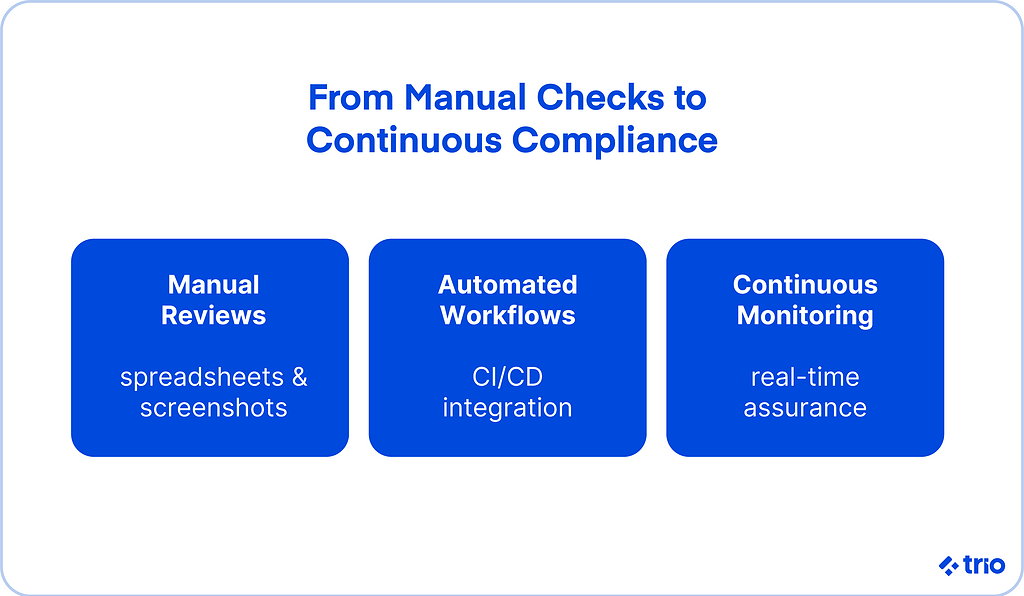
Automating compliance processes looks different for every business, but the common thread involves replacing manual checks with workflows and code.
For example, instead of asking your engineers to confirm encryption settings by hand, you could build a system that verifies configurations continuously and notifies the right person if they drift.
Here is what we often see in early efforts:
Even pulling configuration snapshots into an evidence repository on a daily schedule is enough of a start to see some real value. It removes the time-consuming backtracking that compliance teams often face when reconstructing system states from memory during an audit.
As automation matures, you will probably start with validating policies at deployment time, real-time monitoring for drift, and real-time alerts when controls move out of bounds.
Related Reading: Verification of Payee (VoP)
Automated control testing is one of the automations where you stand to benefit incredibly.
Instead of relying on manual testing all the time, you would implement automated control testing that runs continuous checks against your defined security controls and surfaces failures immediately.
This ends up reducing your SOC 2, PCI DSS, or ISO 27001 evidence burden.
Common controls worth automating first:
The added value here is also a better relationship with your auditors.
The system collects logs, configuration states, and control results continuously through API-driven evidence capture and immutable audit logging.
Just be careful that you don’t automate blindly here, and you'll likely create new problems rather than solve old ones.
Also, be very careful when setting up alerts. We have found that, if every alert goes to the entire team, people eventually stop reading them. If evidence gets collected but is not labeled clearly, your auditors still have questions.
AI now shows up in almost every compliance tool sales pitch. But it’s worth going into how AI is actually being used, and where you realistically still need human oversight.
Where AI in financial services appears to add genuine, near-term value:
Where human oversight still matters:
The reality of these AI solutions in compliance is that they carry a real risk of false positives and, in some cases, model bias that affects which transactions or accounts get flagged.
Deploying AI-powered compliance monitoring without clear escalation paths and periodic model reviews tends to erode confidence in the system over time. AI works best as a first-pass filter, but you are going to want a human in place to make the final decisions.
Generative AI in particular works better for things like summarizing and drafting than for making reliable compliance judgments.
Most fintech companies depend on a chain of vendors, cloud providers, and API partners, some of which provide automation compliance services.
However, each vendor can introduce compliance exposure. That exposure can, itself, be managed through automation.
Automating third-party risk management typically involves:
PCI DSS v4.0, which came into full effect in 2024, places explicit obligations on how you need to manage these third-party service providers. Without automation, keeping those records current can fall through the cracks.
Too many teams treat it as a substitute for accountability. You still need clear decision ownership, regular security audits, and a shared understanding of why compliance matters in the first place, all of which should be part of your engineering culture.
Compliance guardrails should simply be seen as part of reliable delivery.
To build this mindset, you need effective communication, well-designed systems, and direct experience with what a compliance gap actually costs.
Industry experience helps significantly. Hiring a general developer, no matter how skilled they might be, means you are getting someone who doesn’t understand the consequences of failing an audit and who sees compliance as a barrier to speed.
You don’t need to create every tool from scratch. There are many cases where integrating an existing tool is a faster and more cost-effective option.
The right approach depends heavily on your compliance framework, your cloud environment, and your team's capacity to configure and maintain it.
Compliance automation platforms like Vanta, Drata, or Hyperproof centralize evidence collection, automate control checks, and map findings to specific framework requirements.
If you are facing regulations like SOC 2 or ISO 27001 for the first time, these can dramatically reduce time-to-certification and get your product into new markets.
Cloud security posture management (CSPM) tools monitor your cloud infrastructure for configuration drift and policy violations in real time, which feeds directly into your audit evidence store.
SIEM platforms are also great and, when properly configured, provide the audit logging and real-time alerting layer that most frameworks require.
If you want to start somewhere, we recommend that you pick one critical compliance workflow and automate it, starting with the area that causes the most manual pain today.
Centralize logs and audit evidence in one place, with clear labels that map to your specific framework controls, and then add real-time alerts for one or two high-risk configuration drift scenarios.
To make sure that your next steps are as effective as possible for your financial application, and to prevent expensive mistakes, you can bring in FinTech-experienced developers who already understand compliance tools, security controls, and evolving regulatory requirements.
Trio can match you with senior engineers who can build continuous fintech compliance automation systems that fit your workflow.
Talk to an expert.


