

Hire by Technology
SERVICES

Anyone who has spent time inside a tech company knows how unpredictable hiring can feel.
One month, you are trying to recruit one or two software engineers, and the next month, the roadmap shifts and you need to hire the best people across multiple tech roles with limited notice.
Internal recruiting can keep up for a while, especially when the hiring process is orderly, and your talent acquisition teams have the bandwidth. But when pressure builds, internal hiring starts to feel stretched thin.
At that point, many teams start scanning for alternatives.
Tech hiring will have changed enough that the old playbook no longer fits.
Recruiters rely on a broader group of sourcing channels, hiring managers face tighter deadlines, and tech talent often expects quicker responses.
You may also be facing competition from global tech companies that are expanding into remote hiring and pulling talent from regions you once considered your own territory.
If you want to understand the alternatives to internal recruiting for tech teams, it helps to examine the landscape with a balanced eye.
None of these options is perfect. Each approach has advantages that may help you find the right talent and disadvantages that may slow you down if you rely on them in the wrong situation.
Let's walk through the most common alternatives, discuss where they shine, and highlight the questions you should ask before making a decision.
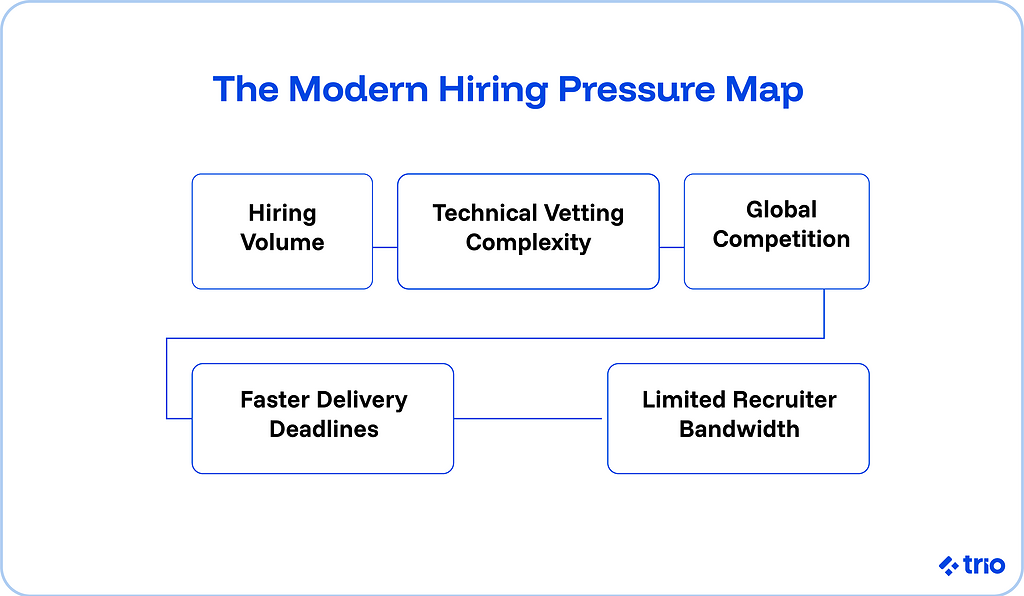
Internal recruiting can be effective when your workload is predictable and your hiring managers are aligned.
But plenty of tech companies experience a different reality.
Here are a few issues that may appear as your team grows:
If you have a small recruitment team, you may notice that sourcing slows every time the team juggles multiple job posts or tries to maintain the talent pipeline for several tech roles at once.
A recruiter can only source so many potential candidates who may fit your tech stack.
When requests pile up, the process starts lagging behind the needs of product and engineering leads.
Many hiring managers still depend heavily on LinkedIn or a familiar job board to find job seekers.
That can limit you to a small set of candidates who might already be fielding multiple offers.
If you cannot source beyond your region or beyond your existing network, your pool of candidates may not match your specific hiring needs.
Recruiting software engineers requires more than general screening.
You need to vet candidates for architecture thinking, debugging ability, and communication style. You may also need awareness of regulated industries, which is especially true for fintech, healthtech, and identity systems.
Internal teams sometimes lack the capacity or context to vet these candidates at scale.
A strong internal process is powerful, but it is also expensive during quiet periods.
Salaries remain the same even if your recruiting workflows are handling lower volumes.
All of this explains why teams look for alternatives that can help them hire the best engineers without increasing internal load.
The challenge is figuring out which alternatives match the hiring journey you actually want.
Hiring managers often start with the most familiar option, though the path you choose depends on the size of your team, the urgency of your roadmap, and whether you need highly specialized tech talent.
A recruitment agency is one of the first places hiring managers turn when internal hiring starts slowing down.
Agencies bring recruiters who understand general recruitment, and they often have a process for reaching job seekers quickly.
They can sometimes produce candidates faster than an overwhelmed internal team.
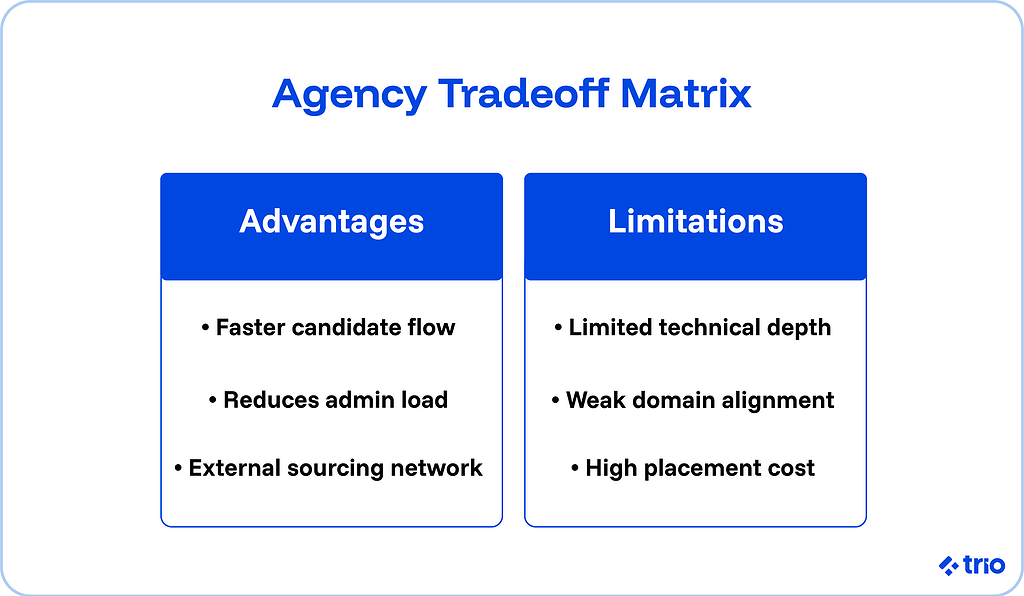
Recruitment agencies can be useful when you need to fill a role quickly and do not mind paying a placement fee. They have a wider sourcing network and can reduce the number of hours your internal hiring teams spend filtering applicants.
They may also lighten repetitive tasks.
Posting on every job board, following up with candidates, coordinating early interviews, and filtering out resumes that do not meet your hiring process criteria can take hours every week.
An external recruiter can remove some of that weight.
The tradeoff is depth.
Agencies are not always built around technical hiring. They sometimes send CV collections that appear impressive but do not align with your tech stack.
You may also encounter potential candidates who may be great in theory but need more onboarding than you expected.
Another challenge is sustainability. A recruitment agency is not always built for long-term technical hiring and may not refine the talent pipeline for niche tech roles.
TLDR: Agencies make sense when you have sudden hiring spikes. They are less ideal if you want consistently vetted technical talent or a high degree of alignment with engineering culture.
Many teams use freelance platforms when they need short-term help.
If you are trying to keep a project alive while searching for permanent staff, a freelance marketplace might serve as a temporary fix.
You can usually hire the best person for a very specific task without going through the entire recruitment process.
Some teams rely on this approach for bug fixes, small UI refreshes, or maintenance tasks that do not require deep architectural work.
The platforms are often free to browse, and the hiring process is quick. You can usually start within days instead of weeks.
Consistency is the biggest risk. Job seekers on these platforms often juggle many clients.
If you need reliability, long-term planning, or a smooth technical hiring process, freelance marketplaces may not support those goals.
You may also find it difficult to maintain an engineering culture when mixing full-time staff with a rotating cast of short-term contractors.
That becomes more noticeable when your product grows more complicated.
TLDR: Freelancers are best for tactical work. They rarely support strategic execution.
Some companies use remote recruiting services to expand their pool of talent.
Competitors in the tech space often discuss this model because it creates access to global talent and reduces hiring friction for specific roles.
These companies may use AI-powered recruitment tools, data-driven recruiting features, and integrations like LinkedIn Talent Solutions.
Some position themselves as an AI recruiter or a streamlined recruiting platform that helps you source potential candidates automatically.
A wider talent pool is often the biggest advantage.
You can work with candidates in multiple tech hubs, which increases your chance of identifying the best candidates for your team. You may also reduce your dependency on expensive local markets.
Another plus is that these companies usually handle visa, onboarding, and payroll considerations for global hiring.
Tech companies that want to scale quickly sometimes appreciate this.
Many of these platforms take a volume-driven approach, so you may still receive resumes that do not fully align with technical hiring expectations.
Some teams find themselves running the same hiring process they wanted to avoid. Others feel the vetting process may be too surface-level.
TLDR: If you want to find the right talent quickly without sifting through stacks of CVs, this model may or may not be enough.
Recruiting software can make your hiring process easier to manage.
A modern applicant tracking system is central to how many hiring managers operate. It organizes your recruiting workflows, streamlines scheduling, manages communication, and helps you keep track of top candidates.
Some tools offer more advanced features.
A few include AI recruiting, candidate scoring, automatic job board distribution, and dashboards that help teams hire faster.
If your internal recruiting team needs help staying organized, investing in a recruitment platform may improve your experience.
It encourages more consistent screening, proper documentation, and cleaner collaboration between recruiters and hiring managers.
These systems do not solve the hardest part of tech hiring.
Even the best recruitment platform cannot magically find technical talent.
You still need recruiters or a recruitment team to source potential candidates who may match your tech stack. You also need someone who understands technical hiring process nuances, which an ATS cannot replace.
Tools can improve internal recruiting, but they cannot replace it.
Embedded engineering partners have grown popular for tech startups and fast-scaling teams.
Instead of trying to hire the best engineers entirely on your own, you work with a partner that supplies vetted software engineers who join your team and operate as part of your product environment.
This is not outsourcing in the old sense.
You still control the roadmap. You still manage the technical direction. The engineers simply integrate into your team without the long hiring journey.
You bypass sourcing, screening, and technical vetting. You also avoid the risk of bringing in talent that needs weeks of onboarding.
These partners usually provide engineers who are familiar with modern systems, familiar with regulated industries if needed, and comfortable joining a team with minimal ramp time.
Many teams adopt this option because it gives them predictable execution during periods of uncertainty.
For smaller companies or tech startups, it is a stable way to scale without overwhelming hiring managers.
You may not use this model if you want to build a permanent bench of full-time employees or if you want complete ownership of the recruitment system.
For teams that value agility, though, embedded engineering partners fill a gap that internal recruiting often cannot.
Some companies position themselves as general talent providers. Trio is different.
Trio focuses specifically on fintech, which means the engineers already understand financial data flows, compliance, identity, and risk.
This makes the integration period much shorter and reduces the number of technical hiring surprises your recruiting process might otherwise face.
We also screen every engineer for both technical skill and fintech fluency.
Many recruiting companies or recruiting platforms rely on keyword matching, but we use deep-domain evaluation.
That means you do not rely entirely on job seekers who may be unfamiliar with your environment. You also skip the need to maintain a high-volume sourcing engine that can drain internal resources.
When considering the alternatives to internal recruiting for tech teams, the decision usually comes down to five questions.
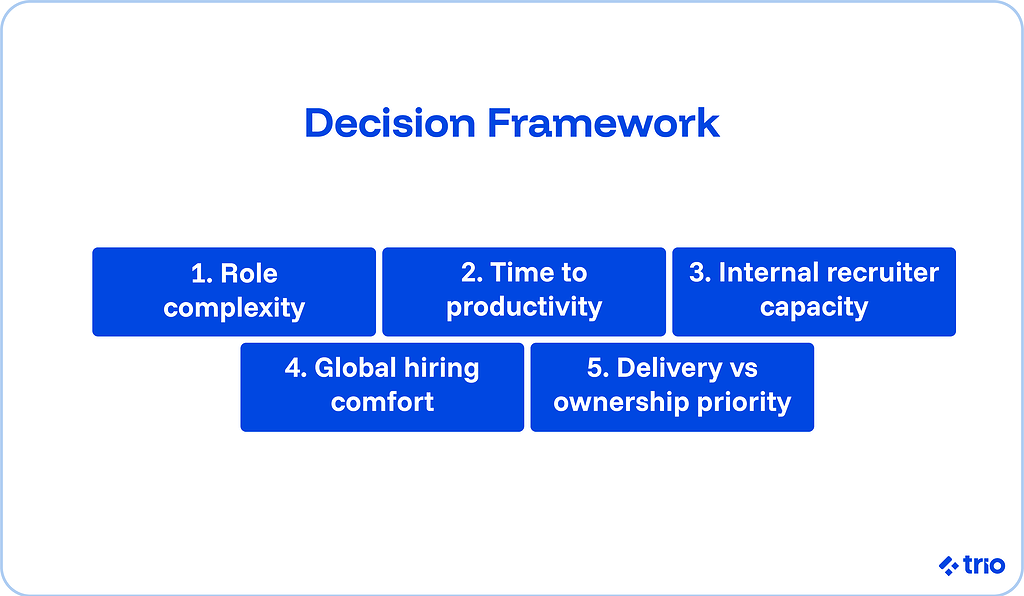
If you are seeking generalists or junior engineers, you might get away with a recruitment agency or a job board.
But if you need specialized tech talent, especially roles involving security, identity, infra, or regulated systems, you need more rigorous vetting.
Some hiring cycles allow for long technical interviews. Others require you to find the best candidates and start building within days.
If your deadlines are strict, a partner with domain experience may be more realistic.
If your recruitment team is handling multiple job posts or struggling to source candidates who may fit your tech stack, external support can offer relief.
If you want access to global talent but prefer to avoid handling payroll or compliance across regions, a partner may simplify your load.
If you want permanent talent acquisition, recruitment agencies and job boards may suit your needs.
If you want a predictable output, embedded engineering partners can be a strong fit.
It is easy to forget that hiring is not the final step. What you truly care about is delivery.
The recruiting process influences how smoothly your product cycles run. Here is how each alternative can affect engineering output:
The right option depends on how valuable consistency is compared to long-term ownership.
In conversations with engineering leaders, a pattern appears.
Teams that hire the best people do not rely on a single approach. Instead, they combine methods in a way that keeps the recruiting process efficient without overwhelming talent acquisition teams.
Here are a few patterns from high-performing companies:
These teams keep a strong internal team for culture fit, long-term planning, and architectural oversight.
They supplement execution with specialized partners when deadlines intensify.
An applicant tracking system helps organize tasks.
It cannot source technical talent at scale, but it prevents unnecessary delays.
Job boards are helpful, though they tend to attract thousands of candidates with uneven alignment.
High-performing teams mix passive sourcing, referrals, and external partners.
Technical roles are becoming more specialized. Fintech, data, AI, and infra each require unique knowledge.
Teams that recruit effectively in these areas rely on domain-specific support instead of general recruitment strategies.
When choosing between alternatives, it is tempting to compare only direct costs. But indirect costs often matter more.
Here are a few that teams underestimate:
A candidate who is not familiar with your domain may take weeks to become productive.
That is costly in fast-moving industries.
If developers must spend time interviewing dozens of potential candidates, it slows product delivery.
If you hire a candidate who fits technically but struggles with compliance or regulatory expectations, your hiring journey becomes more complicated.
A fast hire that does not fit causes more damage than no hire at all.
Teams that evaluate alternatives carefully tend to avoid these hidden costs more consistently.
There is no universal answer. But the pattern we are seeing suggests that tech companies gravitate toward solutions that give them:
For some teams, a recruitment agency is enough. For others, remote recruiting companies offer global reach.
But for teams that prioritize quality and stability while trying to avoid internal bottlenecks, an embedded engineering partner is often the most practical route.
This is especially true in fintech, where regulatory expectations raise the bar for technical hiring.
Tech recruiting has never been more competitive. Internal recruiting still has its place, although its limits are becoming easier to see as teams try to scale their engineering output.
Exploring alternatives does not mean anything is wrong with your talent acquisition approach. It simply means you are adapting to the realities of the times, where hiring managers need options that help them deliver products without unnecessary delays.
If your team wants to find the right talent with less friction, and you want engineers who already understand fintech, Trio can support you with a model designed for speed and reliability.
The best alternatives to internal recruiting for tech teams include recruitment agencies, remote recruiting companies, embedded engineering partners, and freelance marketplaces. Each option offers different levels of sourcing, vetting, and speed.
Tech companies look for alternatives to internal hiring because internal teams often struggle with sourcing volume, technical vetting, and tight timelines. External support can speed up hiring and reduce strain on hiring managers.
Embedded engineering partners differ from recruitment agencies because they provide fully vetted engineers who integrate into your team immediately. This works well when you need consistent delivery instead of one-time placements.
Remote recruiting companies expand your talent pool in ways in-house recruiting cannot. They often support global sourcing, so you can access candidates your local team may not reach.
Tech teams use freelancers instead of full-time hires when they need short-term support or tightly scoped work. This option is practical for tasks that do not require deep product knowledge.
Applicant tracking systems do not replace internal recruiters because they organize workflows rather than source or vet technical talent. They help teams stay structured but still require human judgment.
External partners can help a tech company hire engineers much faster by handling sourcing and vetting upfront. This reduces the steps your internal team must manage.
Global hiring is a useful alternative to local recruiting because it expands the pool of potential candidates. It also helps teams avoid local talent shortages and rising salary competition.