

Hire by Technology
SERVICES

All companies want people who can produce good work and communicate well, but not everyone can afford to pay a recruiter fee.
Luckily, startups can hire developers on their own, and often with better results than traditional recruiting pipelines.
Over the years, we’ve seen founders and CTOs find the right developer for a startup by making a few thoughtful adjustments to how they write job postings, where they search, and how they evaluate candidates.
Being as specific as possible about your requirements and posting to a couple of developer-specific job boards is the best way to get started. Alternatively, you could partner with a firm like Trio, with transparent rates, that aims at long-term tech partnerships.
If you are ready to hire and need to onboard affordable developers within 3-5 days, request talent.
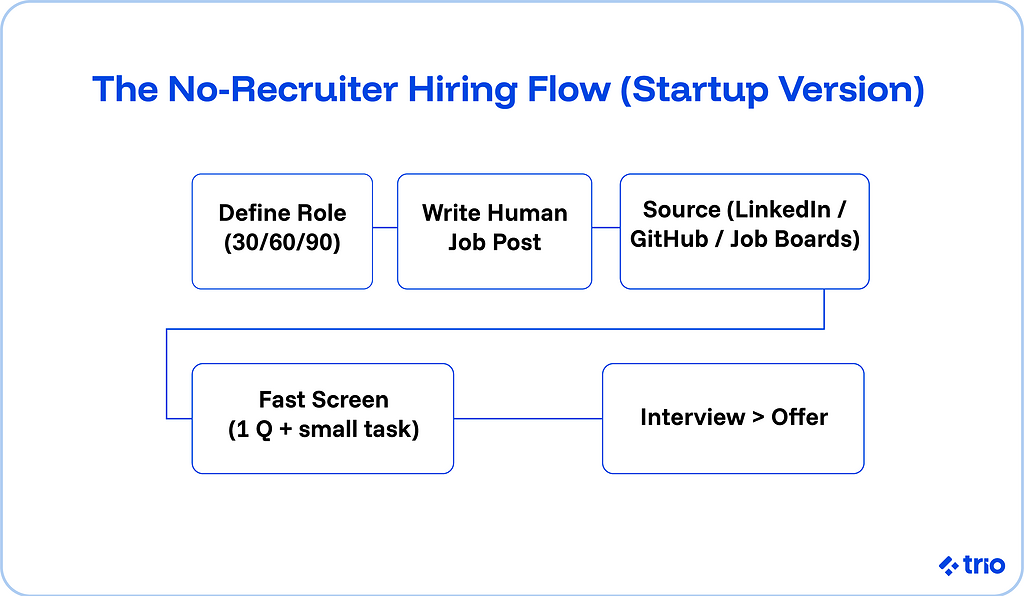
Hiring without recruiters can be made less intimidating if you break the process into steps.
The foundations include:
A developer, especially for a startup where responsibilities may merge, often wants clarity about their first few months.
You don’t need perfect specs, but you do need a grounded view of what their work will look like. It helps to consider:
The clearer you are, the easier it becomes to hire software developers who are actually prepared for your reality.
We often advise founders to write a short outline that includes tasks a new hire will likely tackle within the first few months.
This outline may change, but it forces clarity.
A developer with ten years of experience is not always better than one with three.
What matters is ownership. Can they make decisions without constant oversight? Can they diagnose issues independently? Can they communicate tradeoffs clearly?
If the role requires autonomy, senior developers may be necessary. If the role is structured around a more defined workflow, mid-level developers may thrive.
Developers skim through dozens of job postings, so you need to make sure you are effective to increase your chances of finding the best person.
Developers prefer straightforward writing. They want to know:
Avoid phrases like “we’re a revolutionary platform” or “we’re looking for a rockstar”.
Be specific. Be human.
You might mention:
“We deploy weekly. We collaborate on Slack and use async docs for planning. The codebase is still evolving, and we’re working toward cleaning up technical debt in a few areas.”
Realistic details attract professional developers. Generic statements attract noise.
Even a sentence or two helps them understand whether they fit. Something like:
“Success in this role means shipping features with minimal oversight, communicating clearly with product, and contributing meaningfully to architectural discussions.”
This signals maturity and clarity.
We’ve covered what you need to think about before hiring, and what to include in your job posting. But where exactly do you post or reach out to developers?
Developers spend more time in specialized communities than in general job boards. Some of the best places to look include:
Outside of these job boards, there are also tech-focused communities where you can find developers to reach out to directly.
This includes things like Stack Overflow’s pages, Discord servers, Reddit communities, Slack communities, platforms like daily.dev, and more.
If you’re building a fintech product, hiring developers becomes harder because domain knowledge matters.
Engineers who understand payments, banking, identity, and regulatory constraints are rare.
You could approach Trio. But if you really want to hire on your own, look at who is contributing to open-source products similar to what you need, too.
Startups win when they create a screening process that filters out mismatches without exhausting candidates.
The interview stage is where you see whether a developer can operate in your environment. If you aren’t used to running interviews on your own, try to avoid striving for traditional formats too much.
Instead, focus on real conversations that produce valuable information.
User realistic scenarios. For example: “Imagine a production issue appears in a loan calculation. Walk us through how you would approach it.”
This shows problem-solving skills and communication style.
Also, make sure to talk through tradeoffs. Ask questions that reveal how candidates think about stability, speed, and maintenance.
Most founders worry that they lack the expertise to compare developers fairly.
The good news is that startups do not need a complex scoring system. They just need a consistent way to look at each candidate.
The most valuable traits include:
To assess these characteristics, there are a couple of guidelines you can follow.
Developers who fit well in a fast-paced world of startups explain how they reason through uncertainty.
They talk about what they considered, what information was missing, and how they made a decision anyway.
These kinds of signals are more meaningful than perfect answers.
Candidates who describe projects with clarity, context, and awareness tend to carry their weight on real teams.
They might explain why they chose a certain architecture or how they balanced tight deadlines with quality.
That level of reflection is often a sign of experienced developers who understand the bigger picture.
A candidate who communicates well in writing, in short calls, and during technical discussions is usually a safe hire.
A candidate who communicates well only in one setting could be unpredictable. In a startup environment where communication is half the job, consistency matters.
Ten years in the wrong environment can mean less than three years spent shipping real features.
Developers for startups often grow faster because they are forced to make decisions, debug unpredictable issues, and learn quickly. Focus on capability, not just tenure.
Remote hiring opens access to talent beyond your immediate region, but it comes with its own challenges.
You need to evaluate both the developer’s technical skill and their remote work habits.
Great remote developers do not wait for perfect specifications. They move forward with what is available and ask clarifying questions when needed.
When someone naturally shares progress, raises concerns early, and takes ownership, they tend to excel in remote environments.
Clear writing is often more important than fluent speech.
Most remote workflows rely heavily on Slack, email, and async documentation.
If a candidate struggles to articulate thoughts in writing, it is likely to create friction later.
You do not need identical schedules, but you do need some overlap for collaboration.
Teams that hire remote developers for a startup typically aim for a minimum of two to four hours each day.
This helps resolve issues that are too complex for async discussion.
Some startups hire remote developers from nearby time zones to keep communication smooth.
Nearshore software development allows teams to work almost as if they were local, but with better cost flexibility.
This becomes especially helpful when your startup is scaling and needs predictable collaboration patterns.
You can hire the best developers in the world, but if onboarding is vague or nonexistent, performance lags.
Make sure you share a map of your systems. Even a simple diagram or short document helps.
Developers should know how data flows, which services matter most, and where technical debt exists.
Along with that map, provide clear setup instructions and explain some communication norms. Don’t assume that anything is intuitive.
Finally, consider providing the opportunity for some quick wins to boost morale and allow them to test the waters before they move to critical work. These are usually small tasks that help them get familiar with the codebase without overwhelming them.
Hiring without recruiters saves money, but it does not eliminate cost. Your main investment becomes time.
On top of that, there is the cost of hiring the wrong developer to consider.
Mistakes early in the product cycle create debt, slow releases, and increase stress inside the team. When you hire developers thoughtfully, even if it takes slightly longer, you protect your product and your runway.
Some mistakes are more common than others. Understanding what people have struggled with previously can help you avoid these issues entirely.
Related Reading: Why Is It Hard To Hire Fintech Engineers
There is no single hiring model that works for every startup. The right choice depends on your timeline, budget, and product maturity.
Full-Time developers are best when your roadmap is stable, and you want deep product ownership. Freelancers, on the other hand, are useful when you want fast exploration without long-term commitments.
They can also help validate whether you truly need a full-time developer.
Outsourced or nearshore developers are helpful when you need predictable capacity or domain expertise. This is where specialized partners shine.
At Trio, we’ve seen fintech startups accelerate dramatically because they hired developers who already knew how to operate within regulated environments, handle sensitive data, and implement secure workflows.
As you refine your hiring, pay attention to patterns:
When you hire developers for a startup more than once, each cycle becomes easier. Processes improve. Messaging improves. Confidence improves.
Hiring developers without recruiters may feel like stepping into unfamiliar territory, but with a clear process, thoughtful conversations, and realistic expectations, startups can hire developers who fit both their product and their culture.
You gain direct insight into how people think, avoid misalignment, and build relationships based on honesty rather than filtered communication. Startup teams that understand their needs, write human job postings, search in the right places, and communicate openly tend to hire the right developers faster than they expected.
And when domain knowledge is essential, specialized partners help fill gaps that recruiters cannot always address.
If your team is growing and you want help hiring software developers who can work on your project with confidence, book a discovery call
Hiring developers without recruiters means running the process yourself with clear role definitions, simple screening, and direct outreach. This approach works well for startups because it keeps communication honest and speeds up decisions.
Hiring developers independently is realistic for a startup because most candidates prefer direct conversations with founders. You just need a repeatable process and a clear understanding of what the role requires.
Finding developers without recruiters usually means focusing on LinkedIn, GitHub, startup job boards, and niche communities. These channels have developers who respond better to direct, human communication.
Evaluating developers when you're not deeply technical starts with how clearly they explain problems and decisions. You can also lean on small practical tasks or have another developer review work samples.
Startups hiring developers should look for initiative, adaptability, and strong communication. These traits usually matter more than specific frameworks or fancy titles.
Using a coding test can help because it shows how someone thinks, but it should be short and realistic. The goal is clarity, not pressure.
Hiring developers without recruiters can take anywhere from one to four weeks, depending on your clarity and responsiveness. The tighter your process, the faster the timeline tends to be.
Hiring developers without recruiters is usually cheaper because you avoid large placement fees. Your main investment becomes time rather than cash.
The biggest risk when hiring developers yourself is bringing on the wrong person due to rushed decisions. Clear expectations and small tests reduce that risk significantly.
Startups use a talent partner when the work requires domain expertise or fast onboarding. This is especially common in areas like fintech, security, or regulated industries.