
Hire by Technology
SERVICES

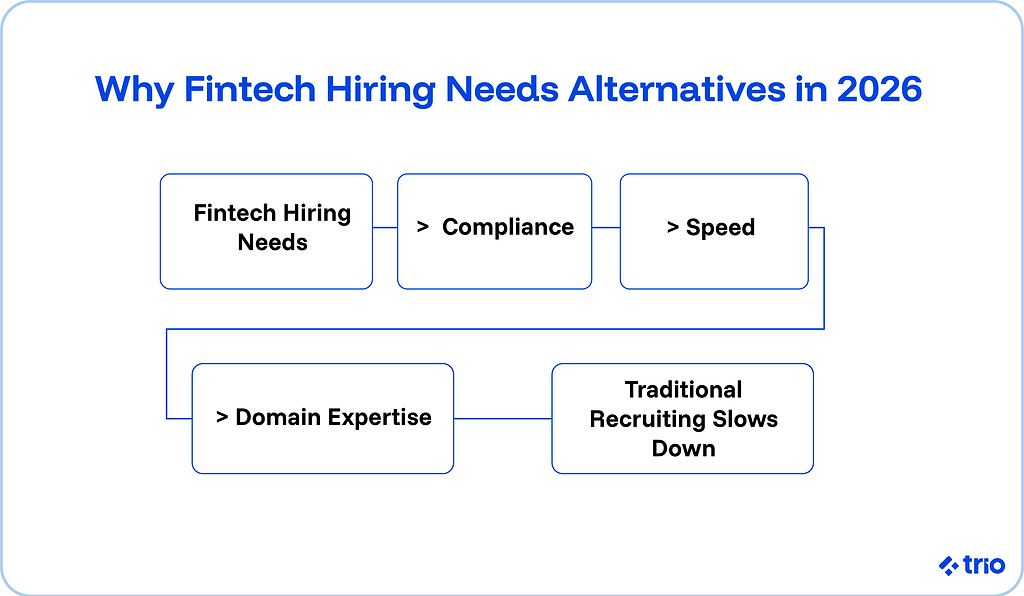
If you've tried hiring in fintech recently, you will already know that the competition for top talent is intense.
Software developers with the right experience are rare, and you are competing with massive institutions. On top of that, traditional recruitment agencies tend to move at a pace that doesn't match the urgency of building financial technology.
Fintech development generally just deals with tighter roadmaps, higher compliance demands, and candidates who can't spend weeks in long hiring funnels.
From what we have seen, the average time to fill a senior tech role runs five weeks or more through a traditional agency, and sometimes months for senior fintech roles.
Many companies trying to meet production or regulatory deadlines can’t afford that.
Fortunately, there are alternatives to general hiring agencies, such as:
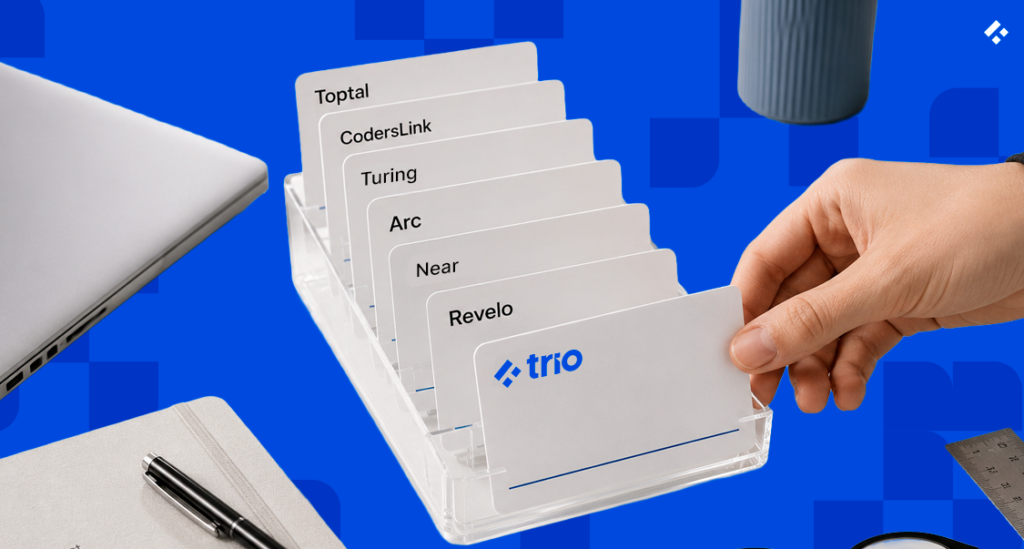
Let's look at those fintech recruiting agency alternatives, how recruiting firms like Trio may help you fill roles faster and with more context than a traditional recruiter can offer.
Fintech has always been a niche space, where you're trying to hire people who understand financial services, compliance, payments infrastructure, and all the quirks that come with building regulated products.
That pool isn't huge to begin with, but then you also need to consider that fintech companies are also competing with banks, crypto platforms, wealth tech firms, and growing insurtech or regtech players.
The more specific the role becomes, the bigger the talent gap you will be faced with.
Recruitment agencies can be helpful, especially when you're looking for executive search support or building out entire teams. But they carry tradeoffs.
Some appear to operate on older playbooks designed for general tech hiring. General hiring firms like these can’t identify niche distinctions, like how a backend engineer with payment processing experience might not always understand ACH settlement windows, PCI DSS obligations, or real-time fraud scoring logic.
This increases your chances of a wrong hire and having to start the process again.
Other firms specialize in fintech recruitment, but their processes may still take too long for a startup that needs someone contributing next sprint, not next month.
Related Reading: In-House Development vs Outsourcing
The best-known fintech recruitment agencies fall into a few categories.
Executive search firms like Options Group, Heidrick and Struggles, and Selby Jennings carry deep networks in financial services and tend to perform well for senior leadership roles.
You can expect that this is going to be quite expensive, though, as we often see recruitment fees of anywhere from 20 to 33% of the placed candidate's annual salary, which is already quite high, with timelines that usually run six to twelve weeks.
General tech staffing agencies with finance divisions, including Robert Half Technology and Kforce, offer broader pipelines but tend to screen for general technical skills rather than fintech-specific knowledge.
If you are in a serious pinch, it might be worth the risk, but the lack of vetting means you never know what you are going to get.
Specialist fintech recruiting firms operate in a narrower band.
You get specific agencies focused specifically on payments, wealthtech, insurtech, or regtech that tend to deliver better-qualified shortlists.
Trio falls into this category, with a talent pool of pre-vetted fintech specialists who are hand-picked based on your requirements, which has led to placement success rates as high as 97%.
Since the placements are pre-vetted, you might find the right developer in as little as 3 to 5 days. But that depends entirely on your requirements.
Other specialist fintech firms have the resources to vet talent, but might not keep them on hand, and may also charge placement fees or related costs.
We have already touched on many of the reasons why companies consider hiring alternatives, but there are many more disadvantages to traditional hiring models. These include:
A good alternative should cover the core expectations of fintech recruitment. This includes things like domain knowledge, the ability to source or provide specialized fintech talent, and a hiring process that respects your timelines.
Here is what you should be looking out for:
A few structured questions before you commit to any partner, whether a traditional fintech recruiting firm or an alternative, can save weeks of wasted cycle time.
Speed signals to verify:
Fintech depth signals to verify:
Cost structure to confirm:
One option that's becoming increasingly common is working with a development partner that specializes in fintech and provides engineers who already understand what you're building.
Trio is, again, a good example of this model because the company focuses exclusively on the fintech sector and vets engineers for payments, lending, banking, compliance, and the broader financial services industry.
Trio sources senior engineers from Latin America as well as Africa, giving your team time-zone-aligned talent typically within one to three hours of the US time zones or Western Europe.
That alignment makes real-time collaboration practical in a way that far-offshore arrangements, where responses arrive hours later, rarely achieve.
Rates also run meaningfully lower than the US market equivalent, at about $40-$90, depending on the skillet you need. This cost reduction stems from the lower cost of living in the developer’s country of residence, not a decrease in quality.
Trio’s aim is to have our developers act as an extension of your staff, with senior engineers who integrate quickly and reduce the ramp-up time almost to zero.
This kind of partner can make sense when you need to hire fast but don't want to compromise on domain expertise.
Best for: Fintech startups and scaleups that need to move fast, want time-zone-aligned engineers, and can't absorb the 6 to 12 week cycle of a traditional executive search.
These platforms usually attract candidates who already have experience within fintech companies or financial technology infrastructure.
You still have to run your own hiring process, which can be time-consuming, but you're not fishing in a generic job board pool.
This option may work if you already have strong internal recruiters or a hiring manager who can dedicate real time to the interviews.
The drawback is that vetting still falls on you, and the quality of applicants can vary quite a bit depending on the role.
Best for: Teams with strong in-house recruiting capacity who want to source their own candidates but need a more targeted talent pool than LinkedIn or general tech job boards typically surface.
Another growing trend is fractional hiring, especially for roles like compliance, risk, architecture, product, or even interim engineering leadership.
A fractional expert may be the right fit when you're trying to manage a temporary gap or accelerate a specific part of the product.
Contract engineers with fintech backgrounds can also be effective, but sourcing them independently often requires more internal effort.
Many companies try marketplaces, but the challenge is usually figuring out who actually has fintech experience versus who has just touched Stripe's API once or twice.
Best for: Teams filling a temporary gap in compliance, risk, or architecture leadership while a permanent search runs alongside. Also useful for pre-launch projects where deep expertise is needed for a defined sprint rather than a permanent headcount addition.
You may not want to rely on recruitment agencies at all, and in that case, building an internal sourcing pipeline might be useful.
Teams are experimenting with AI tools that help filter resumes, identify fintech-specific experience, and narrow down candidates who are familiar with financial services environments.
AI-powered sourcing tools can now scan candidate profiles across LinkedIn, GitHub, and niche job boards to surface engineers who have worked at payment processors, neobanks, or lending platforms, based on job history patterns rather than just keyword matching.
Some tools also generate preliminary screening questions tailored to specific fintech domains, reducing the early-stage filtering burden on your team, but from what we have seen, they can’t verify if the candidate actually understands the operational context of regulated financial products.
Where AI tools add real value in fintech hiring:
Where they appear to struggle:
This route gives you more control, but it's also more work. Startups with small teams often find this is more effort than it's worth.
Best for: Teams with a dedicated recruiter or talent lead who can own the process end-to-end. Less suited to early-stage startups without dedicated recruiting capacity, where the overhead of building and maintaining these systems often exceeds the benefit.
Some companies are mixing models.
For example, they start with on-demand engineers to keep product delivery on track while running a longer executive search for leadership roles.
Or they supplement their staff with specialized fintech talent through a partner like Trio, then use a recruiting agency for senior hires that require more relationship-driven sourcing.
The hybrid approach works best when you're handling multiple hiring timelines at once.
It can also help reduce pressure on the team because product velocity doesn't stall during slow recruitment phases.
Best for: Fintech companies managing multiple hiring priorities at once, particularly those scaling teams while also building out leadership. Also practical for teams that have had a key departure and need to maintain output while a permanent replacement gets found.
Related Reading: Recruiting Agency vs Stagg Augmentation
The table below compares the five main alternatives across the dimensions that tend to matter most for fintech teams:
| Hiring Path | Speed to First Contribution | Fintech Domain Depth | Cost Model | Ideal For |
| On-demand engineering partner (e.g., Trio) | Days to 2 weeks | High, pre-vetted for fintech | Monthly or hourly rate, predictable | Startups and scaleups needing immediate delivery capacity |
| Fintech job platforms | 2 to 4 weeks (you run the process) | Medium, self-selected applicants | Low platform fee, high internal effort | Teams with strong in-house recruiting |
| Fractional or contract professionals | 1 to 3 weeks | Varies depending on the sourcing channel | Hourly or project-based | Temporary gaps in compliance, architecture, or leadership |
| AI-powered in-house sourcing | 3 to 6 weeks, including setup and review | Low to medium, tools surface patterns but not depth | Tool cost plus internal headcount | High-volume hiring with dedicated recruiting staff |
| Hybrid model | Fast for delivery roles, slower for leadership | High for engineering, variable for exec | Mixed: partner rate plus agency retainer | Scaling companies managing multiple hiring timelines |
| Traditional fintech recruiting agency | 4 to 10 weeks | Variable, specialist agencies high, generalists lower | 20 to 33% of annual salary or retainer | Executive and niche senior leadership roles |
To be fair, fintech recruitment agencies still play a valuable role, especially for executive roles or niche leadership hires.
Agencies that specialize in fintech recruitment often maintain extensive networks, and they're effective when the position involves high-stakes responsibilities or extremely specific backgrounds.
If you're looking for a VP of Risk with experience across banks, payments, and lending, or a CRO with hands-on fintech experience, an executive search firm specializing in financial services may be the most direct route.
Other scenarios where a specialist fintech recruiting firm likely earns its fee:
You may want to choose an alternative when:
This is where an option like Trio tends to strike the right balance.
There are a variety of fintech recruiting agency alternatives out there that can help you get the right people without ridiculous timeframes.
At Trio, we support fintech teams with vetted engineers who understand compliance, data flows, and the operational reality of the financial services industry.
Our engineers come from Latin America and Africa, which means your team works with them during the same hours you do. No significant time-zone gap.
Rates run as much as 60% lower than equivalent US talent, without the quality drop that often comes with fully offshore hiring.
Instead of waiting on a recruiter to find candidates, you get access to talent that's already been screened specifically for fintech readiness.
If you're weighing your hiring options and want to explore approaches that preserve your momentum without sacrificing domain expertise, book a decision call.
The best alternative to a fintech recruitment agency is usually a specialized partner that provides fintech-ready engineers on demand. This approach gives you vetted talent without the delays or fees of traditional recruiting.
Fintech recruitment agency alternatives work by giving you direct access to pre-vetted fintech professionals. You skip the long sourcing process and bring in talent that can contribute almost immediately.
Fintech recruiting agency alternatives are often cheaper because you avoid high placement fees. You usually pay only for the actual time or engagement rather than a high upfront cost.
Alternatives for compliance-heavy roles still support those needs by offering talent with financial services and regulatory experience. They focus on specialists who already understand KYC, AML, and similar requirements.
These alternatives can replace internal recruiters in many situations because they reduce the workload around sourcing and screening. Your team can focus on interviews and roadmap decisions instead of sifting through resumes.
Fintech recruiting alternatives are usually fast because they maintain pools of fintech-ready talent. You get candidates or engineers who can join projects in days instead of weeks.
Fintech recruitment alternatives work well for startups because they allow hiring without long commitments. You get access to specialized fintech talent even when your team is still small.
These alternatives help you scale quickly by giving you flexible access to staff who already understand financial technology. You can adjust headcount without restarting a full recruiting cycle.