

Hire by Technology
SERVICES


A contractor NDA protects your confidential information.
It doesn't discharge PCI DSS, GLBA, or GDPR obligations, so you’ll need a separate data processing agreement and real access controls, but it does mean that your employees and partners can’t share your or your clients’ information without facing legal consequences.
In a fintech engagement, we often notice a gap between what an NDA covers and what regulators actually require, creating exposure later.
To ensure your agreements are as comprehensive as possible, let’s go over the key clauses and considerations involved in a fintech NDA for contractors.
Keep in mind that what’s covered simply includes patterns worth noticing and questions worth raising with your own counsel.
At Trio, all of our agreements include NDAs, so you can rest assured that our expert fintech developers contribute meaningfully, without creating risks.
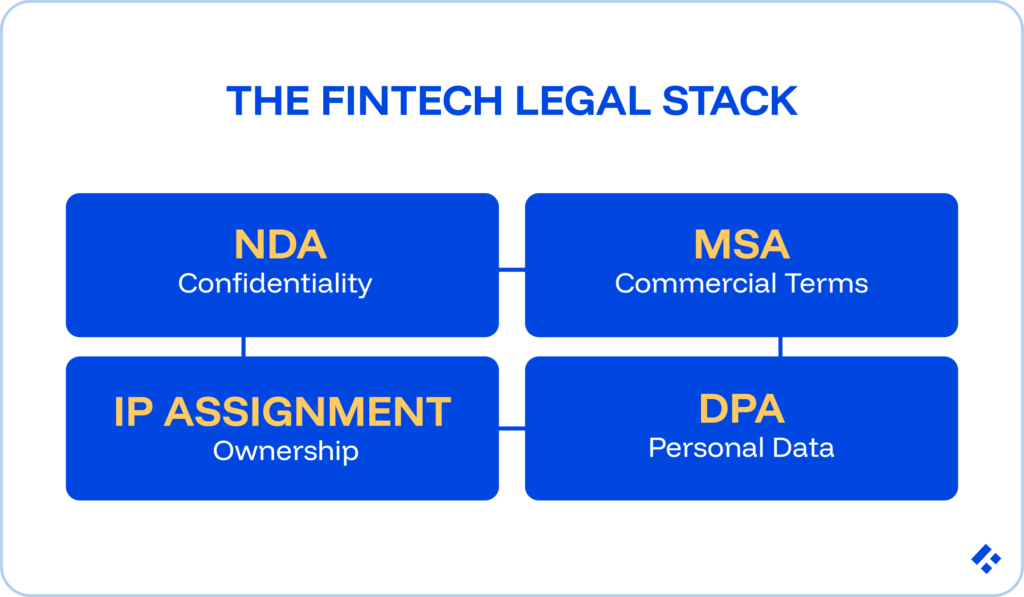
Many people we have worked with use NDA, MSA, and IP assignment interchangeably. But these are very different documents.
An NDA governs what the other party may not disclose. An MSA or statement of work governs the commercial engagement itself, rates, scope, and termination. An IP assignment governs who owns what gets built.
Each of these fails differently, and they're often signed months apart, with the NDA typically being first, sometimes before anything else exists on paper.
It’s important to note that an NDA is a contract between two private parties. Obligations under PCI DSS, GLBA, GDPR, or a sponsor-bank agreement are regulatory, not contractual at all. So a confidentiality clause doesn't touch them.
Similarly, an NDA doesn't make a contractor's laptop an approved processing environment. It doesn't reduce PCI scope (if an engineer has a network path to the cardholder data environment, they're in scope), and it isn't a data processing agreement.
Where personal data gets processed, a DPA covering the required terms is a separate instrument entirely.
If you have an NDA with a contractor, it gives you a claim if that data gets misused later. It doesn't give you a defense if a regulator asks why information was shared with a contractor in the first place.
There is one NDA clause that deserves its own section: the residuals clause.
Here's what it typically says: “nothing in the agreement prevents the receiving party from using general knowledge, skills, or ideas that stay in the unaided memory of personnel who had access to the confidential information, provided nobody deliberately memorized it to get around the agreement.”
It exists because contractors and consultants work across many clients, often in the same industry, and an engineer who learns a genuinely better way to structure a service can't just unlearn it.
A vendor pushing back on a clause that turns every future engagement into a liability isn't being unreasonable.
From what we have seen, this clause likely came about due to a genuine tension between protecting one client's confidential information and not effectively owning everything inside an engineer's head for the rest of their career.
That said, the residuals clause carries risk, as it can create a real loophole in the underlying confidentiality obligation, since anything that ends up in someone's head becomes freely usable.
The clause is also easy to miss entirely because it often sits inside a permitted-use or exclusions section.
Some versions extend further than the basic definition, permitting use for any purpose at all rather than just internal reference, which is a lot broader.
In a fintech context specifically, architecture decisions, reconciliation logic, and system design patterns are precisely the kind of thing that survives in memory.
Staff augmentation increases risk even more, since a residuals clause in a vendor's standard NDA doesn't apply to one engineer on one project. It applies to a population that may, next quarter, be sitting inside a competitor's codebase.
Every NDA makes two separate decisions about time. The first is the stated term, how many years the agreement itself runs. The second is whether confidentiality obligations survive past that term, and for how long.
Two- to five- year terms are common. But we’ve seen technology and software agreements run shorter (one to three years). Usually, the justification for this is that technical information ages out of relevance.
Trade secret protection depends on the owner showing they took reasonable steps to maintain secrecy.
A flat, time-limited confidentiality obligation can undercut exactly that showing, since if the NDA was the only protection in place and it expired, arguing the information was still being actively safeguarded gets a lot harder.
In some cases, courts have even treated a time-limited NDA as effectively replacing whatever broader duty of confidentiality might otherwise have existed.
Trade secrets can be protected indefinitely under the law that governs them directly. Ordinary confidential information generally can't be.
The only way to address this is to draft secrets out of the general survival limit entirely, so those specific obligations continue for as long as the information actually qualifies as a trade secret under applicable law, independent of the NDA's own term.
In fintech, confidentiality obligations sometimes track regulatory retention requirements rather than a flat calendar figure, since privacy and recordkeeping rules can independently require the information to stay protected for a defined period regardless of what the NDA says.
It's worth asking whether the term should follow those obligations instead of a default number pulled from a template.
One big problem people have run into is return-and-destruction obligations at termination, which can directly conflict with your own evidence-retention needs.
If an auditor samples a change from that engagement eighteen months later, a clause requiring destruction of all related materials creates a conflict.
There are six more clauses you need to pay careful attention to. Doing so upfront may take some time, but it is well worth the ensured security later.
If your definition of confidential information is too broad, it amplifies every other risk in the agreement. On the other hand, if it’s too narrow, it leaves real gaps.
We recommend checking specifically whether customer data, transaction data, and system architecture are actually captured, and whether a marking requirement ("must be labeled confidential") would exclude things nobody remembers to label, like a verbal architecture walkthrough or a screen share on a call.
Some agreements treat anything disclosed in a business context as confidential by default, which can be harder to enforce in practice than a more specific definition, since a court may want to see that both sides actually understood what was covered.
This is where you specify the standard exceptions, which are usually information that's publicly available, independently developed, or lawfully received from someone else.
Make sure that you take a careful look at compelled disclosure. Does the clause require notice before information gets disclosed under subpoena or regulatory request, with a real opportunity to seek protective relief?
Regulatory carve-outs are also legitimate and worth a conversation, particularly since a fintech engagement is more likely than most to eventually involve a regulator asking questions.
Usually, the contract runs between the company and the vendor.
The engineer signs with the vendor, not with the company hiring them, so it’s worth asking whether there's any direct recourse against the individual, whether the vendor is obligated to flow the same terms down to personnel and any subcontractors, and whether anyone gets notified when a new person joins the engagement.
Unfortunately, this chain is the same structural weak point that shows up in IP assignment chains. Sometimes, the people in the contract and the people touching the work are not entirely the same.
Vendors frequently propose mutual NDAs. That’s very reasonable, particularly where both sides will genuinely share sensitive information, but it does mean that obligations run both directions.
If this is your case, then you need to be very sure about what the engineering team is now restricted from using or discussing.
Many agreements acknowledge that a breach would cause irreparable harm and that injunctive relief is appropriate.
What’s less standard is a provision allowing temporary suspension of access on suspected breach while an investigation runs.
Access is usually the thing worth stopping fastest, and being able to pause it without terminating the whole engagement is useful.
An agreement governed by one jurisdiction's law can be difficult to enforce if the other party is in another region.
For LATAM engagements specifically, it's worth asking counsel what enforcement would actually involve in practice, and whether the vendor entity's location offers a more realistic path than pursuing the individual engineer directly.
Not every NDA needs a full legal review, so to prevent it from becoming a bottleneck, here are a few signals you can consider to determine if it actually needs to be escalated to counsel.
One of the most time-effective ways to proceed is to sign a vendor's standard NDA to start early conversations, then execute a separate, tighter one before any real data or system access begins.
The NDA that gets a conversation started, and the NDA that governs production access don't have to be the same document.
At Trio, we have extensive experience connecting companies in the heavily regulated fintech sector with developers in LATAM. This means our NDAs are extensive and production-tested.
To explore hiring today, book a discovery call.