

Hire by Technology
SERVICES


The ten MSA red flags that matter most for fintech companies include:
We recommend that you discuss each with qualified legal counsel, because the regulatory consequences in fintech are materially higher than in general software contracts.
This article maps each of the ten red flags to its regulatory or operational consequence in fintech, so you know which to flag for immediate legal counsel and which to raise in negotiation.
At Trio, we work exclusively with fintech firms, and our experience has helped us refine our contracts so both sides are covered as thoroughly as possible in any staff augmentation or outsourcing arrangements.
Request a security-ready consult.
These five red flags appear in even general software development, but in fintech, where failures happen in a regulated environment, the cost of missing them is materially higher.
An IP assignment that uses future-tense language ("will assign," "agrees to assign") rather than present-tense assignment ("hereby assigns all right, title, and interest") can be a big red flag.
Work product ownership that is conditional on full payment, with no mechanism for what happens if a payment dispute arises, also leaves you open to potential issues.
The same can be said for background IP (pre-existing tools and frameworks the vendor brings) that is not distinguished from foreground IP (work product created specifically for your engagement).
In fintech, uncertain ownership of a payment processing system could lead to issues as big as a potential operational shutdown if a vendor exercises an ownership claim.
Engineers' pre-existing tools and frameworks embedded in your codebase without a clear licence create long-term dependency on vendor goodwill that regulatory examiners don't accept as a risk management strategy.
What to flag for counsel: Present-tense assignment language; whether background IP is clearly distinguished and licensed; whether any payment-trigger ownership condition creates operational risk in a payment dispute scenario.
Liability capped at one to three months of fees paid is the most common vendor default position that we have come across, but it could be far from enough. On a $10,000/month engagement, this produces a $10,000–$30,000 liability cap.
The result is a consequential damages exclusion that eliminates recovery for lost revenue and customer remediation costs, either by carving them out of the cap or excluding them from recoverable damages entirely.
Even a small payment system breach costs thousands of dollars per hour in processing downtime, plus customer remediation costs ($50–$500 per affected account for double-charge incidents), regulatory inquiry costs, and potential fines.
The Monzo FCA fine (£21M, July 2025) and the Revolut Lithuania fine (€3.5M, April 2025) give a sense of what systemic control failures cost at the regulatory end.
A three-month-fee liability cap against these exposure levels is barely going to cover the administrative inconvenience of a minor incident.
Make sure that you, along with your counsel, assess the liability cap relative to your actual exposure in a vendor failure scenario.
One-sided indemnification requiring you to defend and hold harmless the vendor for claims arising from your use of their service could be incredibly damaging.
These provide no reciprocal obligation on the vendor for claims arising from their failures.
A very similar issue is indemnification that covers third-party IP claims but not regulatory claims arising from the vendor's compliance failures.
Fintech vendors, BaaS platforms, KYC providers, payment processors, and engineering staffing firms handle regulated activities on your behalf. FINRA's 2026 report reaffirms that firms cannot outsource their regulatory obligations.
This means that, while the indemnification structure determines who bears the cost of pursuing a claim, it doesn't change who the regulator comes after.
If the scope of work language is ambiguous about whether the vendor provides embedded capacity (you manage the work) or delivers a defined outcome (the vendor manages execution), it could create accountability disputes when something goes wrong.
If the vendor's SOW implies they delivered a "compliant KYC flow" as an outcome, they may claim they met the SOW while you dispute whether the code actually meets your compliance requirements.
It is one of the primary causes of contract disputes that our clients have previously encountered, and in fintech, those disputes take on a compliance dimension.
To prevent this, make sure the SOW clearly defines input-billing (staff aug, you manage) versus outcome-delivery (managed services, they manage). Also confirm whether compliance responsibility for delivered code is explicitly allocated.
Governing law set to an inconvenient or unfavourable jurisdiction, mandatory arbitration clauses that remove the right to litigation, arbitration venue set to the vendor's home city, and arbitration cost structures that make pursuing small claims economically impractical fall into this category.
Contract disputes in fintech frequently involve compliance-related claims, a vendor's failure to maintain security standards, a data breach, or a KYC failure that produces a regulatory examination.
Pursuing these claims through arbitration in a distant jurisdiction, or through processes that limit discovery and cap damages, can make legitimate recovery practically unrecoverable.
Double-check whether governing law and dispute resolution terms are practically acceptable, whether arbitration clauses include appropriate carve-outs for injunctive relief, and whether the arbitration venue and cost structure are workable.
Now, let’s look at the five red flags that are unique to fintech. They are the warning signs most likely to be missed in a standard contract review, and they produce the most expensive regulatory and operational outcomes.
The first issue is usually an MSA with no provision granting you the right to audit the vendor's security posture, compliance controls, and access logs.
However, we have also seen an audit-rights clause that is so narrowly drawn, annual frequency only, 60-day advance notice required, scope limited to financial records, that it ends up becoming unusable when you actually need it.
FINRA's 2026 Annual Regulatory Oversight Report reaffirms that firms must maintain contractual oversight over vendors supporting critical functions, particularly IT, cybersecurity, and AML, and that effective practices include the ability to monitor, assess, and test vendor controls.
DORA, effective January 2025 for EU-operating financial entities, goes a step further and explicitly requires that contracts with ICT service providers include rights to audit and inspect.
Regulators are actively checking whether institutions have retained practical oversight rights over their vendors. An MSA with no audit-rights clause is now not just a contract gap but a compliance exposure that surfaces during regulatory examinations.
Flag scope, frequency, and notice requirements of any audit clause, and make sure the rights are practical to exercise under real conditions.
Contract language can sometimes suggest that the vendor "assumes responsibility for regulatory compliance" with respect to the work product.
The same might also appear when a vendor positions their service as "we handle the compliance so you don't have to", implying that your regulatory obligations shift to them when you sign.
This is not the case, though.
Regulatory accountability for a regulated financial system stays with the regulated entity. It cannot be contractually transferred to a vendor.
As we have already mentioned, if a regulator examines your payment system and finds AML control failures, the enforcement action is against you, regardless of what the MSA says about the vendor assuming compliance responsibility.
Language that implies otherwise is either a misrepresentation of how regulatory liability works in fintech or a signal that the vendor is unsophisticated about the compliance environment they're operating in.
An MSA with no data processing addendum (DPA), or no specification of security standards the vendor must maintain, no mention of SOC 2 Type II, ISO 27001, or PCI DSS, creates major vulnerabilities.
These vendors have no obligation to notify you of security incidents within a defined window.
Engineers and technology vendors working on fintech systems access or handle data that might be subject to PCI DSS, GDPR, SOC 2, and AML requirements. The absence of a DPA means no contractual basis for the vendor's data-handling obligations.
Timelines like GDPR's 72-hour breach-notification requirement cannot be met if your vendor has no contractual obligation to notify you in the first place.
Service-level agreements expressed in generic uptime percentages (99.5% availability) without defining what "downtime" means for financial transactions leave too much to interpretation.
Without specifying the financial consequence of downtime rather than just service credits, and without covering transaction-processing accuracy alongside availability, vendors carry very little legal risk.
While 99.5% uptime sounds strong, if that number is applied to a payment processing system, it allows up to 43.8 hours of downtime per year.
At $1,000–$10,000 per hour in lost transaction revenue for a growth-stage fintech, service credits equivalent to one month's contract fees are barely going to cover the vendor's administrative inconvenience and won’t contribute anything to your actual loss.
Standard SLAs also don't cover the failure modes that actually matter in payment systems, like reconciliation accuracy, idempotency commitments, and transaction-rollback procedures for double-charge incidents.
When evaluating an MSA, make sure SLAs define downtime in terms meaningful for financial transaction processing.
They should include whether service credits are commensurate with your actual loss in downtime, whether reconciliation accuracy and idempotency are included in service commitments, and whether the SLA covers the right failure modes or just the convenient ones.
An MSA with no defined exit process is a major red flag.
This could include no source-code handover obligation, no data-portability requirement, no transition-assistance period with defined scope and duration, no obligation to document the system being handed over, and no defined timeline for returning or destroying your data after termination.
Missing any one of these could be an issue, since fintech vendor exits are potential compliance events.
A vendor who exits without transferring source code may leave a payment system operationally stranded, or one who exits without returning customer data may leave you unable to meet data-subject access requests or regulatory reporting obligations.
You don’t want this to become a customer issue.
The Synapse Financial collapse (April 2024) is the defining example of what happens when you ignore this red flag.
Synapse was a middleware BaaS provider. Its technical failure was an FBO sub-ledger reconciliation mismatch that produced a $65–95M shortfall between what partner banks held and what end users were owed.
The result was that over 200,000 accounts were frozen across approximately 100 fintech partners (Yotta, Juno, Relay, Cleo, Dave, among them) for months.
The absence of adequate exit and data-portability provisions in vendor contracts meant partners had no clear path to user data recovery or transition.
When looking at agreements, make sure that you flag source-code handover obligations and timeline, data portability and return timeline, transition-assistance period and its cost, documentation of system architecture as a handover deliverable, and what happens to access credentials and keys on exit.
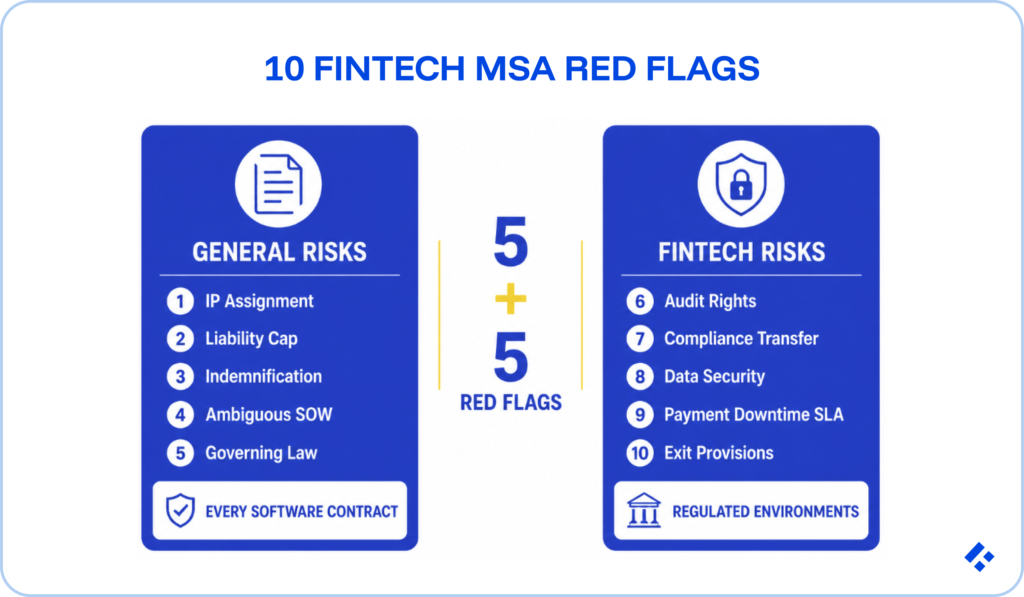
Use this as preparation for your legal review, not as a substitute for it.
| # | Red Flag | General or Fintech-Specific | Consequence if Missed |
| 1 | Missing or ambiguous IP assignment | General (amplified in fintech) | Ownership dispute over compliance-critical codebase |
| 2 | Liability cap below real failure cost | General (amplified in fintech) | Cap is a fraction of the breach or regulatory remediation cost |
| 3 | One-sided indemnification | General (amplified in fintech) | No recovery path for regulatory claims from vendor failure |
| 4 | SOW is ambiguous on staff aug vs. managed services | General (amplified in fintech) | Compliance accountability dispute on delivery quality |
| 5 | Unfavourable governing law and dispute resolution | General (amplified in fintech) | Regulatory claims become practically unrecoverable |
| 6 | No audit-rights clause | Fintech-specific | DORA/FINRA regulatory exposure; flagged in examination |
| 7 | Compliance-accountability transfer attempt | Fintech-specific | Vendor misrepresenting how regulatory liability works |
| 8 | Absent data-security provisions or no DPA | Fintech-specific | GDPR violation; no contractual basis for breach notification |
| 9 | SLAs that ignore payment-downtime costs | Fintech-specific | Service credits are far below the actual transaction-downtime loss |
| 10 | No exit or transition provisions | Fintech-specific | Synapse scenario: vendor failure becomes customer crisis |
Red flags in a fintech MSA are signals about how a vendor thinks about regulated financial partnerships.
Resistance to an audit-rights clause is one of the clearer signals, because a vendor who pushes back here either doesn't understand that FINRA and DORA now treat vendor oversight rights as an expected component of financial institution compliance programmes, or doesn't want that scrutiny in the first place.
An offer to handle your compliance tells you something different. Either the vendor doesn't understand that regulatory accountability stays with the regulated entity in fintech, or they're making a promise they can't keep.
Either way, they've shown you they won't be a reliable partner in a compliance event, which is exactly when you'll need them most.
Missing exit or transition provisions point to a vendor who hasn't thought through what happens when the engagement ends.
Taken together, how a vendor responds to audit rights, data-security provisions, and IP assignment tends to reveal their orientation before you ever sign.
A vendor who expects and welcomes these provisions is demonstrating that they understand the environment they're operating in.
Trio's staff augmentation engagements are structured for fintech from the start.
Because Trio works exclusively with fintech companies, the contractual provisions a regulated company needs appear in Trio's agreements as standard terms, not as additions a buyer has to negotiate into a general-purpose template.
We deal with all the red flags right at the start, so you can rest easy knowing that you are in good hands.
As always: review any specific engagement agreement, including Trio's, with your own qualified legal counsel before signing.
If you are interested in hiring a developer or a dedicated team through Trio, talk to an expert.