

It’s not hard to see that embedded finance is changing how people interact with money.
The line between a fintech app, a marketplace, and a financial institution is starting to blur.
When you can embed financial services like payments, credit, and insurance directly into a platform, users stop thinking of them as separate tools; they just become part of the experience.
That’s why building a fintech marketplace that integrates payments, lending, and insurance is no longer a niche experiment. Instead, it’s a strategy that defines how digital businesses will grow over the next decade.
But the path there isn’t simple.
It requires not only the right APIs and infrastructure but also a careful balance between regulation, technology, and customer trust.
At Trio, we’ve helped startups and established software platforms alike move from transactional systems to full-fledged embedded fintech ecosystems by helping them hire fintech developers well-versed in the challenges associated with this kind of move.
Some projects take months, others years, but our developers are available through staff augmentation for various lengths of time, so you can successfully offer value through embedded finance that feels seamless and natural to the user.
Understanding Embedded Finance and Its Role in Marketplaces
Embedded finance means including financial products and services, like payments, lending, or insurance, within non-financial apps.
Instead of redirecting a user to an external bank or payment processor, the platform quietly performs these actions in the background.
This concept isn’t new. Loyalty cards, in-store financing, and early e-commerce payment buttons were primitive forms of embedded finance. What’s different today is how simple APIs have made integration possible for virtually any fintech app or marketplace.
Still, “simple” might be misleading.
Behind every one-click payment or instant credit decision lies a complex web of banking connections, data sharing, and compliance checks.
The ability to weave these elements together without friction is what separates a good platform from a forgettable one.

Why Embedded Finance Is Reshaping Marketplaces
Marketplaces were once just digital intermediaries, matching buyers and sellers while outsourcing all financial activity to third parties. Now they’re becoming finance companies in their own right.
By embedding payments, credit, and even insurance products, a marketplace can manage the full transaction flow and collect new types of revenue.
This shift appears to signal the rise of embedded finance as a defining feature of digital commerce.
Platforms like Uber and Etsy, for example, use embedded banking features to handle payouts and lending without ever sending users off-site. It’s a smoother experience and, frankly, a reason customers stay loyal.
Of course, not every platform needs to build a full embedded finance stack.
Smaller startups might start by integrating only a payment API, testing whether users respond well before adding credit or insurance later. It’s an incremental process, not a one-time overhaul.
How Marketplaces Leverage Embedded Finance
If you look at how embedded finance works inside a marketplace, the first thing you notice is how it removes layers of friction.
Instead of juggling multiple partners, banks, processors, and insurers, everything happens through API connections that make each transaction almost invisible.
But there’s another side to this story.
Embedded finance also reshapes business models. When a platform can accept payments, lend capital, or offer coverage, it stops being just a connector and becomes part of the financial service ecosystem.
Payments That Simplify Multi-Party Transactions
Take Stripe or Adyen as an example of an embedded finance provider. These APIs allow a platform to accept payments, split revenue between sellers, and manage refunds automatically.
For a digital marketplace, that means a fundamental shift in how money moves.
A crafts marketplace, for instance, might embed payments so funds are instantly distributed between a creator, a courier, and the platform itself. There’s no waiting period or manual reconciliation, just a seamless transaction that feels effortless to the user.
Lending That Fuels Growth
Embedded lending may sound ambitious, but in practice, it’s a natural step once a platform already tracks seller performance and revenue data.
Using APIs from fintech companies like Plaid or Alloy, you can offer working capital loans directly inside the seller dashboard.
Shopify is perhaps the clearest example of embedded finance done right. Its Shopify Capital program uses merchant data to underwrite loans, creating a closed loop where sellers grow, sales increase, and the ecosystem strengthens.
Credit risk still exists, but it demonstrates how embedded finance enables circular growth.
Insurance That Builds Trust
Insurance integration doesn’t get as much attention, but it’s often the most powerful trust signal.
When marketplaces offer embedded insurance options, covering items such as delivery damage, service cancellations, or equipment loss, they provide users with peace of mind.
APIs from embedded finance companies such as Qover or Cover Genius make this integration straightforward.
For instance, an e-commerce platform might automatically add shipping protection at checkout, with claims handled inside the app. It’s one of those subtle user experiences that people don’t consciously notice until it’s gone.
The Embedded Finance Ecosystem
To integrate financial services effectively, it helps to understand the ecosystem behind them.
The embedded finance market sits at the intersection of banking, regulation, and technology, with several players working in tandem.
- Fintech Enablers: These are embedded finance companies that supply ready-to-use APIs for payments, identity checks, or credit scoring. Think of Stripe, Plaid, or Treasury Prime.
- Financial Institutions and BaaS Providers: The regulated backbone that holds funds, processes transactions, and ensures compliance with banking laws.
- Regulatory Partners: Compliance specialists or frameworks (like PSD2 or GDPR) that keep platforms within legal boundaries.
The relationships among these entities aren’t static. They evolve as new regulations emerge or as fintech startups introduce smarter, faster tools.
Building a marketplace on top of this structure takes flexibility, and that’s where development partners like Trio often come in. Our developers have the skills to ensure you can connect the moving parts in a way that scales.
Core Components: Payments, Lending, and Insurance APIs
Most embedded finance products and services fall into three categories: payments, lending, and insurance.
Together, they form the practical backbone of any embedded fintech platform.
Payments: The Starting Point
Payments are usually the first piece of the puzzle. A well-implemented payment API processes transactions and performs additional tasks, such as managing identity verification, fraud detection, and compliance, in the background.
For example, when a user books a rental car through a travel platform, a Stripe API might handle authorization, escrow, and fund distribution, all in seconds.
It’s this kind of embedded financial capability that makes online transactions feel nearly invisible.
Lending: Extending Access to Capital
Embedded lending gives platforms the power to act as facilitators of credit.
By analyzing real-time financial data from sellers or customers, the marketplace can offer financial products such as short-term loans or “buy now, pay later” plans.
The model isn’t without risk, but it allows non-financial companies to support customer growth directly.
Instead of referring users elsewhere, they offer embedded finance within their own ecosystem, keeping engagement high.
Insurance: Completing the Trust Loop
Finally, insurance ties everything together. Offering embedded coverage at checkout or contract signing can increase conversion rates and satisfaction.
It may also reduce support costs since customers feel protected from uncertainty.
Insurance APIs integrate easily now, but they still require thoughtful design.
Coverage terms must be clear, claims simple, and communication transparent. Otherwise, what’s meant to inspire trust can quickly become a point of frustration.
How APIs Power Fintech Marketplaces
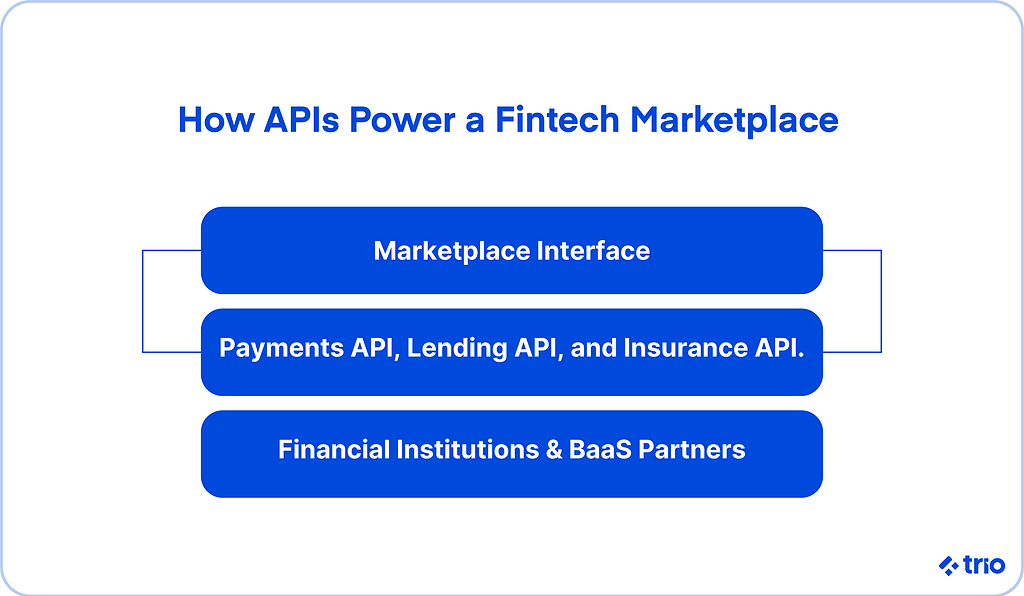
Every embedded finance solution ultimately depends on APIs. These digital bridges connect software platforms with financial institutions, enabling real-time communication across systems that weren’t originally designed to talk to one another.
A single transaction, say, a customer purchasing a digital course, might trigger half a dozen API calls: payment authorization, user verification, accounting entry, credit assessment, and insurance confirmation. When done right, it all happens in milliseconds.
Choosing the right API architecture matters.
- REST APIs are common and simple, ideal for straightforward integrations.
- GraphQL APIs allow more control over data queries, useful for complex fintech applications.
- Open banking APIs follow strict security and consent standards, a must when handling sensitive financial services embedded within your platform.
At Trio, we often help clients orchestrate these interactions. The goal is to ensure that each API performs securely, scales smoothly, and meets compliance requirements without sacrificing the customer experience.
Security, Compliance, and Regulatory Alignment
Fintech development lives under constant scrutiny, and for good reason. Every payment, loan, or policy involves sensitive data that regulators watch closely.
Ignoring this layer, even unintentionally, can undo months of solid app development work.
Key Compliance Considerations
Terms like KYC (Know Your Customer) and AML (Anti-Money Laundering) aren’t optional checkboxes. These are the baseline requirements for any platform that wants to integrate financial services responsibly.
Add in PSD2 for Europe or GLBA for the United States, and compliance becomes not just a task but an ongoing process.
Some founders try to build around these rules; most eventually learn it’s easier to build with them.
Trio’s engineering teams often bake these controls directly into architecture, automating encryption, tokenization, and consent tracking so they operate quietly in the background.
Working With Regulated Partners
If you’re not a bank (and most startups aren’t), you’ll need one, or at least a banking-as-a-service partner, to handle the regulated portions of your embedded banking setup.
These relationships let you integrate fintech features without taking on the full regulatory burden yourself.
It keeps marketplaces safe, scalable, and legitimate in the eyes of users and regulators alike.
Benefits of Embedded Finance for Marketplaces
When everything finally clicks, the benefits of embedded finance are impossible to ignore.
Users complete transactions without friction, sellers get paid faster, and the platform collects data it can use to improve products or create new revenue streams.
A few tangible results tend to stand out:
- Smoother user experience with fewer redirects and interruptions.
- Lower transaction costs thanks to direct API integrations.
- Faster access to capital through automated payouts or credit lines.
- Additional revenue opportunities from lending interest or insurance commissions.
Still, there’s nuance here.
Embedded finance may simplify the front end, but it adds complexity behind the scenes. Maintaining compliance, updating integrations, and managing data securely can stretch even seasoned teams.
Real-World Examples and Case Studies
It’s one thing to talk about embedded finance, but it’s another to see how it actually plays out.
Some of the strongest use cases in the fintech industry show that embedding payments, lending, and insurance is both a tech choice and a business model shift.
Shopify: Expanding Beyond Payments
Shopify might be best known as an e-commerce tool, but its financial layer has quietly turned it into a fintech company.
Through Shopify Payments, the platform lets merchants accept payments globally without ever leaving their dashboard. Later, it added Shopify Capital, which uses sales data to assess creditworthiness and extend loans.
This model feels deceptively simple, but it reflects a deep integration of financial products.
Shopify essentially became its own lender, something that traditional banks might never have allowed on such short notice.
The lesson here? Data is often more valuable than licenses.
Stripe: Infrastructure for Embedded Finance
If there’s an example of embedded finance that nearly every startup recognizes, it’s Stripe.
The company powers financial infrastructure for countless software platforms.
With Stripe Connect, marketplaces can onboard users, manage global payments, and automate compliance. Its Treasury (or Financial Accounts) and Issuing products now extend into embedded banking territory, helping businesses offer financial accounts and cards.
Stripe shows how embedded finance enables companies to launch new financial products without starting from zero. For founders, it’s a reminder that the right partner can simplify complex systems so that innovation focuses on user value, not regulation.
Super Apps and Other Examples
Outside North America, super apps like Grab and Gojek have built their success around embedded financial services.
They combine ride-hailing, food delivery, and mobile wallets under one roof, often bundling micro-insurance or short-term credit at checkout.
Meanwhile, fintech startups in logistics or healthtech are experimenting with embedded insurance, protecting shipments, vehicles, or even patient payments.
Example Architecture: Building a Fintech Marketplace
A fintech app that handles payments, loans, and insurance can seem overwhelming at first glance.
The truth is, every marketplace that integrates these services follows a similar blueprint: a layered system that securely connects users, data, and APIs.
Here’s what a simplified version might look like:
- Frontend Interface: Where users interact, pay, or request financing.
- Backend Orchestration Layer: Routes data between your marketplace, banks, and third-party APIs.
- API Gateway: Controls authentication, encryption, and rate limits.
- Compliance Layer: Monitors KYC, AML, and consent.
- Analytics and Data Storage: Keeps financial data organized for reporting and optimization.
When we design fintech architecture at Trio, we don’t force a one-size-fits-all model.
For instance, a peer-to-peer marketplace might prioritize escrow management and embedded insurance, while an international payment platform focuses on currency conversion and compliance automation.
What matters is flexibility, making sure your platform can grow into new fintech solutions down the line.
Implementation Guide: From API Selection to Integration
Integrating finance into a platform rarely happens in a straight line. It involves testing, revising, and sometimes pausing to rethink assumptions.
The following framework may help you keep the project focused on what actually drives value.
1. Define the Real Business Case
Before choosing any technology, clarify why you want to embed financial services.
Maybe your marketplace struggles with delayed payouts or seller churn. Adding BNPL (Buy Now, Pay Later) could potentially improve conversion rates.
When founders skip this step, they often end up integrating tools they don’t need.
2. Choose the Right API Partners
Your embedded finance provider should match your region, scale, and regulatory context.
Stripe, Adyen, and Payoneer are popular for global payments. Providers like Alloy, FinBox, or Solarisbank support embedded lending and credit checks. For insurance, Qover or Cover Genius makes integration nearly plug-and-play.
It’s rarely just one provider.
A healthy embedded fintech stack usually combines several APIs that handle banking, payment processing, and compliance simultaneously.
3. Test in Sandboxes First
Running experiments in sandbox environments saves enormous time later.
It’s where your app development team can verify token exchanges, test transactions, and identify data flow issues before a single real dollar moves.
4. Design User Flows With Care
It’s easy to get carried away adding new financial buttons and pop-ups. Resist that urge.
The most successful fintech apps make financial features feel invisible, a smooth part of the buying or selling process.
If a feature interrupts the flow, it’s probably too obvious.
5. Monitor Continuously
Once live, monitoring is as important as launch.
Our developers help companies set up dashboards that track API performance, compliance status, and failed transactions in real time.
That kind of visibility keeps financial features reliable and regulatory audits less stressful.
Choosing the Right Development Partner
If there’s one recurring theme in the embedded finance revolution, it’s that integration requires collaboration.
A strong technical team can handle code, but turning an idea into a compliant financial service platform takes broader expertise.
Working with a development partner like Trio means having engineers who already understand how to integrate fintech APIs, coordinate with embedded finance providers, and navigate international regulations.
The goal is to build a foundation that can pass audits, attract investors, and scale responsibly.
When you evaluate potential partners, look for those who:
- Have experience in fintech app development and regulatory frameworks such as PCI DSS or PSD2.
- Understand how to balance user experience with security.
- Can communicate clearly with both engineers and compliance officers.
It’s tempting to go with the lowest-cost option, but in fintech, cutting corners can be expensive later. Solid partnerships keep your marketplace from tripping over hidden complexities.
The Future of Embedded Finance
Predicting the future of fintech is risky, but a few trends already stand out.
Embedded finance is moving past novelty into expectation. Users may soon assume every platform they use, whether a travel app, logistics portal, or education service, will include basic financial products.
AI-driven lending appears to be the next leap forward.
Algorithms can now analyze thousands of behavioral data points to make real-time credit decisions. It’s not flawless, and bias remains a concern, but it’s expanding access to capital in ways traditional banking rarely could.
Meanwhile, real-time cross-border payments are improving quickly. Multi-currency APIs now enable near-instant settlements, a huge win for global marketplaces.
And as these systems mature, regulators are beginning to adapt, pushing the industry toward transparent, embedded financial services that meet local compliance by default.
There’s also a quiet shift toward verticalized embedded finance.
Instead of one generic solution for all, we’re seeing finance companies tailor offerings to specific sectors: freight insurance for logistics, escrow services for property platforms, and micro-lending for freelancers.
Trio’s engineers are closely monitoring these changes so they can adapt their skillsets to keep our clients ahead of their competitors.
Monetization and Growth Opportunities
Integrating payments, lending, and insurance is a growth strategy. Done right, every new financial product opens up new revenue streams for your platform.
- Transaction Fees: Earn a margin on every embedded payment processed.
- Credit Partnerships: Share interest or referral income from lending partners.
- Insurance Commissions: Collect a portion of premiums when users opt into insurance options.
- Account Float: Generate revenue from funds temporarily held in platform accounts.
Less obvious but equally powerful is retention. Users who rely on your embedded fintech platform for their daily business, payments, capital, and coverage rarely switch providers. They’re invested, both financially and emotionally, in your ecosystem.

Conclusion
Building a fintech marketplace that integrates payments, lending, and insurance may sound like a tall order, and in some ways, it is.
The work involves navigating regulations, negotiating with banks, and testing APIs until they behave predictably. But the payoff is hard to ignore.
When embedded finance works, it turns a simple platform into a thriving financial ecosystem. Sellers get faster access to funds. Buyers gain trust through transparent protection. And the platform earns revenue from multiple directions.
Whether you’re an established fintech startup or a non-financial company ready to expand, the opportunity lies in how well you integrate financial services and align them with what users genuinely need.
If you’re considering that step or want to see how a tailored embedded finance solution could fit your marketplace, reach out to Trio. Our team has built fintech systems that power real businesses across industries. Let’s talk about how to bring yours to life.
Get in touch.
FAQs
What is embedded finance in marketplaces?
Embedded finance in marketplaces means integrating financial services like payments, lending, or insurance directly into the platform experience.
How does embedded finance work in fintech apps?
Embedded finance works through APIs that connect a fintech app or marketplace with banks, payment processors, and insurers.
Why should platforms integrate financial services?
Platforms should integrate financial services to improve user experience, reduce friction, and open new revenue channels.
What are the main benefits of embedded finance?
The main benefits of embedded finance include seamless payments, faster lending access, and built-in insurance coverage.
Which APIs are used for embedded finance?
APIs from providers like Stripe, Adyen, and Qover are used for embedded finance in payments, lending, and insurance.