

 Read Client Stories




 Alex Kugell
 Key Takeaways
- Fraud detection and credit risk assessment remain the most mature, proven AI applications in fintech, with real institutions reporting measurable results.
- Agentic AI, systems that take action rather than just recommend one, is the newer, harder engineering problem. It raises the bar considerably on permissions, auditability, and rollback design compared to a standard AI feature.
- Explainability remains a genuine, unresolved constraint. Regulators increasingly expect financial institutions to explain an AI-driven credit or fraud decision.
- Data privacy and bias in training data are ongoing operational risks, and both require continuous monitoring rather than a launch-day review.
- Building AI into a fintech product well requires developers who understand both the AI implementation and the regulatory weight of the decision it’s making.
AI and machine learning have become part of almost all fintech offerings in 2026. The real question is which specific applications are mature enough to build on now, and which still need real caution before they touch a production financial decision.
Finance is heavily regulated. User data and finances are on the line. When leveraging AI and ML in fintech, it is incredibly likely that some sensitive information will reach those models eventually.
Let’s look at everything you need to know to utilize these technologies without creating new problems.
To get the expert developers on your team to help you do this, Trio can help.
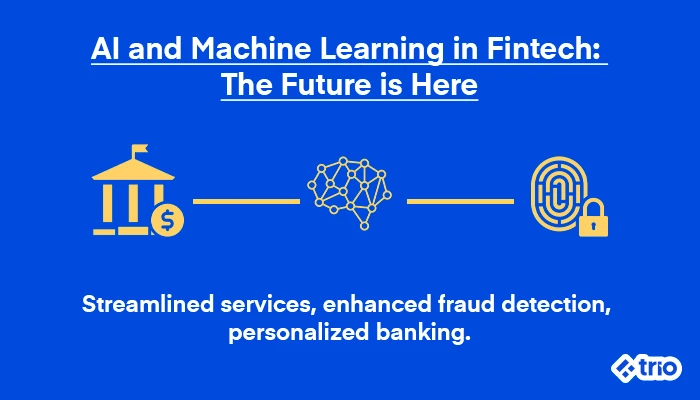
Where AI and ML Are Already Proven in Fintech
As you can expect, there are many areas where AI and ML are already being used in fintech with varying degrees of success.
Fraud detection is probably the most mature case we see. AI models excel at spotting even incredibly subtle patterns in real-time that a rules-based system or a human reviewer struggles to catch consistently.
PayPal has used AI-driven transaction monitoring at scale for years specifically to flag suspicious activity as it happens.
Credit risk assessment is also well used. Machine learning models can incorporate a wider range of signals, income, transaction history, and increasingly alternative data.
This lets you figure out whether or not it might be worthwhile to lend to people who don’t have a traditional credit score, or allows you to get a more complete picture than these credit scores could ever provide.
Outside of risk management, this is playing a massive role in inclusion.
Conversational and virtual assistants are quickly moving past novelty.
Bank of America’s Erica assistant is a great example. Reporting has credited it with a measurable earnings lift for the bank.
Algorithmic trading and portfolio management continue to lean on AI’s ability to process market signals, news, and historical data faster than any human team could.
They can take into account massive quantities of information, informing everything from robo-advisor allocation to institutional trading strategy.
HSBC, for instance, has used AI specifically to strengthen its predictive analytics for identifying high-growth opportunities.
The Harder Problem: Agentic AI in Finance
Agentic AI, or systems that take real action on a user’s or institution’s behalf rather than just surfacing a recommendation, is moving finance from reactive to proactive automation.
This means that, with as little as a simple description of your goals, they can start adjusting a portfolio, managing a budget, or initiating a transaction without a human confirming each individual step.
In terms of engineering, an agent that only suggests something carries limited risk if it’s wrong, while an agent that acts needs real permission boundaries defining exactly what it’s allowed to do without confirmation.
You also need to be able to generate an audit trail of every action taken and why, and a tested, reliable way to roll back a decision that turns out to be wrong.
The Constraints That Haven’t Gone Away
There are a couple of engineers that our developers are still working on for a variety of different companies trying to integrate AI and ML in their fintechs.
The explainability problem is real and unresolved.
It’s very difficult to explain how a complex model arrived at a specific decision, which creates a real regulatory tension.
Financial institutions need to explain credit, fraud, and risk decisions to regulators and to the customers affected by them. A purely black-box model can’t reliably do that.
Bias in training data doesn’t announce itself
A model trained on biased historical data will reproduce that bias.
Many models are retrained on an ongoing basis, so this bias can resurface even after an initial review passed cleanly.
Continuous monitoring should be built into the operating process to ensure you catch potential issues.
Regulatory frameworks are still catching up to the technology
GDPR, CCPA, and PCI DSS all touch how AI systems can handle financial data.
These frameworks, in particular, are evolving roughly as fast as the technology they’re meant to govern.
This means compliance here is an ongoing engineering commitment.
What This Means for Building AI Into a Fintech Product
From what we have observed, the teams doing this well share real AI and ML implementation skill, paired with genuine fintech domain judgment about which decisions carry regulatory weight and which don’t.
A strong AI engineer without fintech context can build a technically impressive model but create a compliance problem.
On the other hand, a fintech-experienced engineer without current AI skills can’t build the feature at all.
For teams without deep in-house AI expertise, working with a nearshore or offshore partner that specializes in fintech specifically can close that gap faster than building the combination internally from scratch.
If you need pre-vetted developers with guaranteed production experience, Trio can assist.