Hire by Technology
SERVICES


The shift toward embedded finance feels complex, but the reality is that they open up incredible opportunities for SaaS platforms and the like.
The biggest challenge is that embedded payments touch licensing, risk management, underwriting, and customer experience all at once.
This means that missteps here can slow your time-to-market or expose you to compliance risk, which can affect your customer relationships negatively and discourage future business.
The good news is that the tools and payment infrastructure have matured a lot in recent years, so you don't need to become a bank to build a financial layer into your product. You just need to understand the basics of the embedded finance landscape and how to apply them to your business.
Let’s look at everything you need to know to deploy embedded payments in your SaaS platforms successfully.
Our specialist fintech developers have worked with a variety of embedded financial services, including payment solutions.
View capabilities.
Let’s start by making sure that you understand the broader idea of embedded finance, including what it actually is and how it works.
Embedded finance refers to the integration of financial services, like payments, lending, insurance, or card issuing, directly into non-financial software products.
Think of things like Stripe or Klarna, integrated into checkout.
The point of this is that users don't have to open a separate banking app or payment processor to finish their transaction. It's all integrated directly into your app, which opens up new ways to create value by empowering customers through your payment services.
Embedded finance depends on a network of APIs and partnerships that bridge regulated financial infrastructure with software platforms.
Banks hold the licenses and handle custody of funds, while fintech enablers provide compliant APIs, and SaaS providers integrate those APIs into their product, so you don’t need to go through any licensing of your own.
When a user initiates a payment or requests a card, the action moves through several layers. The process starts on the app interface, moves through the payment processor, the acquiring bank, the card network, and sometimes even a sponsor bank.
Each step needs to be compliant with all relevant regulations and needs to keep user data secure.
Fortunately, you don't need to build any of this. You just need to have a basic understanding of which layer of the stack you'll own, and what someone else's development responsibility is.
The embedded finance ecosystem typically involves three key players.
The whole chain is beneficial to all players, so treating this as a partnership network rather than a vendor list tends to produce better outcomes.
Most SaaS platforms start out by redirecting users to a third-party processor at the point of payment. This could be something like a hosted Stripe page or external gateway.
While this works, it’s very easy for the experience to feel disjointed and can be frustrating, acting as a barrier that may discourage completion of the checkout process.
Users land on another brand mid-workflow. You lose visibility into the handoff. Any customization you want, branded receipts, in-platform reporting, and real-time balance updates require working around the processor rather than through it.
With embedded payments, the transaction happens inside your product. You own the user interface in its entirety, giving you control over the entire experience.
Your users never leave your platform, and you gain access to transaction-level data that can inform product decisions downstream.
The shift can also let you capture a portion of the processing fees rather than passing that revenue to a third party.
Now that you understand embedded finance as a whole, we can look at how embedded payments are payment capabilities built natively into a software platform.
Think of a booking platform where service providers get paid directly through the app, or a B2B tool that lets companies pay invoices in a few clicks. The transactions are just a natural part of the workflow.
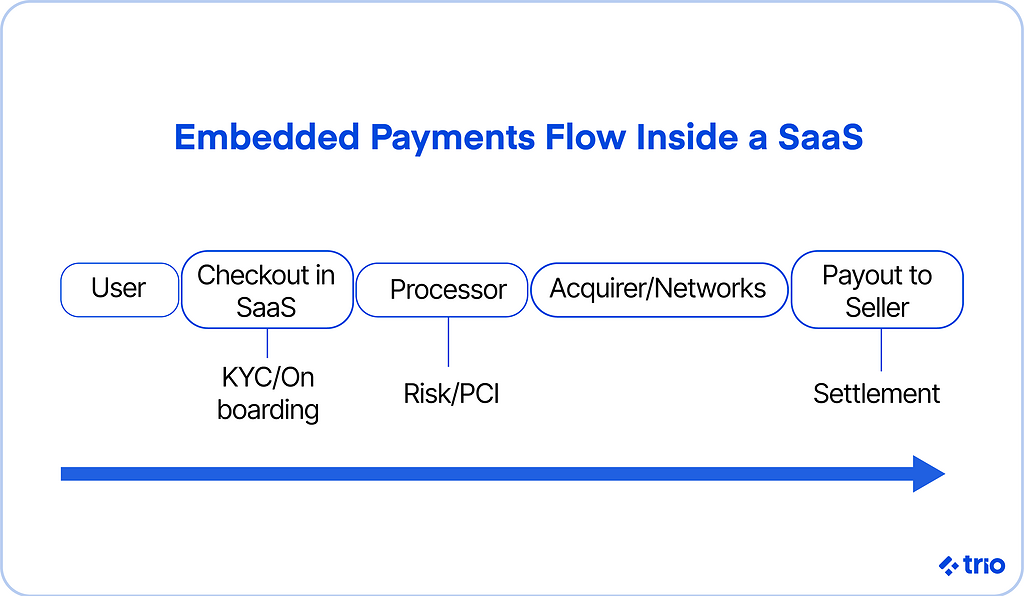
Integrating payments into your product isn't a one-size-fits-all process. You will need to carefully consider what your existing tech stack is made up of and what you want to control.
If you just want a lightweight integration, you might use a white-label provider's API to handle everything end-to-end. If you have a more mature platform and need a little bit more control, you might take on underwriting and sub-merchant management yourself.
There are several models for embedding payments. Each of these has trade-offs in control, compliance, and revenue share.
In our time in the industry, we've noticed that most non-fintech companies tend to land somewhere between the API model and PayFac-as-a-Service, depending on how quickly they need to ship and how much compliance overhead they can realistically absorb.
Separately from the integration model, you also need to think about the different ways SaaS platforms actually earn from payments. These different models are critical because they share your compliance load.
The three most common models we see include:
While the user experience might look simple, several layers make up a functioning embedded payment system. If you don’t know what you are doing, there is a lot of room for error.
Before merchants can accept payments, someone needs to make sure that they are a legitimate business.
This process, called underwriting, also assesses if they are compliant with financial regulations. In an embedded model, your SaaS becomes part of this flow, often collecting business details and verifying identity through an API connection to a payment facilitator (PayFac) or sponsor bank.
The smoother you can make this process, the better it is for the overall customer experience.
This covers the technical core of the payment process and involves things like capturing payment details, authorizing transactions, routing funds, and settling payouts to the proper accounts.
Payment processors handle much of the heavy lifting on the technical side here, but your platform controls the flow and experience. You might display transaction statuses or need to update account balances on the client interface.
Embedded payments bring you closer to financial data, which also brings you closer to risk and makes you liable for fines if regulatory bodies do not believe your systems are secure and compliant.
Chargebacks, fraud detection, PCI compliance, and dispute resolution all need to be accounted for. Fintech partners can handle some of this, but you'll still need visibility and governance to protect your brand and your users.
Our developers firmly believe that it is best to ensure transparency in your processes from the start. Integrating auditable reporting later is often more difficult and also more expensive.
Related Reading: Fintech Vendor Risk Management
We have already alluded to many of the benefits, like improving the experience of users, but there are many other reasons why you should consider embedding payments in your SaaS platform.
By facilitating payments directly, you can capture a portion of each transaction's processing fees. That may sound minor, but at scale, even a small take rate translates into meaningful revenue.
Many SaaS platforms evolve from flat subscription pricing toward hybrid models, where transaction-based income smooths out cash flow and fuels reinvestment.
When payments happen within your platform, you control every touchpoint from onboarding to settlement. You also gain richer data about customer behavior, which can then inform your later product design and help personalize future services.
Embedding payments lets users start transacting faster because they don't have to create separate accounts with a third-party processor or navigate complex setup flows.
When done well, payment onboarding feels like a natural extension of signing up for your app, a subtle but powerful way to boost activation rates and early retention.
SaaS markets are crowded, and a built-in financial product can set your platform apart, especially in vertical SaaS, where payment flows often reflect niche workflows.
Once users start running revenue through your platform, churn drops naturally.
The principles of embedded finance apply across industries, but they show up differently depending on your vertical and customer needs.
Marketplaces are classic candidates for embedded payments since you need to deal with payouts to the relevant party while also dealing with platform fees. You can also automate escrow-like flows.
The most important thing here is transparency to ensure all parties feel safe using your features.
Our developers have also noted that subscription-based SaaS products benefit from built-in recurring billing and real-time reporting, with no third-party dashboards required.
When it comes to HealthTech, PropTech, and EdTech, examples include patient billing, rent collection, and tuition payments, respectively.
Embedding payments directly into these systems simplifies compliance and reduces friction for end users, and opens doors to adjacent financial services like credit lines or insurance, further deepening user engagement.
If your software manages expenses or reimbursements, embedded finance can handle payouts at scale. Commissions might also fall into this category.
You can issue virtual cards and track spending in real time. This not only improves user experience but can become a key selling point in procurement and finance departments, especially if you have added features like approval automation.
Accounting and ERP tools have a natural fit for embedded payments since they allow users to pay invoices, reconcile transactions, or manage vendor payments inside the same interface, streamlining workflows and reducing manual errors.
This means that platforms otherwise outside the industry immediately turn into financial platforms.
As your embedded payment volume grows, so does its financial contribution to your business.
Every transaction you facilitate generates a small fee. Typically, you would share this between you and your payment provider. As your total processing volume increases, that share compounds.
This isn't a big deal if you only handle a couple of hundred transactions, but most companies want to get to the stage where they handle millions.
Your take rate is the portion of payment fees you retain. Depending on your model, this could range from a few basis points to several percentage points.
Established SaaS platforms have the luxury of negotiating favorable fee structures with payment partners. Eventually, you could also start taking on more of the PayFac responsibilities yourself, which can significantly impact profitability.
Higher margins often come with higher compliance overhead, so this trade-off deserves careful modeling before you commit.
Embedded payments can also improve cash flow visibility. With direct settlement data, you can gain real-time insights into when money moves through your ecosystem.
For many of the clients that we have worked with, this information is invaluable, especially if you have the systems in place to route it into manageable dashboards or other parts of the analytics stack.
That transparency can also help you forecast revenue and plan growth investments.
Building a smooth checkout experience is one thing. The additional difficulty comes from handling money on behalf of others and dealing with the required compliance and security associated with that task.
Now that you understand everything about embedded payment systems, here is a practical approach to integrating these systems into your own app.
Begin by mapping your current stack and identifying what capabilities you already have and what you'll need to outsource. Then, choose a partner that matches your scale, geographic reach, and compliance requirements.
Remember not to evaluate their documentation alone, but to assume that things will go wrong and to assess things like partner responsiveness ahead of time. Sandbox tools can also be incredibly helpful.
Decide how money will move through your platform. Will users pay each other, or are you collecting on their behalf? Will you charge platform fees or markups?
These decisions define your flow of funds diagram, which partners and auditors will expect to see. They also determine your monetization strategy, whether you earn a percentage of volume, a fixed markup, tiered fees based on user activity, or something else entirely.
Once the flow is defined, you'll integrate your provider's APIs or SDKs. Having fintech-experienced developers on your team is incredibly beneficial for this step.
These developers will help you focus on modularity, separating the core payment logic from your app logic so you can swap providers or expand later without needing to overhaul major sections of code.
If you're building in-house or customizing heavily, prioritize robust webhooks for event handling, for example, payment succeeded, payout delayed, dispute opened.
Before you go live, most providers require certification testing to confirm your integration handles edge cases correctly, refunds, partial captures, timeouts, and chargebacks.
The sandbox environments we mentioned earlier allow you to start the testing process without needing to go live, simulating real-world transaction volumes, latency spikes, and user behavior.
Once you've passed, roll out gradually with a pilot group before scaling to full production.
Payment data has to flow cleanly between your product, your provider, and your accounting systems. Using event-driven architecture or a message queue prevents data drift and ensures payouts always match ledger records.
Another frequent pain point our developers come across is UX consistency, especially if the payment provider's hosted components don't match your app's design language.
Building lightweight custom wrappers around SDKs can keep the experience cohesive without sacrificing compliance.
For most SaaS teams, becoming a registered PayFac or licensed financial entity is overkill. That's where PayFac-as-a-Service and Banking-as-a-Service (BaaS) platforms come in.
PayFac-as-a-Service providers offer a turnkey way to embed payments without taking on the full regulatory or operational load of becoming a PayFac yourself.
The important thing here is that you still control the user experience, but your provider manages everything that goes on in the background.
Building your own PayFac infrastructure is a multi-year project, and most small SaaS companies don't have the time or the resources required to do this properly.
You'd need legal counsel, compliance officers, risk teams, and banking relationships before processing a single transaction.
PayFac-as-a-Service means all you need to do is integrate their APIs, and you instantly gain access to everything you need.
The wrong choice of provider can lock you into a plan that will ultimately limit your growth. It is important that you assess potential payment providers thoroughly before making your decision.
When you are evaluating different providers, make sure that you assess their:
It’s a good idea to request references from similar SaaS platforms if at all possible.
Each major provider is slightly different, and thus slightly more suitable in certain circumstances:
As you will have noticed, the choice depends largely on your target market and technical maturity. If you're planning to expand internationally or layer additional financial features later, consider how each platform's roadmap aligns with yours.
In general, it’s a good idea to build your own platforms if payments are central to your differentiation and you have in-house expertise.
On the other hand, we recommend that you partner if you want to share responsibility with a fintech enabler and move faster.
White-label is another option that may be viable if you want control over branding without managing licenses or risk.
For many SaaS companies, we have found that a hybrid approach works best. Start with a PayFac-as-a-Service partner, then gradually bring parts of the stack in-house as you scale.
The embedded finance landscape continues to evolve, like all other aspects of fintech. You can’t just assume that what works as a differentiator today may well become a best practice for most SaaS platforms in a couple of months.
SaaS 2.0 is defined by platforms that facilitate economic activity. Credit issuance and transaction data are becoming core performance metrics alongside basic volume, ARR, and churn.
Any information that you gather could be useful to you later, to power your business strategy.
Cross-border payments are still one of the hardest challenges in fintech.
There are massive differences in regulations across the world, and currency changes make the process incredibly complex, especially if you are trying to get payments done as quickly as possible.
However, new networks and partnerships, particularly in Europe, Asia, and LATAM, are closing these gaps, and it is always a good idea to plan for future expansion.
Embedded payments are no longer optional if you want to have a good chance at growing your SaaS platform. But getting there requires some level of understanding of the fintech industry.
The complexity of building payment infrastructure correctly, especially in regulated verticals, tends to surface faster than teams expect.
Having engineers with genuine fintech experience means you can embed payments correctly from the start, preventing costly mistakes that lead to regulatory fines and even a loss in user trust.