
Fintech has become one of the most demanding parts of modern banking and digital retail. Customers want transfers to clear fast, balances to stay accurate across multiple systems, and fraud detection to work quietly in the background.
When the business grows, the software systems behind it usually get harder to maintain. The business domain stretches, the codebase becomes tangled, and the architecture struggles to keep up with new business needs.
We have watched teams wrestle with this, and the pattern is always familiar. Parts of the system drift away from what they were originally meant to do.
Domain Driven Design provides a way to align software development with real-world financial systems. It helps you shape the domain model around business capabilities rather than technical shortcuts.
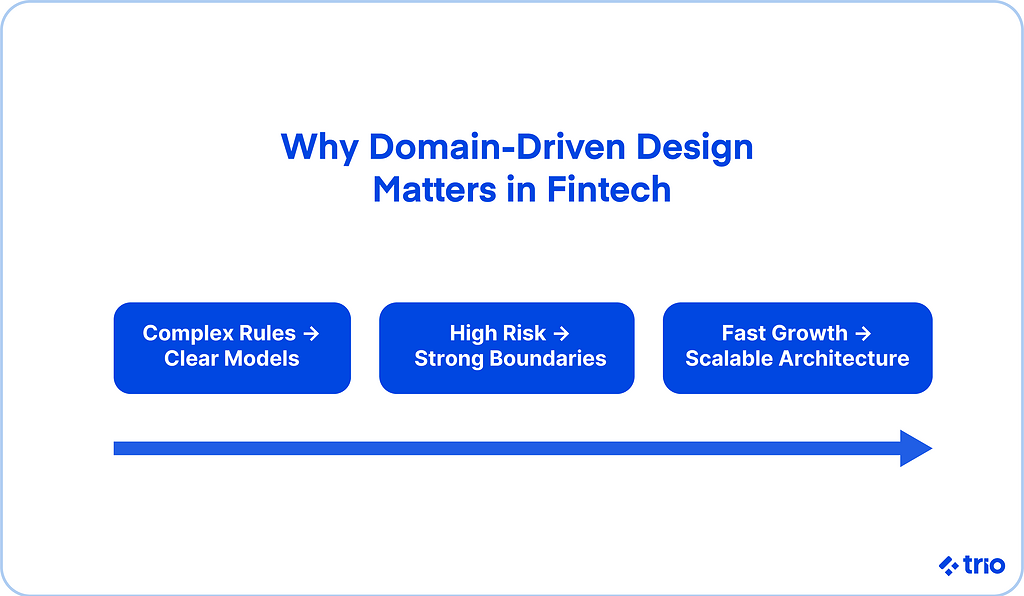
If you apply DDD with care, the result tends to feel more scalable, more maintainable, and easier for everyone on the team to understand.
Our specialist fintech developers can help you implement DDD in your architecture.
Understanding Domain Driven Design for Fintech
Before you apply DDD, it helps to understand where it came from and why it works so well in the fintech space.
DDD was introduced by Eric Evans and centers software around the business domain and its rules. It may sound academic, yet it solves a very practical business problem.
Complex software becomes a lot easier to manage when the structure matches the work the company actually does.
What Domain-Driven Design Means in Software Development
Domain Driven Design focuses on strategic design, shared language, and clear boundaries.
A software engineer might think of it as a way to reduce accidental coupling. A product manager might see it as a method for aligning features with real customer expectations.
Key DDD Principles
DDD principles offer building blocks that help developers and domain experts think together with less friction.
- Ubiquitous language: Teams use the same terms across product, backend, analytics, and account management, which makes communication smoother across teams.
- Bounded context: A bounded context represents a clear zone where models and business logic stay well-defined and consistent.
- Aggregate and domain model patterns: Aggregates help you maintain rules inside the domain model so complex business steps happen safely and predictably.
- Domain events: Domain events capture important changes such as currency updates, transaction processing results, or new risk signals.
Why Fintech Benefits From DDD
Fintech moves quickly, and the industry has become a challenger to traditional banking. With tight regulatory requirements and high-performance expectations, mistakes become expensive.
DDD fits well here because it keeps the architecture adaptable when the business evolves.
You get clearer separation between parts of the system, stronger data management, and better alignment between developers and domain experts. It also reduces the chance that complex business logic leaks across contexts.
Fintech systems tend to grow in unpredictable ways. A domain-driven approach makes that growth less chaotic.
Identifying Subdomains Inside a Fintech Product
A strong architecture begins with clear subdomains. Subdomains represent specific business capabilities inside the financial system, and understanding them helps you avoid a tangled codebase.
Types of Subdomains
Subdomains usually fall into core, supporting, or generic categories. The labels matter less than the clarity they create.
Core domains hold your competitive edge. Supporting domains keep the product moving. Generic domains solve common problems such as authentication.
Common Subdomains in Fintech
Most fintech products share a predictable set of subdomains, even if each company implements them differently.
- Payments: Handles movement of funds, settlement timing, and partner integrations.
- KYC and identity: Deals with verification steps, AML checks, and the onboarding flow.
- Fraud detection: Evaluates patterns and reacts within millisecond time budgets to prevent suspicious activity.
- Risk scoring: Updates risk levels based on transaction history, analytics, and external data.
- Lending: Manages approvals, interest calculations, repayment flows, and collections.
- Treasury and settlement: Tracks liquidity and currency positions and reconciles with external partners.
- Accounting: Supports reporting, ledger entries, and regulatory compliance.

Why Subdomains Matter
Clear subdomains make the architecture safer. They help you see which parts of the system need to scale, which need strict rules, and which can stay simple.
When you define them well, they become easier to reason about and far easier to maintain.
Using Bounded Contexts in a Fintech Architecture
Once the subdomains are understood, you can define each bounded context. These contexts protect your business domain from confusion and accidental coupling.
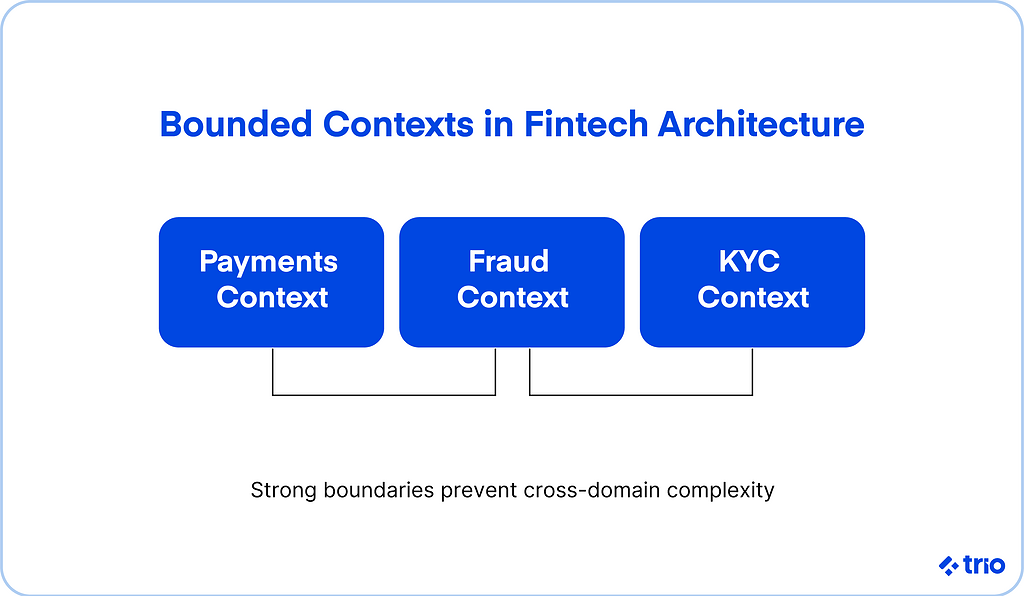
Boundaries That Reflect Business Logic
A good bounded context matches how the business thinks. Payments should not manage fraud rules. Lending should not care how identity checks happen.
When contexts match real work, the system feels more reliable.
How Contexts Communicate
Contexts often interact through APIs or domain events. Event signals help reduce coupling because contexts do not wait on each other.
This approach is especially useful when latency makes or breaks the customer experience.
Team Alignment Around Contexts
Contexts also help teams stay organized.
Developers, domain experts, and product managers can focus on one slice of the business without constantly coordinating across teams.
Strategic Design and Tactical Patterns in Fintech
DDD operates at two levels. Strategic design shapes your architecture. Tactical choices shape the inner details.
Strategic Design
Strategic design helps you identify which areas deserve the most investment.
Maybe your company cares deeply about lending accuracy. Maybe it cares more about customer experience or payment routing.
Strategic choices keep the work aligned with specific business capabilities.
Tactical Patterns
Tactical choices shape the small decisions developers make daily.
Aggregates protect rules inside the domain model. Repositories separate data concerns from business logic. Anti-corruption layers help keep confusing partner APIs from leaking into the core domain.
These patterns give developers predictable tools to handle complex business tasks.
Ubiquitous language in practice
A reliable shared language helps everyone follow the same understanding of the domain.
It also makes it easier to onboard new engineers without losing context.
APIs and Event-Driven Interactions in DDD
APIs and events act as the glue between contexts. They help you avoid tight coupling and keep business logic in the right place.
Domain-first APIs
Domain-first API design keeps endpoints aligned with the real business.
It prevents awkward interfaces that grow harder to maintain.
APIs and event-driven flows
Events allow contexts to react without constant synchronous calls.
Payments, risk scoring, or customer onboarding can run independently but still stay coordinated.
Clear contract boundaries
Clean contracts protect your domain from erratic external data.
They make integrations with partners more reliable and easier to test.
Architecture Styles That Support DDD
Choosing the right architecture affects how well your domain-driven design holds up as the business evolves.
Modular monolith
A modular monolith gives you domain boundaries inside one codebase.
It works well early on because you avoid the extra infrastructure, yet you still have room to separate business capabilities cleanly.
Microservice design
A microservice can make sense when one subdomain grows faster than the others. Payments may need high-performance routing while KYC only checks documents occasionally.
Splitting them by domain helps them scale independently without causing latency problems elsewhere.
Event-driven systems
Event-driven systems help contexts communicate without tight coupling.
They handle things like transaction processing, settlement events, and currency changes more smoothly because downstream services react at their own pace.
Scalability considerations
Scalability touches nearly every part of fintech architecture. A clear domain model helps you decide when to use CQRS, how to shard, or where to add stateless services.
These decisions get easier when the domain boundaries already make sense.
Maintaining a DDD System Over Time
A domain-driven architecture ages well only when you put effort into maintenance.
Versioning
Versioning protects you from breaking downstream consumers. It also lets teams introduce new fields or workflows while old clients continue functioning normally.
Contract tests
Contract testing helps ensure that APIs and event formats behave the way other contexts expect. It prevents subtle regressions that are easy to miss in complex business domains.
Documentation
Short documentation keeps your shared vocabulary alive. It also speeds up onboarding when new developers or domain experts join the team.
Language maintenance
Language drift is common when several teams change business logic at the same time. Checking terminology periodically keeps everyone aligned.
Challenges When Using DDD in Fintech
A domain-driven approach brings clarity, but only if the team avoids common pitfalls.
Overcomplication
Teams sometimes apply every DDD pattern from day one.
A simpler structure may work better until requirements stabilize and the business domain becomes clearer.
Boundary mistakes
If boundaries come from technical preferences instead of actual business logic, they usually age poorly.
They also create places where change feels more painful than it should.
Communication gaps
DDD depends on shared understanding.
When developers and domain experts stop talking, the architecture often drifts in small but harmful ways.
Latency pressure
Latency limits are strict in fintech. If contexts call each other too often, the customer experience may suffer.
Event signals help reduce this kind of coupling.
Integrations
External partners often return inconsistent data.
ACLs help translate those mismatches, but they still require thoughtful data management and careful testing.
Staying agile
Agile teams can use DDD without slowing down.
It just requires discipline about boundaries and a habit of checking whether the domain still reflects the business problem.
Conclusion
Fintech systems grow more complicated faster than most teams expect.
Domain Driven Design helps you keep the architecture aligned with the real business.
When you define the right boundaries, build consistent language, and rely on events and contracts, you give the product space to scale without constant firefighting.
If you need help implementing DDD into your projects, get in touch to connect with our seasoned fintech experts!
FAQs
What is Domain Driven Design in fintech?
Domain Driven Design in fintech means structuring your system around real financial workflows. It helps teams keep rules, data, and language consistent as the product grows.
Why do fintech companies use DDD?
Fintech companies use Domain Driven Design because it reduces complexity and prevents cross-domain leakage. It also helps teams ship changes without breaking core financial flows.
How do you identify subdomains in a fintech product?
Identifying subdomains in a fintech product starts by mapping business capabilities such as payments, fraud, and KYC. Each area gets its own rules, models, and data.
What are bounded contexts in fintech architecture?
Bounded contexts in fintech architecture are zones where models and language stay consistent. They keep payment logic separate from fraud or risk, so teams do not step on each other.
Is DDD only for large fintech companies?
DDD is not only for large fintech companies because small teams benefit from clear boundaries too. The scale may differ, but the structure still helps.
How does DDD improve scalability in fintech?
DDD improves scalability in fintech by grouping logic so each domain scales independently. Payments can handle spikes without dragging KYC or risk checks with it.
Can DDD work with microservices in fintech?
DDD can work with microservices in fintech when boundaries match real business domains. It prevents teams from splitting services for the wrong reasons.