


Most engineering leaders recognize the feeling long before they have a name for it.
A project slows down without a clear reason. A developer who normally moves quickly suddenly seems to struggle with simple tasks. The backlog grows in strange ways, and the roadmap feels slippery.
You start to suspect the engineering team may be stretching past its bandwidth, but it is hard to tell whether you are dealing with a temporary pinch or a deeper bandwidth issue that could affect future work.
These slowdowns often appear small in the beginning, which is why engineering managers sometimes miss them.
The real harm shows up later when productivity drops across the whole development team, technical debt accumulates, and critical projects keep missing their targets.
When the engineering team is overloaded for long enough, burnout creeps in, and the team can’t deliver at the speed the business expects.
If any of this feels familiar, you are not alone. And you are not stuck. We have seen and dealt with this many times in the years we have been augmenting fintech development teams.
Once you understand what tends to shrink a team’s bandwidth, you can take practical steps to fix it in a sustainable way that protects both people and product momentum.
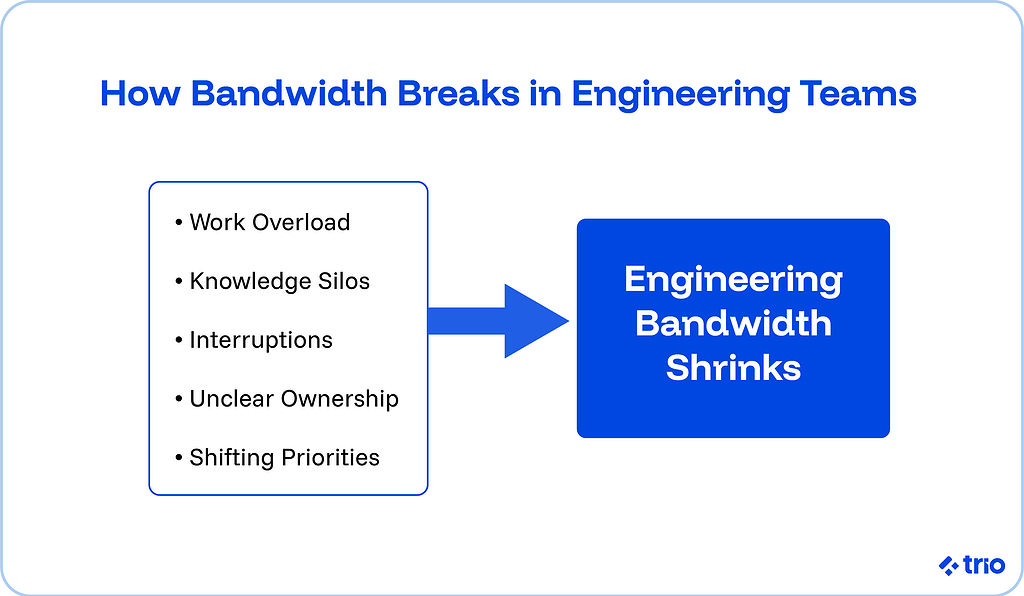
Why Engineering Bandwidth Problems Appear
Most bandwidth problems do not come from one dramatic event. They usually compound quietly over several sprints.
Too Much Work in Progress
A team may feel productive when several initiatives are open at once, but in most cases, this is a trap.
Every switch between tasks, costs, time, and attention, and when a developer jumps between three or four streams of work in a single day, velocity slows in ways that are easy to misinterpret.
You might think the complexity increased when the real issue is simply too much work happening at the same time.
Knowledge Silos That Create Bottlenecks
Almost every engineering team has at least one expert who seems to know the whole system.
It feels comforting until you realize how many decisions or pull requests rely on this one engineer. When they are busy, on leave, or pulled into support work, the development team stalls.
Even a healthy team may not notice how dependent it is on a few people until a bottleneck appears.
Operational Load That Eats Into Meaningful Development Time
Support work, break-fix work, manual testing, deployment tasks, and internal requests can swallow hours of the day.
These interruptions often feel small on their own, although they add up quickly.
Teams start sprint planning with good intentions and then drown in unexpected tasks until the sprint loses shape.
Organizational Choices That Slow Down Delivery
Some bandwidth issues come from the structure around the engineering team.
A manager may be responsible for too many engineers, or project managers may introduce an extra process that creates overhead.
Sometimes ownership is unclear, which forces small decisions through too many people.
Any of these patterns can introduce delays that feel minor until they appear in every sprint.
A Reactive Culture Where Priorities Shift Too Often
If priorities keep changing, engineers lose the ability to plan their work.
They stop trusting the roadmap. They jump into whatever is loudest, and the team isn’t able to finish what it starts.
Slower delivery becomes the norm, and the whole team feels like it is chasing fires instead of building software.
Misalignment Between Product, Engineering, and Leadership
A product team may define new features faster than engineering can refine them.
Stakeholders might expect shipping features at a pace that doesn’t match current capacity.
These mismatches create unrealistic timelines and eventually push the engineering team into overload.
6 Warning Signs That Team Bandwidth Is Shrinking
Bandwidth issues often show up in clues scattered around the team’s daily work.
Spotting them early is the easiest way to prevent long-term damage.

1. Delivery Slows Down Even When Tasks Look Simple
You start seeing straightforward tasks taking longer than they should.
A feature that ought to be a week of work stretches into two or three.
There may be no single cause, which makes the slowdown harder to spot until it becomes a pattern.
2. Backlogs Grow Faster Than the Team Can Deliver
A backlog that keeps growing is one of the clearer warning signs that the engineering team is overloaded.
Even when the work is well defined, the team can’t move fast enough to keep up with incoming tasks.
Eventually, project managers begin delaying commitments, and stakeholders notice unpredictability.
3. Dependence On One or Two Key Engineers
When a developer becomes the default person for architecture decisions, urgent fixes, or approvals, work ends up stuck behind them.
This dynamic creates significant risk if they take leave, experience burnout, or simply run out of hours in the day.
4. Little to No Time for Technical Improvements
Teams operating at full capacity usually stop investing in refactoring, documentation, or infrastructure upgrades.
Those improvements get pushed to later and later, never arrive.
Technical debt accumulates, and future sprints feel slower and heavier.
5. Burnout and Mood Changes Within the Team
People may appear tired, withdrawn, or frustrated. Standups become shorter. Engineers start quietly signaling that they cannot get something done or that the sprint goals feel unrealistic.
These emotional cues usually show up before metrics confirm a problem.
Planning Becomes Stressful and Short-Term
When the team can’t look beyond the next sprint without feeling pressure, it is often a sign that the development team is trying to manage too much.
Long-term initiatives feel risky because the team can’t protect time for them.
Why Leaders Often Miss These Patterns
Even thoughtful managers may not catch early bandwidth signals. The reasons vary.
Overestimating What a Team Could Handle
When you work with talented engineers, it is easy to assume they will simply push through busy periods.
The trouble is that these periods stack up and slowly become the new normal.
Belief That Hiring Someone Will Solve Everything
Hiring can help, although only if the structure around the engineering team supports it.
If problems stem from workflow or organizational choices, adding more developers tends to increase overhead rather than reduce it.
Limited Visibility Into Daily Workflows
Some teams don’t track cycle time, review times, or work in progress.
Without this visibility, leaders may not know how much time the team spends waiting for decisions, reviews, or clarification.
Too Much Reliance on Informal Processes
Informal communication works for a small team, although it doesn’t scale.
Once the team grows, missing documentation, unclear priorities, and ad hoc decision-making start to create delays.
The Hidden Cost of Meetings and Interruptions
Engineers often lose focus due to random requests or constant context switching.
These interruptions might look harmless on a calendar, but they erode productivity.
Practical Ways to Fix Bandwidth Issues in an Engineering Team
Most bandwidth problems can be solved with a mix of structural improvements and thoughtful cultural shifts.
The goal is to build a healthier environment so the team can move with clarity and maintain sustainable velocity.

Lower Work in Progress and Help the Team Focus Again
Start by reducing the number of initiatives the team is juggling.
Even cutting one or two streams of work can make a surprising difference in speed.
A development team that focuses on fewer things usually finishes work sooner, feels less stressed, and reduces unnecessary delay.
Improve Tooling and Automate Repetitive Tasks
If the team spends too much time on support work or deployments, this is often where you gain the most.
Faster build times, stable pipelines, or automated testing help developers stay in flow.
The point is to remove friction rather than enforce a rigid process.
Clarify Ownership and Simplify Decisions
When everyone understands who owns which part of the product, the team spends less time waiting.
This clarity helps engineers move on to the next task without searching for approval. It also avoids situations where work gets missed because responsibility was unclear.
Spread Knowledge Instead of Creating Bottlenecks
Encourage pairing, rotate responsibilities, and document core systems in simple, practical ways.
You don’t need heavy manuals. Even a short readme can reduce dependency on a single engineer.
What helps is getting developers with the necessary base skills on your team, like the fintech specialists provided by Trio. This makes spreading knowledge easier as there is true understanding.
Protect Time for Technical Debt and Infrastructure
Teams that ignore technical health eventually pay for it in slower delivery. Set aside recurring time for technical debt work.
Even a small commitment each sprint lowers future risk and supports overall sustainability.
Use Metrics to Understand How Work Flows
Cycle time, review time, and WIP limits give you insight into how the team moves. These metrics help you spot bottlenecks early.
Pair the numbers with qualitative input from the team for a complete picture.
Align Expectations Across Product and Engineering
Misalignment is a major cause of bandwidth strain. Make sure the roadmap reflects what the engineering team can reasonably support.
Clearer expectations usually prevent scope creep and reduce unpredictability.
When Hiring Helps and When It Makes Things Worse
Hiring is a tempting fix for any bandwidth issue, although it doesn’t always work.
If the team is overloaded due to unclear ownership or process gaps, adding more engineers usually slows things further.
On the other hand, if the team has a strong structure and simply cannot keep up with demand, it may be time to hire someone or consider staff augmentation for specific initiatives.
Many teams choose a blend of internal development and external help.
At Trio, for example, clients sometimes bring us in when they need temporary support or want to accelerate a critical project without overwhelming their internal team members.
This approach often gives them breathing room while they strengthen their processes.
Situations That Reveal Bandwidth Problems Clearly
There are a few patterns that show up in many engineering teams.
Too Many Projects Move Slowly at the Same Time
A team may open five initiatives and finish none.
Once they close out three and focus on two, the team suddenly becomes more predictable again.
Hero Developers Become the Forced Gatekeepers
A senior engineer may hold too much system knowledge, which means every decision runs through them.
The team can’t move when they are busy.
Support Work Takes Over Entire Sprints
A team that constantly drops feature work to handle bugs or outages can’t build momentum.
Automation and better boundaries often help here.
The Backlog Grows in All Directions
A backlog filled with old tasks signals that priorities were unclear.
Cleaning it up gives the team clarity and allows them to focus on the right things.
A Quick Diagnostic Checklist for Engineering Managers
If you want to assess your team’s bandwidth quickly, look at a few simple indicators.
Organizational Health
Do engineers have clear ownership? Does your management team have enough time to support people properly?
Workflow Patterns
Is the work in progress too high? Are reviews or decisions slow? Does the team get stuck behind one bottleneck?
Team Well-Being
Is anyone showing persistent signs of burnout? Are people feeling frustrated or stuck?
Technical Foundations
Are builds slow? Is deployment fragile? Are there infrastructure tasks the team hasn’t touched in months?
A 30 Day Plan to Recover Engineering Capacity
You don’t need a full transformation to see improvement.
A few targeted moves can help the team regain capacity.
Week 1: Review Active Projects and Pause What Isn’t Top Priority
This helps the team focus on the work that delivers the most value and reduces stress.
Week 2: Fix One Meaningful Bottleneck
Find a workflow issue or delay that causes frustration and solve it. Even small wins help.
Week 3: Share Knowledge Intentionally
Choose a part of the codebase where only one person feels confident and spread that knowledge to someone else.
Week 4: Improve Structure or Responsibility Boundaries
If your team is overloaded or unclear about ownership, make one targeted adjustment to clarify how decisions are made.
Closing Thoughts
Bandwidth issues happen to strong engineering teams just as often as inexperienced ones.
They appear gradually and usually reflect growth, rising workload, or insufficient clarity around priorities.
But with the right visibility and a willingness to make small, strategic adjustments, you can restore the team’s focus and help them deliver more predictably.
If your team feels overloaded or stuck, Trio can help you stabilize the load, support critical projects, and create a healthier development rhythm that protects your engineers and keeps delivery on track.
We do this by providing skilled developers who integrate into your team with ease and use their extensive experience to assist you.
To hire fintech developers with Trio, get in touch!
FAQ
What are engineering team bandwidth issues?
Engineering team bandwidth issues refer to situations where the engineering team doesn’t have enough capacity to handle the workload, which limits productivity and slows delivery.
What are the warning signs of a bandwidth issue?
Warning signs of a bandwidth issue usually appear through slower delivery, growing backlogs, higher stress levels, and increased dependence on a few key engineers.
How can a manager fix bandwidth problems?
A manager can fix bandwidth problems by reducing work in progress, improving workflow clarity, and removing delays that prevent the team from moving smoothly.
Why is my team overloaded even with strong engineers?
A team is overloaded when the workload, prioritisation, or structure creates more demand than the engineers can support, even if their skills are strong.
Should I hire someone to solve bandwidth issues?
Hiring someone can help solve bandwidth issues when structure is healthy, although it may not work if process gaps or unclear ownership are the real bottlenecks.
What causes a team’s velocity to slow down over time?
A team’s velocity slows down when context switching, technical debt, unclear priorities, or interruptions reduce the time available for focused development.
How do I know if we have too much work in progress?
You know you have too much work in progress when tasks keep rolling over, deadlines slip, or the team can’t finish initiatives without constant delay.
Can technical debt create bandwidth problems?
Technical debt creates bandwidth problems because it increases friction in development, which slows progress and crowds out feature work.
Is burnout connected to bandwidth issues?
Burnout is often connected to bandwidth issues since ongoing overload, shifting priorities, and unpredictable sprints drain energy and motivation.
What’s the fastest way to improve engineering bandwidth?
The fastest way to improve engineering bandwidth is to pause lower-priority work, clear bottlenecks, and give the team space to focus on fewer tasks at once.


