

Hire by Technology
SERVICES


There are many ways in which AI tools can be used to speed up fintech development, but there are also many challenges that come along with using them.
AI tools generate more code, which demands more review. And fintech codebases, multi-service payment systems, KYC pipelines, ledger infrastructure, and compliance workflows are structurally harder for AI to reason about correctly.
This last issue largely comes from fintech codebases spanning many services and carrying implicit financial conventions (decimal precision, idempotency patterns, state machine design) that models don't know by default.
There are also real regulatory consequences when something goes wrong.
To prevent as many issues as possible, you not only need the best software developers on your team, but also the best AI coding tools for fintech development teams.
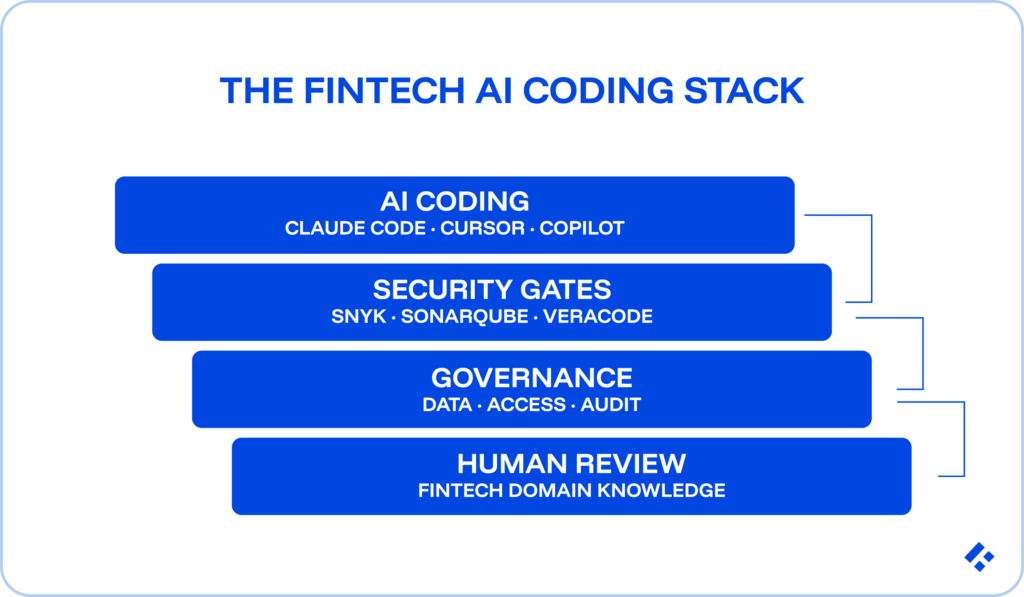
The best AI coding tools for fintech teams in 2026 combine a generation layer (Claude Code for architectural work, Cursor for daily editing, GitHub Copilot for IDE breadth), a security gate layer (Snyk or SonarQube scanning AI output in CI/CD), and, for teams with strict data residency needs, a governance layer (Tabnine air-gapped, or an AI governance platform like TrueFoundry).
This guide evaluates the leading AI coding tools against fintech-specific criteria, recommends a stack calibrated by team stage, and covers the governance and review practices that determine whether AI amplifies safe output or accelerates unsafe output.
If you need the best developers on your team, with experience coding rapidly in production fintech applications, we can connect you with the right people in as little as 3-5 days.
General AI coding tool roundups evaluate code quality, IDE integration, pricing, context window, and enterprise security.
However, for a fintech development team, you need to make sure you cover any industry-specific gaps.
Here are five criteria that determine whether an AI coding tool is genuinely safe and effective for regulated financial engineering:
The generation layer is whatever your engineers actually interact with day to day to write, refactor, and debug code.
Based on what our developers have seen in the last couple of years, five tools currently dominate fintech engineering teams.
The 1M token context window on Opus 4.8 is the strongest current answer to the many-microservices problem. It allows Claude Code to read an entire payment system's architecture in one session, so its changes stay coherent across service boundaries.
CLAUDE.md configuration is another benefit, as it encodes fintech conventions like DECIMAL arithmetic, idempotency patterns, KYC state machine design, and PCI DSS logging constraints into every session before the model writes anything.
The subagent architecture can spawn a dedicated security-focused subagent to check architectural changes against compliance requirements.
In terms of data handling, Anthropic doesn't train on customer code submitted via the API. This allows it to maintain a HIPAA-eligible posture and offer an enterprise DPA.
Its major, fintech-specific weakness is that the terminal-first workflow is less polished than Cursor's IDE experience for routine daily editing, and usage-based pricing can spike on complex, multi-file architectural tasks.
Historically, Pro is priced at $20/month, with higher Max and Ultra tiers for heavier usage. It’s worth confirming current tiers directly, though, since pricing in this space has shifted more than once over the past year.
Best fintech use case: Large-scale refactors across payment services, compliance architecture reviews, KYC pipeline redesigns, and anything genuinely requiring cross-service understanding.
Cursor carries the clearest third-party compliance story among the major AI coding tools, SOC 2 Type II certification, and a zero data retention option. This provides an easy answer to give in a PCI DSS-focused security review.
Composer handles multi-file feature work effectively, and recent independent coding-agent benchmarks place it among the stronger options for that kind of task, though exact rankings shift often enough that it's worth checking current standings rather than treating any single score as fixed.
Bugbot's AI-driven PR review adds another check on AI-generated financial logic before a human reviewer gets involved.
When it comes to data handling, Cursor is SOC 2 Type II certified, with a zero data retention option and standard encryption in transit and at rest.
The weakness here is that context depth is optimized more for focused sessions than full-codebase architectural understanding, and Project Rules require manual setup rather than automatically enforcing fintech conventions.
Costs run around $20/seat and a higher compliance-focused tier (sometimes called Business, sometimes restructured under different names) around $40+/seat, but again, make sure that you confirm the latest pricing as it changes relatively often.
Best fintech use case: Daily payment feature works, KYC UI extensions, reporting queries, and anything that benefits from inline editing and visual diffs.
Related Reading: Claude vs Cursor for Fintech Engineering Teams
IP indemnity, legal protection if AI-generated code creates an IP liability, is a genuine differentiator among major AI coding tools and matters directly to fintech companies approaching M&A or an IPO.
Copilot carries SOC 2 and ISO/IEC 27001 certification, works inside essentially any IDE without forcing engineers to switch tools, and its multi-model support (choosing between Claude, GPT-4o, and others inside one subscription) plus native GitHub PR review adds a review layer without extra tooling.
There is also an enterprise option offering no code retention.
The big fintech-specific weakness here is the lower autonomous capability ceiling than Claude Code for genuinely complex architectural work, and less configurable for fintech-specific conventions than CLAUDE.md-based tools.
There is a free tier with a completion cap, a Pro tier around $10/month, and an Enterprise tier around $39/user/month.
Best fintech use case: Junior and mid-level engineers working on routine fintech features, teams with mixed IDE environments, and organizations where M&A-sensitive IP protection matters.
Tabnine is set apart by its genuine air-gapped deployment, and code that never leaves the machine, with support for a fully on-premises model serving through tools like Ollama.
For fintech teams whose security policy prohibits transmitting code to any external API or who need absolute data residency, Tabnine is one of the only enterprise-viable options among the major tools.
It carries SOC 2 Type II and ISO 27001 certification rather than a federal accreditation, so it's worth being precise about that distinction rather than overselling it in a compliance conversation.
The downside is that generation quality trails Cursor and Claude Code on genuinely complex tasks, which you’re swapping for complete data isolation, and the on-premises deployment carries more operational overhead.
Pricing is based on several plans, including enterprise, custom, and tied to an on-premises deployment scope option.
Best fintech use case: Any fintech team whose compliance posture rules out external code transmission entirely, particularly PCI DSS Level 1 merchants or regulated banking entities.
Augment Code's context engine indexes several hundred thousand files across multiple repositories, directly addressing the many-microservices problem that limits shallower tools.
It became the first AI coding assistant to achieve ISO/IEC 42001 certification, the international standard for AI management systems, audited by Coalfire and confirmed in 2025, alongside SOC 2 Type II and VPC or on-premises deployment options.
Its architecture uses customer-managed encryption keys and a proof-of-possession model that keeps suggestions scoped to code a given developer has actually accessed, which matters specifically for multi-tenant fintech platforms trying to avoid cross-tenant contamination.
If you are a smaller firm, consider that credit-based pricing creates less predictable costs for high-usage teams than a flat per-seat model. The tool is also just a newer entrant with a smaller ecosystem than Cursor or Copilot.
Tiered plans have been in the $20-$200/month range, at the moment starting at $100/month for up to 50 seats, depending on credit usage, with custom enterprise pricing above that.
Best fintech use case. Enterprise fintech teams, generally 50 or more engineers, that are building on multi-service payment architectures, where cross-repository context is the main constraint on how useful an AI tool actually is.
Veracode's ongoing GenAI Code Security research has consistently found that roughly 45% of AI-generated code introduces exploitable vulnerabilities.
That rate has stayed the same, even though the raw syntax correctness has climbed above 95%.
Separately, Apiiro's research across Fortune 50 enterprises found AI-assisted development correlates with a notably higher rate of design-level security flaws, like authentication bypass and improper session handling, along with a sharp increase in privilege escalation paths.
Second, if the model doesn’t understand your company's parameterized query conventions, you risk introducing an SQL injection vulnerability.
AI-generated fintech code should be treated as untrusted input until it clears the same quality gates as human-written code. Three tools tend to do this work inside the CI/CD pipeline:
Two more dimensions apply once a fintech team's data requirements get strict enough to need them.
Claude Code, Cursor, and Copilot all operate with developer-level privileges and can connect to internal systems through MCP servers.
A compromised MCP connection can exfiltrate credentials without leaving a trace in any static scanner, since the vulnerability sits in the workflow rather than in the code itself.
If your fintech team is running AI tools with MCP integrations, they should treat every MCP connection as a potential attack surface and restrict access to approved servers only.
If you’re subject to the EU AI Act's governance requirements, or to the SOC 2 scope that now includes AI usage evidence, platforms like TrueFoundry provide audit logging of every LLM request, tool invocation, and agent action with full user attribution, piped into tools like Splunk, Datadog, or Grafana with retention long enough to serve as SOC 2 evidence.
As of 2026, AI coding tools reliably produce code that looks correct to a general code review.
However, AI tools can introduce subtle errors that take experienced developers more time to debug than writing the code manually would have taken in the first place.
In fintech specifically, those subtle errors carry financial and regulatory consequences.
Engineers who understand the core fintech competencies, monetary precision, payment idempotency, KYC state machine design, PCI DSS scope awareness, and general regulatory framework knowledge are the review layer that actually makes an AI coding stack safe to run in regulated financial engineering.
Trio places pre-vetted LATAM fintech engineers who bring both AI tool fluency and domain knowledge to review AI output for the failure modes that tools consistently miss.
To find out if we have the right engineers for your project specifically, request a consult.