

Hire by Technology
SERVICES


SOC 2 compliance tends to get discussed as a controls framework for employees and internal systems.
The implicit assumption behind this is that the compliance perimeter ends at the employee boundary, which sits behind a large share of audit findings for fintech companies using external engineering talent.
The problem is that SOC 2 doesn't work that way.
The Common Criteria governing access control, personnel security, change management, and vendor risk apply to any person who accesses your systems, commits code to your repositories, or works on your compliance-critical infrastructure, regardless of whether they appear on your payroll.
An augmented engineer from a staffing partner who accesses your payment system enters your SOC 2 compliance perimeter the moment their access gets provisioned.
If your fintech is pursuing SOC 2 Type II certification, an auditor evaluates whether controls exist and whether they operated consistently throughout a 12-month observation period.
Augmented staff not covered by the same access provisioning, background check, device, change-management, and offboarding controls as internal employees are accumulating audit findings in real time.
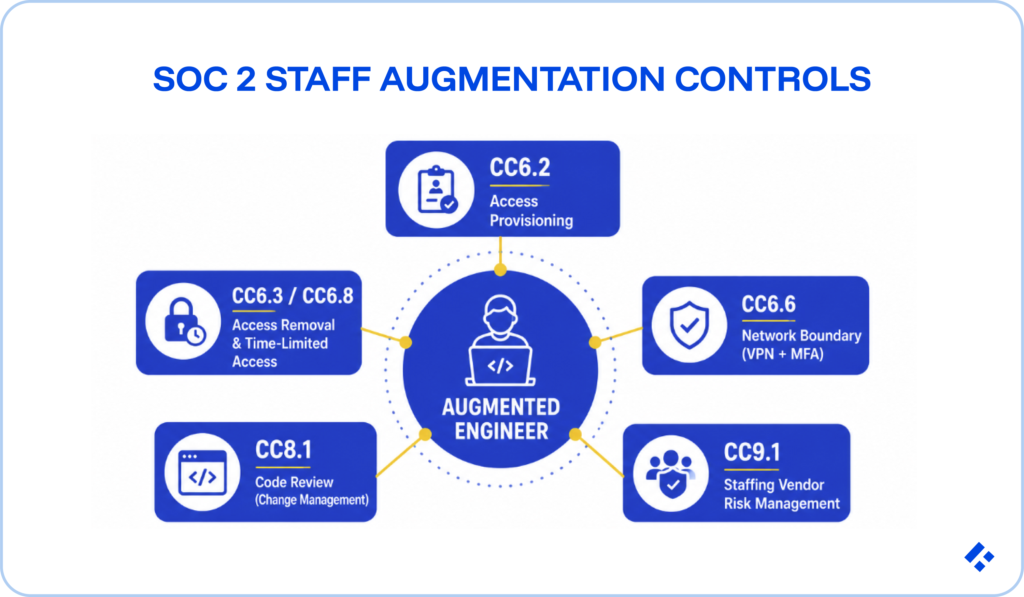
Let’s map the five Common Criteria clusters that govern staff augmentation to the specific evidence a SOC 2 auditor expects and the five controls a fintech must implement before the observation period begins.
At Trio, we have extensive experience augmenting staff for fintech companies and ensure that everything is ready for audits.
SOC 2 Type I reports describe whether controls exist and if they were suitably designed at a single point in time.
On the other hand, Type II reports evaluate whether those controls operated effectively across an observation period, typically 12 months.
For staff augmentation specifically, a Type I audit might confirm that your access provisioning process was documented and designed correctly.
A Type II audit examines whether that process ran correctly for every provisioning event during the observation window. It covers everything and everyone, including every augmented engineer whose access came online during that period.
This means that an augmented engineer who joined in month three but whose access was provisioned without the documented manager approval your policy requires produces an audit finding.
Controls governing augmented staff access need to be in place and consistently applied before the observation period opens to ensure the best results.
Five clusters of SOC 2 Common Criteria apply directly to the use of augmented engineering staff. Each maps to a specific control requirement and a specific category of audit evidence.
CC6.2 covers the registration and authorisation of new internal and external users before initial access is ever provisioned.
It covers "external users" explicitly, which includes contractors and augmented staff.
The best way to approach this is to ensure that provisioning follows a documented process: a formal access request, manager approval, role-appropriate access scoping, and a provisioning ticket that demonstrates the correct sequence: approval first, access after.
Auditors typically sample 10 to 25 provisioning tickets from the observation period population.
For each, they check for documented manager approval, proof that accounts came online after approval, access scoped to the engineer's actual role, and consistency across the full observation period, not just the months closest to the audit.
From what we have seen, ad hoc provisioning generates the most common CC6.2 finding for companies using augmented staff.
To prevent this issue, make sure that you implement procedures so that every augmented engineer provisioning event follows the same documented approval and ticketing process as an internal hire.
CC6.3 covers the other side of the coin, with the timely removal of access that's no longer needed. In other words, it is the offboarding control. CC6.8 requires that contractor and vendor access be time-limited, expiring automatically or reviewed on a fixed schedule.
Auditors look at things like whether contractor access carries an expiry date or a documented periodic review, whether access was revoked promptly when an engagement ended ( usually one business day), and whether any contractors still hold access to systems they don’t use.
Two patterns come up most often.
Usually, an issue stems from cases where a former augmented engineer's access wasn't revoked at engagement end, which represents ongoing, uncontrolled access to a payment system or data repository and carries real weight in a regulated fintech context.
The other common example we see is when contractor access was provisioned with no expiry or review cycle, meaning stale permissions can accumulate without any mechanism to surface them.
To prevent all of this, set time-limited access from the provisioning step. Expiry should be tied to the engagement end date or a 90-day review cycle when the end date stays open.
Offboarding also deserves as much documentation as onboarding. Include things like a revocation ticket and confirmation of revocation, and retain both of these as evidence.
According to Bastion's 2026 SOC 2 audit exception analysis, late offboarding ranks as the most frequently cited finding industry-wide.
CC6.6 covers access to system components within the compliance perimeter, requiring restriction and securing through network segmentation, VPN, and MFA at the boundary.
For augmented engineers accessing systems remotely, this governs the channel through which they connect.
Usually, we see auditors looking at whether remote access to in-scope systems (payment databases, KYC pipelines, cardholder data environments) routes through a VPN with MFA enforced.
We have also seen them examine whether network segmentation prevents an augmented engineer from reaching systems beyond their scoped role and whether access events appear in logs at the boundary.
A single instance of an augmented engineer accessing in-scope systems without VPN or MFA during the observation period produces a CC6.6 finding.
However, fintech teams running strong DevSecOps pipelines usually already have logging infrastructure in place. The more important thing in these cases becomes consistent treatment across internal and contract hires.
CC8.1 covers the change-management process, such as how changes to production systems get authorised, reviewed, tested, and deployed.
In a software engineering context, this means mandatory code review for all changes, branch protection rules preventing direct commits to main or production branches, documented approval in the pull request record, and a deployment pipeline that enforces the review gate.
When you’re being assessed, auditors will look at things like whether the change-management process applied to all code committed during the observation period, including code from augmented engineers.
A pull request merged without documented approval, or a commit pushed directly to main without branch protection, produces a finding.
To prevent issues when augmenting your staff, make sure that you enforce branch protection rules uniformly, with no direct commits to main, mandatory review before merge, and documented approval in the PR record.
This covers third-party vendor risk management, specifically the assessment and ongoing monitoring of vendors whose services sit inside the organisation's control environment.
A staffing partner placing engineers inside your fintech's compliance perimeter qualifies as a vendor in the SOC 2 sense.
This means that their practices, background checks, security training, device controls, and employment verification affect your control environment directly.
Examiners will consider if you assessed the staffing partner's own controls before engagement, if that risk assessment exists on file, and if the staffing partner's security obligations appear in the engagement agreement.
SOC 2 evidence is generated continuously during the observation period. For staff augmentation specifically, a fintech compliance team should be able to produce the following on request:
If your fintech is planning to use augmented staff, there are five controls that need to be in place before the SOC 2 Type II observation period opens to ensure nothing comes up throughout the entire timeline.
Building them partway through creates evidence gaps that can't be filled retroactively and may lead to a failed audit.
Trio's staff augmentation engagements are structured to support a fintech company's SOC 2 posture rather than create gaps in it.
We conduct thorough background checks before placement and make sure to provide any security-awareness training if required, covering data handling, access control, and incident reporting.
Trio also provides the documentation a fintech client needs for its CC9.1 vendor risk assessment.
All of this means you can rest easy knowing that your staff augmentation partner will help you meet SOC 2 requirements, not hinder your audits.