
Crypto wallets have come a long way since the early days of simple browser extensions and clunky seed phrases.
As Web3 applications expand, so does the demand for wallet infrastructure that’s flexible, secure, and invisible to the user.
That shift has led many teams to explore modular architecture for embedded wallets, a design approach that separates wallet functionality into independent, programmable parts.
At Trio, we’ve worked with developers building everything from DeFi dashboards to cross-chain payment systems, and one pattern keeps proving itself: modular wallets make embedded wallet adoption simpler, faster, and safer.
If you are interested in hiring fintech developers for your own modular architecture, we can assist through staff augmentation and outsourcing.
Still, it’s worth unpacking what “modular” really means and how this architecture changes the way crypto wallets fit into everyday products.
Understanding Modular Wallet Architecture
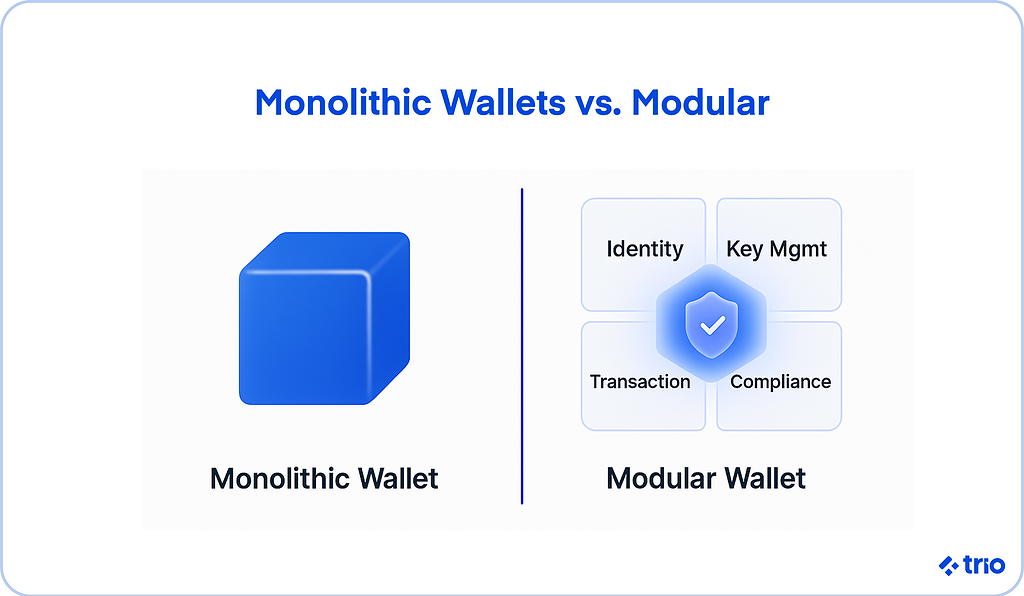
A modular wallet might sound abstract, but the idea is fairly intuitive. Instead of one large, tightly-coupled codebase, the wallet is built as a set of smaller components, key management, authentication, transaction signing, and compliance, that can be updated or replaced independently.
This modular structure offers flexibility that traditional, monolithic systems can’t match.
For instance, a developer could replace an outdated key management service with a modern MPC wallet library without rebuilding the entire app. It’s a bit like upgrading a car engine without touching the rest of the vehicle.
Monolithic vs. Modular Wallet Systems
A monolithic custodial wallet keeps everything bundled: identity verification, transaction logic, and data storage.
That might be fine for small-scale projects, but it becomes a bottleneck once millions of wallets or multiple blockchains are involved.
Modular wallets, on the other hand, separate those layers so each can scale at its own pace.
Why Modularity Matters for Developers
Developers often struggle with vendor lock-in.
A modular wallet framework limits that risk because each module can communicate through APIs or SDKs that follow open standards.
In our experience, this makes integrating new wallet providers or embedded wallet features far less painful and dramatically cuts onboarding time for new users.
Principles of Modular Architecture
If modularity is the “what,” then architecture is the “how.”
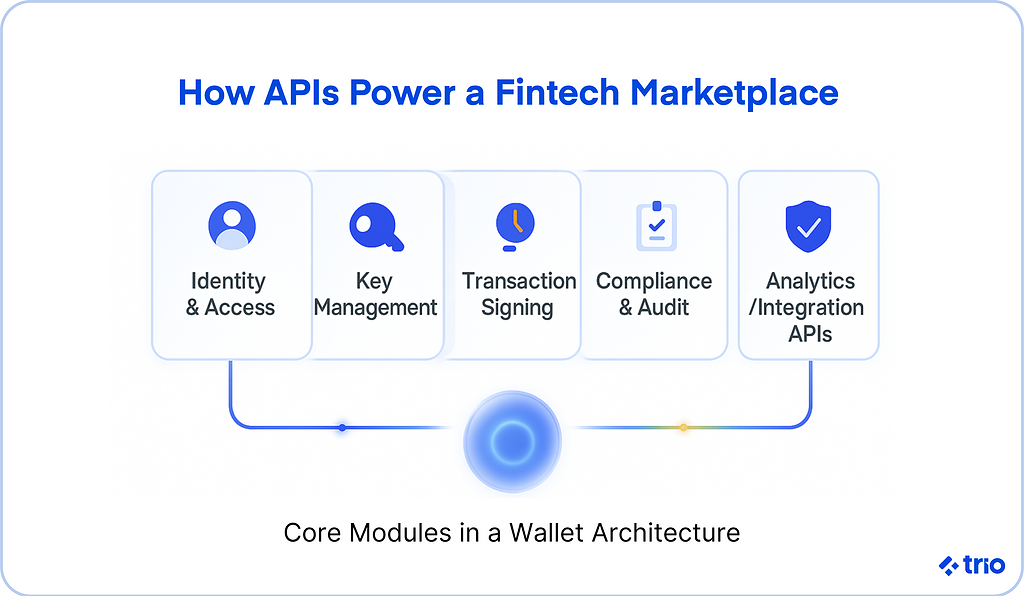
Modular wallet architecture usually revolves around decoupled services that handle identity, custody, and compliance independently.
Core Modules in Wallet Infrastructure
A strong modular architecture may include:
- Identity and access layers for social login or passkey-based authentication
- Distributed key systems using multi-party computation (MPC) or trusted execution for enhanced security
- Transaction signing microservices that support gas sponsorship and smart account logic
- Compliance modules that adapt to region-specific data privacy rules
Each of these modules can be deployed, audited, or replaced without affecting the rest of the wallet stack.
Design Flexibility and Performance
Separating modules also improves performance.
A developer can optimize signing latency on Solana while keeping Ethereum compliance logic untouched.
This separation of concerns reduces downtime, allows continuous delivery, and provides a smoother wallet experience for users across different blockchains.
What Makes an Embedded Wallet Different
An embedded wallet is exactly what it sounds like: a crypto wallet that’s built into another application.
It might handle digital assets within a game, manage NFT ownership in a social app, or process cryptocurrency payments on a DeFi platform.
Traditional custodial wallets take full control of user keys. Non-custodial wallets return that control, but often at the expense of UX.
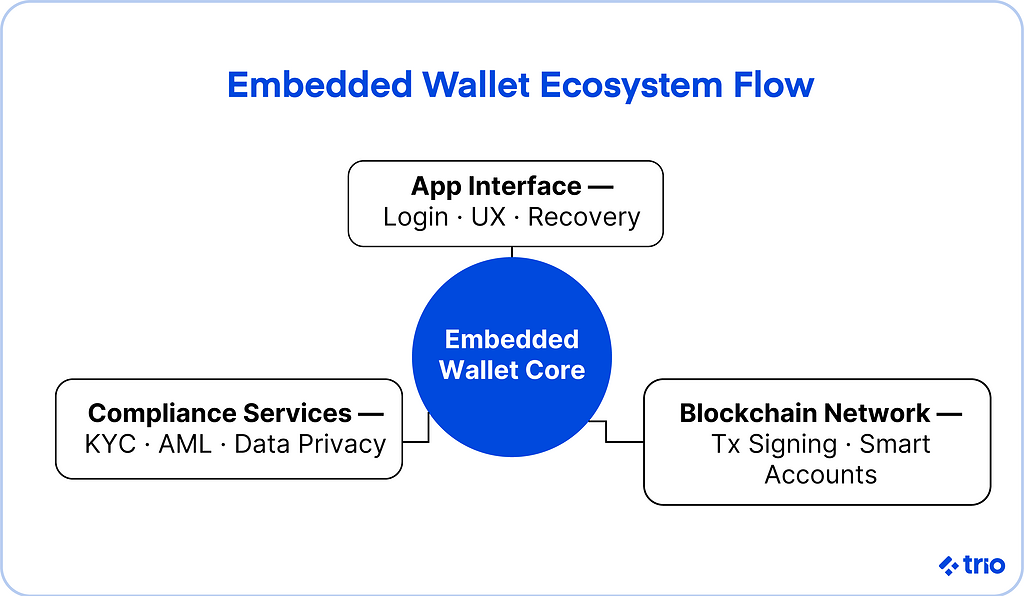
Embedded wallets live somewhere in between. They rely on programmable architecture to give users full control of their assets while hiding complexity like seed phrase management.
A Better Wallet Experience
For most users, creating a wallet shouldn’t feel like configuring a security system.
With account abstraction and smart account support, developers can design wallets that behave more like modern apps, offering social login, recovery through passkeys, and even gas sponsorship so transactions just work.
This approach reduces friction during wallet setup and encourages adoption in ecosystems where new users might otherwise give up before their first transaction.
Developer Experience and Integration Tools
Developers are the ones who feel the pain of wallet integration most directly. A modular architecture changes that dynamic.
Modern SDKs and APIs expose clean abstractions for wallet creation, key recovery, and authentication. With these, a team can integrate embedded wallets into an existing app in days instead of weeks.
At Trio, our developers often customize SDK layers for clients who want a mix of enterprise-grade compliance and lightweight UX.
A modular SDK also allows realistic sandbox testing.
Developers can simulate wallet access, test multi-chain transactions, and debug smart contract interactions before going live. That kind of flexibility is crucial when building in the constantly shifting world of crypto infrastructure.
When onboarding new users, embedded wallet solutions that support social login or passkeys can cut drop-off rates by half.
People want self-custody without the anxiety of losing keys; a modular design gives them that balance.
Integrating Embedded Wallets in Real-World Projects
Choosing among embedded wallet providers depends on your goals.
Fireblocks is popular with enterprises managing digital payments and custody, while Magic Labs focuses on easy onboarding, and Privy emphasizes privacy-preserving integrations.
The evaluation process often comes down to three things:
- Security model, MPC vs. TEE or hybrid systems
- Integration speed, SDK maturity, and documentation quality
- Scalability, how well the wallet architecture handles millions of users
When Trio helps teams integrate embedded wallets, we usually recommend a layered design:
- A front-end SDK that manages wallet creation and user sessions
- A back-end service coordinating MPC key shards or secure enclaves
- Optional APIs for analytics, compliance, and fraud monitoring
This modular pattern keeps systems programmable and reduces maintenance risk later on.
Security Architecture for Modular and Embedded Wallets
Security is always the most challenging aspect of wallet design. The security architecture of modular wallets centers on a shared responsibility among software, hardware, and distributed computation.
MPC and Distributed Key Management
Multi-party computation (MPC) splits a private key into several parts stored on different servers or devices.
No single system ever holds the complete key, which drastically lowers attack risk. MPC wallets also make key recovery easier when one component fails.
Trusted Execution and Hardware Protections
Some providers add hardware-level security using trusted execution environments (TEE), which isolate sensitive operations from the main system.
Combined with MPC, this creates a defense-in-depth model suitable for enterprise-grade use cases.
Reducing Risk at the API Layer
Developers still need to secure their APIs, things like rate limiting, encrypted transport, and constant audit logging.
Even with a modular design, human error in API permissions can expose critical data. It’s not glamorous work, but it’s the difference between a secure wallet and a compromised one.
As AI becomes more integrated, it’s likely we’ll see adaptive threat detection layered into MPC systems.
Our developers have already begun experimenting with that blend to enhance security and detect unusual signing behavior before it causes damage.
Use Cases and Ecosystem Applications
The use cases for modular and embedded wallets keep expanding across the blockchain ecosystem:
- DeFi platforms: Modular wallets simplify transaction signing, especially for complex smart contract wallets handling loans or swaps.
- NFT and gaming projects: Embedded wallets onboard players instantly, hiding blockchain friction entirely.
- FinTech and banking: Enterprises embed digital wallets into existing payment apps, giving customers access to tokenized assets.
- Custody-as-a-Service: Some businesses now license wallet infrastructure to power internal treasury operations.
Each implementation benefits from modularity because it lets teams tune for different levels of self-custody, compliance, or UX, without reinventing the wheel.
Challenges and the Road Ahead
Coordination between independent modules can create new debugging challenges. And because crypto regulation changes quickly, compliance modules often need constant updates.
The real balancing act lies between custody, UX (user experience), and compliance.
Modular architecture helps, but it doesn’t remove trade-offs.
Data sovereignty remains tricky, too. Some regions require that wallet data stay within borders. Modular design allows for regional deployments, though it adds operational complexity.
As embedded wallets mature, expect to see stronger cross-chain coordination, AI-assisted risk scoring, and better developer tooling.
The web3 wallet ecosystem is still young, but it’s evolving fast, and developers who embrace modularity now are likely to stay ahead of the curve.
Conclusion
The shift toward modular architecture for embedded wallets marks a turning point in how we think about crypto wallets and digital payments.
By separating wallet components into independent modules, developers gain flexibility, security, and control, without forcing users to manage seed phrases or external wallets.
If your team is exploring a wallet approach that prioritizes both user trust and developer agility, Trio’s fintech developers can help design and implement it.
From MPC integration to API optimization, our engineers know what it takes to build scalable, secure wallets for real-world products.
Get in touch!
FAQs
What is modular architecture for embedded wallets?
Modular architecture for embedded wallets means breaking wallet infrastructure into independent components so developers can update or integrate features like key management or account abstraction without rebuilding the whole system.
How does an embedded wallet differ from a custodial wallet?
An embedded wallet differs from a custodial wallet because users keep full control of their assets while enjoying a smoother in-app experience without external wallet setup.
Why are modular wallets important for developers?
Modular wallets are important for developers because they allow faster integration, easier testing, and greater flexibility when adapting to new blockchains or regulations.
What role does MPC play in embedded wallet security?
MPC plays a key role in embedded wallet security by splitting private keys into multiple parts, ensuring no single system has full control over a user’s crypto assets.