


 Read Client Stories





 Lace Brunsden
 Key Takeaways
- Vietnam sits 12 hours ahead of US Eastern in winter and 11 in summer, so two ordinary nine-to-five workdays overlap by exactly zero hours.
- Treat published headcounts as claims. FPT Software states around 33,000 staff, while its listed parent, FPT Corporation, reported 54,110 at the end of 2025, and the two figures are used interchangeably.
- Budgets run roughly $25 to $49 an hour for most Vietnamese agencies, under $25 at the high-volume end, and $50 or more from the globally branded firms.
- Vietnam slipped to 489 on EF's 2026 index, back under the 500 mark that separates moderate proficiency from low. Listening, at 440, is now its weakest skill. Written specs survive that gap. Live calls are where it shows.
- Price the engineering leadership separately, because a rate card answers who writes the code and says nothing about who decides what gets built.
Vietnam has become the default suggestion once a US company decides its next engineering hires will not be American.
Around 530,000 IT workers by the official count, rates well below US levels, and a government that treats software exports as national policy. Finding a vendor is not the hard part.
Working out which of them can deliver your particular project, and what you trade away in return for the rate, takes longer than most founders expect.
This list covers 10 firms, compared on the things that decide delivery: bench depth, who owns the technical thinking, and whether the contract sits with a Vietnamese entity or a Western one.
At Trio, we do not outsource to Vietnam. We build senior Latin American engineering teams that work inside US hours, which removes the time zone and language gap while keeping much of the cost advantage.
The 10 Firms at a Glance
Company | Founded | Stated size | Best for |
|---|---|---|---|
FPT Software | 1999 | 33,000+ | Enterprise programs |
TMA Solutions | 1997 | 4,000 | Telecom and embedded |
CMC Global | 2017 | 3,000+ | Cloud and managed services |
NashTech | 2000 in Vietnam | 2,000 to 3,000 | Regulated work |
KMS Technology | 2009 | 1,100 to 1,500 | Product engineering and QA |
Rikkeisoft | 2012 | 2,300 | Japan market and AI |
Axon Active | 2008 | 650 | Long-running agile teams |
Savvycom | 2009 | 700 | Fintech and healthcare |
Orient Software | 2005 | 300 to 400 | Australia and New Zealand hours |
Saigon Technology | 2012 | 400 | MVPs and SaaS builds |
The 10 Software Outsourcing Companies in Vietnam
1. FPT Software: Enterprise Scale, and the Headcount Caveat
Founded in 1999 in Hanoi, with around 33,000 staff now. Best for: multi-year enterprise programs.
FPT Software runs delivery centers in more than 30 countries and sells into enterprise IT much the way Infosys or Wipro do. Its own site has claimed over 33,000 employees and 1,100 clients, though independent workforce trackers put the subsidiary higher.
You also need to watch the headcount, since the 54,000 figure sometimes quoted belongs to FPT Corporation, the listed parent, which reported 54,110 staff at the end of 2025.
By July 2026, FPT was quoting 88,553 across its wider ecosystem of subsidiaries and affiliates. That makes four different numbers for one vendor, depending on which entity you count.
FPT is built for multi-year enterprise programs, so a six-person product squad is a small account there. Expect the junior end of the bench and slow escalation.
Teams buying one squad usually do better with a smaller firm.
2. TMA Solutions: Where Telecom and Embedded Work Goes
Founded in 1997 in Ho Chi Minh City, with about 4,000 engineers now. Best for: telecom, embedded and test automation.
One of the oldest firms in the market and the one that most often turns up at the cheap end of published rate tables.
Its strength sits in areas that take years to staff: telecom protocols, embedded work, large-scale test automation.
It's a less obvious fit if what you need is consumer product design.
3. CMC Global: Cloud Migration and Managed Services
Founded in 2017 in Hanoi, with about 3,000 engineers. Best for: cloud migration and managed services.
The outsourcing arm of CMC Corporation, a much older company, which is why sources disagree about the founding year.
This seems to be a solid option for AWS and Azure migration and ongoing managed services, and it also sits toward the bottom of published rate bands.
4. NashTech: Vietnamese Engineers, UK Contracting Entity
In Vietnam since 2000, London headquarters, with roughly 2,000 to 3,000 staff now. Best for: regulated work that needs an audit trail.
Delivery happens in Ho Chi Minh City, Hanoi, and Da Nang, but the contract sits with a UK company, which is usually the whole point for buyers who want recourse in a familiar jurisdiction.
Just keep in mind that talent is priced accordingly: one 2026 comparison puts NashTech at $50 to $99 an hour, while most local firms sit between $25 and $49.
5. KMS Technology: Product Engineering and QA Discipline
Founded in 2009, with operations in the US and Vietnam, and roughly 1,100 to 1,500 people. Best for: software companies shipping their own product.
KMS grew out of testing work and still shows it, which suits companies whose real problem is release quality rather than raw capacity.
Having a US entity makes contracting simpler. Headcount claims range from about 1,100 to 1,500 depending on who is counting.
6. Rikkeisoft: Strongest When Your Roadmap Runs Through Japan
Founded in 2012 in Hanoi, with about 2,300 staff now. Best for: Japan-market delivery and AI work.
Most of its delivery history points at Japanese clients, and its processes reflect that.
The US practice is newer, so ask for US references specifically rather than accepting a company-wide client list.
7. Axon Active: Swiss Ownership, Long-Running Teams
Founded in 2008 in Ho Chi Minh City, with about 650 engineers on their team these days. Best for: multi-year embedded agile teams.
Swiss-owned and built around teams that stay with one client for years rather than project work.
That shows up in the contract, which reads more European than Vietnamese. Since the firm itself is quite small, you will need to keep in mind that they have limited capacity.
8. Savvycom: Fintech and Healthcare Build Teams
Founded in 2009 in Hanoi, with around 700 staff today. Best for: regulated consumer products.
Concentrates on fintech and healthcare builds, with the compliance vocabulary that implies.
It's probably worth a look if your product touches payments or patient data and you cannot absorb the risk of generic talent or the time and resources it takes to familiarize them with compliance requirements.
9. Orient Software: Full-Cycle Delivery, Strongest on Asia-Pacific Hours
Founded in 2005, Ho Chi Minh City, 300 to 400 staff. Best for: Australian and New Zealand buyers.
Twenty years of delivery into Australia and New Zealand, where the time difference runs three to four hours rather than twelve.
US buyers get the same team on a far worse clock. One comparison puts its minimum project size at around $50,000.
10. Saigon Technology: The One That Publishes Its Rates
Founded in 2012, Ho Chi Minh City, about 400 staff. Best for: MVPs and SaaS builds.
This firm actually publishes a rate range of about $22 to $46 an hour on its outsourcing page.
It is ISO 9001 and 27001 certified, agile-first, and aimed at smaller builds than the enterprise names above.
The published band still excludes most of what decides your final bill, so treat it as a starting point rather than a quote.
What Does It Cost to Outsource Software Development to Vietnam?
Prices can differ drastically, but it is important to note that at least some of this variance can be attributed to how vendors price against each other rather than what you will end up paying.
Most Vietnamese agencies charge $25 to $49 an hour for mid-level and senior engineers.
High-volume firms such as TMA Solutions and CMC Global come in under $25, which usually reflects scale and junior-heavy staffing rather than a bargain.
Globally branded vendors like NashTech run $50 to $99, where part of what you buy is the contracting entity.
Dedicated teams quoted monthly land around $4,200 to $5,500 per developer, tooling and support included.
Three numbers get blurred together in most proposals, and separating them early saves an argument later.
A developer's salary is what the engineer takes home.
The vendor fee is what you pay, usually a multiple of that salary once bench time, management, and margin go in.
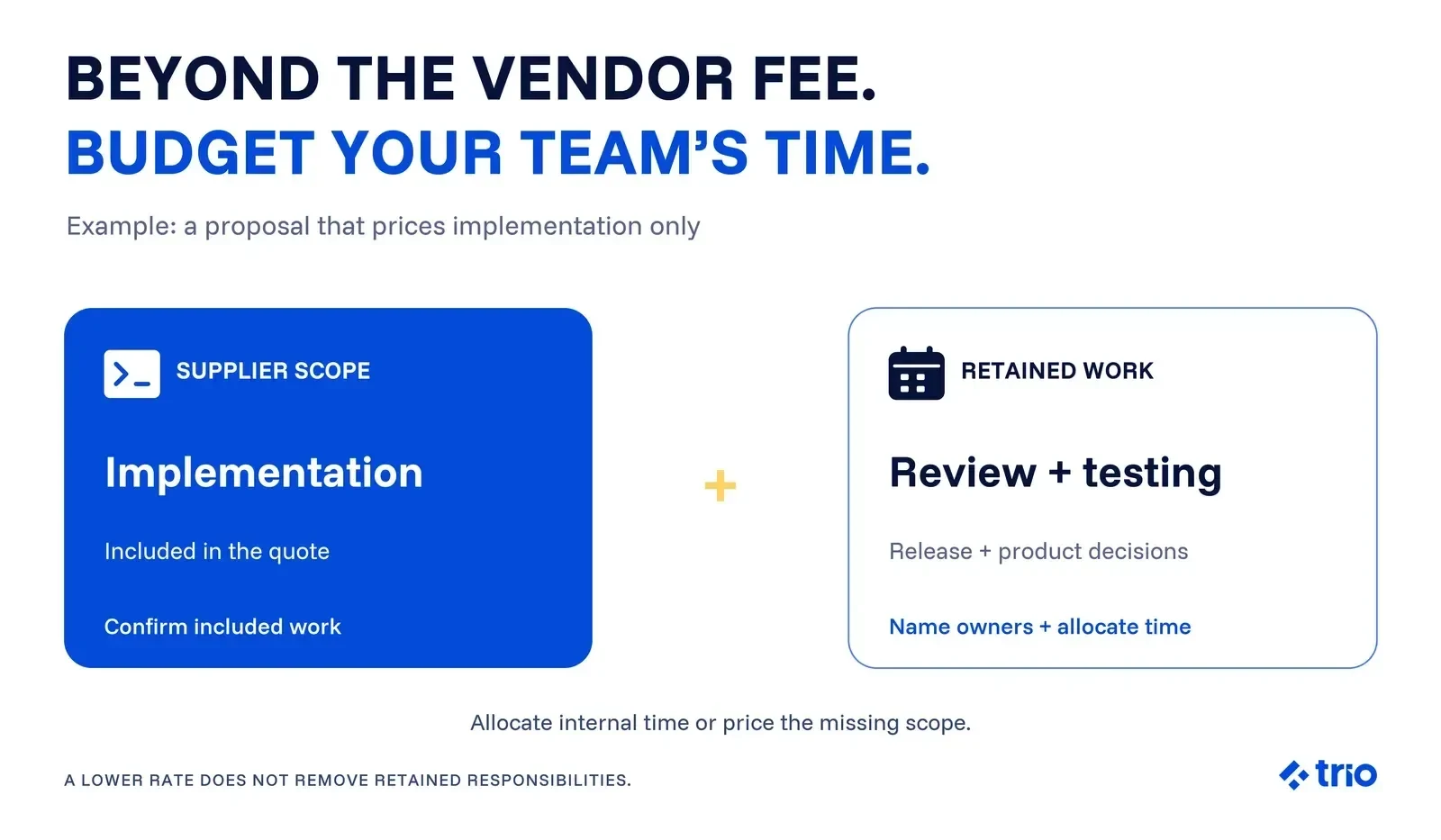
Your total delivery cost adds whatever the contract leaves on your side: technical review, QA, release engineering, product decisions.
If a proposal excludes technical review and testing, those hours have not vanished. They have moved onto your own team's calendar.
How Many Hours Will You Actually Share With a Vietnamese Team?
Vietnam runs on UTC+7 all year and does not observe daylight saving time.
US Eastern sits at UTC-5 in winter and UTC-4 in summer, which puts Vietnam 12 hours ahead of Eastern Standard Time and 11 hours ahead of Eastern Daylight Time.
This can be an advantage if you are based in Europe or Australia. For a US buyer, the same number works out rather differently.
Assume both teams keep ordinary 09:00 to 17:00 days. The Vietnamese workday then runs 21:00 to 05:00 Eastern Standard Time, or 22:00 to 06:00 under Eastern Daylight Time. Two unshifted workdays share no hours at all.
Vendors often attempt to solve this with shifts, and most of the larger firms will offer one.
Ask which named engineers take the early start, how long they have held it, and whether your product owner sits in the same window.
A shift covering two hours of your morning changes the arithmetic. A promise that the team is flexible does not do much.
What this costs you depends on the work. A groomed backlog and written specs travel overnight perfectly well, and plenty of teams ship that way for years.
Unresolved product questions do not. Each one waits a day for its answer, and a bad week turns a two-day decision into a fortnight.
You also need to keep in mind that, in industries like fintech, certain events need to be addressed within time limits specified by local regulatory bodies.
Ask how a question reaches the person who can settle it, and who picks up a release that needs attention outside the shared window.
Which Engagement Model Fits the Leadership You Already Have?
Three models cover most hiring offerings. They differ mainly in who owns the thinking, not who writes the code.
Staff augmentation puts vendor engineers on your backlog, following your code review rules. You supply direction, estimates, and acceptance. Cheapest per head, and the model that fails hardest when the lead who was meant to direct them leaves.
A dedicated team means the vendor employs and runs a standing squad while you own the backlog and set priorities. Ask whether a project manager or business analyst sits inside the quoted rate or costs extra, because vendors describe this differently and the gap usually amounts to a full salary.
Fixed price fixes the scope up front and handles additions through a change request, which suits work you can specify tightly and rules out most early product discovery.
Price the leadership explicitly, whichever you choose.
Adding engineers never answers who makes and reviews technical decisions. Buy staff augmentation with no lead to direct it, and you have bought a second problem, not a solution.
How Do You Check a Vietnamese Vendor Before Signing?
There are a couple of points you need to work through with any vendor that reaches your shortlist. Each item asks for evidence rather than reassurance.
Name the actual team: Ask for roles, seniority, allocation, and the city each person is based in, then put your own engineer on a call with them. A vendor that will only present an account manager has told you something.
Test English with the engineers: Vietnam scores 489 on EF's 2026 index against a 485 global average, and its weakest skill is listening, at 440. Written specs travel fine. A fast three-way call is where the gap surfaces.
Ask for attrition on your account: A tidy corporate figure can hide one team that turned over twice in a year.
Get the shift in writing: including which named engineers work which hours, under both US seasonal offsets, and who answers a production page at 03:00 Eastern.
Separate the rate from the bill: Ask what the hourly figure covers: management, QA, release work, holidays, and whether the 13th-month bonus Vietnamese employers pay gets passed through to you.
Settle ownership from the first commit: Repository, cloud accounts, CI, IP assignment, and what lands in your hands on exit.
Check that certifications apply to your delivery unit: An ISO 27001 certificate held by a parent company says nothing about the eight people building your product.
Ask which data protection regime the vendor works under: Vietnam replaced Decree 13/2023 on 1 January 2026 with the Personal Data Protection Law, 91/2025/QH15, and Decree 356/2025/ND-CP, which tightened impact assessments and cross-border transfer rules.
When Does Vietnam Turn Out to Be the Wrong Answer?
Plenty of US companies should not outsource to Vietnam. It is the wrong choice if:
Your product needs daily live collaboration: Design reviews, pair debugging, and fast pivots all degrade when the only overlap window sits in somebody's evening.
You have no engineering leadership to spare: Offshore teams amplify whatever direction they get, including none.
The work runs small or short: A three-month, one-developer engagement rarely repays the vetting, onboarding, and contracting overhead.
You need regulated US data handling with onshore staff: Some HIPAA, ITAR, and federal arrangements rule out offshore delivery before cost enters the conversation.
You are buying on rate alone: The gap between $22 and $46 an hour vanishes the first time a feature gets built twice.
Vietnam or Nearshore: Which Fits a US Product Team?
Vietnam competes on two things: price and depth of bench.
For a large, well-specified program that brings its own delivery management, a 4,000-engineer vendor in Ho Chi Minh City remains hard to beat on cost per competent engineer.
What it cannot offer a US team is a shared working day.
That reflects geography rather than any vendor failing, and no amount of goodwill moves Hanoi closer to Chicago.
Latin America trades some of the cost advantage for overlap. Teams in Brazil, Colombia, or Argentina run within one to three hours of US Eastern, so standups, code review, and incident response all land inside normal hours on both sides.
Trio builds teams that way, which may be worth a look if the time zone math of Vietnam doesn't work for you.
We build senior Latin American engineering teams that work your hours, and we will tell you plainly when one of the Vietnamese firms above is the better fit for what you are building.
Request a consult.