
Companies often confuse product engineers with software engineers. But the reality is that, while there may be some overlap in skillset, they have very different roles, and can approach the same problems in very different ways.
A software engineer, who owns the technical side of the product, may open the codebase and start tracing the bug through API calls and database queries.
A product engineer, who owns the product as a whole, may open the analytics dashboard, check where users are dropping off, and wonder whether the bug even matters compared to the confusing UI three steps earlier.
Both product engineers and software engineers write code and ship features, but they are worried about different metrics and optimize their workflows accordingly.
We have both options here at Trio, which specialize in fintech, and can help you determine which might be the right one to fit your needs.
Key Takeaways
- Product engineers own product outcomes while software engineers own code quality.
- Both roles write code, but product engineers prioritize user impact while software engineers prioritize the technical side of your product.
- Customer empathy and product roadmap ownership define the product engineer role.
- System design, scalable architecture, and engineering best practices define the software engineer role.
- Product engineering is a good option for small fintechs validating product-market fit. Software engineering scales for technically complex platforms.
- Many successful teams benefit from both, with each discipline reinforcing the other at different stages of the product lifecycle.
Product Engineer vs Software Engineer: Core Differences
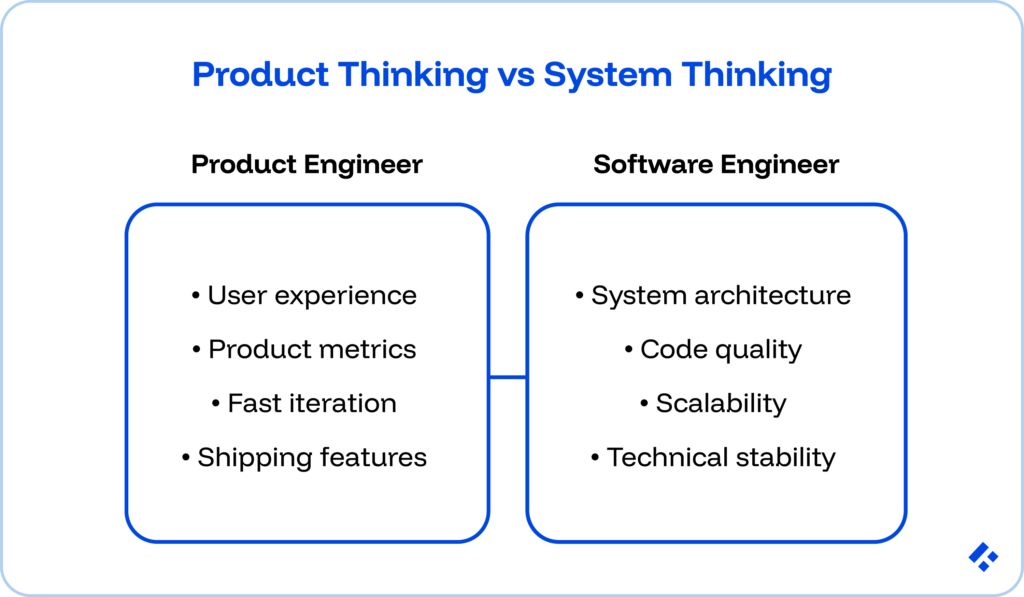
There are many small differences in their roles, but the simplest framing is that a software engineer owns the code, and a product engineer owns the product.
At first glance, that can feel like a very small distinction, but it shapes nearly every tradeoff they make.
A product engineer takes a holistic view of the product, weighing user experience, business deadlines, the product roadmap, and sometimes even investor expectations alongside the technical implementation.
To be able to do their jobs well, they often work across the full stack, with a natural lean toward frontend work where users directly feel the results of their decisions.
A software engineer focuses deeper on technical precision. They are the ones who focus on systems, performance optimization, scalable architecture, design patterns, and secure code.
The goal isn’t just a working feature but a well-architected, maintainable codebase that holds up under pressure and allows you to scale easily going forward.
One isn’t necessarily better than the other, so you need to think about the trade-offs you are willing to make.
You can either ship something imperfect to test with users now, or take longer to build it right. Software engineers tend to lean toward building it right. Product engineers tend to lean toward shipping and iterating.
| Aspect | Product Engineer | Software Engineer |
| Primary goal | Build products that users value | Build reliable, scalable software systems |
| Scope | Full product lifecycle | Coding, testing, and maintenance of software systems |
| Approach | Iterative, user-centered, pragmatic | Systematic, best-practice-driven, specialized |
| Decision-making | Owns product decisions | Defers to the product manager for direction |
| Pacing | Fast, scrappy, willing to rebuild | Deliberate, optimized for stability |
| Best fit | Startups, early-stage, B2B SaaS | Complex platforms, infrastructure, and enterprise |
When it comes to the fintech industry, we usually recommend a mix of both. But neither choice is the correct one if you are looking at someone who doesn’t have real-world fintech experience.
Related Reading: The Fastest Way to Hire Engineers for Fintech
What a Product Engineer Actually Does
Now that you have a basic understanding of the two different roles, let’s dive deeper into the responsibilities of each.
Owns the product
The one characteristic that sets a product engineer apart is ownership.
They don’t build features from a spec handed down by a product manager. They decide which features deserve to be built in the first place.
That means that they have to do tasks that you wouldn’t typically expect from an engineer, like talking to customers, digging into usage data, researching competitors, and using that knowledge to shape a product roadmap they genuinely own.
Linear, the project management tool, operates almost entirely with product engineers rather than dedicated product managers.
When you have someone with technical knowledge talking directly to users, product decisions happen faster because there’s no need to negotiate what’s technically feasible.
Prioritizes shipping and iterating
Product engineers prioritize getting something real in front of users quickly.
They build prototypes and run experiments.
This pragmatic approach means they’ll rebuild from scratch if something doesn’t work, rather than spending time perfecting an implementation that may not solve the right problem.
With AI coding tools now widely available, product engineers can move features from zero to one faster than before, handling more of the implementation themselves without getting bogged down by repetitive code.
The result is faster iteration cycles and tighter feedback loops with users. With fintech experience, they also understand which corners they can cut and which they can’t.
Leans toward frontend and full-stack work
Product engineering also tends to concentrate on frontend and full-stack development. That’s where user experience lives, and it’s where a product engineer’s attention naturally goes. Decisions about UI and the flow of a digital product matter as much to them as the underlying logic that powers it.
This doesn’t mean product engineers avoid backend work entirely, though.
They do write backend code when needed, which means that they need a good understanding of what backend development requires.
But the overall orientation, what they care most about, usually starts with the user-facing experience rather than the systems underneath it.
What a Software Engineer Actually Does
In many ways, you can think of a software engineer as the product engineer’s long-term support.
Owns the code and the technical standard
Software engineers maintain a more idealistic approach to their work.
They try to create the best solution to a technical problem rather than the fastest one. Usually, speed and quality are also influenced by them, applying established engineering principles consistently, and building on prior work using well-understood patterns.
Their goal extends to security and maintainability in your codebase.
This makes software engineers particularly valuable for technically complex products like those that handle financial transactions at scale, process sensitive personal data, or serve large enterprises.
Focuses on system design and scalability
A significant portion of a software engineer’s time goes to work that rarely shows up in a product demo: system design, performance optimization, backend architecture, database reliability, and the maintenance of software systems that already exist.
This is the developer responsible for what happens when 50,000 users hit the system at once, or when a new regulatory requirement changes how data gets stored and audited.
Their work happens largely in the background of the user experience, but it’s what keeps the product from falling apart as it grows.
Collaborates in specialized cross-functional teams
Software development projects tend to move at a more deliberate pace than product engineering work, partly because they require more cross-functional coordination.
A software engineering team might include a frontend engineer, a backend engineer, a QA engineer, a designer, and a product manager.
Each person contributes a specialized skill set, and coordinating that work introduces overhead that product engineering teams tend to avoid by keeping responsibilities broader.
Related Reading: How to Build a Software Development Team
How Each Role Spends Its Time
Time distribution tells the story more clearly than a job title ever could.
A product engineer spends time on:
- Talking to customers and analyzing usage data from the product dashboard.
- Building prototypes and running experiments to validate ideas quickly.
- Researching competitors and understanding the broader market context.
- Defining, owning, and communicating a product roadmap.
- Gathering feedback from users and presenting findings to the broader team.
A software engineer spends time on:
- Designing and reviewing system architecture and design patterns.
- Testing, debugging, and maintaining software systems at depth.
- Optimizing performance and ensuring the codebase can scale.
- Writing secure code and managing access controls and system reliability.
- Collaborating with architects, QA, and other specialists on technically complex problems.
Skill Sets: What Each Role Requires
Of course, being able to code is a baseline requirement for either role. You should always be looking for someone familiar with the technologies you want to use. But there are some other skills you need to think about when trying to hire someone for either of these positions.
Product engineer skill sets
Product engineers need strong product thinking. They should understand user experience principles, feel comfortable making product decisions with incomplete information, and know how to read usage data to guide their choices.
Communication matters too, since product engineers regularly interact with customers, stakeholders, and the broader business.
The ability to iterate quickly, prioritize ruthlessly across a roadmap, and maintain a holistic view of the product is often what separates a strong product engineer from a technically skilled developer who struggles in the role.
Software engineer skill sets
Software engineers need deep technical expertise in their chosen domain.
Whether that involves backend systems, frontend frameworks, data pipelines, cloud infrastructure, or security, the expectation is specialized knowledge and the ability to apply engineering principles rigorously rather than just get something working.
Problem-solving at the architecture level, rather than just at the feature level, is a core part of the job.
Software engineers think about how today’s decisions affect the codebase a year from now, which requires both technical depth and discipline.
When to Hire a Product Engineer vs. a Software Engineer
The best choice is going to depend on what your company needs right now.
Product engineers tend to make the most sense when:
- A startup needs to validate product-market fit quickly and can’t afford long development cycles.
- A team wants to ship digital products and iterate based on real user feedback rather than assumptions.
- The development lifecycle needs to stay lean, and the team is small enough that broad ownership makes sense.
- A company needs people who own outcomes, not just tasks, and can navigate cross-functional teams independently.
Software engineers tend to make more sense when:
- A product needs specialization to scale and maintain at an enterprise level.
- The platform handles technically complex requirements like financial data processing, real-time transactions, or high-volume APIs.
- A team needs to build secure code or infrastructure that supports the product reliably for years.
- Requirements demand deep technical depth in specific areas rather than product breadth across the full stack.
Product Engineering and Software Engineering: Why Both Matter
The strongest product teams in the fintech industry tend to blend both disciplines rather than treating them as separate tracks.
Product engineering brings the user-first mindset and the speed to ship. Software engineering brings the technical depth and the architecture that makes scaling possible without everything breaking or inviting fines from failed regulatory audits.
We see this a lot in agile development models, where cross-functional teams include product engineers close to users alongside software engineers focused on the systems supporting them.
Common Tools Across Both Disciplines
Some tooling appears across both product engineering and software engineering roles. Others tend to be role-specific. Here is a very brief look at the tools most product engineers and software engineers are familiar with.
| Category | Product Engineering | Software Engineering |
| Project Management | Jira, Trello, ClickUp | Jira, Asana |
| Design | Figma, Adobe XD | Figma (handoff) |
| Code Repos | GitHub, GitLab | GitHub, Bitbucket |
| Testing | BrowserStack, Postman | Selenium, JUnit |
| DevOps and CI/CD | Jenkins, CircleCI | Docker, Kubernetes |
| Monitoring | Mixpanel, Google Analytics | Datadog, New Relic |
Conclusion
If your team is early-stage, then the product engineer’s ability to own outcomes across the full product lifecycle, rather than just execute on a defined spec, tends to accelerate early product development substantially.
If your team has found product-market fit and needs to scale, harden security, reduce technical debt, or support enterprise requirements, the balance likely shifts toward software engineering.
In practice, a lot of teams need both in order to function effectively. If you need developers in a variety of positions, with guaranteed fintech experience, book a discovery call.
Frequently Asked Questions
Is a product engineer the same as a software engineer?
A product engineer is not the same as a software engineer. Both of them are coders, but a product engineer owns product outcomes and user impact, while a software engineer prioritizes technical precision and code quality.
Do product engineers need to know how to code?
Product engineers need to know how to code. They need to be able to communicate viability with users and ship new features rapidly.
When should a startup hire a product engineer vs a software engineer?
If you have a small startup, you should probably hire a product engineer first, since the priority is validating ideas quickly and staying close to users. As the product matures, a software engineer is a great way to ensure success.
Are product engineers more common at startups or large companies?
Product engineers appear in both startups and large companies, but they are seen most often at startups and growth-stage companies that need to move fast and stay close to users.
Is product engineering less effective for companies with large, technically complex products?
Product engineering is generally considered less effective for companies with large, technically complex products such as infrastructure platforms or enterprise systems at scale. These environments tend to require specialization and careful architecture that ensures scalability and regulatory compliance.