

Toptal gets mentioned in a lot of hiring conversations. It has a strong brand, a well-known vetting process that allows it to claim only the top 3% of developers.
If you need to add senior engineering capacity to a fintech product, it’s probably come up at least once.
But brand name alone doesn’t tell you which option will actually solve your problem, especially when it comes to an industry as niche as fintech.
Toptal and Trio serve different kinds of buyers, with different risk tolerances, different budget expectations, and very different definitions of what support looks like after a match gets made.
Let’s put them head-to-head, Trio vs Toptal, and identify which platform actually works for fintech engineering teams, and which will be best for your project.
For further assistance in figuring out what the right option is for you, book a decision call.
Key Takeaways
- Toptal operates as a broad freelance marketplace with global reach; Trio functions as a dedicated fintech staffing partner with nearshore LATAM engineers.
- For companies hiring in payments, lending, banking, or compliance-heavy environments, Trio’s domain-specific vetting appears to reduce ramp time significantly.
- Toptal’s rates typically run $100 to $200+ per hour with a platform markup; Trio’s transparent range sits between $40 and $90 per hour.
- Both platforms offer some form of trial or replacement, but the structures differ in ways that matter depending on your risk tolerance.
- If your stack includes niche frameworks outside of the fintech industry, Toptal’s larger talent pool may be a better fit.
Quick-Glance Comparison
| Toptal | Trio | |
| Model | Freelance marketplace | Dedicated staffing partner |
| Talent Focus | Generalist (all industries) | Fintech-specific |
| Geography | Global | LATAM / Brazil-forward |
| Time to First Candidate | 1 to 2 weeks | 3 to 5 days |
| Pricing Range | $60 to $100+/hr + platform fee | $40 to $90/hr, no hidden markup |
| Replacement Guarantee | 2-week trial period | Ongoing replacement policy |
| Onboarding Support | Minimal (self-managed) | Assistance Available |
| Stack Coverage | Very broad | Fintech-specific |
| Domain Expertise | General seniority | Fintech domain fluency |
Toptal Overview: What the Platform Brings to the Table
Founded in 2010, Toptal built its reputation on a rigorous multi-stage screening process that claims to accept only the top 3% of applicants.
The platform covers developers, designers, finance professionals, and product managers, which gives it broad appeal across industries and team types.
Their vetting process runs through four stages: an English and communication screen, a problem-solving assessment, a technical interview, and a live test project.
For general engineering seniority, that bar holds up reasonably well.
The model works like a traditional freelance marketplace. You describe your needs, Toptal matches you with available candidates, you decide if you want to proceed, and then the freelancer integrates into your team on a contract basis.
Like many other freelance marketplaces, that’s where their job ends. Ongoing management stays on your end.
Pricing sits at $79/month for platform access, with developer hourly rates ranging from roughly $60 to $100 or more, depending on seniority and skill set. You also need to pay a deposit when you decide to hire a developer.
Where Toptal clearly excels is in the incredible variety of skillsets that it has, all in one place.
If you need a designer, a fractional CFO, a UX strategist, or a developer working in a framework outside the mainstream, Toptal’s global talent pool likely has someone. That breadth is real, and for teams with diverse or unusual requirements, it may justify the premium.
Related Reading: Top 8 Toptal Alternatives for Hiring Developers.
Trio Overview: What the Platform Does Differently
Trio focuses exclusively on fintech, making a great, niche-specific Toptal alternative.
Every engineer on the platform has some sort of real-world background in financial systems, whether that’s payments infrastructure, lending platforms, banking APIs, or compliance-adjacent work.
Trio’s vetting process screens for domain fluency alongside technical ability, which means candidates already understand what KYC, AML, SOC 2, and PCI DSS actually require in practice.
The sourcing runs primarily through Latin America, with a strong concentration in Brazil.
That geographic focus means you get access to engineers who overlap with the US Eastern and Central time zones. You don’t struggle with 8 to 12-hour gaps that make asynchronous collaboration painful.
Beyond the match itself, Trio stays involved as a reliable technology partner.
Clients get a delivery framework that includes overlap hour expectations, sprint rituals, async communication norms, an escalation path, and a replacement policy that doesn’t expire after two weeks.
For engineering managers who don’t want to rebuild their management layer from scratch every time a new contractor joins, that structure matters.
Pricing runs $40 to $90 per hour with no platform subscription fee and no hidden markup.
The tradeoff is narrower stack coverage: Trio has a wide range of developers with a large knowledge base in terms of tech stack, but Trio is a smaller company.
Vetting Process Comparison:
Both platforms use the word ‘vetted,’ but the screening they describe solves different problems.
Toptal’s process filters for engineering seniority in a general sense.
A developer who clears is definitely a good developer. They need to go through several weeks of assessment to clear Toptal’s high bar. In that process, they will have demonstrated strong algorithmic thinking, code quality, and communication ability.
What the process doesn’t assess is whether they are up to date with the latest requirements of the financial environment.
They also do not assess very specific skills that can be considered subcategories under fintech, like whether they understand how payment rails behave under load, or know what a compliance team will ask them in their first week.
Trio’s screening adds a domain layer. Candidates who clear the process have demonstrated not just technical competence but practical fintech experience, with work on real-world products and actual regulatory scrutiny.
This differentiation is critical for getting skilled developers who can contribute from day one.
A fintech engineer who has worked on a lending origination system, for example, likely doesn’t have the same skills as someone who worked on digital wallets.
That gap appears to close quickly for some candidates and slowly for others, but it adds real onboarding friction that rarely shows up in hiring conversations.
Speed to Hire: Time to First Candidate and Ramp Time
Toptal typically delivers a candidate match within one to two weeks.
For teams evaluating multiple platforms simultaneously, that timeline feels reasonable. The onboarding process after the match, though, falls entirely on the client.
Trio targets three to five days to a first candidate, with an onboarding plan included that helps you cover practical details like who attends standups, how tickets get assigned, what escalation looks like, and when the relationship gets reviewed.
Neither of those numbers means much if the fit is wrong.
But for fintech teams dealing with a slipping roadmap or an upcoming deadline, the difference between five days and two weeks can represent a meaningful delivery risk.
Time zone alignment adds to this: LATAM engineers working in overlapping hours tend to get unblocked faster than someone operating on a different continent’s schedule.
Pricing Comparison:
Toptal’s cost structure deserves more scrutiny than it usually gets. The $79 monthly access fee appears small, but the real number comes from the developer rates, which start around $60/hr for mid-level talent and climb quickly.
Toptal adds a platform markup on top of the rate the freelancer receives, meaning the gap between what you pay and what the developer earns can be substantial.
Trio’s pricing sits between $40 and $90 per hour with no subscription, no access fee, and no markup obscuring the actual number.
For a team adding two or three engineers simultaneously, that difference can compound over a couple of months.
That said, ROI comparisons only hold up if the quality delivers comparable output. If Toptal’s pool surfaces a genuinely better fit for a specific technical problem, paying more may make sense.
Fintech Domain Fit:
In most cases, choosing the right platform means seeing engineering talent as interchangeable, given equivalent seniority. In fintech, that does not work.
Regulated financial products carry specific constraints that shape how engineers need to think.
Data handling around personally identifiable financial information, transaction idempotency, audit logging, environment separation between development and production, least-privilege access models, and incident escalation pathways all require either prior experience or a real learning curve.
As we have already mentioned, there are also differences between different types of fintech products.
A strong generalist developer can absolutely learn these things, but the timeline for that learning doesn’t always align with your delivery schedule.
Toptal’s engineers come from diverse industry backgrounds.
Some have fintech experience; many won’t.
The likelihood of a fintech-ready match depends heavily on what’s available in the talent pool at the time you’re hiring.
Trio’s domain focus attempts to address this by design.
Whether it fully closes the gap in practice varies by candidate and project type, but the intentionality behind the vetting process appears to produce faster time-to-contribution for fintech-specific work.
Delivery Support: Ongoing Partnership vs. Self-Managed
This may be where the two platforms diverge most in day-to-day experience.
Once Toptal delivers a match, the relationship effectively transfers to you.
Disputes, performance concerns, communication breakdowns, or scope confusion become your problems to manage.
For teams with strong engineering leadership and experience managing contractors, that’s manageable.
For teams that are lean, fast-moving, or led by founders who need to focus elsewhere, the self-managed model adds overhead.
Trio’s engagement models keep the platform involved throughout. If there are any issues, we help you address them. If you want to scale your team up and down to accommodate later changes, we can help.
Replacement doesn’t require starting the process over from scratch, either.
Having a fintech development work with you to find placements, personally, means that they can better understand the issues that you run into and adjust going forward.
Risk and Guarantees: Replacement Policies and Exit Terms
Toptal offers a no-risk two-week trial.
If you’re not satisfied within that window, you don’t pay. That’s a meaningful commitment, but it sets a short clock on a process that sometimes needs more than two weeks to reveal genuine fit or capability gaps.
Trio’s replacement guarantee runs beyond the initial trial period.
If a placed engineer isn’t working out, the replacement process activates without requiring you to restart sourcing from zero.
Neither guarantee eliminates risk entirely. But the structure of ongoing replacement protection may reduce the downside exposure on longer engagements.
When to Choose Toptal:
There are real scenarios where Toptal fits better.
Trio is a smaller company with fewer developers. If your tech stack relies heavily on frameworks or languages outside Trio’s core network, Toptal’s global reach likely gives you more options.
The same goes for teams that need designers, product managers, finance specialists, or anything else alongside developers. Toptal’s cross-functional coverage works well for those situations.
If your organization requires US-based contractors specifically, or if offshore/nearshore models face internal policy resistance, Toptal’s global pool can source closer to US geography when needed.
When to Choose Trio:
For fintech teams scaling through a product milestone or approaching a funding event, the combination of domain-vetted talent, faster time to candidate, and rapid onboarding is incredibly attractive.
An engineer who arrives already knowing what an API integration with Stripe and Plaid doesn’t need three weeks of onboarding before contributing to a sprint.
Teams that have struggled with offshore or nearshore in the past often point to the same pain points: timezone gaps that make daily communication difficult and cause delays.
Trio’s LATAM focus addresses the timezone problem directly, and the security onboarding process covers access controls, environment separation, and incident escalation in a documented way.
Related Reading: Outsource Fintech Software Development vs In-House.
Conclusion
Both Toptal and Trio are great staffing options, but they’re not solving the same problem.
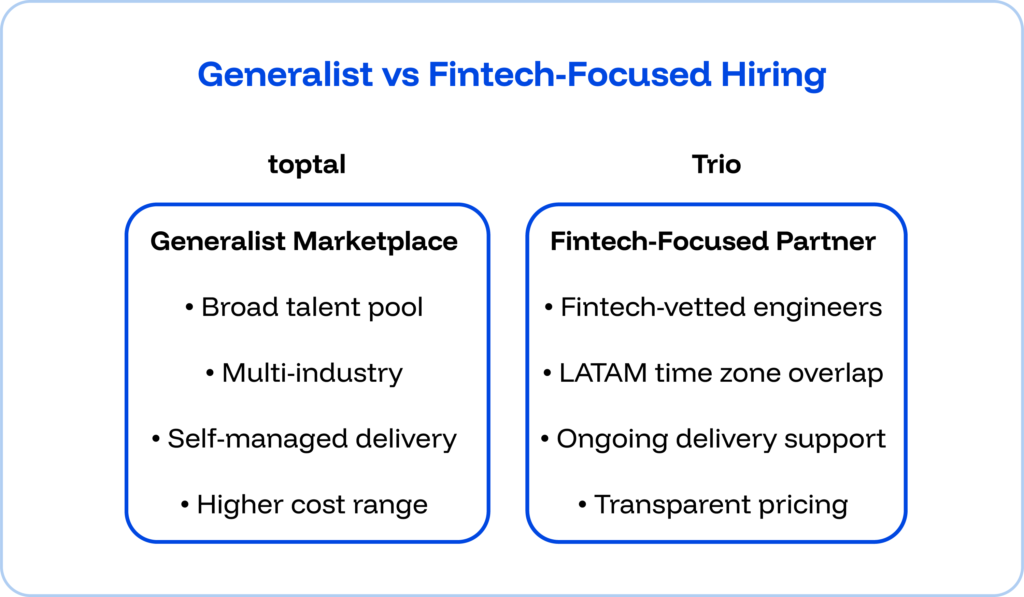
Toptal operates as a broad freelance marketplace with wide coverage and strong brand recognition. Trio functions as a fintech-specific development partner with a narrower scope but deeper domain alignment.
For most fintech teams at the Seed through Series C stage, building products in payments, lending, banking, or identity, the combination of domain-vetted engineers, time zone alignment, transparent pricing, and ongoing delivery support makes Trio a more practical fit.
The cost difference alone tends to open up meaningful budget flexibility when scaling a team.
That said, if your situation involves unusual stack requirements, a need for non-engineering roles, or a strong preference for a US-based freelance model, Toptal’s breadth may serve you better.
The honest answer: neither platform works universally well. Match your actual constraints to what each one actually provides, and the right call usually becomes clearer.
For more information, schedule a call to compare options.
Frequently Asked Questions
Is Trio a legitimate alternative to Toptal for fintech companies?
Trio is a legitimate, strong alternative to Toptal specifically for fintech teams because it screens engineers for domain expertise in payments, lending, banking, and regulated environments rather than general seniority alone.
How does Toptal’s pricing compare to Trio’s?
Toptal’s developer rates generally run between $60 and $100+ per hour, plus a $79 monthly platform access fee. Trio’s pricing ranges from $40 to $90 per hour with no subscription fee or any other hidden costs.
Does Trio only hire developers from Latin America?
Trio’s talent network centers on Latin America, with a particularly strong concentration in Brazil, because that geography delivers time zone overlap with US Eastern and Central teams that makes real-time collaboration practical. Trio also hires from regions like Africa for teams that need developers with alternative working hours.
What happens if a placed engineer from Trio or Toptal isn’t working out?
If a placed engineer isn’t working out, Toptal offers a two-week no-risk trial, after which replacement protection expires, and resolving a poor fit becomes the client’s responsibility. Trio’s replacement guarantee extends beyond the initial trial period.
Can startups use Trio, or does it work better for larger companies?
Yes, startups can use Trio. While Trio’s developers work with fintechs of all sizes, the staffing models are particularly attractive for US fintech startups from Seed through Series C.
How long does it take to get a developer through Toptal versus Trio?
With Toptal, it generally takes between one and two weeks to get a developer, from initial intake to a candidate introduction. Trio targets three to five days to a first candidate.
What tech stacks does Trio cover compared to Toptal?
Toptal’s global talent pool covers a very broad range of technologies, frameworks, and languages, making it more flexible for teams with unusual or niche stack requirements. Trio’s has fewer developers, which means there are some non-fintech legacy or niche technologies they do not cover.